
Sporting Cabinetmakers · Suffolk
Fitted Gun Rooms
A gun room is not a bigger cabinet. It is a room turned into a safe and then made beautiful enough that you want to spend time in it — steel behind the walls, a firearms door dressed in timber, and joinery drawn around the guns you actually own.
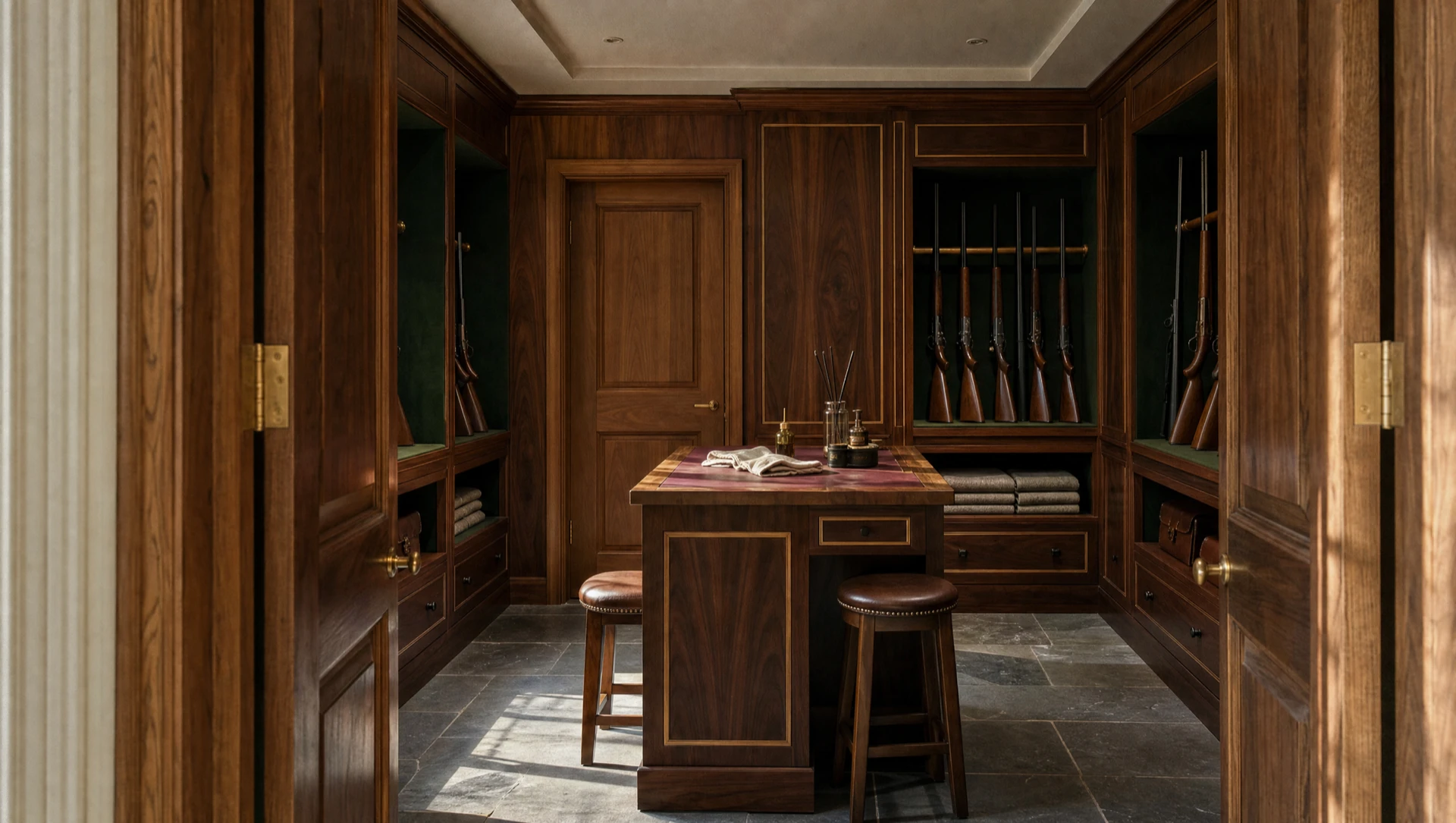
Our clients’ homes and gun cabinets are private, and most ask that they are not photographed or published. The images here are visualisations based on our own workshop drawings for commissions we have completed. If you would like to see drawings, samples and references for completed work, we will show them to you in person — visits to the Mickfield workshop are by appointment.
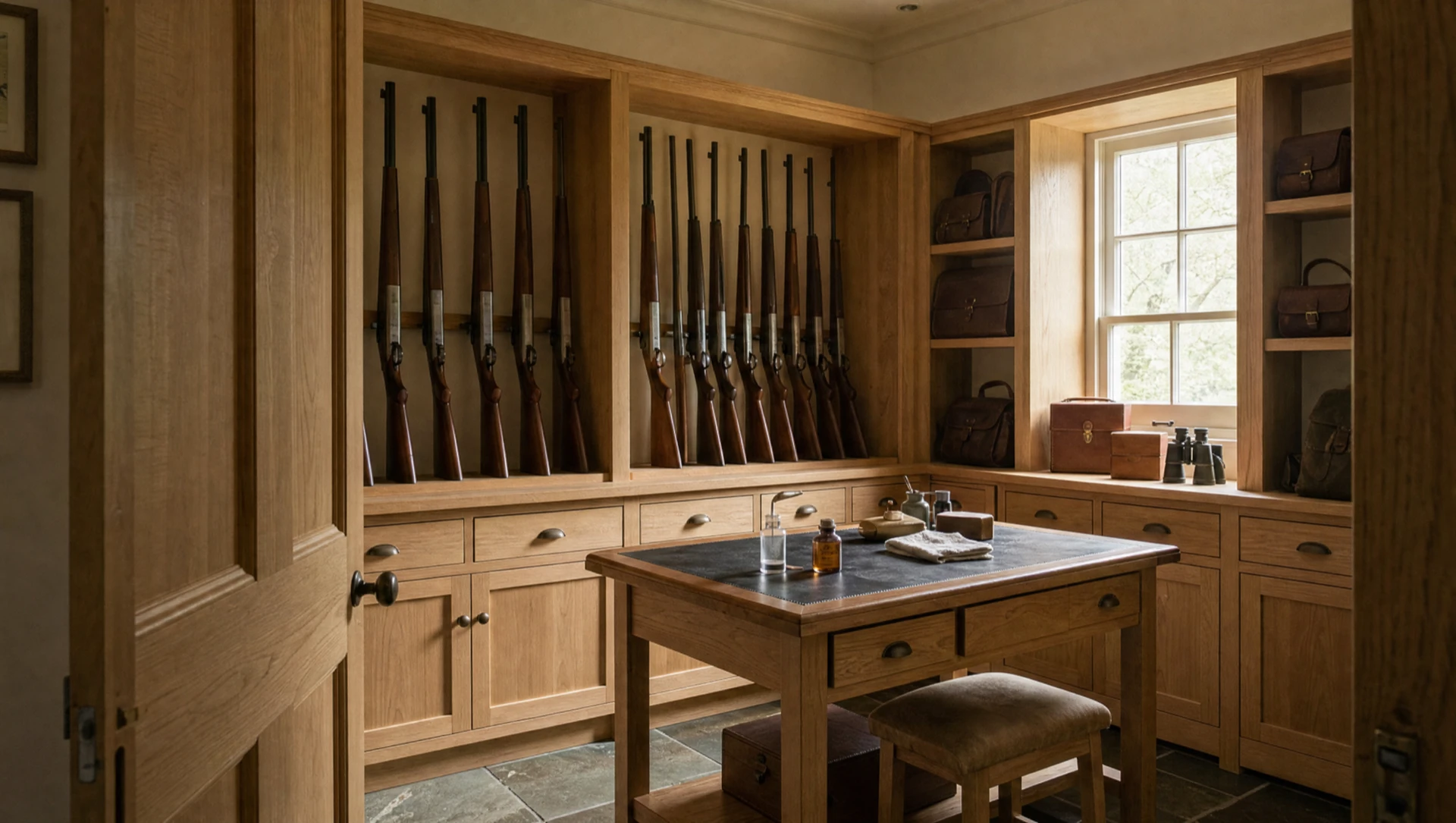
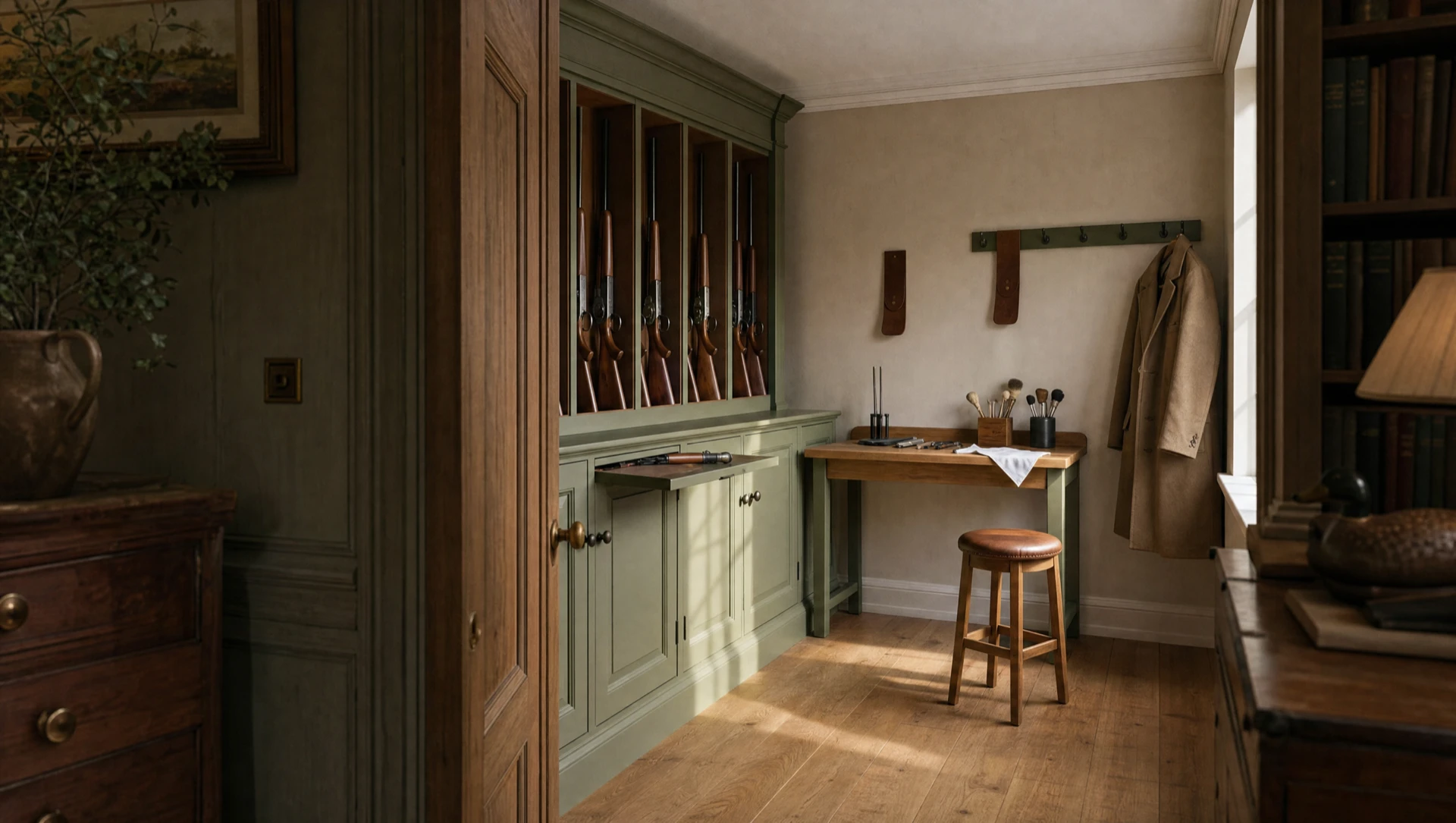
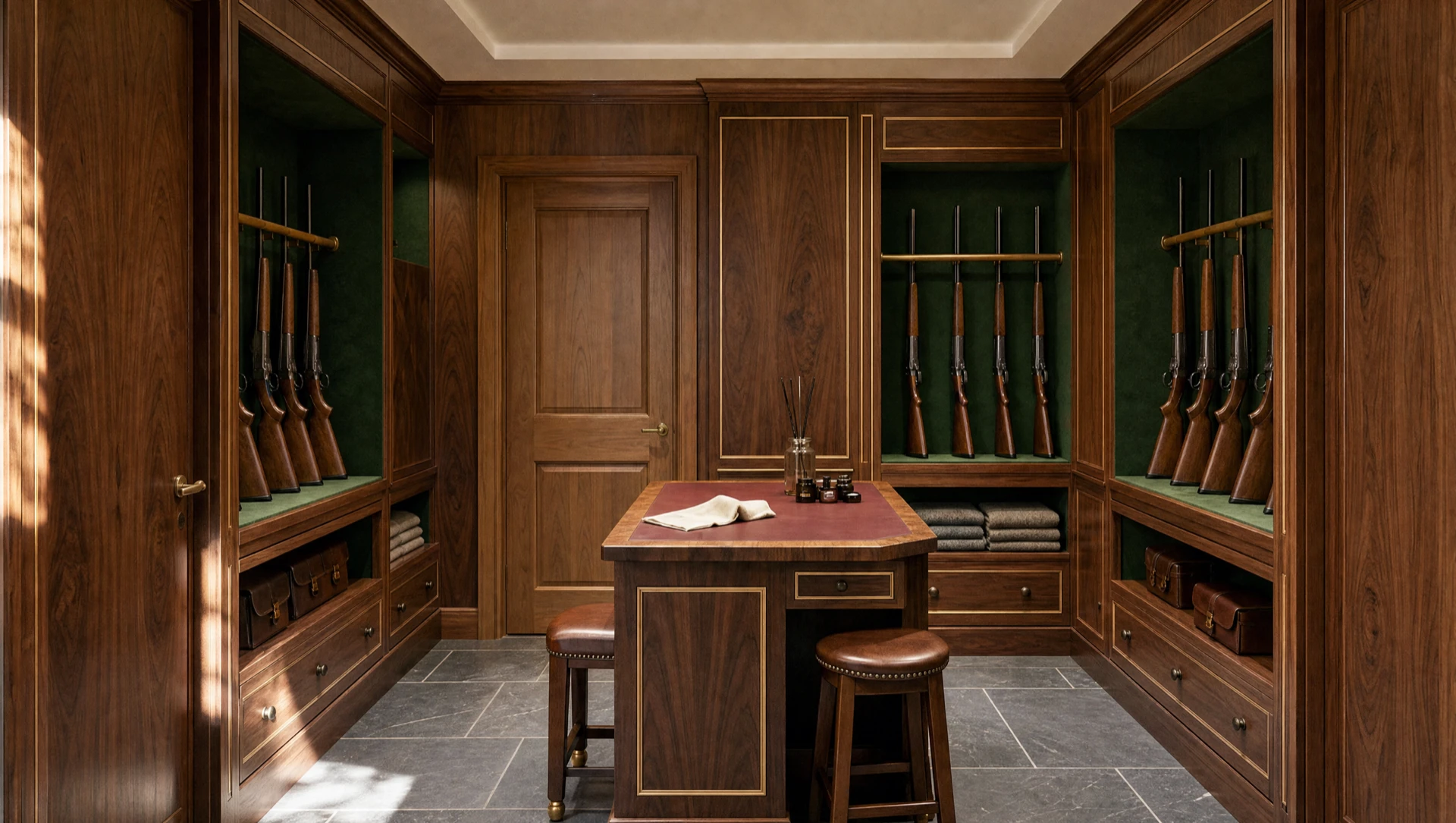
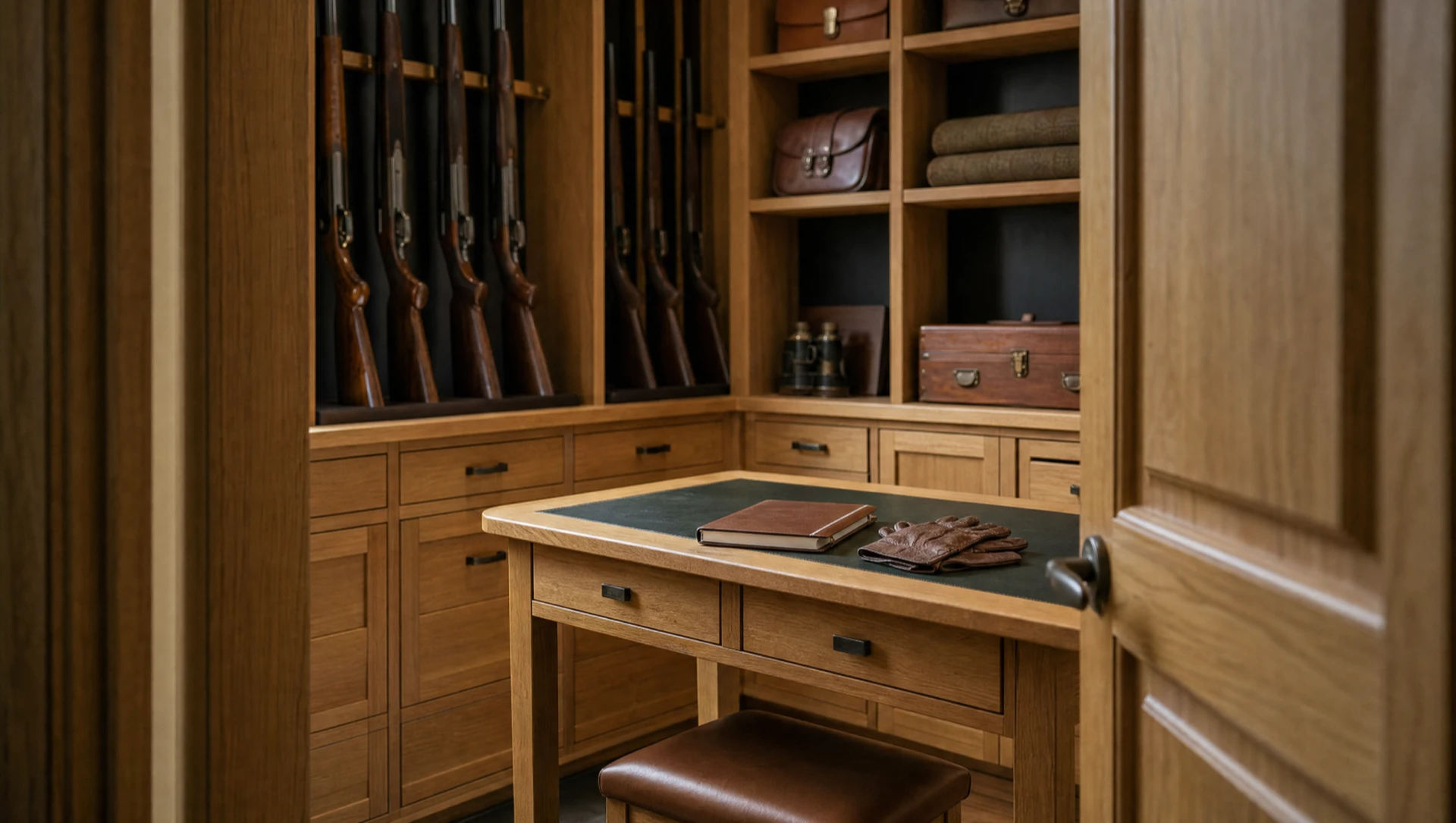
Most people arrive at a gun room the same way. The collection outgrew the cabinet, then it outgrew the second cabinet, and now there are three steel boxes in a boot room and nowhere sensible to clean anything. At that point the question stops being where do I put another cabinet and becomes what should this room be.
We answer that question in timber and steel. We are cabinetmakers first — the workshop has been making bespoke joinery in Suffolk since 2015 — and a gun room is the most interesting brief we get, because it has to satisfy a firearms enquiry officer and a wife on the same afternoon.
On this page
- What a fitted gun room is
- When a cabinet stops being enough
- What we do, and what we don’t
- The steel lining
- The firearms door
- The joinery inside
- Ammunition and separation
- Light, heat and humidity
- What a gun room costs
- How the commission runs
- Your firearms enquiry officer
- Where we work
- Fitted gun rooms, or a wall of cabinets?
See the work
Finished cabinets, interiors, a timber-faced firearms door and workshop making, shown with the discretion this work requires.
What a fitted gun room actually is
A fitted gun room is a dedicated room whose fabric has been upgraded to hold firearms securely, and whose interior has been fitted out as joinery rather than as storage. Those are two separate pieces of work and both matter.
The security half is invisible when it is finished. Steel is fixed to the walls, the doorway is replaced with a steel firearms door, and both are then clad in timber so that the room reads as a study or a boot room rather than as a strongroom. Nobody walking past it knows what it is. That is the point: concealment is not a substitute for security, but it is a very useful addition to it.
The joinery half is what you actually live with. Racks cut to the guns, not to a catalogue. Glazed doors if you want to look at them, solid if you do not. A cleaning table at the right height, with a felt bed and drawers for rods, jags and oil. Cartridge drawers on full-extension runners because a full cartridge drawer is heavy. Lighting that comes on when the door opens, so you are not feeling for a switch with a rifle in your hand.
Done properly the two halves are indistinguishable. You should not be able to point at the room and say where the safe ends and the furniture begins.
When a cabinet stops being enough
There is no single number at which you must have a gun room. The security condition on your certificate is applied by your local police firearms licensing department, and what they will accept depends on the collection, the property, its location and its occupancy. A pair of shotguns in a village house and fifteen guns in an isolated farmhouse are not the same problem, and they do not get the same answer.
What we see in practice is that people move to a room for one of four reasons:
- Volume. The collection has passed the point where cabinets can be arranged sensibly. Guns are being stored behind other guns.
- Handling. There is nowhere to clean, nowhere to case up and nowhere to lay a gun down safely. The kitchen table has become the cleaning bench and it is not popular.
- Value. The collection has reached a value where the insurer has taken an interest, and the conversation has become specific.
- The house. A room has come free in a renovation and it is the obvious moment to do it once, properly, rather than bolt more steel to a wall later.
If you are between the two — too many guns for comfort, not obviously enough for a room — a wall of fitted gun cabinets often does the work of a room at a fraction of the cost, because the cabinets are built into the joinery of an existing room rather than the room being rebuilt around them. We will tell you honestly which one your situation calls for. We would rather sell you the right thing once.
What we do, and what we don’t
This is worth being blunt about, because it is the single most common misunderstanding at first enquiry.
Our scope
We do: line the walls in steel; supply and fit a steel firearms door; clad the steel and the door in timber; and design, make and install all the joinery within the room — racks, cabinets, cleaning tables, drawers, shelving, panelling and finishes.
We do not: carry out building work. We do not knock through, underpin, form openings, alter structure, run first-fix electrics or plumbing, plaster, or lay floors. The room is prepared by your builder; we arrive to a shell and fit it out.
That division suits everybody. Your builder is on site anyway and is better placed to form the opening and get power to the room than a joinery firm arriving from Suffolk. We turn up when the room is ready, install cleanly, and leave. On projects with an architect and a main contractor we work to their programme and issue our drawings into the contract set — that is how most of our work runs.
Where there is no builder, we will tell you what needs doing before we can start, in enough detail that a local builder can price it. It is usually a short list.
The steel lining
The walls are lined with steel sheet, fixed back into the structure of the building, so that the room is enclosed rather than merely locked. A locked door in a plasterboard wall is a locked door in a plasterboard wall.
Our standard is 3mm mild steel (0.12in) throughout. That is heavier than a domestic installation is ever likely to need, and we build to it anyway on every room, because the difference in cost across a room is modest and the difference in what the room will survive is not. Fixings go back into masonry or into structural timber, never into board alone.
How the lining is planned, how far it goes and how it is fixed is set out in full in steel-lined gun rooms.
The steel is then battened and clad. Once the timber is on, the room takes any finish you like — oak panelling, painted MDF panelling, bookcases, boot benches, whatever the house wants. A gun room can read as a study, a boot room or a butler’s pantry, and where the brief calls for it the entrance can disappear entirely into a run of full-height shelving with no visible handle.
The firearms door
The door is where a gun room is won or lost. A steel-lined room with a domestic door is theatre.
We fit a purpose-made steel firearms door into the prepared opening, hung on a steel frame that is anchored into the structure. The lock is an 8-lever safe lock to EN 1300 Class A, the European standard for high-security locks on secure storage units, and the door’s folded return passes behind the frame, so removing the hinges does not remove the door. Both edges resist attack, not just the one with the keyhole in it.
The door is then clad in timber to match the room it sits in. From the corridor it is a door. Its weight gives it away when you push it, and nothing else does.
Where a client wants the room genuinely hidden rather than merely discreet, the door can be built into a run of joinery — a bookcase, a panelled wall, a wardrobe back — with a concealed release. That is covered properly on concealed gun storage, because it is a design problem as much as a security one.
The joinery inside
This is the part we care most about, and it is the part that is almost always an afterthought elsewhere.
We draw the interior around your actual collection. Before we design anything we ask for a list: what you own, what you shoot, what stays cased, what has a scope left mounted, what is long, what is short, what is heavy, what is fragile and what is never going to be sold. A gun room drawn from that list works. A gun room drawn from a standard rack layout means side-by-sides touching over-and-unders and a rifle that will not stand up with its glass on.
What goes in
- Racks cut to the guns. Barrels supported, stocks seated, nothing touching its neighbour. Felt-lined where the gun sits.
- Scope clearance so rifles stand with optics mounted and do not have to be stripped every time.
- Glazed or solid cabinet doors. Where they are glazed we use laminated security glass, 26mm (1in) as standard.
- A cleaning table at working height, felt-bedded, with drawers beneath for rods, jags, brushes, oils and solvents — kept away from the guns and away from the cartridges.
- Cartridge drawers on full-extension heavy-duty runners, sized so a full drawer still slides.
- Cased-gun storage, because slips and motor cases need somewhere that is not the floor.
- Hanging and drying for coats, and boot storage, where the room doubles as the way in from the field.
Timber is quarter-sawn where the figure matters — solid oak, walnut or mahogany, book-matched across doors — or hardwood built for paint where the room calls for a painted finish. Finishes run from French polish through hand-oiled to hand-painted, and we antique where the house asks for it. Ironmongery is solid brass or bronze, aged if you want it aged.
Ammunition and separation
Ammunition is stored separately from the firearms, in its own lockable cabinet or lockable drawer within the room, so that securing one does not depend on securing the other. Where a certificate carries a condition about ammunition, that condition is what we design to — tell us what it says and we will build to it rather than to a general assumption.
Expanding ammunition and any component held under a certificate condition gets its own locked provision. It is a small amount of joinery and it removes an argument later.
Light, heat and humidity
Steel-lined rooms are cold rooms, and cold rooms with poor air movement are where blued steel goes to rust. This is the detail most often missed.
- Ventilation. The room needs air movement. Ducted, trickle-ventilated or dehumidified — your builder or M&E consultant will specify it, and we will make sure the joinery does not block it.
- Gentle background heat rather than a hot room. Firearms are happier at a stable, unexciting temperature than a warm one.
- Lighting on a door switch, low-heat LED, aimed so it lights the racks rather than glaring off glass. Nobody should be reaching into a dark cabinet.
- Nothing airtight. Cabinets are ventilated internally; sealed cases and damp guns are a bad combination.
We cover this in detail on gun room lighting, heating and ventilation, and on humidity, damp and blued steel, which is the guide to send to anyone who has ever found a bloom of rust on a gun they put away clean.
What a fitted gun room costs
A fitted gun room starts at around £24,000 including VAT. That is the honest floor, not a teaser.
The reason it sits well above a cabinet is that the work is cumulative: line the room in steel, supply and fit a firearms door, clad both in timber, then design, make, finish and install the entire interior. A bespoke gun cabinet — a single piece of furniture, delivered and bolted to the wall — starts at around £8,400 including VAT, and for many people that is the correct answer.
| What moves the number | Why |
|---|---|
| Size of the room | Steel, cladding and joinery all scale with wall area |
| Timber and finish | Figured walnut, book-matching and French polish cost more than painted hardwood |
| Glazing | Laminated security glass is heavy, and heavy doors need heavier hardware |
| Concealment | A hidden door built into a bookcase is a harder piece of joinery than a clad door |
| Complexity of the collection | Mixed shotguns, rifles with optics and cased pairs need more drawn detail |
| Distance | We work UK-wide; installation away from East Anglia carries travel and accommodation |
You get the price before we draw anything. We survey, we scope it, we quote, and the quote is the quote. If the brief changes we tell you what the change costs before we make it.
How the commission runs
- ConversationTell us the room, the collection and the house. Photographs and a gun list get us a long way in one call.
- SurveyWe measure the room ourselves. We do not build from a builder’s drawing without checking it.
- Specification agreed with your FEOBefore anything is made. See below — this is not optional and it is not a formality.
- Design and drawings3D CAD, issued to you and, where there is one, to your architect and main contractor.
- QuotationFixed, itemised, against the drawings.
- WorkshopMade in Suffolk by our own cabinetmakers. Not subcontracted, not imported.
- InstallationOur team, on your programme. Steel, door, cladding, then joinery.
- HandoverIncluding a signed specification sheet — see below.
Lead times depend on the workshop, the season and the complexity of the piece. We will give you a date and we will hold it; on-time delivery is the thing our architect and builder clients keep coming back for, and we are not about to start losing it.
Working with your firearms enquiry officer
We agree the specification with your local firearms enquiry officer before we start. It costs a phone call and it removes the only genuinely unpleasant surprise available in this process — a finished room that the FEO is not satisfied with.
The legal position is straightforward and worth stating plainly. Secure storage is a condition of your certificate under the Firearms Act 1968 and the Firearms Rules 1998. The Home Office Firearms Security Handbook is guidance on how that condition is usually met — it is not itself the law, and it does not bind your force to a particular product. What matters is that your licensing department is satisfied with the arrangement at your address.
What you get on completion
- A signed specification sheet listing steel thickness, glass specification, lock model, fixing type and fixing centres
- Drawings as installed
- Care instructions for the timber and the finish
Your FEO can verify what has been built rather than take our word for it, and your insurer gets something better than a photograph.
Responsibility for meeting the security condition on your certificate rests with you as the certificate holder. The adequacy of any storage arrangement is a matter for your local police firearms licensing department. Nothing on this page is legal advice, and we would always rather you checked with your FEO than took our word for it.
Where we work
We work throughout the United Kingdom from the workshop in Suffolk, and regularly beyond East Anglia — London, the Home Counties, the West Country, the North and Scotland. Fitted gun rooms are an installation job, so distance is a matter of programme and cost rather than possibility.
We also take commissions in Europe, and we ship cabinets internationally, including to the United States, through established shipping partners. Storage law differs by country and, in the United States, by state; an English-made cabinet is bought there for what it is rather than for a certificate condition, and we build it accordingly.
Not sure yet whether you need a room at all? Bespoke gun cabinet or fitted gun room sets out where the line usually falls. For a collection that has already outgrown one room, see a gun room for a forty-gun collection.
Questions we are asked
How many guns do I need before I need a gun room?
There is no fixed number. The security condition on your certificate is applied by your local firearms licensing department, and it depends on the collection, the property, where it is and whether it is occupied. Most people move to a room when arranging the guns in cabinets has become a puzzle, or when there is nowhere sensible to clean.
Do you do the building work as well?
No. We line the walls in steel, fit and clad the firearms door, and make and install all the joinery. Structural work, openings, electrics, plumbing, plastering and floors are done by your builder before we arrive.
What does a fitted gun room cost?
From around £24,000. The figure moves with the size of the room, the timber and finish, the amount of glazing, whether the door is concealed and how far the installation is from Suffolk. You get a fixed price before we draw anything.
Can the room be hidden?
Yes. The firearms door can be built into a bookcase, a panelled wall or a run of joinery with a concealed release, so there is no visible door at all. It is a harder piece of joinery and it is priced accordingly.
Will my firearms enquiry officer accept it?
We agree the specification with your FEO before we make anything, and hand over a signed specification sheet on completion so the installation can be verified rather than assumed. The decision remains theirs, which is exactly why we involve them at the start rather than the end.
How thick is the steel?
3mm mild steel throughout, on every room, fixed back into masonry or structural timber. That is heavier than a domestic installation is likely to require. The cost difference is small; the difference in what the room will survive is not.
Can I have glass doors on the cabinets inside?
Yes, and most clients do — a gun room you cannot see into is a cupboard. Glazed doors use laminated security glass, 26mm as standard.
How long does it take?
It depends on the size of the room and the workshop programme at the time. We give you a date at the point of quotation and we hold it. Installation itself is measured in days rather than weeks, once the room is ready for us.
Fitted gun rooms, or a wall of cabinets?
Not every house that wants a gun room needs one, and it is worth being clear about where the line falls before you commit to builder’s works.
| A wall of fitted cabinets | Fitted gun rooms, lined | |
|---|---|---|
| Typical from | £14,400 | £24,000 |
| Builder’s works | Little or none | Structural opening, lining allowance, first fix |
| Suits | Existing house, no reordering | New build, or a room being rebuilt anyway |
| Cleaning bench in the same space | Sometimes | Always |
| Scales to a large collection | To a point | Yes |
| Moves with you | No | No |
Our honest position is that fitted gun rooms make sense when the room is being built or gutted anyway, when the collection is large enough that a wall of cabinets stops being enough, or when you want the room to be somewhere you spend time rather than somewhere you fetch from. Where none of those is true, a run of properly made fitted cabinets does the same job for less and involves no builder.
What we will not tell you
We will not tell you that a lined room is required, because it very often is not. The Firearms Security Handbook works from the whole arrangement at your address — the cabinet, the fixing, the building, the location — and a well-fixed cabinet in a sensible position satisfies most certificates for most collections. Anyone telling you that a room is necessary before they have seen the house is selling, not advising.
Send us your gun list
It is the fastest way to a useful conversation. Tell us what you own, send a photograph of the room, and we will tell you what it would take and roughly what it would cost — before anybody draws anything.
Steel-Lined Gun Rooms
A locked door in a plasterboard wall is a locked door in a plasterboard wall. Lining the room in steel is what turns a room with a good door into a room that is actually enclosed — and it is the half of the job nobody ever sees.
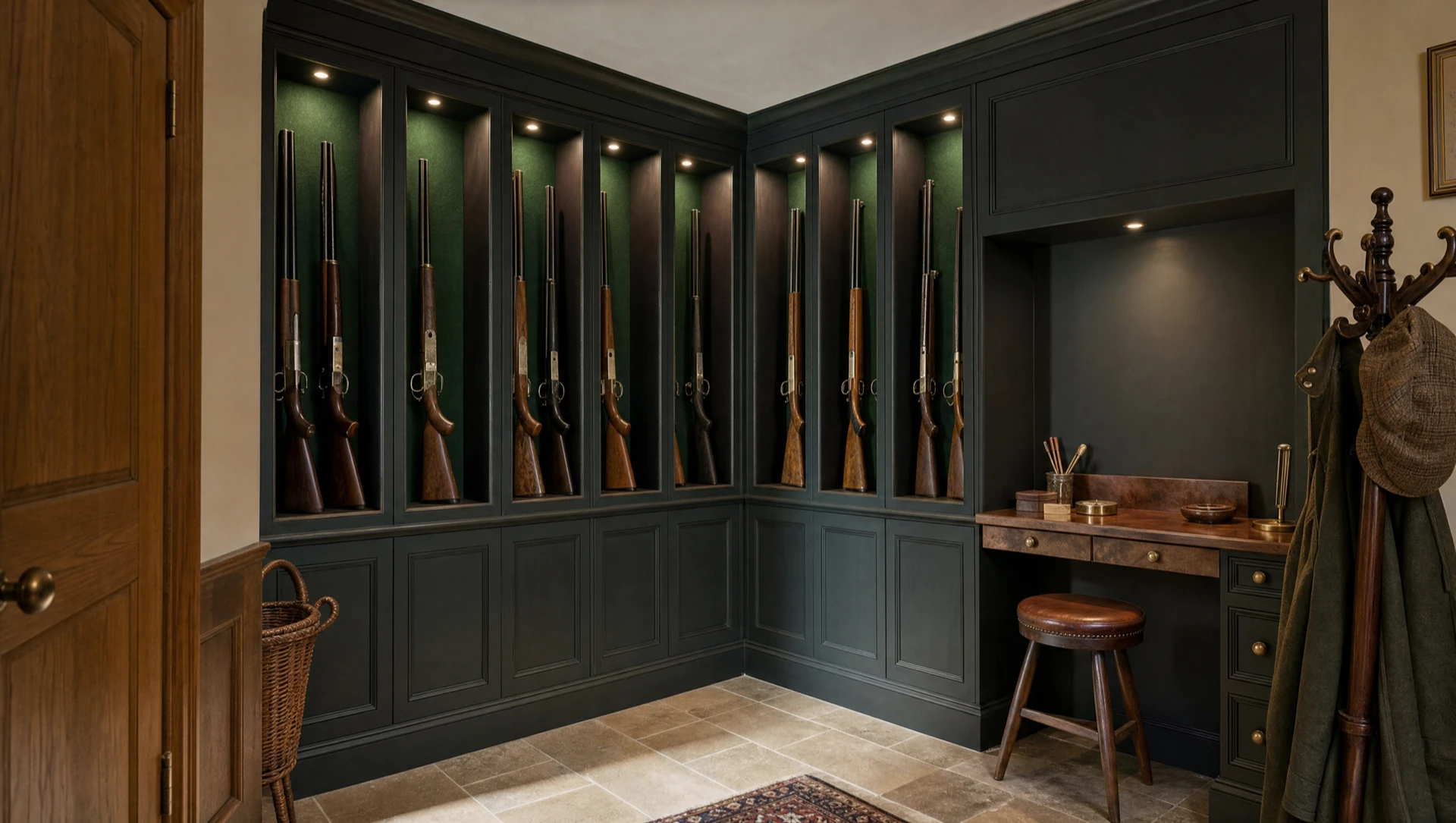
Ask most people what makes a gun room secure and they will describe the door. Ask anyone who has ever seen how a building is actually broken into and they will describe the wall. The lining is designed around the structure and the room; the joinery then makes the finished space read as part of the house.
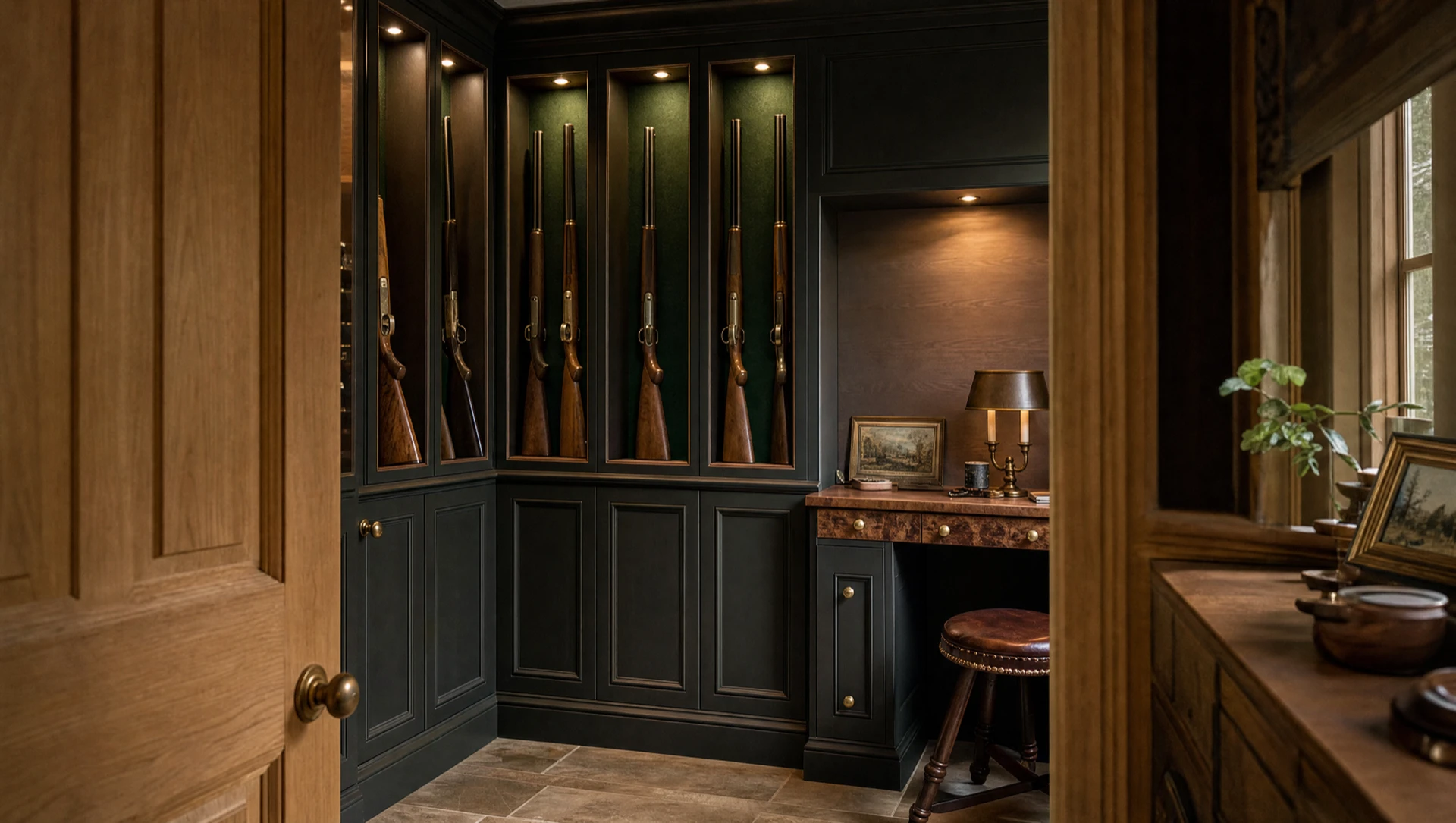
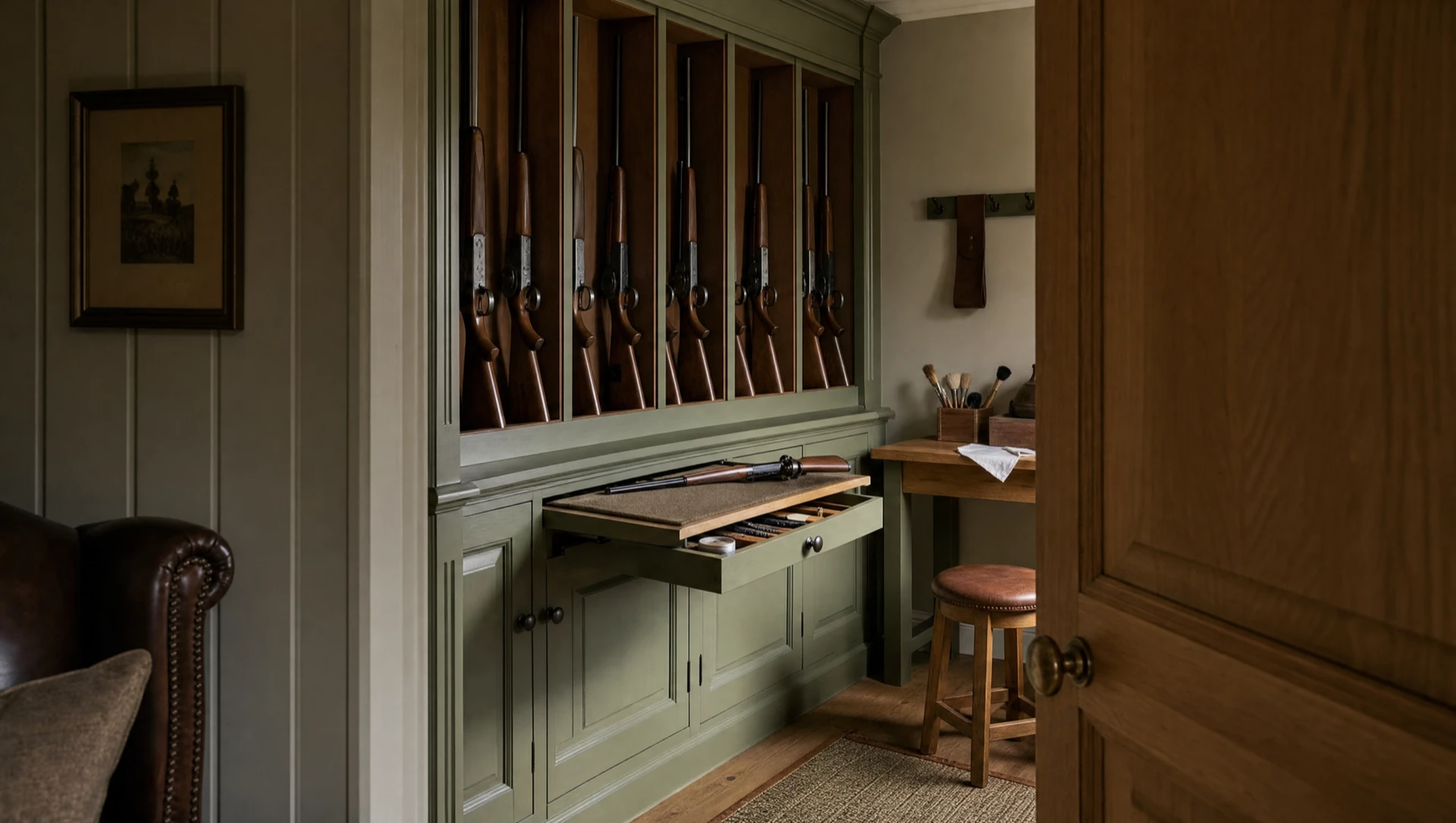
Why line a room at all
A gun cabinet is a box. A gun room moves the barrier outwards to the room perimeter, leaving the interior free for racks, glazed cabinets, a cleaning table and properly considered joinery. It only works when the walls, ceiling, floor and openings have been considered as one arrangement.
What we line it with
Steel sheet is cut to the room and the extent is agreed at survey. The lining is coordinated with the structure and with the joinery that will cover it. The correct extent depends on what is on the other side of each wall, the ceiling and the floor; it is not a universal prescription.
How it is fixed
Fixing is back to structure, not merely to plasterboard. Substrates, backing, anchor arrangement and the recording of concealed work are agreed with the appointed builder and confirmed as part of the handover information.
How far the lining goes
External walls, accessible voids, ceilings, floors, windows and full-height returns are considered individually. We recommend only what the room and its position in the building require.
Battening and cladding
Once the security perimeter is resolved, the room becomes a joinery project. Oak panelling, painted panelling, bookcases, full-height cupboards or a quieter fitted treatment can make the room read as a study, boot room or other part of the house.
Services behind the steel
Lighting, alarm cabling, ventilation and any dehumidification are resolved before the lining is closed. Wireless signals can be attenuated by steel, and every penetration should be planned with the electrician or M&E consultant.
What your builder does first
- Form and square the structural opening.
- Confirm the wall substrate and provide backing where required.
- Check floor level, structure and access route.
- Complete agreed first-fix electrics and ventilation.
- Provide a dry, prepared shell for fit-out.
When lining is not the answer
If a properly anchored cabinet is the right answer for the collection or the building, we will say so. Lining is not required by law in every case and the adequacy of any arrangement is for the certificate holder and local firearms licensing department to agree.
The wall build-up
A lined room uses space. We issue the actual build-up and setting-out information for the project rather than relying on a generic detail.
Nothing on this page is legal advice. Please do not send serial numbers, certificate numbers or exact security details through the website.
Firearms doors, clad in timber · Gun room design and layout · Talk to the workshop