
Wader, Net and Kit Storage
The wet end of a fishing room. Everything here has one job — to get things dry — and almost every arrangement we are asked to replace was designed to get them out of sight instead. Wader storage that works is ventilated, drained and warm enough to move air, and it looks nothing like a cupboard.
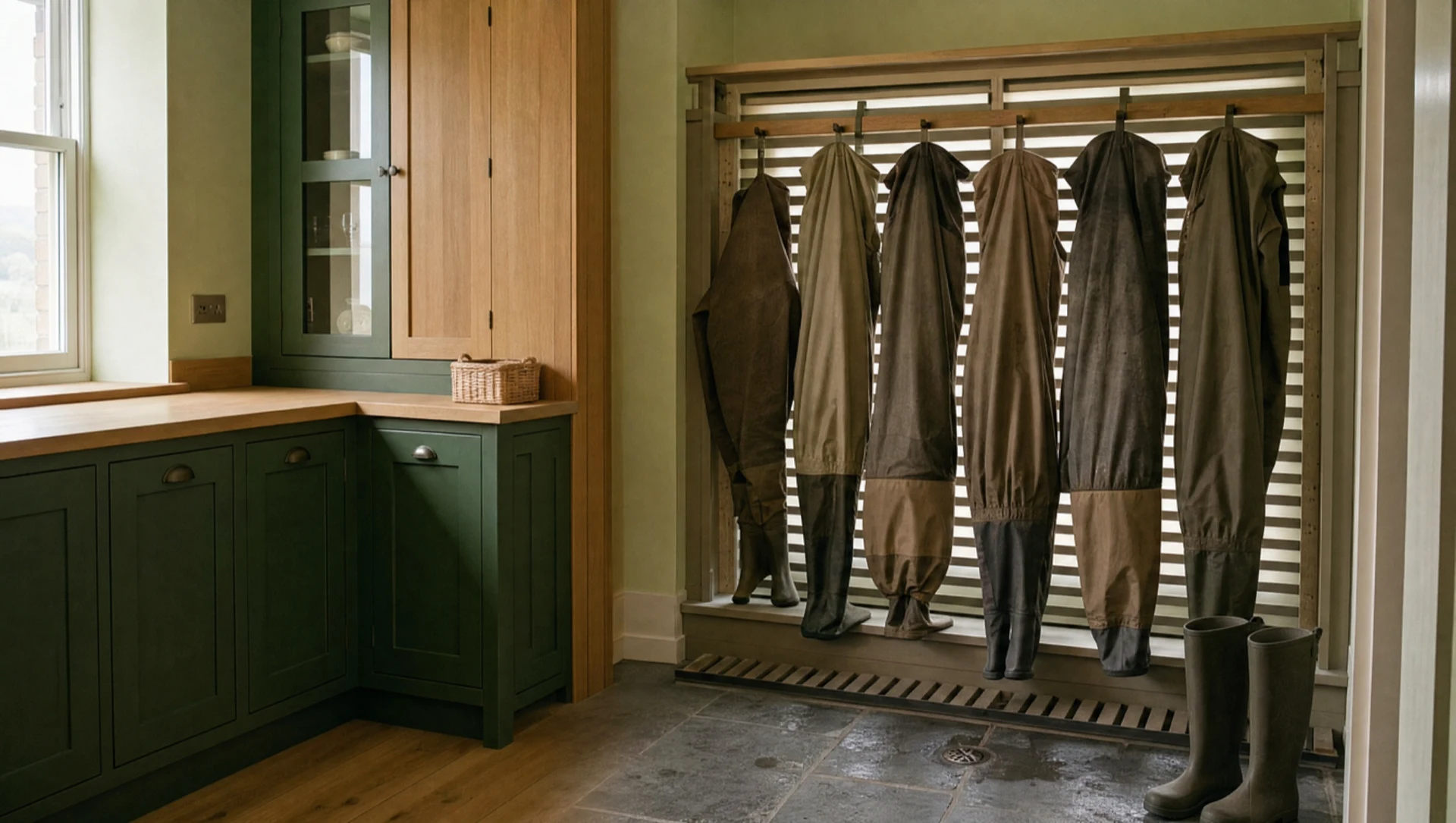
Waders fail from the inside. Not from the gravel, not from the barbed wire, but from being folded damp in a bag in a warm cupboard for a fortnight.
Breathable waders in particular are a laminate, and folding a damp laminate repeatedly in the same place is how delamination starts. The crease at the knee and the crease at the ankle are where it happens, and they are exactly where a wader creases if it is hung by the braces or stuffed in a bin.
On this page
Waders: hang them upside down
The single most useful thing on this page.
Hung the right way up by the braces, a wader dries from the outside and stays wet inside the foot, which is where the water is and where it does the damage. Hung inverted — boot end up, legs open downward — the inside drains and air moves through the whole length. It also lets the neoprene bootie, which is the slowest part to dry, dry first rather than last.
So the fitting is a hanger with two arms that hold the wader open and inverted, at a height that lets the legs hang clear of the floor, over a drainable surface. Some people alternate — inverted overnight to dry the inside, then the right way up for storage. That is a good habit and it wants two hanging positions rather than one.
What matters in the joinery:
- Full height, unfolded. A stocking-foot wader wants roughly two metres of clear drop. Anything less and it kinks.
- Air on all sides. Waders against a wall, or against each other, dry on one face. Spacing matters more than it looks.
- Nothing sharp, nothing hot. No radiator directly beneath — heat that intense ages the laminate and the seam tape. Gentle warmth and moving air, not a hot spot.
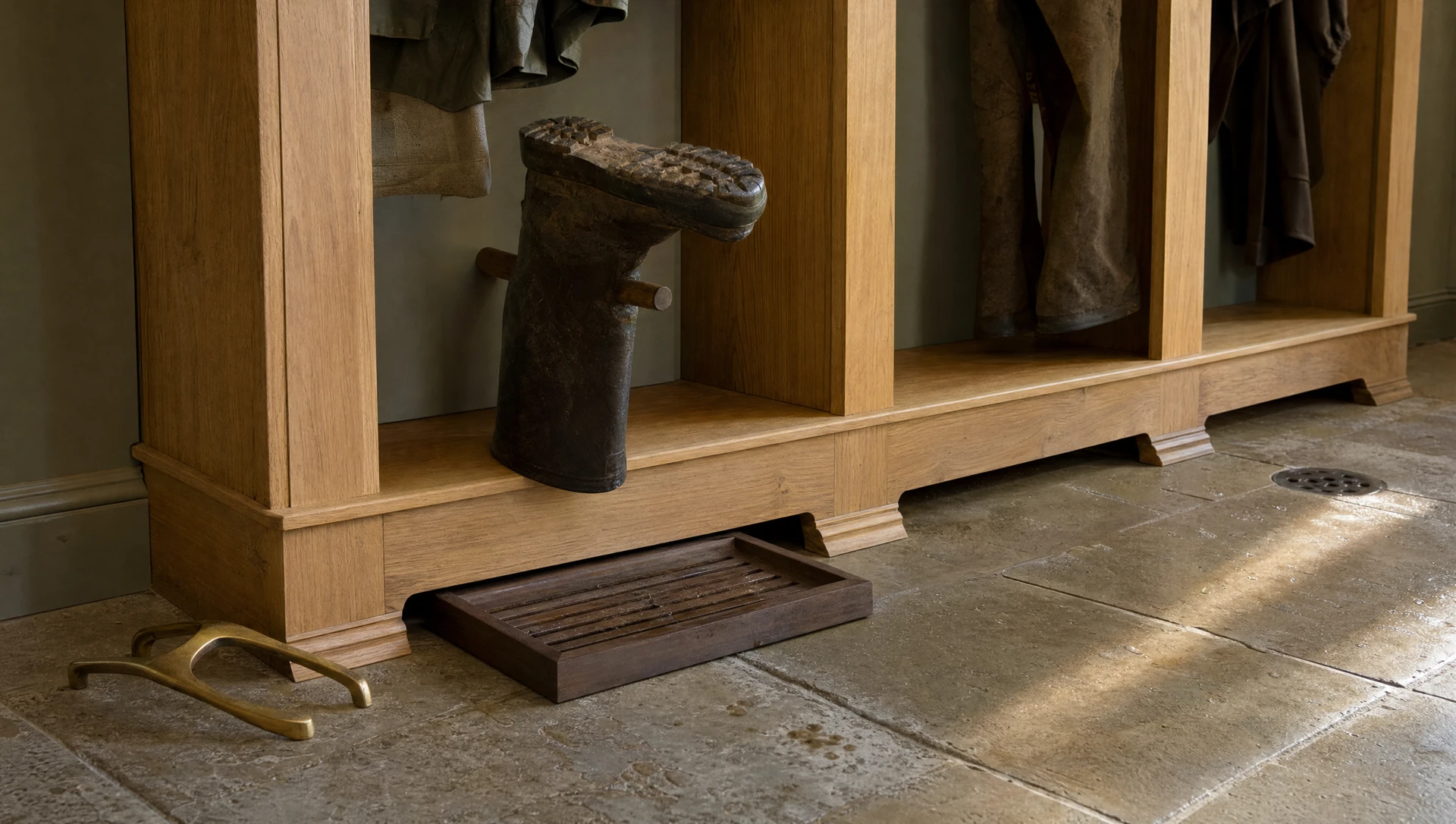
- A drainable floor detail below, and the joinery on a plinth clear of it.
Boots
Wading boots come off soaked, full of grit, and frequently full of water. They are the wettest object in the house.
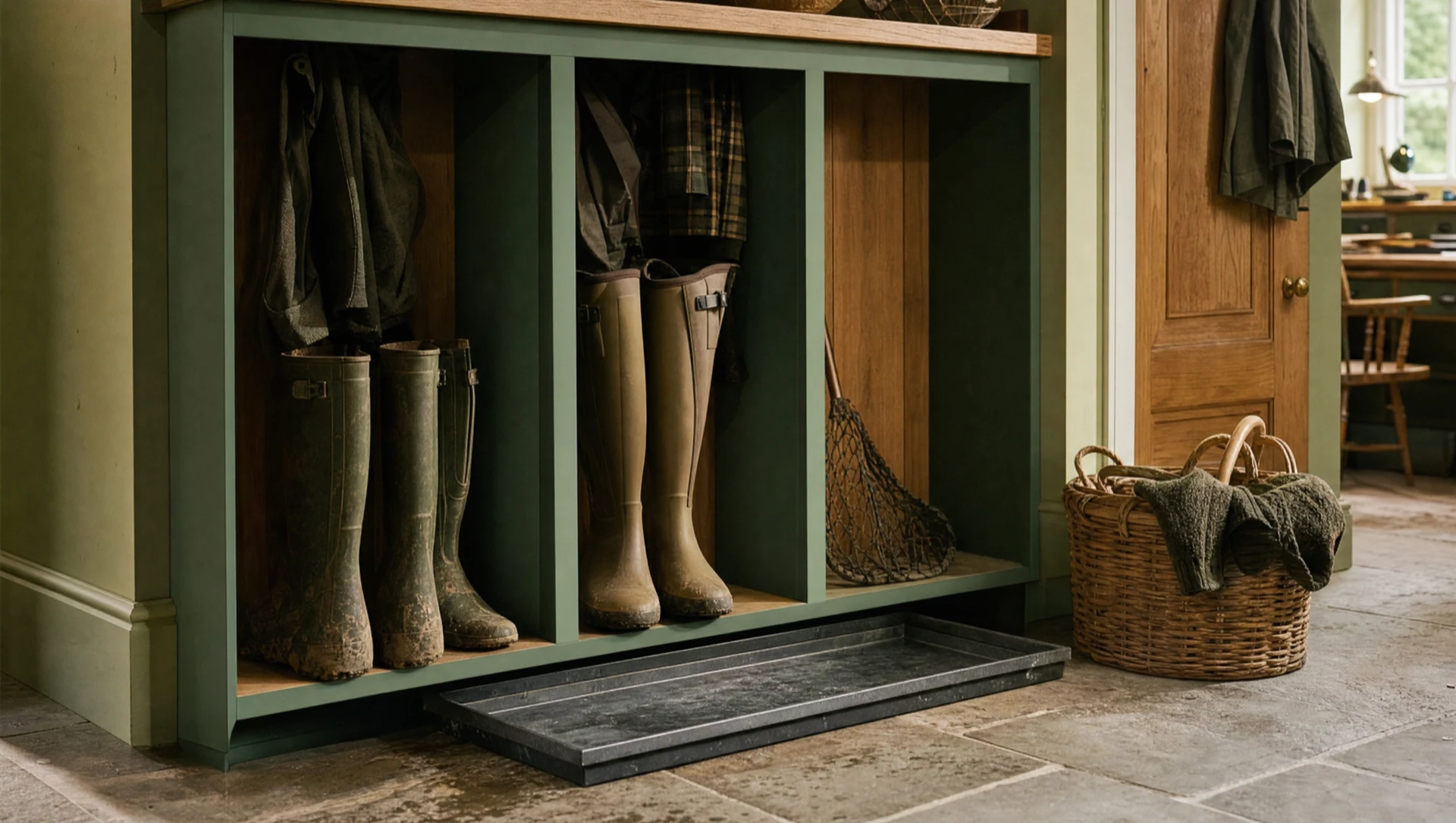
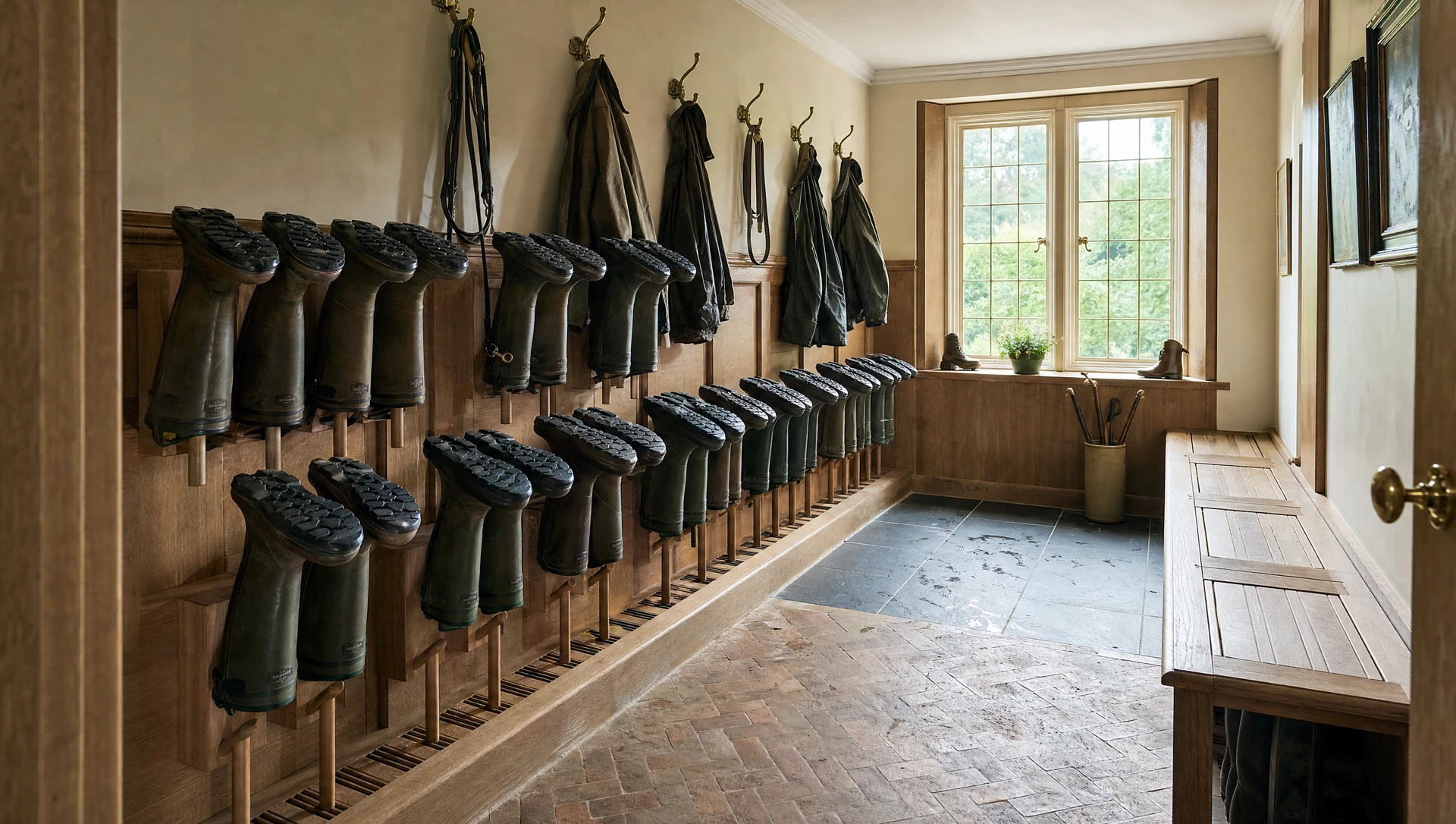
They want to be inverted and off the floor, on pegs or an angled rack that lets water run out of the boot rather than sit in the toe. A removable drip tray beneath — removable being the important word, because a tray that cannot be lifted out is a tray that is never emptied.
Felt soles, where they are still used, hold an extraordinary amount of water and take a long time to dry. If there are felt soles in the household, the drying provision needs to be more generous, and the biosecurity point below applies with more force.
Nets, bags and the rest
A landing net is an awkward object: long, rigid, with a bag that must not be stored folded or compressed. Hung by the handle with the net hanging free is the answer, which means a peg high enough that the mesh does not sit on the floor.
Wet mesh left bunched stays wet and eventually smells, and a net stored under pressure takes a shape it keeps.
Beyond that, the wet end usually has to take: a wading jacket, a wading staff, a sling or chest pack, a net or two, gloves and a hat, a wading belt, and the bag it all travels in. All of it wants hanging with air around it rather than stacking.
The mistake almost everybody makes
Hooks too close together. Coats and jackets need air on both faces to dry, and a run of hooks at close centres gives you a compressed wet lump that is still damp on Thursday. Fewer hooks, further apart, dries more kit than more hooks closer together.
Air, heat and drainage
Three things dry a room, in this order of importance: air movement, drainage, and gentle warmth. Most wet rooms are given the third and none of the first two, which is why they are warm and still damp.
- Air movement. Open racking rather than closed cupboards. Slatted shelves. Space behind everything. Extraction or a vent if the room is small and has no through draught.
- Drainage. A floor that takes water and a fall to somewhere, or trays that lift out. Joinery on a plinth, clear of the wet.
- Gentle warmth. Background heat, evenly spread. Not a hot radiator in a sealed room, which drives moisture into the coldest wall and leaves it there.
Where a fishing room adjoins living space, extraction stops being optional. A wet room drying properly is putting a large amount of moisture into the air, and it has to go outside rather than into the hall.
Check, clean, dry
Worth a paragraph because it affects how the room is designed.
Invasive non-native species — the ones that move between waters on wet kit — are a genuine problem in British fresh water, and the standard advice to anglers is to check, clean and dry equipment between waters. Felt soles, wader booties, net mesh and the inside of boots are the places things travel.
Doing that properly needs somewhere to wash kit down and somewhere it can dry thoroughly rather than nearly. A tap or an outside supply at the wet end, a drainable floor, and enough hanging space that a set of kit can be left to dry completely between trips rather than being packed damp.
It is the same design as good drying, done for a second reason — which is convenient, and worth mentioning to whoever is doing the building work rather than discovering afterwards that there is no water at that end of the room.
How it is built
The wet end is the one part of a fishing room where we will argue for less joinery rather than more. Open racking, slatted shelves, generous spacing and a hard drainable floor beat a beautiful cupboard every time.
Where there is joinery, it is built to take the conditions: solid timber, finished on all faces including the backs and undersides, on a plinth clear of the floor, with air paths designed in rather than left to chance. Solid brass or bronze ironmongery, because it is a wet environment and cheap plated fittings do not last one season in it.
Timber choice matters here more than elsewhere. Oak is a good deal more tolerant of this end of the room than walnut, and where a client wants the fishing room to read as one piece we will often use oak throughout the wet end and the finer timber where things stay dry.
The wet end usually sits at one end of a run that takes in rod racking, reel and tackle drawers and a tying bench. Getting the sequence right — wet at the door end, dry and fine at the far end — is most of what makes the room work. It is the same principle as a boot room, and frequently it is the same room.
Common questions
How should waders be stored?
Hung upside down — boot end up, legs open downward — so the inside drains and air moves through the whole length, including the neoprene bootie, which is the slowest part to dry. Hung the right way up by the braces, a wader dries on the outside and stays wet in the foot, which is where the damage happens. Full height, unfolded, with air on all sides and nothing hot beneath.
Why not just fold waders away in a bag?
Because breathable waders are a laminate, and folding a damp laminate repeatedly in the same place is how delamination starts. The crease at the knee and the crease at the ankle are exactly where a wader creases if it is bagged or hung by the braces, and they are exactly where they fail.
Can I put a radiator under the waders to speed drying?
Not directly beneath, no. Heat that intense ages the laminate and the seam tape. What dries a wet room is air movement first, drainage second and gentle even warmth third — most wet rooms are given only the third, which is why they are warm and still damp.
How should landing nets be stored?
Hung by the handle with the net hanging free, on a peg high enough that the mesh does not sit on the floor. Wet mesh left bunched stays wet and eventually smells, and a net stored under compression takes a shape it keeps.
Does the wet end need water?
It is worth having. Anglers are advised to check, clean and dry equipment between waters to avoid spreading invasive non-native species, and felt soles, wader booties, net mesh and the inside of boots are where things travel. That needs somewhere to wash kit down and enough hanging space for it to dry thoroughly. Worth raising with your builder early rather than discovering there is no supply at that end of the room.
What timber suits a wet room?
Oak is a good deal more tolerant of this end of the room than walnut. Where a client wants the whole fishing room to read as one piece, we will often use oak through the wet end and the finer timber where things stay dry. Everything is finished on all faces including backs and undersides, and stood on a plinth clear of the floor.
Wader storage that actually dries
Breathable waders fail from the inside. The membrane delaminates where it stays damp, the seam tape lifts, and the boot foot goes first because it is the part that never gets air. A pair hung properly after every outing will last three or four times as long as a pair folded into a bag, and the difference in a drying bay is measured in tens of pounds, not hundreds.
| Item | What we build |
|---|---|
| Waders | Hung upside down from the boot foot on a shaped hanger, so water runs out rather than pooling in the feet. 1,900 mm clear height. |
| Boots | Angled rails, soles up, off the floor. Never a flat shelf. |
| Air | Slatted or open backs throughout. A gentle low-level warm feed, 300–500 W, and a humidistat extract set to 62%. |
| Drainage | A zinc or slate tray beneath the bay, falling to a gully or a removable pan. Water has to go somewhere. |
| Nets and bags | Hung open on pegs at 300 mm centres, not stuffed into a bin. |
| Floor | Stone, tile or engineered board with a sealed edge. Not carpet, and not solid oak. |
Heat without air movement makes things worse rather than better — it drives moisture into the timber and holds it there. The pair together is what works, exactly as in a lined gun room.
Check, clean, dry — and why the joinery matters
Invasive species move between catchments on damp kit, and the national Check Clean Dry guidance asks for equipment to be checked, cleaned and dried thoroughly between waters. Felt soles are the worst offender and are banned on many fisheries for exactly this reason.
That is a joinery problem as much as a discipline problem. A drying bay that gets kit properly dry within forty-eight hours makes compliance automatic; a cupboard makes it something you are supposed to remember. We build a rinse point into the bay wherever there is a service run within reach, because the easiest way to make somebody rinse their boots is to put a tap where they take them off.
Tell us what comes in wet
How many sets of waders and boots, whether there are felt soles, how many nets, and what the floor is. Plus a few wide photographs of the room and where the door is.