
Sporting Cabinetmakers · Suffolk
Sporting Rooms
Trophy and display cabinets, cleaning tables, boot rooms and the dogs’ end of the house. Everything in a sporting house that is not the gun room, and that almost nobody makes properly.
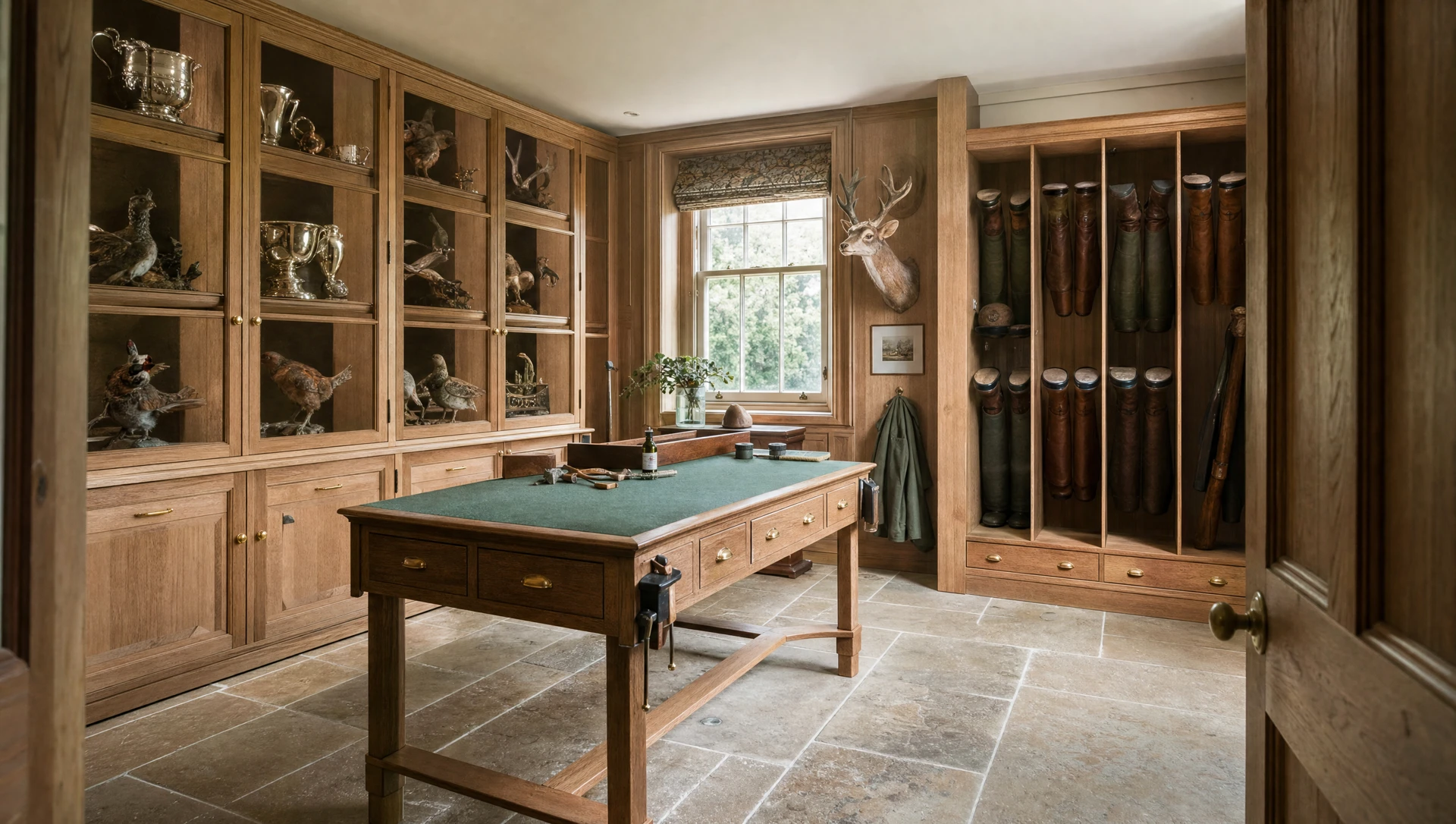
Our clients’ homes and gun cabinets are private, and most ask that they are not photographed or published. The images here are visualisations based on our own workshop drawings for commissions we have completed. If you would like to see drawings, samples and references for completed work, we will show them to you in person — visits to the Mickfield workshop are by appointment.
Gun rooms get the attention and the budget. Everything else in a sporting house ends up in a corner of the boot room, in plastic crates, or in a cupboard that was designed for towels.
We think that is the wrong way round, because the objects are frequently better than the storage they are given. A pair of antlers, a case of flies, a set of trophies, a good cleaning kit, forty years of shoot cards — these are the things a house is actually about, and there is almost nobody making furniture for them.
On this page
See the work
Finished cabinets, interiors, a timber-faced firearms door and workshop making, shown with the discretion this work requires.
Trophy and display cabinets
The difference between a display cabinet and a glazed cupboard is entirely in the details, and there are four of them.
The glass
Ordinary float glass has a green cast that you stop noticing in a window and never stop noticing in front of something you care about. Low-iron glass is close to colourless and it costs a little more. On a cabinet holding anything with subtle colour — feather, fur, patinated metal, old leather — it is the single change that makes the most difference.
Where a piece is valuable or the room gets strong daylight, we specify laminated glass with a UV-filtering interlayer. Light is what fades a specimen, and the damage is cumulative and permanent.
The light
Lighting a display cabinet from a single point at the top produces a bright shelf, a shadowed one below it, and reflections in the glass at eye level.
What works is low-heat LED, colour-matched across the piece, positioned to graze rather than flood, and switched on the door or on a separate circuit. Heat matters more than people expect: an enclosed glazed case with a warm lamp in it will cook a specimen slowly and will drive moisture about.
The back
A mirrored back doubles the apparent depth and shows you the reverse of whatever is in front of it. A fabric-lined back — baize, wool, linen — kills reflection entirely and makes the object the only thing in the frame. Painted is quieter still.
Which is right depends entirely on what is going in. We would rather see the collection, or photographs of it, before drawing anything.
The proportions
Shelf spacing is where most display cabinets fail. Equal shelves look tidy in a drawing and are useless in practice, because collections are not evenly sized. Adjustable is the usual answer and it is a compromise: the strips show, and the shelves rarely get moved after the first fortnight.
Given a list of what is going in, we set the shelves out properly, fix them, and the piece looks composed rather than arranged.
Cleaning tables
The most used piece of furniture in a sporting house, and usually the kitchen table.
A proper cleaning table is a specific object. It wants to be at standing height rather than dining height, because you work at it standing up and stooping for an hour is what makes cleaning a chore. It wants a top that tolerates solvent and oil without marking, and a felt or baize bed so a barrel can be laid down without either party suffering.
Below the top, drawers — because everything involved in cleaning a gun is small, easily lost, and worse when it rolls. Rod sections, jags, brushes, mops, patches, oil, a snap cap, the small screwdriver that fits and no other. Full-extension runners, so the back of the drawer is reachable rather than archaeological.
Two details worth insisting on
A raised lip or a returned edge on at least the working side. Oil finds the floor otherwise, and so does anything cylindrical.
Ventilation, and a solvent-tolerant finish. Cleaning products are volatile, and a sealed cupboard full of them under a table is unpleasant to open and worse to store rags in. If the room is small, we vent the carcass.
Height is worth measuring rather than assuming. Tell us your height and we will set the top to it — it is the same conversation as a workbench, and the difference between a table you use and one you work around.
Boot rooms
A boot room’s job is to dry things. Most of them store them wet, which is why they smell.
The principles are unglamorous and they work:
- Air, not doors. Open racking, slatted shelves, and space behind. A wet coat in a closed cupboard is a wet coat tomorrow.
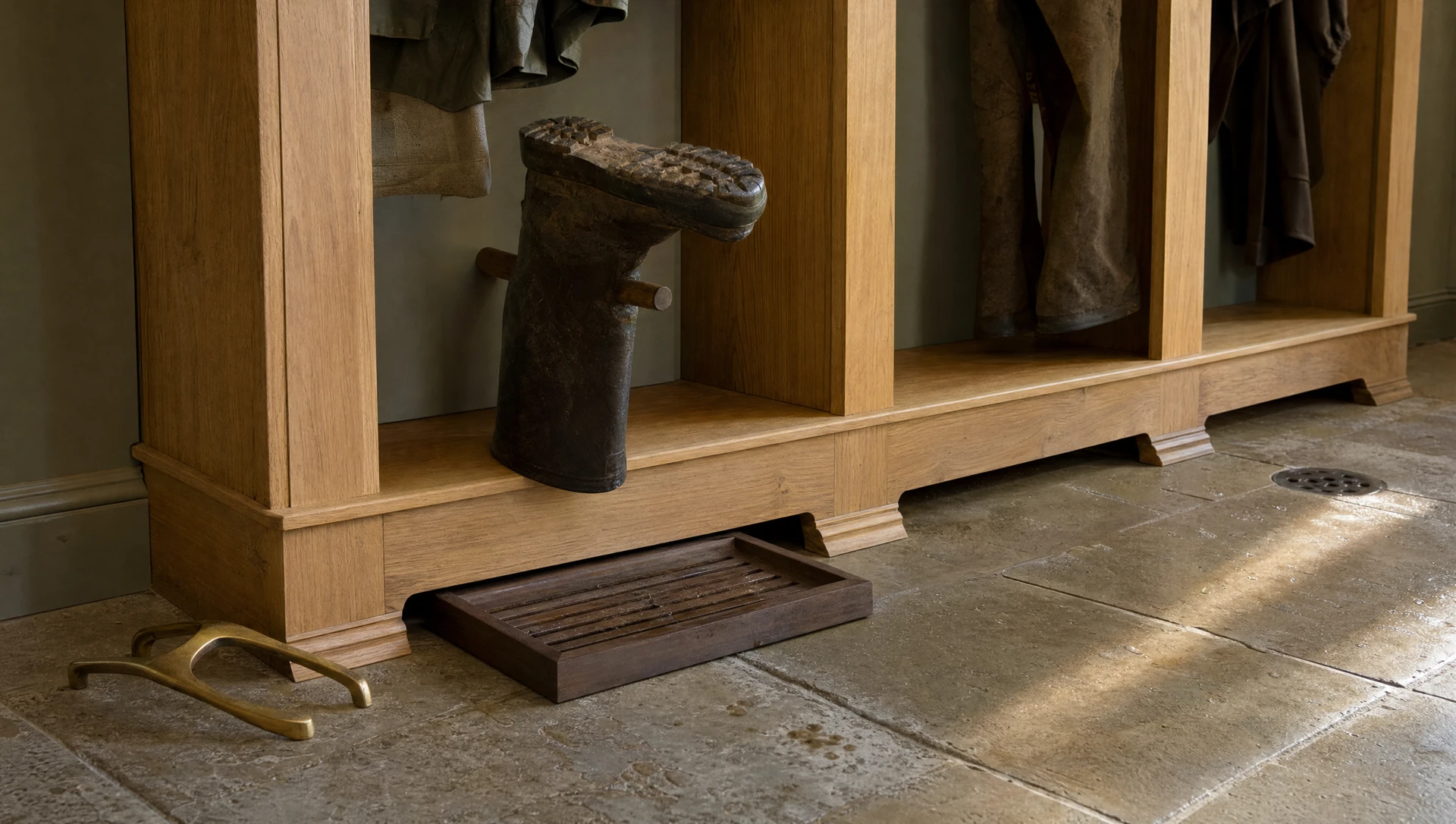
- Boots upside down and off the floor. Boot pegs or a rack that holds them inverted so water runs out rather than sitting in the toe. A drip tray under, removable, so it can actually be emptied.
- Hooks with room between them. The commonest mistake in the country. Coats need air on both sides; hooks at 150mm centres give you a compressed wet lump.
- A hard, drainable floor detail at the wet end, and a plinth that lifts the joinery clear of it.
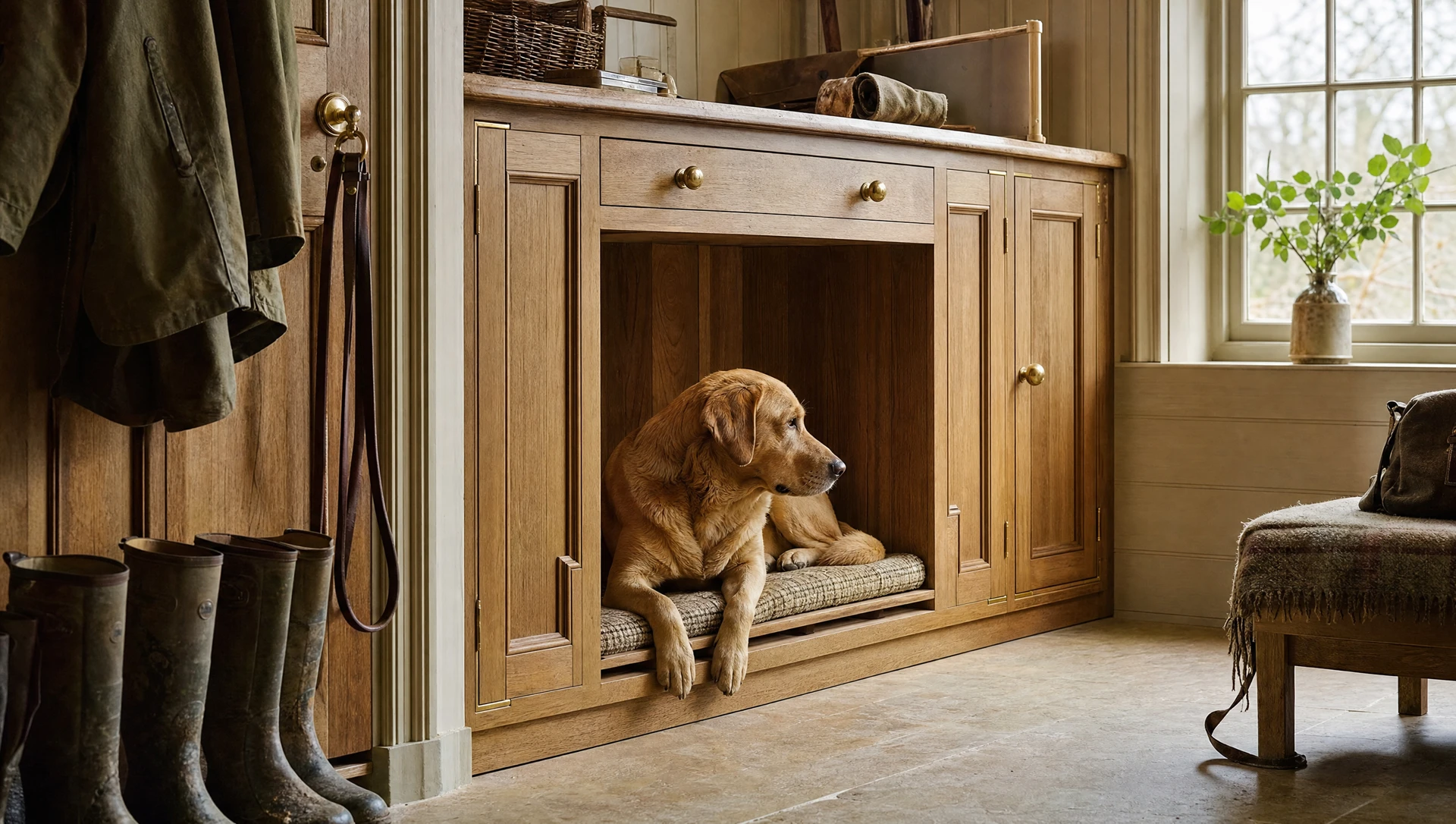
- Somewhere to sit and take boots off. A bench with storage under it, at the right height, is worth more than another metre of hanging.
Heat helps but it is not the whole answer. Gentle background warmth plus air movement dries a room; a hot radiator in a sealed space just moves the moisture somewhere colder, which is usually the wall behind the coats.
There is more on this in boot rooms and dog rooms: which end is allowed to be wet, getting boots off the floor, and building the dog a bed into the run rather than buying one.
The dogs
It is generally the same house and usually the same room, so it is worth drawing in rather than working around.
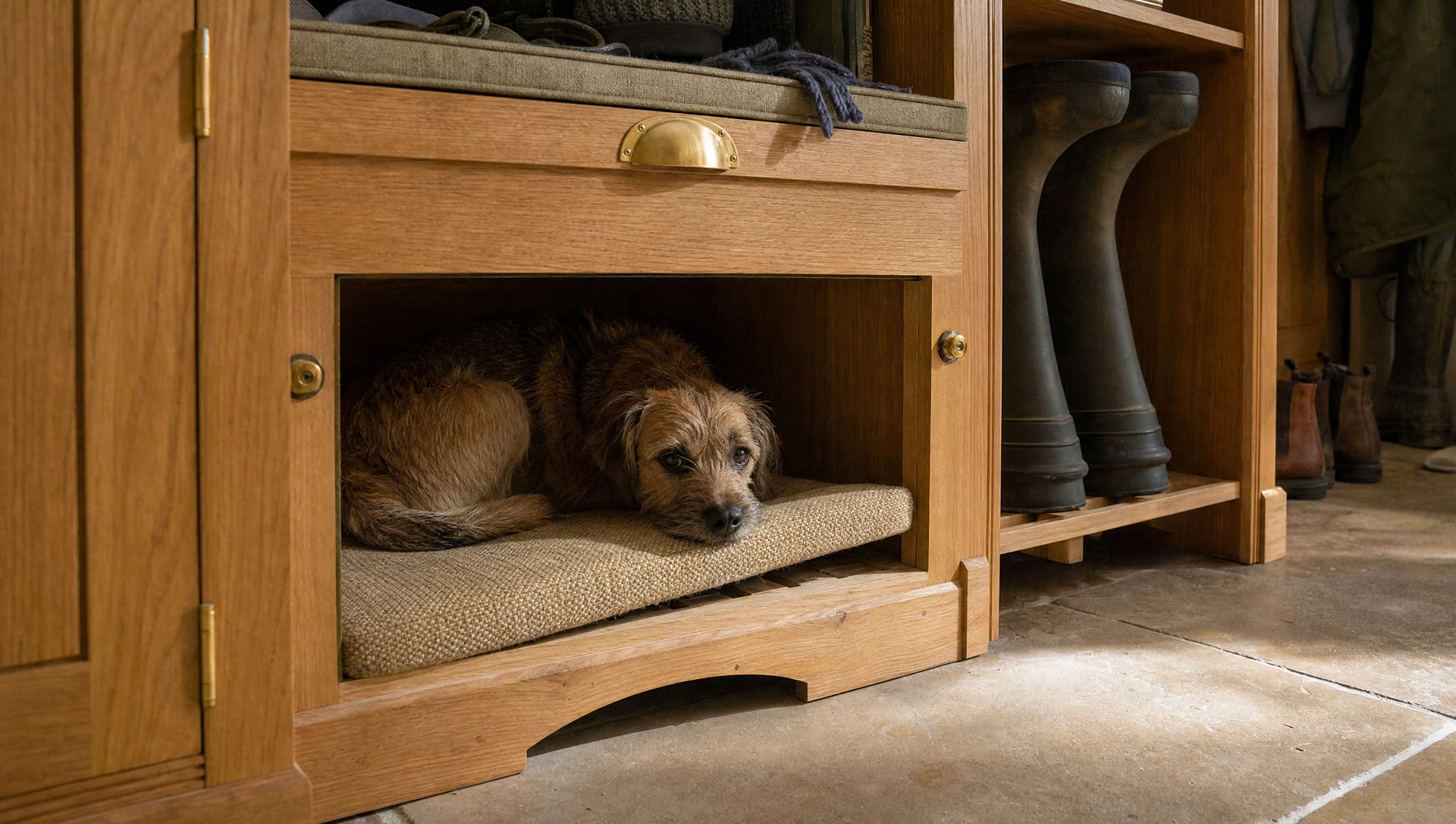
A built-in bed with a removable, washable base and air beneath it. Feed in a sealed, vermin-proof drawer or bin at a height that does not require kneeling. Leads, whistles and collars on their own hooks rather than shared with the coats. Somewhere for a wet dog to be towelled that is not the middle of the floor. And, if the room is right, a run of low cupboard that a dog can be shut behind when the front door is open and somebody is carrying a cake.
None of this is difficult joinery. It is simply a matter of somebody asking how many dogs there are and what actually happens when they come in — which is the same question we ask about guns.
Treating it as one room
The reason this page exists as a whole rather than four separate products is that in most houses these things are in the same space, and the space works or it does not.
The sequence usually runs: door from outside, wet things off and hung, boots off sitting down, dogs dealt with, then through. If the joinery follows that sequence, the room works. If the coat hooks are past the boot bench, it never does, whatever it cost.
So we survey the room and ask about the route before drawing anything, in exactly the way we ask for a gun list before drawing a cabinet. It is the same discipline applied to a less glamorous problem.
And it is frequently the same commission. A gun room and a boot room next door to each other, drawn together, in the same timber and the same finish, reads as one thing rather than two jobs. Fitted gun rooms · Fishing and rod rooms
How it is made
Exactly as everything else we make. Quarter-sawn solid oak, walnut or mahogany, book-matched across pairs of doors, or a hardwood built for paint. French polish, hand-oiled, hand-painted or antiqued by hand, in our own finishing shop by our own polisher. Solid brass or bronze ironmongery. Made at our own bench in Suffolk and installed by our site team.
Where a sporting room includes storage for firearms, that element is built to the full specification — 3mm mild steel (0.12in) throughout the enclosure, folded doors returned behind the frame, 8-lever safe locks to EN 1300 Class A, and mechanical anchoring into masonry. The published specification is here.
Common questions
What height should a gun cleaning table be?
Standing height rather than dining height, and set to the person using it rather than to a standard. Tell us your height and we will set the top to it. Stooping over a low table for an hour is what turns cleaning from a pleasure into a chore.
Why low-iron glass in a display cabinet?
Ordinary float glass carries a green cast that is invisible in a window and very visible in front of something with subtle colour — feather, fur, patinated metal, old leather. Low-iron glass is close to colourless and costs a little more. Where daylight is strong we also specify a UV-filtering laminated interlayer, because light damage to a specimen is cumulative and permanent.
Can you build a boot room that actually dries things?
Yes, and it is mostly a matter of air rather than heat. Open racking rather than closed cupboards, boots held upside down and off the floor over a removable drip tray, hooks spaced far enough apart that coats have air on both sides, and a plinth lifting the joinery clear of a drainable floor. Gentle background warmth plus air movement dries a room; a hot radiator in a sealed space just moves the moisture into the wall.
Do you build for dogs?
Yes — built-in beds with removable washable bases, vermin-proof feed storage at a sensible height, hooks for leads and whistles separate from the coats, and somewhere a wet dog can be towelled. It is not difficult joinery; it just needs somebody to ask how many dogs there are and what happens when they come in.
Can a sporting room and a gun room be one commission?
Frequently, and it is usually better. Drawn together, in the same timber and the same finish, adjoining rooms read as one thing rather than two separate jobs. It is also more efficient to survey, make and install in one programme.
What does a sporting room cost?
It depends entirely on the scale, from a single cleaning table to a fully fitted boot room and display wall. Send photographs of the room and a list of what has to live in it and we will give you an indication of cost before anybody surveys anything. Our prices page sets out the ranges for the main pieces.
Sporting rooms, trophies and what the law says about them
Trophy and display cabinetry is a large part of what we make for sporting rooms, and it is one of the few areas of our work where there is a genuine legal question hiding in the timber.
Most British sporting trophies — roe, red, fallow, muntjac, and native birds and fish taken lawfully — raise no issue at all. Where it gets complicated is anything imported. Many species are listed under CITES, which controls international trade in endangered species; specimens require permits to import and, for the most strictly controlled species, further certification to display or sell. That applies to a good deal of African and Asian material, and it applies to old pieces as well as new ones. The gov.uk guidance on CITES imports and exports is the starting point.
We are cabinetmakers and not a licensing service, so our position is simple: we will build the case, and the paperwork for what goes in it is yours. Where a client is buying a mount specifically for a room we are designing, we say this early, because discovering it after a case has been made to a specific size is an expensive way to find out.
Building a case that does not destroy what is in it
Taxidermy and antler are damaged by three things: ultraviolet light, insects, and swings in humidity. All three are design problems.
- Glaze with UV-filtering laminated glass where a case is anywhere near a window. Fading is cumulative and cannot be reversed.
- Seal the case properly and light it with LED. Halogen in a closed case cooks the specimen and the adhesive with it.
- Line in wool cloth, not synthetic. And build for inspection — a case that can never be opened is a case where an infestation is found too late.
- Keep it off external walls, for the same reason as a gun cabinet.
Cleaning tables, boots and dogs
The rest of a sporting room is unglamorous and it is where the room is actually used. A cleaning table at 950–1,000 mm, long enough to take a gun apart with room either side. Boot storage that is ventilated from beneath rather than a cupboard with a door. Dog beds built in rather than pushed into a corner, with a washable, replaceable base. Done as one scheme it reads as a room; done piece by piece it reads as a utility area with furniture in it.
Tell us what has to live in it
A list of what needs storing, a few wide photographs of the room, and what happens when everybody comes in through that door. That is enough for us to tell you what we would build.
Cigar cabinets, humidor tables and cigar rooms · Watch winders and watch safes · Fitted gun rooms · Fishing rooms