
Machinery and Hand Work
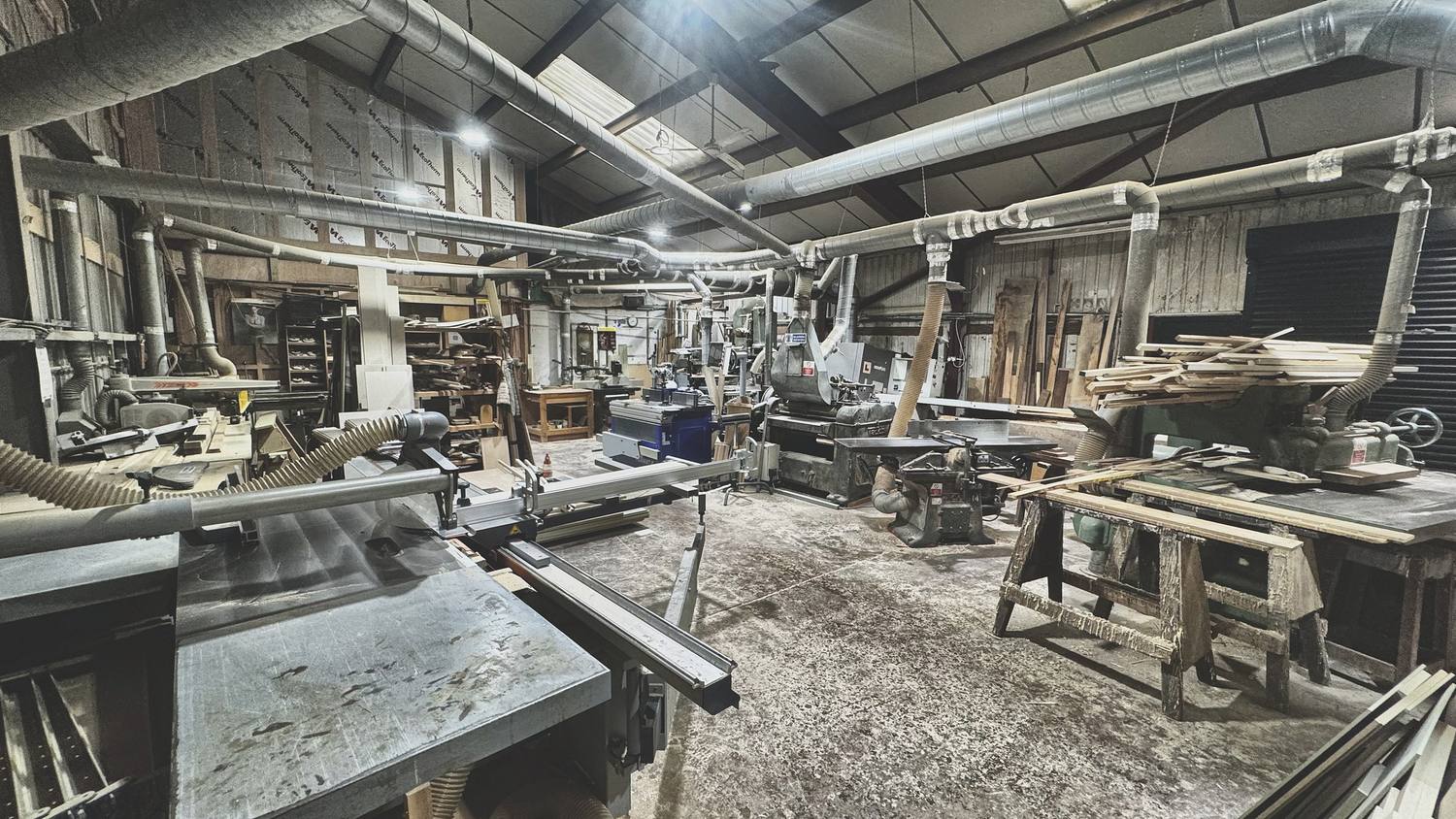
The interesting question in a modern joinery shop is not whether you use machinery — everybody does — but where you stop. Ours stops at the point where a decision has to be made about a particular piece of timber, and from there it is all bench.
On this page
Where the machine stops
A useful test: if the answer is the same every time, a machine should do it. If the answer depends on the piece of timber in front of you, a person should.
Cutting forty rack components to the same length is the first kind. Deciding which of six boards goes on the left-hand door, which way up, and where the book-match falls, is the second. Machining a moulding to a profile is the first. Easing that moulding where it meets a scribe against a wall that is out of true is the second.
Firms that machine everything produce work that is accurate and slightly dead. Firms that romanticise hand work produce beautiful things slowly and expensively and are usually late. The interesting bit is the line between, and getting it in the right place is most of what running a workshop is.
The moulder, and why it matters to you
This is the single most useful machine in the building for the kind of work on this website, and it is the one nobody asks about.
A moulder runs a length of timber past a set of shaped cutters and produces a moulding to a profile. The point is not speed — it is that the profile can be anything we choose, because the cutters are ground to it.
Which means: when you send us a section of a forty-year-old cornice, or a bead from a run of panelling in a house built in 1780, we do not go looking for the nearest match in a supplier’s catalogue and then explain why it is close enough. We grind knives to your profile and run the moulding here.
That is the whole reason we can promise to match existing joinery. Everything else — the timber, the finish, the ironmongery — can be sourced. A moulding cannot. Either you can machine it or you cannot, and most firms selling bespoke cabinets are buying stock profiles.
What to send us
A physical section of the moulding — an offcut, a spare length, a piece from the back of a cupboard, or a small piece cut from somewhere it will not be seen. Six inches is plenty.
Failing that, a squeeze of profile putty or a card template taken from the moulding itself. A photograph is the last resort, and it will get us close rather than exact.
What is in the machine shop
| Machine | What it does here |
|---|---|
| Panel saw | Sheet material and long rips, cut square and to size |
| Planer and thicknesser | Timber brought to a face, an edge and a dimension |
| Moulder | Mouldings to any profile we grind. See above |
| Spindle moulder | Shorter runs, curved work, and profiles worked on the bench-side |
| Bandsaw | Curves, deep cuts, and re-sawing boards for book-matching |
| Morticer and tenoner | The joints that hold frame-and-panel work together |
| Radial arm and mitre saws | Cross-cutting to length, accurately and repeatedly |
| CNC | Repeat components, jigs, templates, set-outs |
Some of it is old and some of it is new, and we are not sentimental either way. A cast-iron machine from the 1960s that has been maintained is frequently better than a modern equivalent, and occasionally it is simply what is in the corner and still perfect for the job.
CNC, honestly
Because clients ask, and because there is a certain amount of nonsense talked in both directions.
What it is genuinely good at: forty identical parts to a tolerance no hand can hold; jigs and templates that make the bench work faster and more accurate; a set-out that is square before anyone touches it; and repeat components in a run of fitted cabinets where consistency is the whole requirement.
What it cannot do: choose a board. Read figure. Decide that a particular piece of walnut wants to be a door front rather than a rail. Fit a scribe to a wall that undulates. Ease a door into an opening that is 6mm out over its height. Judge when a finish is right.
Anyone telling you their cabinets are entirely hand-made is either running a museum or being loose with the truth. Anyone telling you CNC makes the hand skills unnecessary has not fitted anything into an old house. We use both and we will tell you which did what.
Extraction
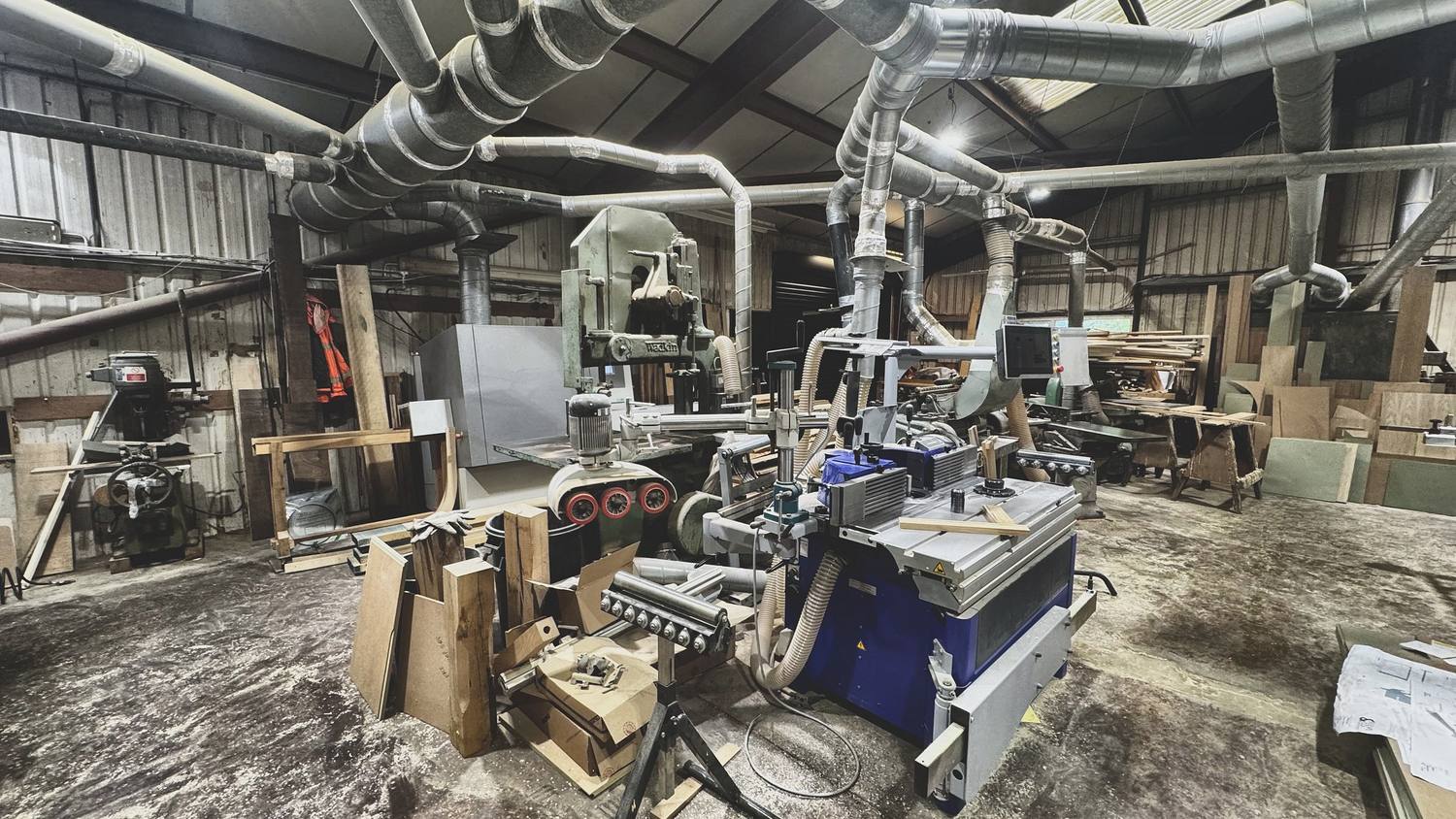
Ducted extraction to every machine, which is the least glamorous capital expenditure a workshop makes and one of the most important.
It matters for three reasons and only one of them is tidiness. Wood dust is a health issue and a legal duty. Dust in the air is dust that eventually lands on a wet finish, which is why the finishing shop is a separate space. And a shop where the extraction actually works is a shop where the floor is clear and people are not tripping over hose.
Waste and offcuts go into the workshop’s biomass heating rather than into a skip.
The bench
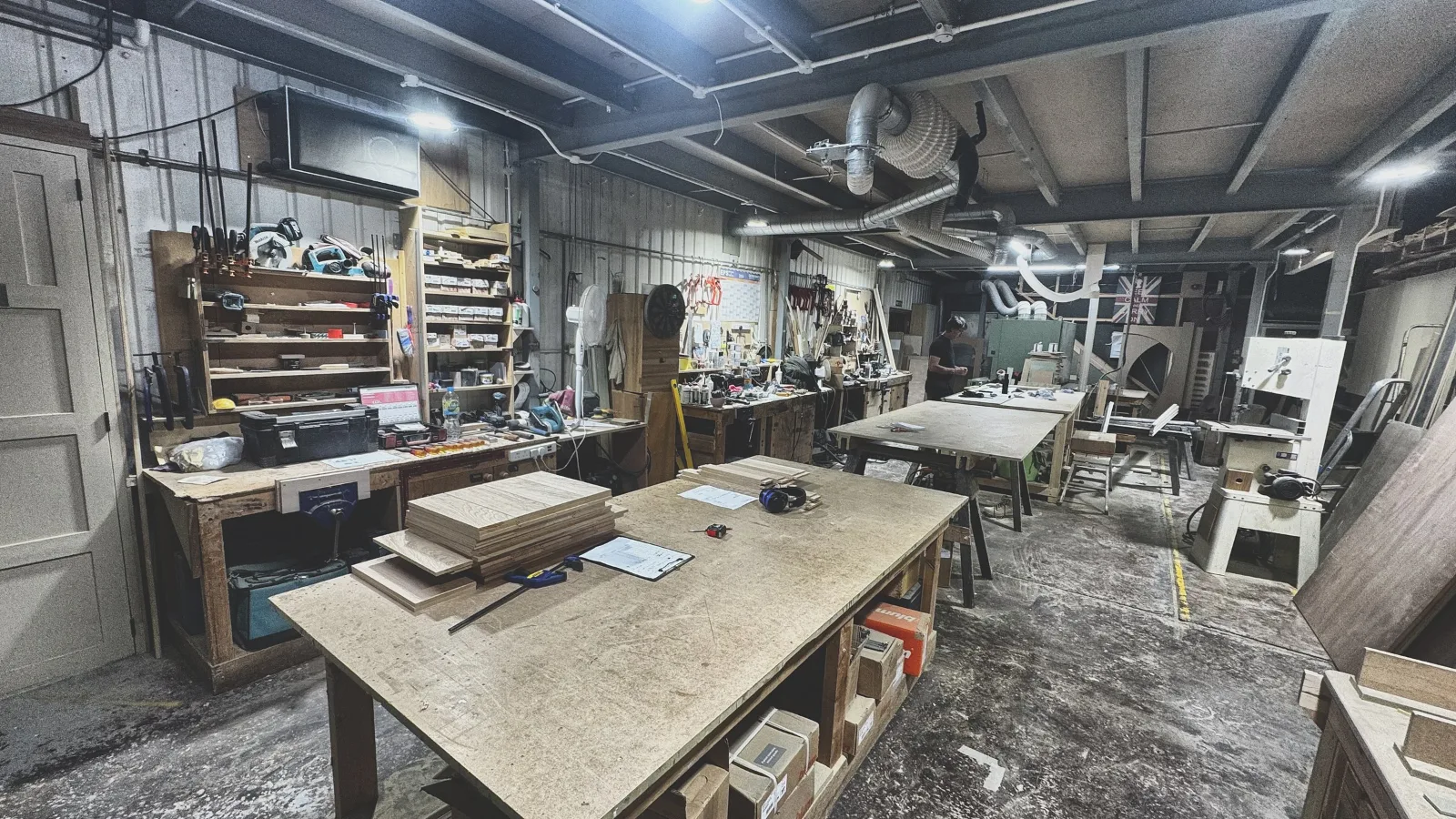
Where the machined components stop being components.
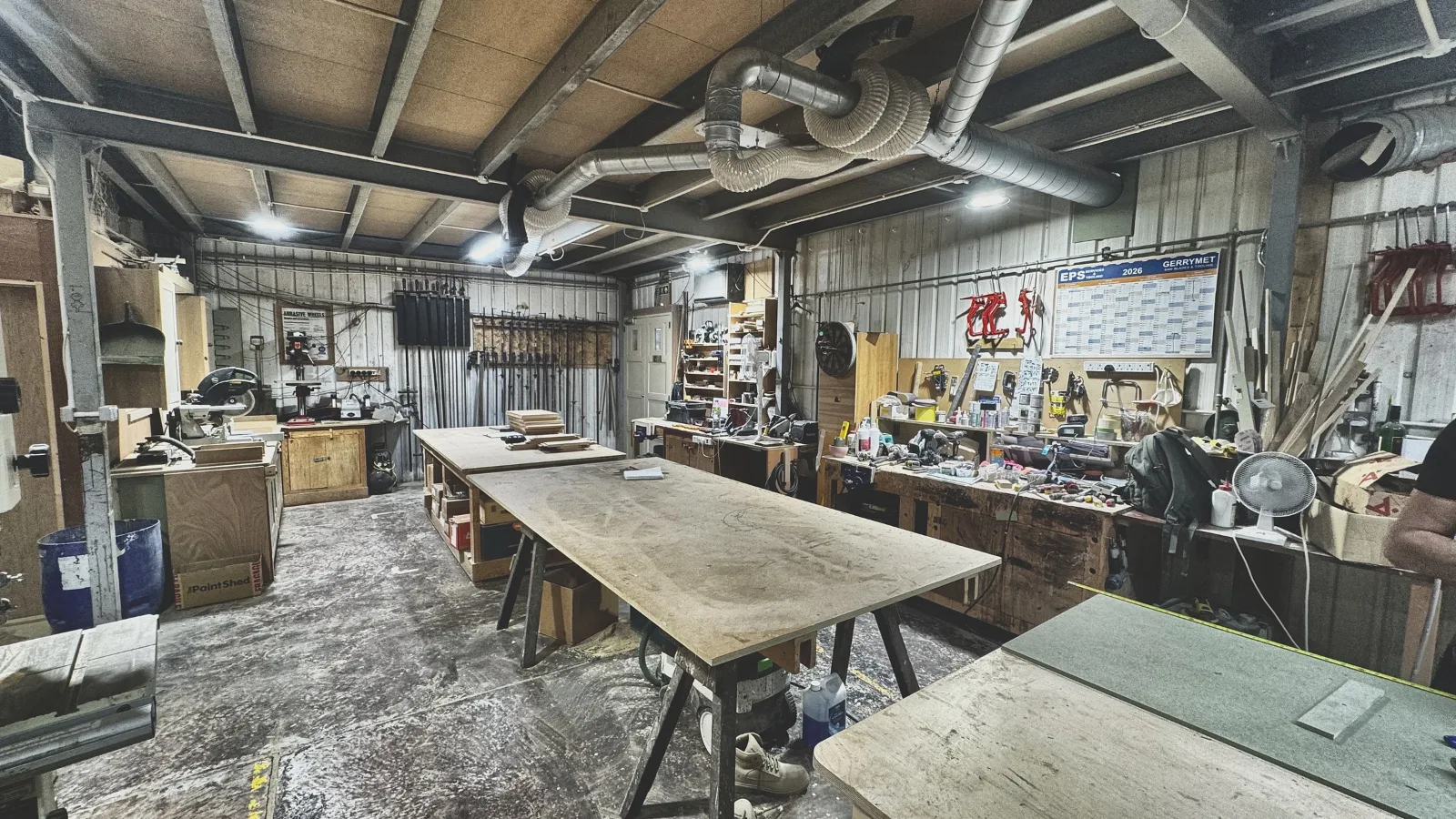
Jointing, assembly, drawer fitting, hanging and fitting doors, glazing, ironmongery, and the endless small adjustments that turn accurate parts into a piece that works. A drawer that is made to its opening rather than to a dimension. A door eased until the shut line is even top to bottom. A moulding mitred and worked so the joint does not open when the timber moves.
Cabinets are assembled complete here, with doors hung and drawers fitted, and the whole piece is made to work before it is taken apart for finishing. A cabinet first assembled on site is a cabinet whose problems are discovered in your house.
Setting out
The first thing that happens at the bench and the reason the rest of it works.
Setting out means producing a full-size drawing or rod from which every component is marked directly. Every part comes off one set of marks, rather than each being measured from the last — which is how small errors accumulate into a door that is 3mm (0.12in) out at the bottom.
It is unglamorous, it takes a morning, and it is the difference between joinery and carpentry. It is also why we survey the room ourselves rather than working from someone else’s dimensions: a rod is only as good as the measurements it was drawn from.
Steel, in a timber shop
A gun cabinet is the one thing we make that is two trades at once, and the order matters.
The steel enclosure is built first and the timber is made around it — not applied to it. That is the opposite of how a steel locker with a timber front goes together, and it is the reason the proportions come out as furniture rather than as a box with a face screwed on.
Locks are fitted here, glazing is bedded here, and the completed cabinet is checked working before it leaves the building. The signed specification sheet — steel thickness, glass specification, lock model, fixing type and centres — is written from what was actually built. The full detail is on the specification page.
Questions we are asked
Can you match our existing mouldings?
Yes — we run our own moulder and grind cutters to your profile, so mouldings are machined here rather than bought from a supplier’s catalogue. Send a physical section, six inches is plenty. It is the single reason we can promise to match existing joinery.
Do you use CNC?
Yes, for repeat components, jigs, templates and set-outs — anything where the answer is the same every time and consistency is the requirement. Everything that depends on the particular piece of timber in front of you is done at the bench.
Is your work hand-made?
Partly, and we will tell you which parts. Anyone claiming their cabinets are entirely hand-made is running a museum or being loose with the truth; anyone claiming machinery makes hand skills unnecessary has not fitted anything into an old house.
What is setting out?
A full-size drawing or rod from which every component is marked directly, so every part comes off one set of marks rather than being measured from the last. It takes a morning and it is why the doors fit.
Is the cabinet assembled before it comes to me?
Yes — assembled complete at the bench, doors hung, drawers fitted to their openings, the whole piece made to work, and only then taken apart for finishing. A cabinet first assembled on site is one whose problems are discovered in your house.
How is the steel handled in a timber workshop?
The steel enclosure is built first and the timber made around it, rather than a timber front applied to a steel locker. Locks are fitted and glazing bedded here, and the cabinet is checked working before it leaves.
A machine shop that is properly run
Woodworking machinery is the most dangerous equipment in ordinary manufacturing, and the way a machine shop is run tells you a great deal about how the rest of a business is run. The Health and Safety Executive’s woodworking guidance is the standard, and we work to it because a shop that cuts corners on guarding and extraction is a shop that will cut corners on your cabinet.
In practice that means: braked motors on the spindle moulder and the saws; power feeds used on every straight moulding run rather than hands near the block; limited-cutter-projection tooling as standard; LEV to every machine, tested annually as the regulations require; and nobody on a machine they have not been trained and signed off on.
It also means the dull things. Push sticks that are actually to hand. A floor swept between operations. Blades changed on a schedule rather than when they start to burn. None of it appears in a photograph and all of it appears in the work.
What comes out of the machine shop, and what does not
Machining gives us four things and nothing else: dimensional accuracy, repeatability across a batch, the ability to cut a bespoke moulding profile from a section we have taken off your existing joinery, and speed on the parts where speed costs nothing. What it does not give is the decision about which board goes where, how a panel is set out across a pair of doors, how a joint is fitted, or where a moulding is stopped. Those are made at the bench, by a person, with the actual timber in front of them — and they are what you are paying for.
The machine shop, item by item
For anyone who wants to know what is actually in the building: a sliding-table panel saw, a surface planer and a thicknesser, a spindle moulder with a power feed, a bandsaw, a morticer, a wide-belt sander, a CNC router, and a Felder spindle moulder added in 2026. Everything is on three-phase, everything is braked, and every machine is ducted to the extraction plant.
What that list buys is not speed for its own sake. It is the ability to cut a moulding profile from a section we have taken off your existing joinery rather than choosing the nearest thing from a catalogue — which, in a house with good original mouldings, is the single most convincing thing a joiner can do.
Send us a section of the moulding
Six inches of the real thing tells us more than a page of photographs, and it is the difference between matching your joinery and approximating it.