
Fly-Tying Benches and Desks
A fly tying bench is the most particular piece of furniture in a sporting house. Everything about it is decided by three things: where the light falls, how solidly the vice is held, and whether the materials are where your hand already expects them to be.
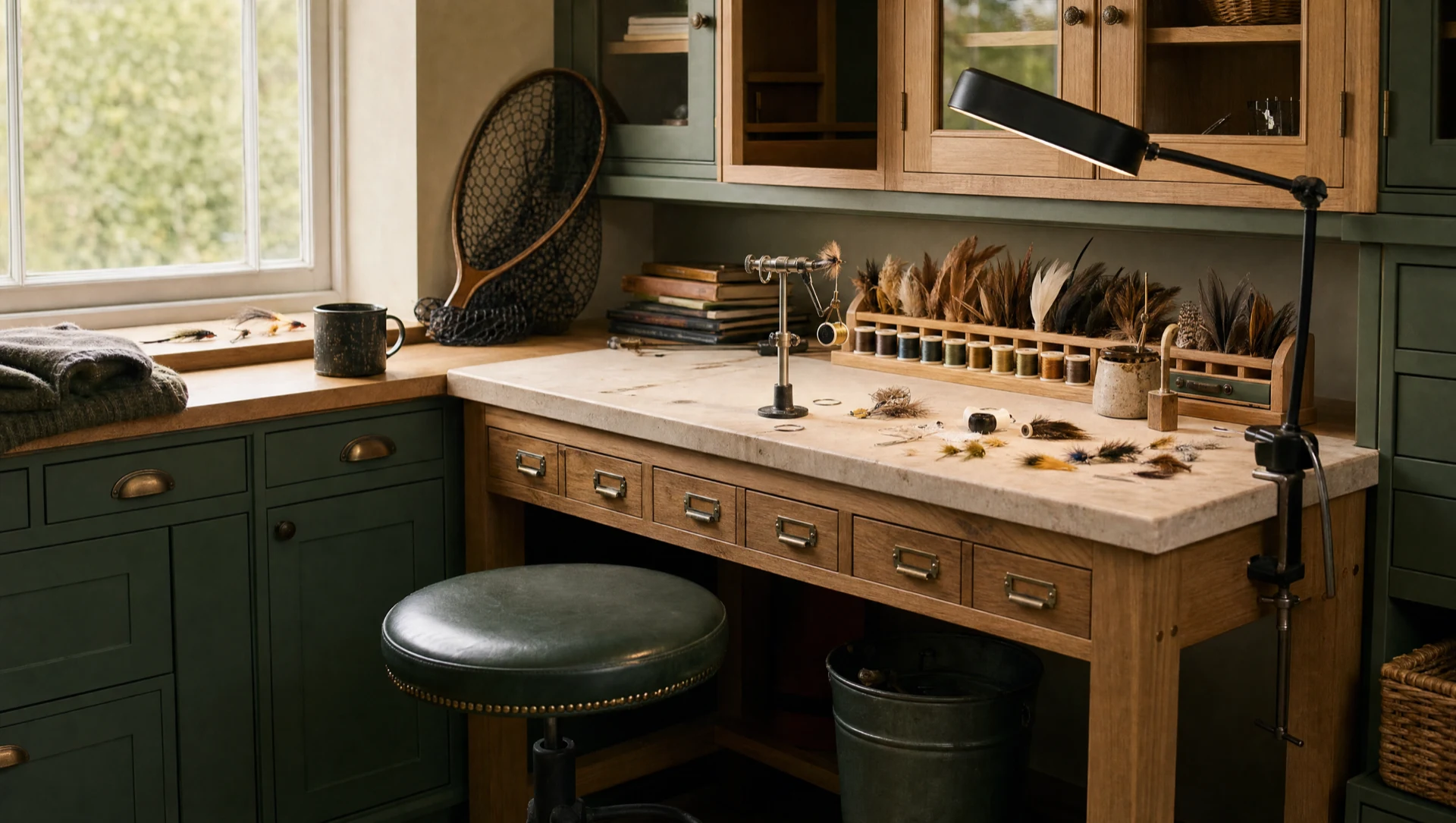
A fly-tying desk is a workbench that has to live in a house. It is asked to be precise, well lit and full of very small things, while also being a piece of furniture somebody is prepared to look at.
Almost every one we are asked about replaces a dining table, a spare desk, or a shelf in the corner of an office. All three work until you tie regularly, at which point the shortcomings are the same every time.
On this page
Light, which decides everything else
Tying is close work in small scale with subtle colour, and it is done in the evening far more often than in daylight. Light is therefore not an accessory; it is the first design decision, and the desk gets drawn around it.
Three things matter and they are all easy to get wrong.
- Position. The light comes from the side and slightly in front, on the opposite side to your working hand. Directly overhead puts your own head in the way; directly behind puts the vice in your own shadow.
- Colour. A neutral white, somewhere near daylight, so that a dubbing blend or a hackle looks in the evening as it will look on the water. Warm domestic lighting flatters everything and lies about olive and dun in particular.
- Diffusion. A single hard point source produces glare off thread and hard shadows behind the hook. Two softer sources, or one diffused, is easier to work under for an hour.
If the desk sits under a window, that decides the orientation and we work to it. If it does not, we design in the lighting properly and route the cable so it is not draped across the top — which means knowing about it at drawing stage, because it is a cable run and a switch position, not an afterthought.
The vice, and why the top must not move
The single mechanical requirement of the whole piece.
A vice is either clamped to the edge of the top or held in a pedestal standing on it. In both cases, any movement or flex in the top is movement at the hook, and at the scale you are working it is very noticeable.
So a tying top is thicker and stiffer than it needs to look, properly supported, and rigid at the front edge where a clamp goes. A thin top on a light frame will drum and flex, and no amount of good lighting compensates.
Two things worth specifying:
- A clean, square front edge with clear space beneath it, so a C-clamp actually fits. An apron rail or a drawer front immediately below the top makes edge-clamping impossible, which is the commonest reason a beautiful desk cannot take a vice.
- Where the vice lives. If it is left set up, that space stays clear and everything else is arranged around it. If it comes off between sessions, it wants a drawer or a housing sized for it.
Materials, in the order your hand reaches
Tying materials are the most awkward storage problem in the house, because they range from a spool of thread to a whole cape, and they are all needed at once.
The principle is proximity. What you reach for constantly lives within arm’s length without standing up; what you reach for occasionally lives further away; what you reach for twice a year can be across the room.
| What | Where | Why |
|---|---|---|
| Thread, tinsel, wire, bead heads | Shallow divided drawer in the top tier, or a rack at the back of the top | Constant use. Spools want individual round divisions or a spindle rack, never a heap |
| Dubbing | Shallow divided drawer, one compartment per colour, lidded or deep enough not to blow about | Very light, escapes easily, and colour matters — you want to see it all at once |
| Hackle capes and saddles | Wider, shallower drawers, laid flat, not folded | Creasing a cape damages it. Flat and dark also keeps the colour |
| Furs, hair and larger materials | Deeper drawers lower down | Bulky and less frequently reached for |
| Tools | A rack or block at the back of the top, upright | Bobbins, hackle pliers, scissors, whip finisher. Upright and visible or they are lost |
Two things worth building in
Dark storage for anything natural. Hackle, hair and fur all fade in daylight, and it is permanent. Drawers rather than open shelves, and away from the window if the desk is in one.
Moth protection. Natural materials are food. Cedar-lined drawers help, sealed containers help more, and either is far easier to build in now than to add later.
Hooks, thread and the very small things
Hooks come in small boxes or packets, there are always more sizes than expected, and they are useless if they are not sorted.
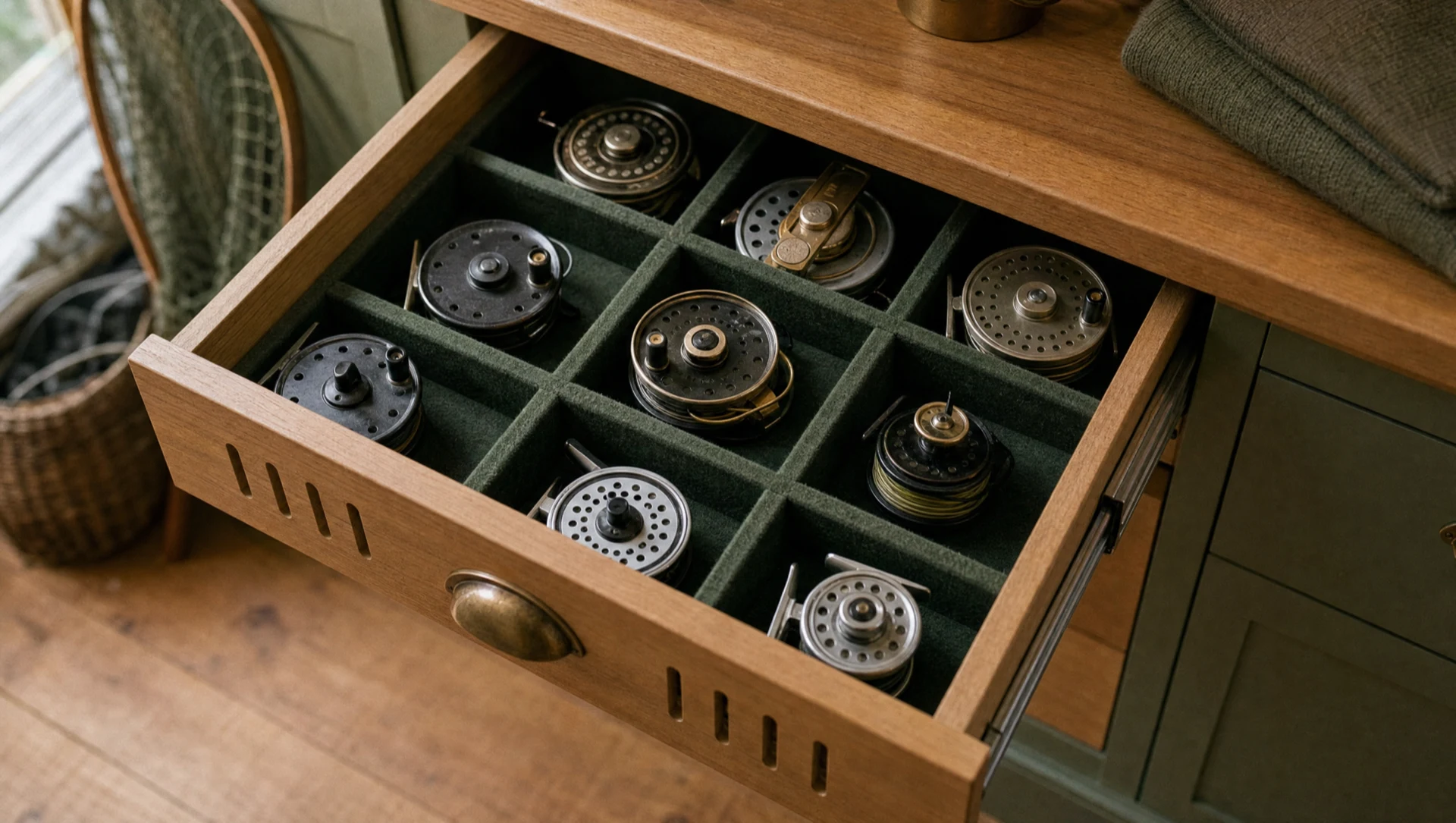
The arrangement that works is a shallow drawer divided to hold the boxes on edge with the labels up, sized to whatever boxes you actually use, so the whole range reads at a glance. The same drawer usually takes beads and weights.
It is a small piece of joinery and it is the difference between reaching for a size 16 and hunting for it.
Waste, which nobody plans for
Tying produces a surprising volume of clippings, and they are light, staticky and they travel. A desk without a waste solution scatters hackle fibre across a room within a week.
The two answers that work are a bin bracketed to the front edge below the vice, catching what falls where it falls, or a shallow recessed well in the top itself, emptied by hand. The first is more effective; the second is better looking and is what most people choose when the desk lives in a room rather than a workshop.
Height, chair and posture
Tying is done seated, close in, for longer stretches than intended. Desk height, chair height and vice height together decide whether that is comfortable at the end of an hour.
We would rather set the top to you than to a standard. Tell us your height, whether you use a pedestal vice or a clamp, and what chair you intend to use — the vice adds its own height above the top, and a pedestal vice on a standard desk with a standard chair puts most people’s shoulders up around their ears.
Knee room matters too. A drawer bank on both sides looks balanced and leaves nowhere for your legs. One bank, or a shallower centre, is the usual answer.
How it is built
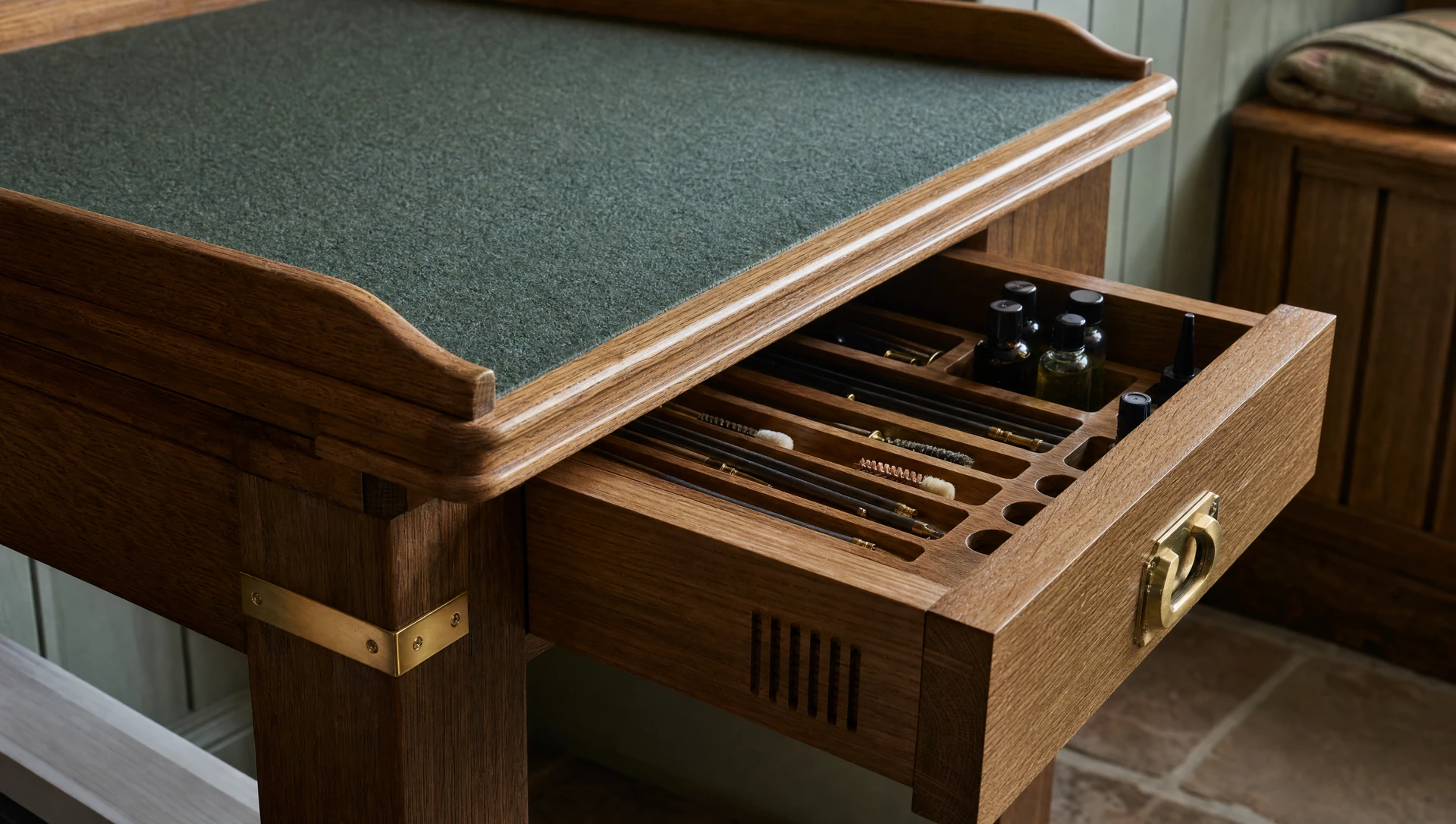
Quarter-sawn solid oak, walnut or mahogany, or a hardwood built for paint. Dovetailed solid drawer boxes on full-extension runners so the back of a shallow drawer is reachable. Leather, linen or baize where a surface wants to be soft. Solid brass or bronze ironmongery. Finished in our own finishing shop by our own polisher, and made at our own bench in Suffolk.
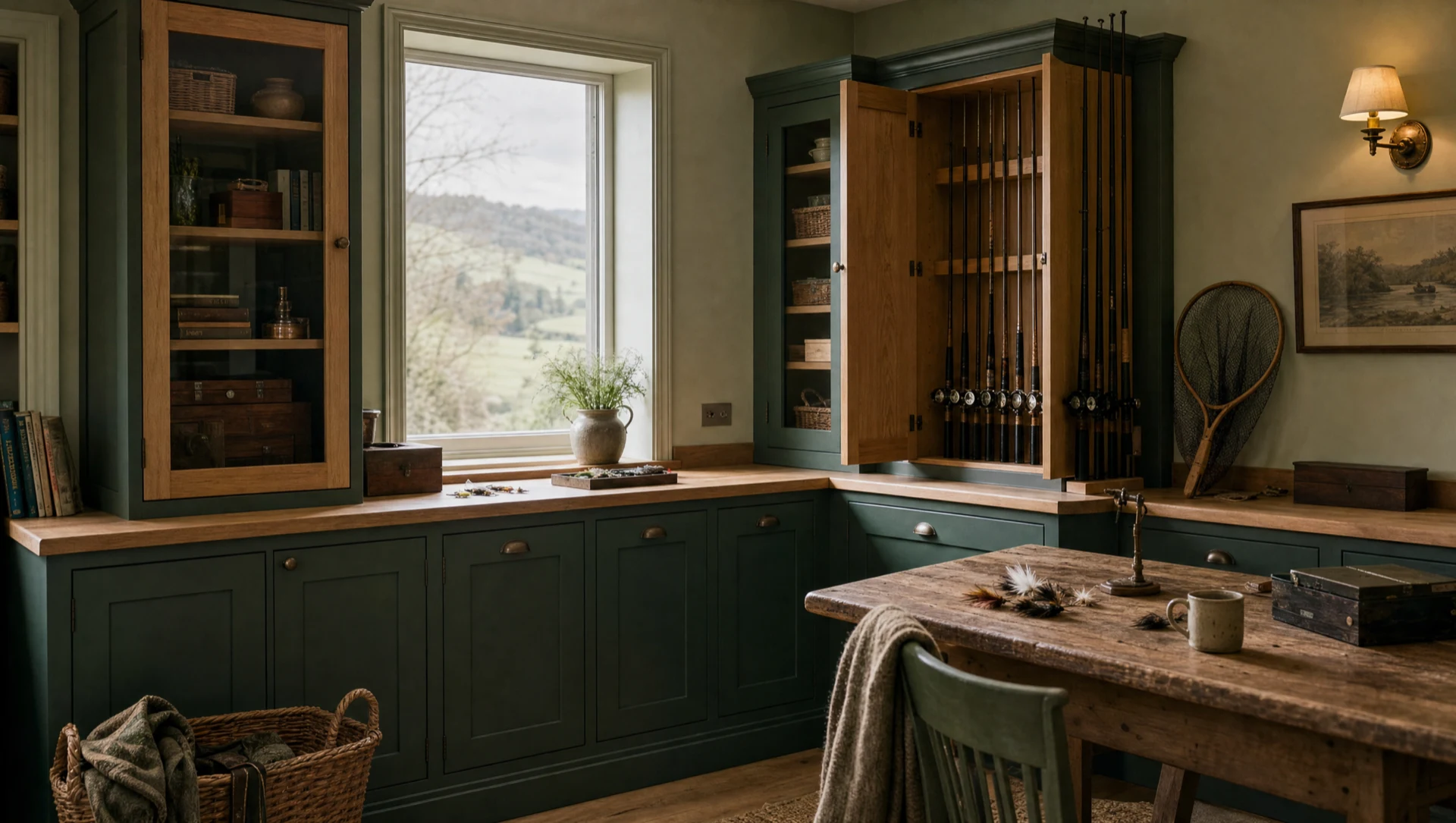
A tying bench is frequently drawn as part of a fitted room — under a window, with rod racking along the opposite wall and reel and tackle drawers beside it. It works equally well as a single freestanding desk, which is where most of these commissions begin. The fishing room page sets out the whole thing.
Common questions
Where should the light on a fly-tying desk come from?
From the side and slightly in front, on the opposite side to your working hand. Overhead puts your own head in the way and behind puts the vice in your shadow. Use a neutral white close to daylight so colours look in the evening as they will on the water, and diffuse it — a single hard source produces glare off thread and hard shadows behind the hook.
Does the top need to be thicker than a normal desk?
Yes. A vice is clamped to the edge or stood on the top in a pedestal, and any flex in the top is movement at the hook, which at that scale is very noticeable. The top is thicker and stiffer than it needs to look, properly supported, and rigid at the front edge.
Why does the front edge matter so much?
Because a C-clamp needs a clean square edge with clear space beneath it. An apron rail or a drawer front immediately below the top makes edge-clamping impossible, and it is the commonest reason a beautiful desk cannot actually take a vice.
How should tying materials be stored?
By how often you reach for them. Thread, wire and beads in a shallow divided drawer in the top tier; dubbing in its own divided drawer, one compartment per colour; capes and saddles laid flat in wider shallow drawers, never folded; furs and bulk lower down. Keep anything natural dark, because hackle, hair and fur fade permanently in daylight, and build in moth protection while it is easy.
What do you do about the clippings?
Either a bin bracketed to the front edge below the vice, which catches what falls where it falls, or a shallow recessed well in the top emptied by hand. The first is more effective; the second looks better and is what most people choose when the desk lives in a room rather than a workshop.
What height should it be?
Set to you rather than to a standard. Tell us your height, whether you use a pedestal or a clamp vice, and what chair you will use — the vice adds its own height above the top, and a pedestal vice on a standard desk with a standard chair puts most people’s shoulders around their ears.
Fly tying bench dimensions we work from
These are our starting figures. Every one of them moves for the person who will sit at it, and the reason we ask you to sit at a mock-up at survey is that a 25 mm error in top height is the difference between an hour at the vice and twenty minutes.
| Dimension | Our default | Note |
|---|---|---|
| Top height | 740 mm | Desk height, not bench height. Tying is seated close work. |
| Vice jaw height above the top | 150–180 mm | Set so the hook sits just below eye line with a straight neck. |
| Top depth | 600 mm | Below 550 and the material drawers foul your knees. |
| Clear knee width | 600 mm minimum | Pedestals go outboard of this, never into it. |
| Top thickness at the vice | 45 mm solid | The clamp needs mass. A 22 mm top drums and moves. |
| Material drawer height | 60–75 mm | Deep drawers crush hackle. Shallow and many beats deep and few. |
Light
Daylight from the left for a right-handed tyer, and never directly in front, because a window in front of the vice puts you in permanent silhouette. Task lighting at 4000K and CRI 90 or better — a high colour-rendering index is what lets you tell olive from dun at eleven at night, and it is the single cheapest improvement to a tying bench that exists.
Materials, and the pest problem nobody mentions
Natural fur and feather is food for clothes moth and carpet beetle, and a warm, undisturbed drawer full of hackle is an ideal breeding site. We line material drawers in cedar rather than felt, fit them with a proper dust seal, and build in space for a lidded box for anything unwashed. Cedar is not a cure — carpet beetle larvae will happily ignore it — but a sealed, cool, dark drawer that gets opened regularly is far less likely to become an infestation than a cardboard box in a loft.
Tell us how you tie
Pedestal or clamp, what you tie most, roughly how much material you have, and whether it lives under a window. Plus your height. That is enough to draw a desk that fits you rather than an average.