
Rod Racks and Rod Storage
Rods are long, expensive, and stored badly in almost every house that owns them. A rack made to your own rods costs very little more than a rack made to an average, and it is the difference between storage and a slow accident.
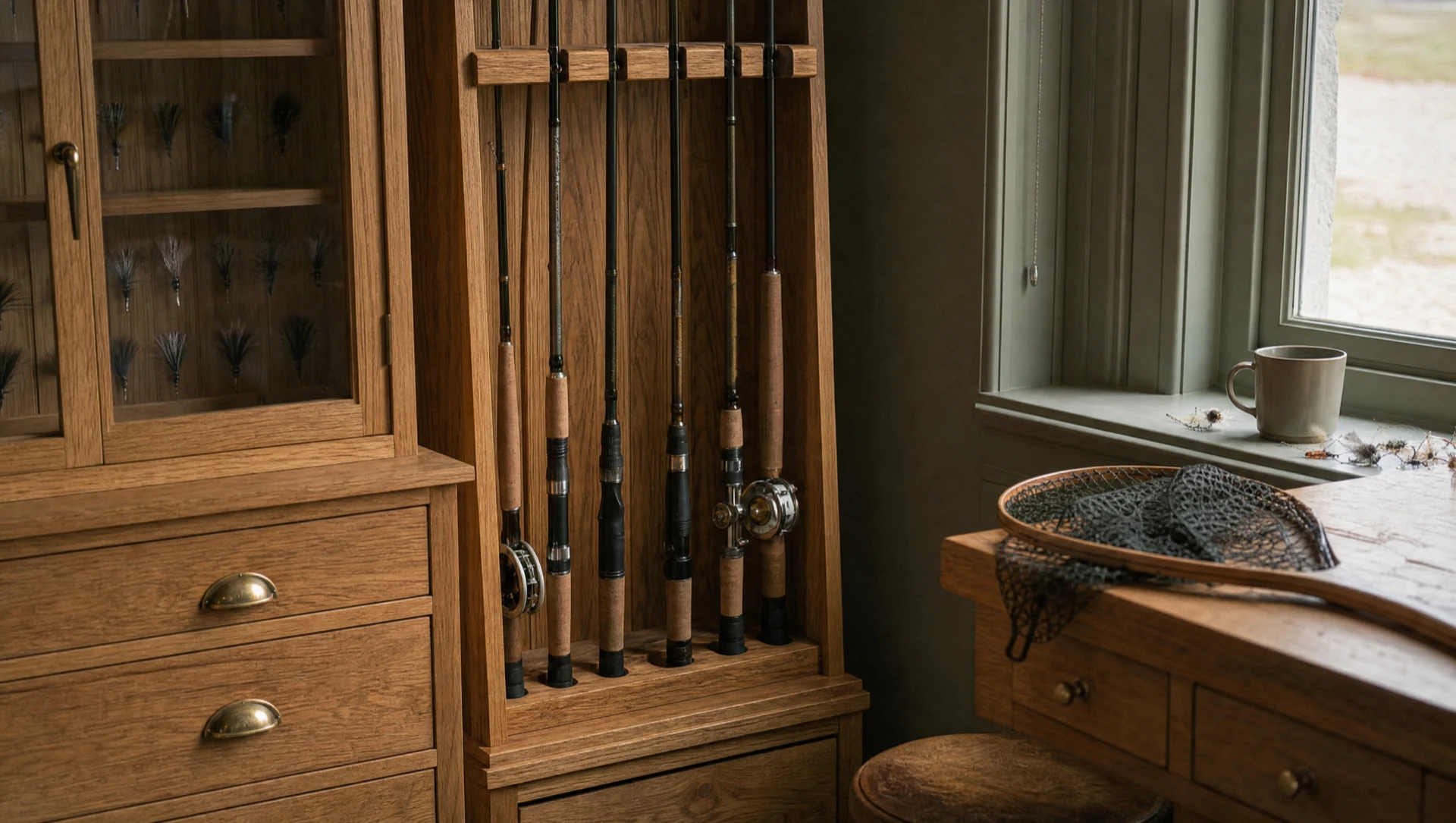
The usual arrangement is a corner of a garage, a set of hooks, or the tubes leaning against a wall behind a door. It works until somebody moves something, and then it stops working expensively.
What a rod actually needs is straightforward, and once it is said out loud it is obvious.
On this page
The one thing that matters: no pressure on the blank
A rod blank is designed to bend under load and return. What it is not designed to do is sit bent, unloaded, for months.
Carbon is tolerant of this and cane is not, but neither benefits. The damage from bad storage is rarely dramatic — it is a rod that has taken a slight set, a tip that no longer sits straight, a section that has crept. Nobody notices the day it happens.
Which produces three rules that govern everything else on this page:
- Support at the butt, locate at the tip. The weight goes on the butt; the tip end is held from falling sideways and carries nothing.
- Never clamp the blank. Anything that grips a rod tightly enough to hold it is gripping it tightly enough to mark it. Cradles, not clamps.
- Never let a rod rest on its tip ring. The commonest single fault we see, and it is entirely a matter of where the rack puts the rod down.
Vertical, horizontal or angled
All three are correct in the right room. The choice is usually decided by ceiling height rather than preference.
| Arrangement | Suits | Watch for |
|---|---|---|
| Vertical Butt in a cup, tip located above | Rooms with height. The most compact by floor area, and the quickest to use — one hand, one movement | Needs the ceiling. A made-up 10ft rod wants better than 10ft of clear height plus room to lift it in |
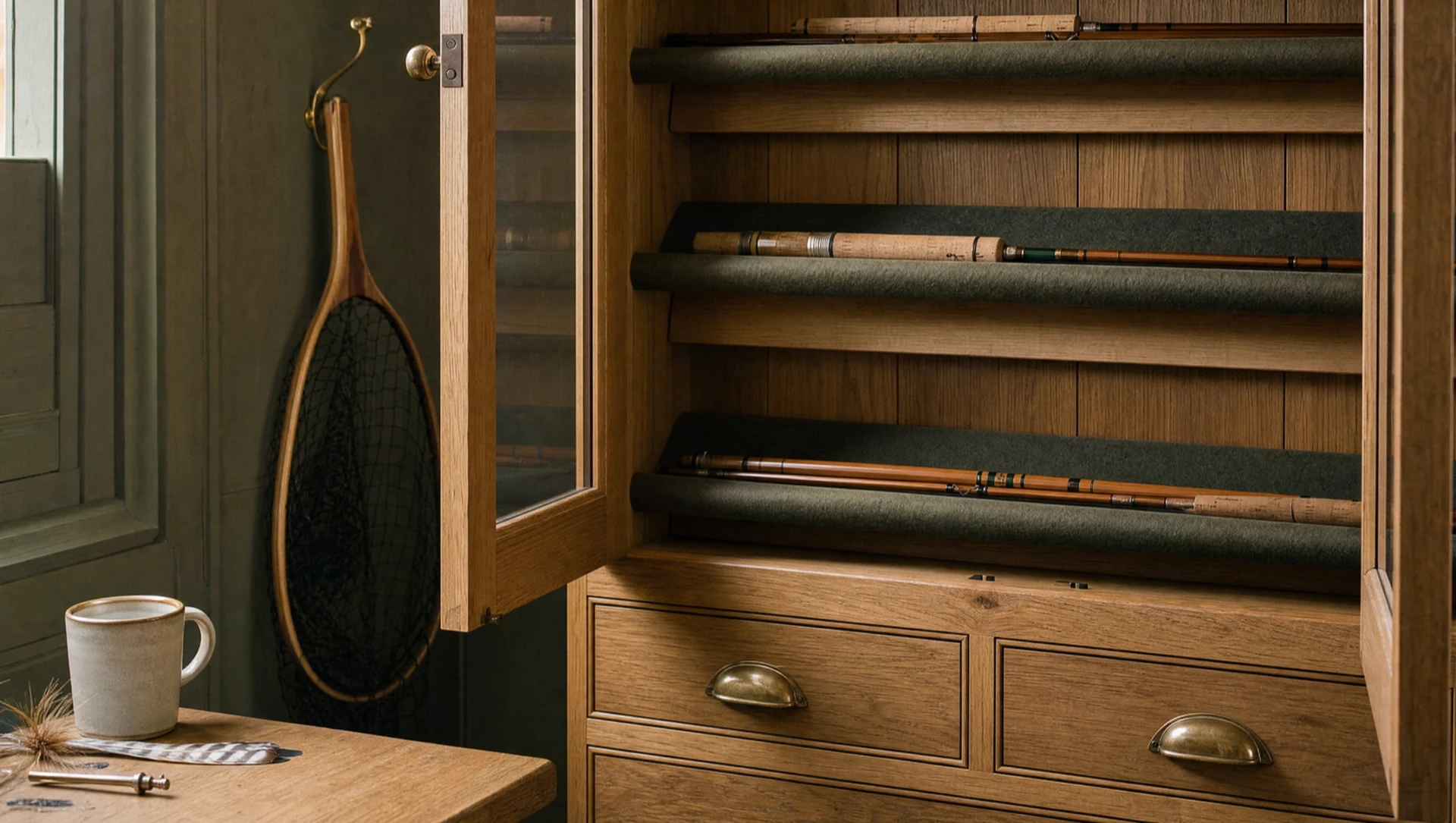
| Horizontal Laid in cradles along a wall | Low rooms, long walls, cellars and outbuildings. Also the kindest arrangement for cane | Eats wall length. Needs enough cradles that the blank is supported, not spanning |
| Angled Leaning in a raked rack | Rooms that are neither tall nor long. A good compromise and often the best-looking | The rake has to be right or the rods walk. Butt cups must actually retain |
Vertical is what most people picture and it is frequently not what the room can take. A four-piece 9ft rod broken down is a different storage problem from the same rod made up, and it is worth deciding which of those you are actually going to do before the rack is drawn.
Made up, broken down, or in tubes
Three habits, three different pieces of furniture. Most houses need two of them.
Made up
The best argument for a rod room. A rod that lives made up is a rod that gets fished, because the barrier between deciding to go and going is thirty seconds rather than fifteen minutes at the car.
It demands the most from the room: full length, clear height or clear wall, and enough spacing that rings do not touch. Rings are the reason rods should never be racked tight against each other — two rods pressed together will mark each other’s whippings and eventually the blanks.
Broken down
Shorter, easier, and what most travel rods do anyway. Sections want to be located individually rather than bundled — a four-piece rod dropped into one hole comes out with the sections rubbing.
In tubes
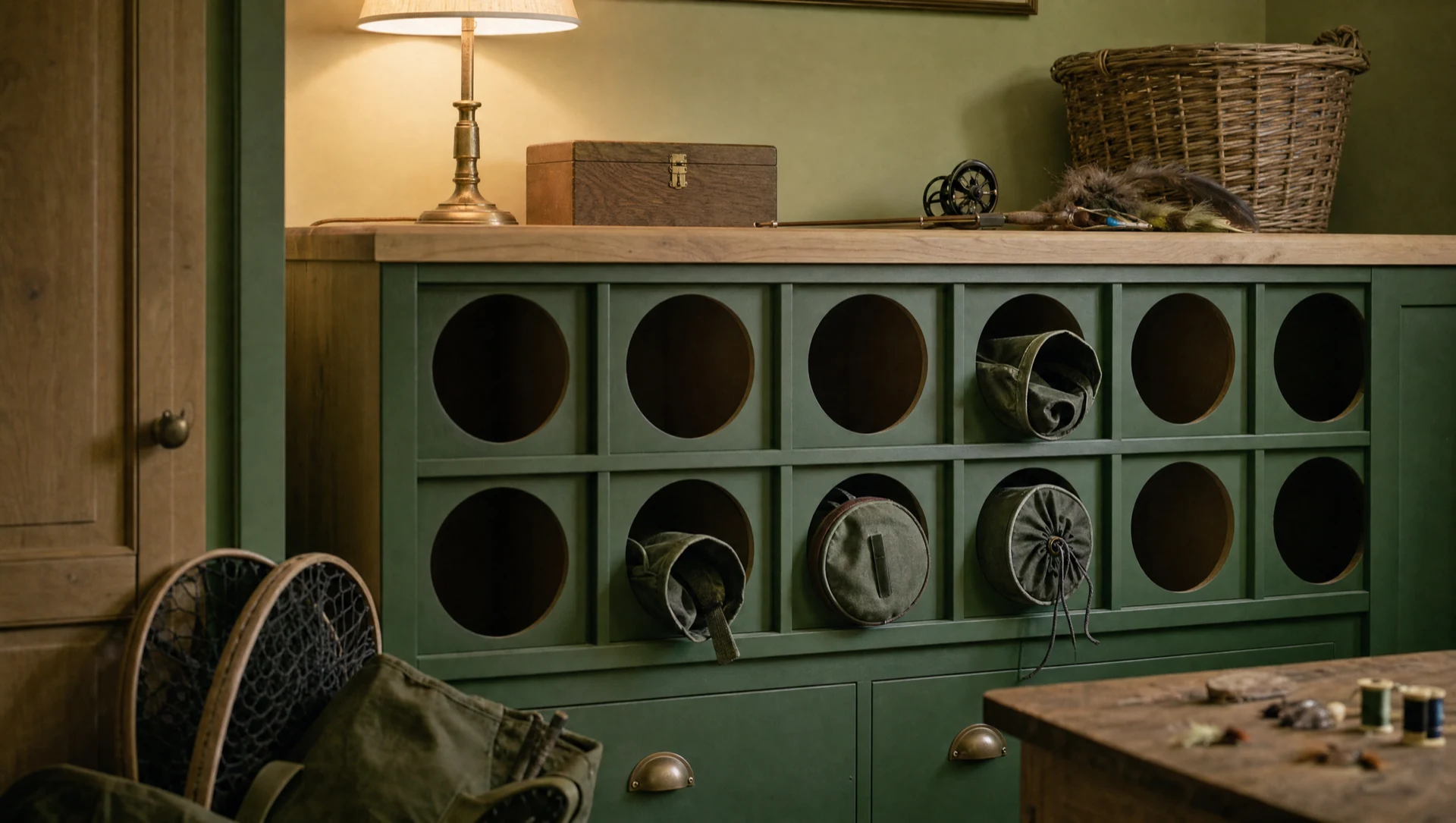
The safest for the rod and the least convenient for the angler, which is why tubes end up in a heap. Tubes rack beautifully because they are rigid, uniform and hard-wearing: a simple pigeonhole run does it, sized to your tubes rather than to a guess, with the labels facing out.
One thing worth knowing about tubes
A rod put away damp inside a sealed tube stays damp. Aluminium tubes in particular hold condensation, and the cork handle and any silk whipping are what suffer. If rods live in tubes, they want either drying before they go in, or a rack that lets the tubes stand with the caps off. This is the same problem as the one on the humidity and damp guide, in a smaller container.
Cane is a different problem
If there is cane in the collection, say so at the outset, because it changes the design.
Split cane takes and holds a set far more readily than carbon. Stored vertically for years on a warm wall it will bend, and it will not come back on its own. Cane also dislikes swings in humidity, which affect the glue lines and the varnish rather than the fibres.
So cane wants horizontal storage in cradles, well supported along its length, out of direct sun, away from a radiator, and in a room whose humidity is reasonably steady. If a collection is mixed, we usually rack the carbon vertically and give the cane its own horizontal run — different furniture in the same room, which is a perfectly good answer.
How we set a rack out
The same way we set out a gun rack, and from the same kind of list.
What we want to know is: how many rods, what lengths, whether they live made up or broken down or in tubes, whether any are cane, how many are two-piece against four-piece, whether reels stay on, and how many more you expect to own in five years. Everybody underestimates the last one.
From that we set the spacing rather than defaulting to it. Rings and reel seats are what dictate the gaps — a rod with a large stripping guide needs more room than one without, and a made-up rod with the reel left on needs a butt cup deep and wide enough to take the reel foot without the rod sitting proud.
Butt cups are lined, usually in felt or baize. Tip locators are lined too, and shaped so a rod drops in rather than needing to be threaded — a rack that requires aim is a rack that gets used carelessly.
How it is built
Quarter-sawn solid oak, walnut or mahogany, or a hardwood built for paint, made at our own bench in Suffolk and finished in our own finishing shop. Solid brass or bronze where there is ironmongery.
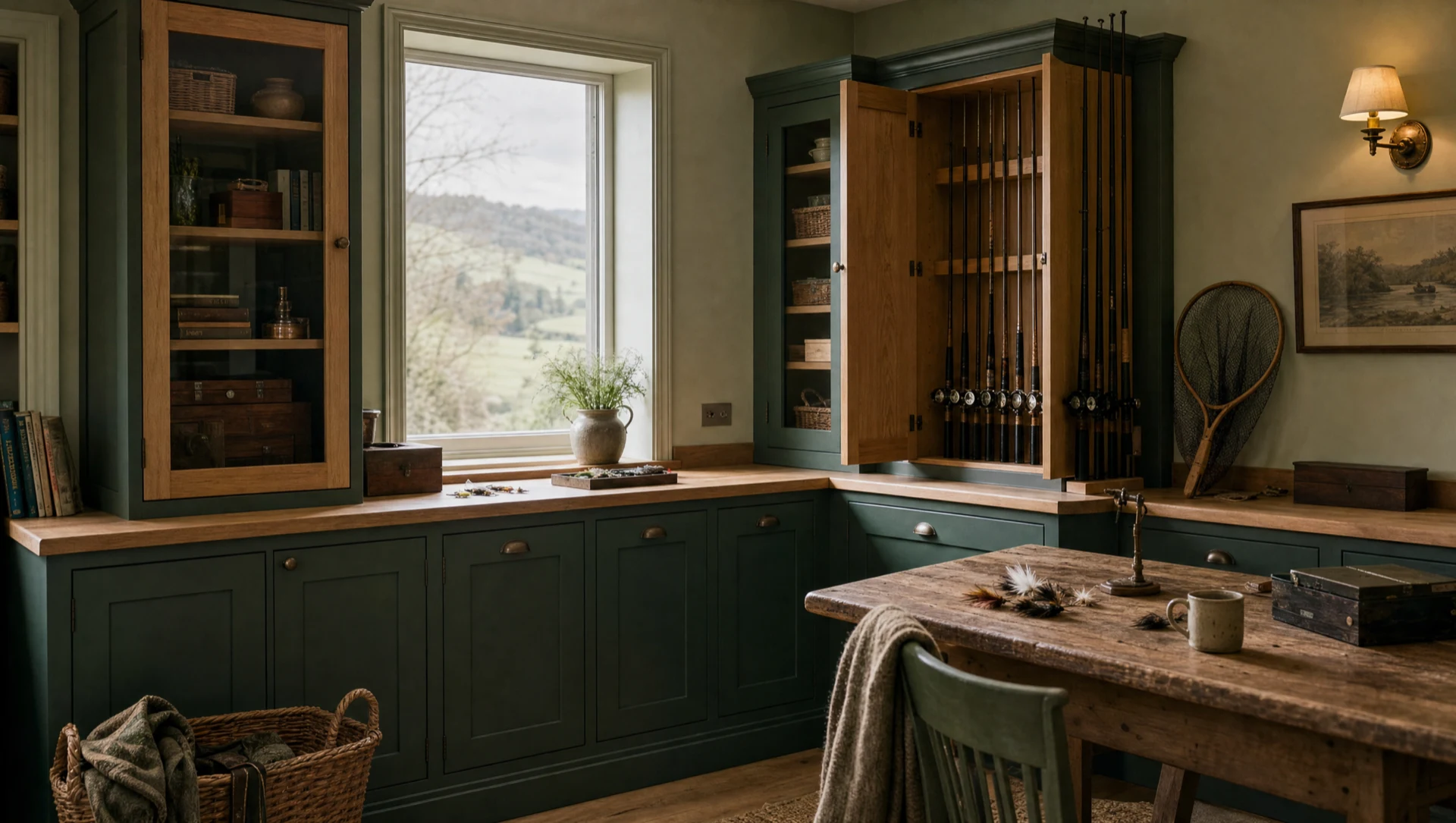
Rod racks are frequently part of a larger fitted room rather than a standalone piece — a run of racking over a bank of reel and tackle drawers, with wader storage at the wet end and a tying bench under the window. Drawn together, it reads as one room.
Where a fishing room adjoins a gun room, we build both in the same timber and the same finish and install them in one visit. The fishing room page sets out the whole thing.
Common questions
Should rods be stored vertically or horizontally?
Either, correctly done — the decision is usually made by ceiling height rather than preference. Vertical is the most compact by floor area and the quickest to use, but a made-up 10ft rod needs better than 10ft of clear height plus room to lift it in. Horizontal suits low rooms and long walls, and it is the kinder arrangement for cane. What matters in both is that the weight sits on the butt and the tip is located without carrying load.
Can rods be stored made up?
Yes, and it is the best argument for a rod room — a rod that lives made up is a rod that gets fished. It needs full length, clear height or clear wall, and enough spacing that the rings of adjacent rods do not touch. Two rods racked tight together will mark each other’s whippings and eventually the blanks.
Is split cane stored differently from carbon?
Yes, and it is worth telling us at the outset. Cane takes and holds a set far more readily than carbon, and it dislikes swings in humidity because of the glue lines and the varnish. Cane wants horizontal storage in cradles, well supported, out of direct sun and away from a radiator. On a mixed collection we often rack the carbon vertically and give the cane its own horizontal run.
Can I keep the reel on the rod in the rack?
Yes, if the rack is drawn for it. The butt cup needs to be deep and wide enough to take the reel foot without the rod sitting proud, and the spacing has to allow for the reel as well as the rings. Tell us at the start, because it changes the set-out rather than being an adjustment afterwards.
Is it bad to leave rods in their tubes?
It is the safest place for the rod and the least convenient for the angler, which is why tubes end up in a heap. The real risk is damp: a rod put away wet in a sealed tube stays wet, and aluminium tubes hold condensation, which affects the cork handle and any silk whipping. Either dry the rod before it goes in, or use a rack that lets tubes stand with the caps off.
Setting out rod racks: the figures
Rod racks are simple to make and easy to get wrong, and everything follows from one principle — no pressure on the blank, anywhere, ever. A rod supported at two points near its centre of mass keeps its action for a lifetime. A rod hanging by its tip, or wedged into a hole that grips it, takes a set within a season.
| Storage | Support points | Clear height needed |
|---|---|---|
| Made up, vertical, butt down | Butt cup + upper cradle at 1,400 mm | 2,900 mm for a 9 ft rod with room to lift |
| Made up, angled at 15° | Butt cup + cradle | 2,450 mm — the usual answer in a normal ceiling height |
| Made up, horizontal | Three cradles, evenly spaced | Wall run of 3,000 mm |
| Broken down, in bags | Vertical tubes, felt-based | 1,500 mm |
| In tubes | Horizontal, on runners | Depth of the longest tube + 150 mm |
Cradles are lined in napped wool and cut with a generous radius — the rod sits in them, it is not gripped by them. Butt cups are drilled deeper than they need to be so a wet cork butt can drain rather than stand in a puddle. Nothing in a rod rack should ever be a tight fit.
Cane, which is a different problem
Split cane takes a set far more readily than carbon and should be stored either fully horizontal on three supports, or vertical tip down in its bag and tube — the opposite of what most people assume. It also hates heat: a cane rod stored above a radiator or in a sunlit window will move within a season, and the varnish will go milky in humidity. Cane wants a cool, dark, dry, well-ventilated corner, which happens to be the same corner everything else in a fishing room wants.
Rods, tubes and travel
If you travel to fish, build for the tubes rather than the rods. A rack designed only for made-up rods means the tubes end up in the hall. We usually run a made-up rack at high level and a tube drawer or open bay beneath it, so the two live together.
Between waters, everything wants drying properly before it goes away — see Check Clean Dry. It is why our fishing rooms have a drying bay rather than a cupboard.
Send us your rod list
How many, what lengths, made up or in tubes, and whether any of it is cane. Plus a few wide photographs of the room. That is enough for us to draw a rack that fits your rods rather than an average.