
Finishes
The finish is the last five per cent of the work and the first thing anybody sees. It is also the part of the job that decides whether a new piece sits comfortably in an old room or looks like a new piece in an old room — and it is the reason we have our own finishing shop rather than sending work out.
On this page
Why it is done here
Three reasons, and the third is the one that matters commercially.
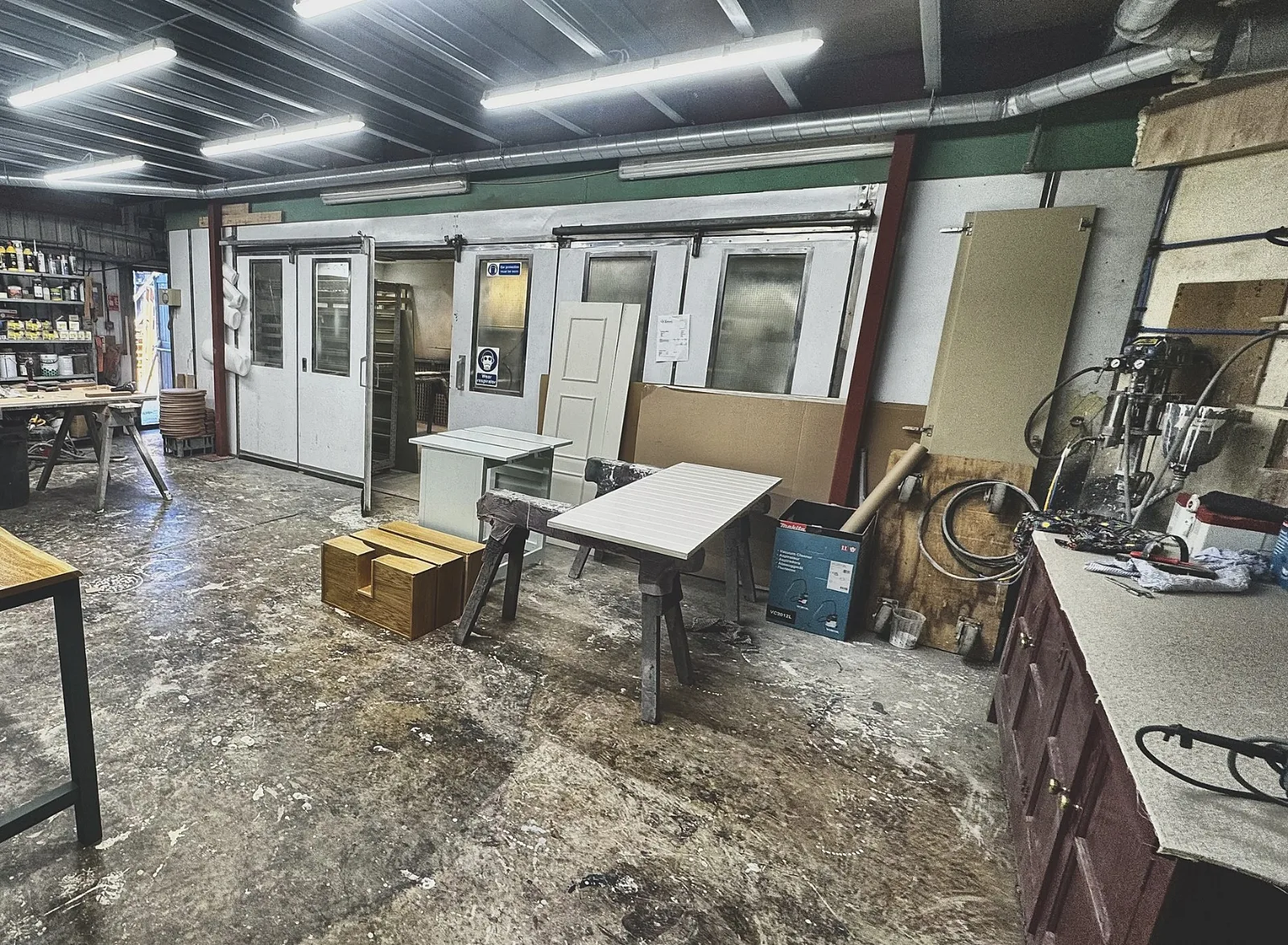
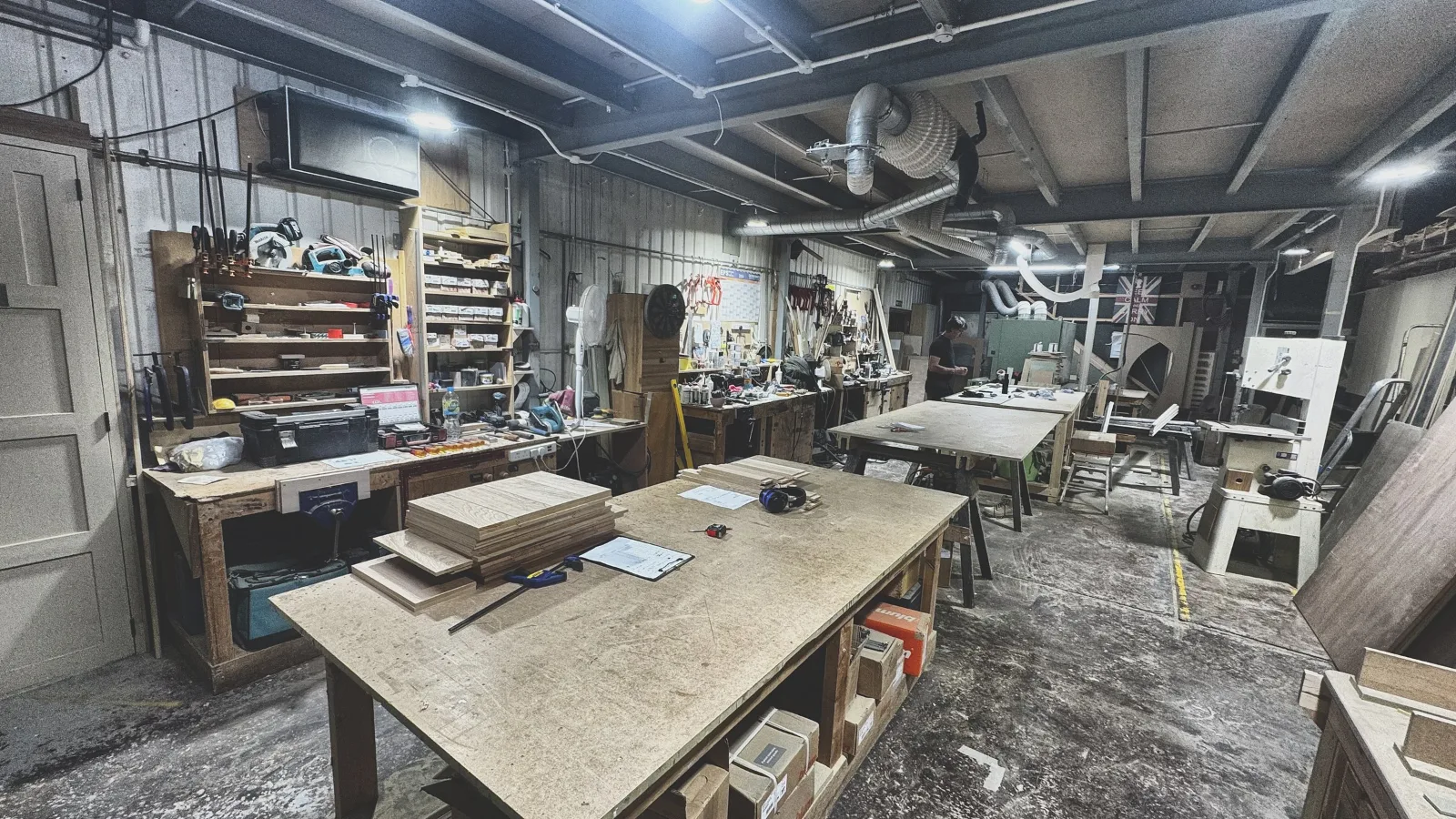
Dust. Airborne dust settling into a wet finish is the commonest reason a well-made piece comes out looking ordinary. The finishing shop is a separate space with its own spray booth, kept away from the machine shop, and that separation is not fastidiousness — it is the whole reason the surface is flat.
Time. A French-polished surface is built up over days. That is not a process that fits round somebody else’s schedule, and it is certainly not a process that happens in your house while a decorator waits.
Accountability. Matching an existing finish is the last ten per cent, and it is a person standing between two pieces, adjusting. You cannot subcontract that and then guarantee it. Because our polisher does it, we can promise a match — and mean it.
French polish
Shellac, applied by hand with a rubber, built up in many thin passes over days and then bodied and spirited off.
It is the deepest finish available to a cabinetmaker. Light goes into a French-polished surface and comes back out of it, which is why a polished mahogany door looks like it has depth and a lacquered one looks like it has a coating. On figured walnut it is transformative.
Two further properties people do not expect:
- It repairs. A mark or a scratch can be worked back in and made invisible, because each new application melts into the last. Modern lacquers cannot do this — damage means stripping a panel.
- It ages properly. It mellows rather than degrades, which is why two-hundred-year-old polished furniture still looks right.
Against it: it is not the toughest finish in the world. It dislikes standing water, alcohol and heat, and it is the wrong answer for a surface that will be worked on hard. On a gun cabinet — a piece that is opened and closed rather than written on — that is rarely a constraint.
Hand-oiled
A lower sheen, applied and worked back by hand, building slowly in the timber rather than on it.
Oiled oak is the most forgiving finish in a working room. It shows the grain honestly, it takes handling and knocks without showing them, and — the real advantage — you can touch it up yourself. A mark on an oiled surface is a matter of a rag and ten minutes rather than a phone call.
It is the finish we most often recommend for a cabinet that lives in a boot room, a back hall or a working gun room, and for any piece a wet dog will pass twice a day. It is also correct in a modern interior, where the depth of French polish can read as too formal.
Hand-painted
On hardwood prepared for paint, with the grain filled properly, so the finished surface reads as painted furniture rather than as painted board.
The work is almost entirely in the preparation: filling, sanding, priming, sanding again, until the surface is genuinely flat. Paint hides nothing — it shows every ridge and every telegraphed joint far more than a clear finish does, which is why a wide painted panel is one of the few places we will use an engineered core.
Colour is matched to a physical sample or to a named paint reference from a named manufacturer. We will not match a colour from a photograph or a screen. Screens differ, daylight differs, and a colour that is nearly right on a large panel is worse than one that is deliberately different.
Painted work suits a modern country house scheme, a boot room, and any room where the joinery is meant to recede rather than announce itself — and it is materially less expensive than figured timber, which makes it the sensible reduction if budget is the constraint.
Painted work is what most boot rooms end up in, for the reason that it can be touched in where a boot has caught it. There is more on that in boot rooms and dog rooms.
Antiquing
Done by hand, and done sparingly.
The purpose is narrow and specific: to stop a new piece from rejecting an old room. In a house where every other surface has two hundred years of wear, a perfectly crisp new cabinet sits in the room like a shout. Softening the arrises, taking the edge off the sheen and easing the colour lets it belong.
The failure mode is overdoing it. Distressing applied by the yard — simulated worm, dents in improbable places, a wash of dark glaze in every corner — looks like exactly what it is, and it looks worse than a new piece honestly finished. We do the least that works, and we would rather you told us it needed more than have to undo it.
Oak takes antiquing better than any other timber, which is one more reason it is the default.
Matching an existing finish
The hardest thing we do, and a large part of what we are asked for.
A forty-year-old finish has a colour that has shifted, a sheen that has been worn unevenly, and a surface that has been handled in some places and not in others. Reproducing that on new timber is a sequence of judgements, each made in front of the actual piece.
What we need, in order of usefulness
1. A physical sample. An offcut, a spare length of moulding, a drawer front, a door taken off a cupboard nobody uses. Worth more than everything below it put together.
2. A named paint reference. Manufacturer and colour name, not a guess.
3. Photographs. Taken in daylight, without flash, close up on the mouldings and wide for context.
Where we cannot have a sample, we will make up finish samples and send them to you to look at in the actual room, in the actual light, before we commit the piece.
Choosing between them
| If the room is… | Consider |
|---|---|
| Period, formal, mahogany or walnut | French polish. Nothing else has the depth |
| A working gun room, boot room or back hall | Hand-oiled. Forgiving, and you can touch it up yourself |
| Painted throughout | Hand-painted on hardwood, grain filled |
| Old enough that new looks wrong | Antiqued oak, done lightly |
| Modern, with figured timber as the feature | Oiled, or a low-sheen polish. Let the figure do it |
| Matching existing joinery | Whatever the existing piece is. Send us a sample |
Living with each one
- French polish. Dust with a soft dry cloth. Wax occasionally if you like, sparingly. Keep standing water, alcohol and hot things off it. Damage can be worked back in — ring us rather than trying it with a proprietary product.
- Oiled. A wipe with a barely damp cloth, dried off. Re-oil a working surface every year or two, or when it starts to look thirsty. You can do this yourself and we will tell you what to use.
- Painted. A barely damp cloth. Avoid solvent cleaners entirely — they will take the sheen off before they take the mark off.
- Glass. Damp cloth then dry. Solvent cleaners run down onto the timber below the glass and will take the finish off the bottom rail over a few years, which is a slow and irritating way to spoil a door.
Care instructions go out with every piece, written for the finish you actually have rather than as a generic sheet.
Questions we are asked
What is French polish, and is it worth it?
Shellac applied by hand with a rubber, built up over days. It gives a depth no sprayed lacquer reaches, it mellows rather than degrades, and — unusually — it can be repaired invisibly because each application melts into the last. It is worth it on mahogany, on figured walnut and on anything period.
Which finish is most hard-wearing?
Hand-oiled is the most forgiving in a working room: it takes knocks without showing them and you can touch it up yourself with a rag. French polish is deeper and repairable by us but dislikes standing water, alcohol and heat.
Can you match our existing paint colour?
Yes, from a physical sample or a named manufacturer and colour name. We will not match a colour from a photograph or a screen — daylight and displays differ too much, and nearly right on a large panel is worse than deliberately different.
Can a new cabinet be made to look old?
Yes, by hand-antiquing — softening the arrises, easing the sheen and adjusting the colour so a new piece does not shout in a two-hundred-year-old room. Done sparingly. Overdone distressing looks exactly like what it is.
Why not just spray a modern lacquer?
Sometimes we do, where it is the right answer. But lacquer sits on the timber rather than in it, it cannot be repaired invisibly, and it does not age — it degrades. On a piece expected to be in the house in fifty years, that matters.
Is the finishing done on site?
No, and we avoid it wherever possible. Dust settling into a wet finish is the commonest reason a good piece looks ordinary. Everything is finished in our own finishing shop before it is delivered.
French polish, solvents and a properly run finishing shop
Finishing is the part of joinery with the real health risk in it, and a shop that takes it seriously is usually a shop that takes everything else seriously too. Ours has a booth with its own extraction, forced-air masks rather than cartridge respirators for spray work, and a COSHH assessment on file for every product we hold. That is a legal requirement under the Control of Substances Hazardous to Health Regulations rather than a virtue, but a surprising number of small shops do not do it.
It matters to you for two practical reasons. The first is that a shop with proper extraction has clean air, and clean air is what stops dust landing in a wet finish — the single most common reason a panel has to be flatted back and done again. The second is that our polisher is an employee working in a controlled space, which is why we can offer french polish at all. It is a slow, solvent-heavy process that almost nobody now does in house, and it is the reason we can match an existing finish rather than approximate it.
Living with each finish
| Finish | Repairable in situ | Water tolerance | Expect to refresh |
|---|---|---|---|
| French polish | Yes, completely | Poor — mark it and it shows | Every 15–25 years, or spot-repair as needed |
| Hand-oiled | Yes, easily | Good | Every 2–5 years, by you, in an hour |
| Hand-painted | Locally, with care | Very good | Every 15–20 years in a busy room |
| Lacquer | No — it comes off and goes back on | Excellent | Rarely, but a full strip when it goes |
If a gun room is unheated or seasonally damp, say so before we choose. French polish is the wrong finish for a room that swings, and we would put you into an oiled finish and tell you why.
Matching an existing finish
This is the thing having a polisher in the building actually buys you. Where a new piece has to sit beside eighteenth-century panelling or a run of joinery someone else made twenty years ago, we take a sample away at survey — an offcut, a drawer front, occasionally a photograph and a colour reference if nothing can be removed — and the match is worked up on the actual timber the piece will be made from, under the light it will be seen in.
It usually takes three or four attempts and it cannot be done from a chart. Nor can it be done by a spray shop working from a code, which is why most makers approximate rather than match.
Send us a sample, not a photograph
An offcut, a spare moulding or a drawer front from a cupboard nobody uses is worth more than any number of pictures — and it is the difference between a match and an approximation.
Order timber and colour samples — £10 each, posted free.