
Cartridge Storage and Wellington Chests
Cartridges are the heaviest thing in a gun room and the least thought about. A drawer that runs sweetly when it is empty is a completely different object with a slab in it — which is why cartridge storage is an engineering problem dressed as a piece of furniture.
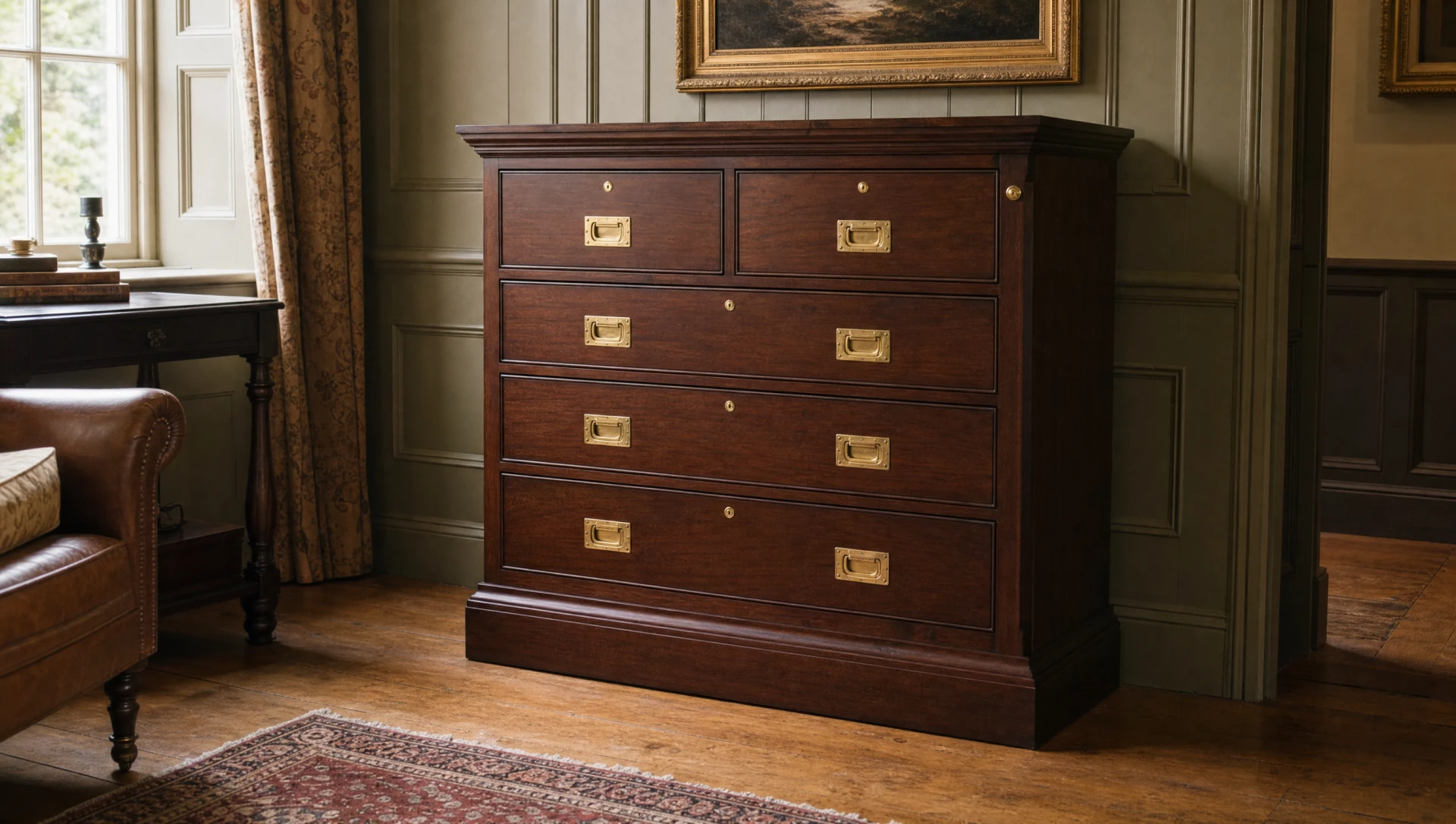
Almost every cartridge drawer we are asked to replace has failed the same way. The runners were specified for the drawer box rather than for the load, the drawer was long and shallow, and there were no divisions — so the boxes slid, the drawer racked, and within two seasons it needed lifting to open.
On this page
The Wellington chest
A Wellington chest is a tall, narrow chest of drawers with a hinged locking stile down one side which, when closed and locked, secures every drawer in the piece at once. It is a nineteenth-century English form, and it turns out to be almost perfectly suited to cartridges.
Why it works here:
- Narrow and tall — short drawers rather than long ones, which is exactly what a heavy load wants.
- Many drawers — the load is divided, so no single drawer is unmanageable.
- One locking action — the stile secures the whole bank, which is a genuinely elegant piece of design.
- It reads as furniture — nobody looks at a Wellington chest and thinks about ammunition.
- It fits where nothing else does — a narrow return, a landing, the end of a run.
We make it as the original was made, with the locking stile working properly rather than being an applied moulding, and then build the specification behind it — 3mm (0.12in) steel, 8-lever safe locking to EN 1300 Class A, anchored into masonry. It is one of the more satisfying things we build.
Designing for the load
The whole page comes down to this section.
- Runners sized for a full drawerFull-extension, heavy-duty, rated well above what the drawer will actually carry. This is not the place to save money, and it is the first thing to fail when somebody has.
- Short and deep, not long and shallowA long drawer full of cartridges racks in its opening and binds. A shorter, deeper drawer carries the same weight and keeps running.
- Load taken by the carcassRunners carried on rails fixed back into the carcass frame, so the drawer sides are not doing structural work.
- Drawer boxes made properlyDovetailed, in solid timber, with a bottom that is fitted rather than pinned on. A stapled drawer box under load comes apart at the front corners.
- Stops that stopA loaded drawer pulled fast has real momentum. Ours are timber, positive, and fixed to the carcass.
- The floor consideredA full chest is heavy. On a suspended timber floor we will ask what is underneath before we set the position.
Divisions and depth
Divisions are not tidiness, they are structure. Boxes that stand squarely against a division do not slide; boxes that slide turn into a heap, and a heap is what jams a drawer and bruises a drawer front from the inside.
We set drawer widths and divisions to standard cartridge box dimensions, so a slab stands without wedging and without a gap. Depths are set so nothing is stored two deep — anything you cannot see when the drawer is open is something you will forget you own.
Where you hold more than one load, we mark positions discreetly. Knowing what is in which drawer without opening three of them is worth more than it sounds on a dark morning.
Locking
Cartridge and ammunition storage is separately locked from the firearms, with its own lock, so that securing one does not depend on securing the other. On a Wellington chest that is the locking stile; on a drawer bank it is a single locked front or an individually locked unit.
Where your certificate carries a specific condition about ammunition — and conditions vary between forces and between certificates — send us the exact wording and we will build to it rather than to an assumption. There is more on that on ammunition cabinets.
Responsibility for meeting the security condition on your certificate rests with you as the certificate holder, and the adequacy of any storage arrangement is a matter for your local police firearms licensing department. We agree the specification with your firearms enquiry officer before we make anything — see the FEO process. Nothing on this page is legal advice.
Other forms
| Form | Suits |
|---|---|
| Wellington chest | The classic. Narrow, tall, one locking action, reads as furniture |
| Locked base cupboard beneath a gun cabinet | The most common arrangement. Guns above, cartridges below, out of sight |
| Drawer bank within a run of fitted cabinets | Uses the low part of a run where a gun will not stand anyway |
| Under-bench drawers in a gun room | Where the cleaning table is. Cartridges where you load slips |
| Window seat or blanket box with a lifting top | Discreet, and it uses a space that is otherwise decorative |
| Standalone chest in a different room | Where quantity or separation calls for it |
Sizing it, honestly
The commonest sizing mistake is designing to what is on the shelf in June rather than to what arrives in September.
So we ask three questions instead of one. What do you hold now? What do you hold at the peak, after a bulk order and before the season? And does anyone else’s ammunition live here — a spouse’s, a son’s or daughter’s, or a guest’s during a shooting weekend, each of which may sit under a different certificate?
Then we build to the peak, with headroom. An extra drawer at drawing stage costs very little. A second chest in three years costs a great deal, never quite matches the first, and leaves you with two pieces where you wanted one. The intermediate state is worse still: provision that is technically adequate and visibly crammed, which is exactly the impression you do not want to give at renewal.
One further question worth answering before we draw: do you buy in slabs and store them as slabs, or break them down into boxes? The two produce different drawer depths and different divisions, and it is much cheaper to know now.
Everything that is not a cartridge
The other reason to build proper drawers is that a sporting house generates an enormous amount of small, heavy, easily-lost equipment, and it all ends up in the same place.
- Chokes, keys and tools — a shallow lined drawer near the top, divided, because these are the things that vanish.
- Ear defenders and glasses — a drawer near the door, since that is where you will be standing.
- Cleaning kit — rods, jags, brushes, mops. Kept away from the cartridges and away from the guns.
- Oils and solvents — separately, ventilated, and not above anything you care about.
- Slips and covers — hanging rather than folded, so they dry.
- Paperwork — certificates, insurance schedule, and the signed specification sheet we hand over.
Line the drawers you open most in felt or baize. It costs very little, it is quiet, and it is the sort of detail people notice for twenty years.
Timber and finish
Quarter-sawn solid oak, walnut or mahogany, or a hardwood built for paint. On a chest the drawer fronts are the piece, so where the timber is figured we set out the fronts in sequence from the same board, so the grain runs down the front of the chest rather than jumping between drawers. It is a small piece of extra work and it is the difference between a chest and a stack of drawers.
Handles are solid brass or bronze — traditionally sunken or inset on a Wellington chest, which is correct and also practical, since a proud handle on a narrow chest catches sleeves. Finishes run from French polish through hand-oiled to hand-painted and hand-antiqued, all applied in our own finishing shop.
Where it goes
Away from heat and away from damp: not above a radiator, not in an airing cupboard, not against a flue, not in a south-facing bay. Gentle background temperature and air movement rather than warmth and a seal — the same conditions that suit guns. Our cabinets are ventilated internally as standard, and there is more on this on humidity, damp and blued steel.
And somewhere you will actually use. A cartridge chest at the far end of the house is a chest you will work around rather than with. The best position is usually on the route out — near the gun cabinet, near the door, near where slips get loaded.
Questions we are asked
What is a Wellington chest?
A tall, narrow nineteenth-century English chest of drawers with a hinged locking stile down one side which, when closed and locked, secures every drawer at once. Its short drawers and divided load make it very well suited to cartridge storage, and it reads as furniture rather than as storage.
Why do cartridge drawers stop running?
Weight, almost always. Runners specified for the drawer box rather than the load, long shallow drawers that rack in their opening, and no divisions so boxes slide into a heap. The fixes are heavy-duty full-extension runners, shorter deeper drawers, divisions set to cartridge box sizes, and the load carried by the carcass.
Does cartridge storage need to lock?
Ammunition storage is separately locked from the firearms as standard on everything we build, with its own lock. Where your certificate carries a specific condition about ammunition, send us the exact wording and we will build to it.
How much cartridge storage should I allow?
More than you first think. We ask what you hold and what you hold in season — the second figure is routinely underestimated, and oversizing the drawers at drawing stage costs very little.
Can it match our existing furniture?
Yes. Timber, mouldings, handles and finish are all matched, and on figured timber we set drawer fronts out in sequence from the same board so the grain runs down the chest. Send a physical sample where you can rather than a photograph.
Where should a cartridge chest go?
Away from heat and damp, and somewhere on the route out — near the gun cabinet and near where slips get loaded. A chest at the far end of the house is one you work around rather than with.
Cartridge storage: the weights, written down
Almost every failure we are asked to replace is a weight failure, so it is worth setting the figures out plainly. A slab of 250 twelve-bore game cartridges weighs a little over 10 kg. A drawer holding four slabs is therefore carrying more than 40 kg before you add the drawer itself, and a bank of five such drawers is loading a carcass with over 200 kg. That is a structural problem dressed up as a piece of furniture.
It is why cartridge storage in our work uses solid-timber drawer sides at 16 mm rather than the 12 mm normal in cabinetwork, drawer bottoms housed and glued rather than pinned, and full-extension runners rated at 45 kg minimum with the deeper drawers moved to 60 kg. The carcass is dovetailed, not dowelled, and the back is housed into a rebate so the case cannot rack under load.
| Drawer depth | Typical capacity | Loaded weight | Runner rating we use |
|---|---|---|---|
| 100 mm | 2 slabs, laid flat | ≈ 22 kg | 45 kg |
| 150 mm | 4 slabs | ≈ 44 kg | 45 kg |
| 200 mm | 6 slabs | ≈ 65 kg | 60 kg |
Deep drawers are a trap. A 300 mm drawer will take nine slabs and weigh 100 kg, at which point nobody can open it comfortably and the runners will not last. We would rather give you two shallow drawers than one deep one, every time.
Storing cartridges so they are still good next season
Modern cartridges are far more tolerant than they are given credit for, but two things do shorten their life: heat and repeated cycling between damp and dry. A cartridge drawer in an unheated outbuilding, or in a boot room that swings from 4°C overnight to 20°C by lunchtime, will produce the occasional soft primer strike within a few seasons. The same cartridges in a drawer in a stable, gently heated room will still be perfectly good in a decade.
Which is a long way of saying that cartridge storage belongs in the house, in the gun room, and not in the garage — and that if the gun room is a lined room, the ventilation and background heat described on our lighting, heating and ventilation page matter to the cartridges as much as to the guns. The Home Office Firearms Security Handbook is silent on shotgun cartridges, which are not required to be locked away at all — but most people prefer them to be, and a locked drawer costs nothing extra to build.
In the standard range
The Orwell is our Wellington chest published with its sizes and prices, in six or eight graduated drawers, and The Brett is the low chest for cased guns lying flat. Both are made to the same cornice and plinth as the cabinets — see the standard range.
Tell us what you hold in season
That figure, plus a photograph of where it would live and any furniture we would be matching, is enough for us to draw something and price it.
For how cartridge and ammunition storage is usually separated from the guns, see our guide to ammunition, cartridges and separate locking.
>