
What to Ask Any Gun Cabinet Maker
Nine questions. Ask them of us, and ask them of everyone else you are talking to. We have written the page this way round because on most of them we are confident, and on the two where the honest answer is “it depends”, we would rather say so than pretend.
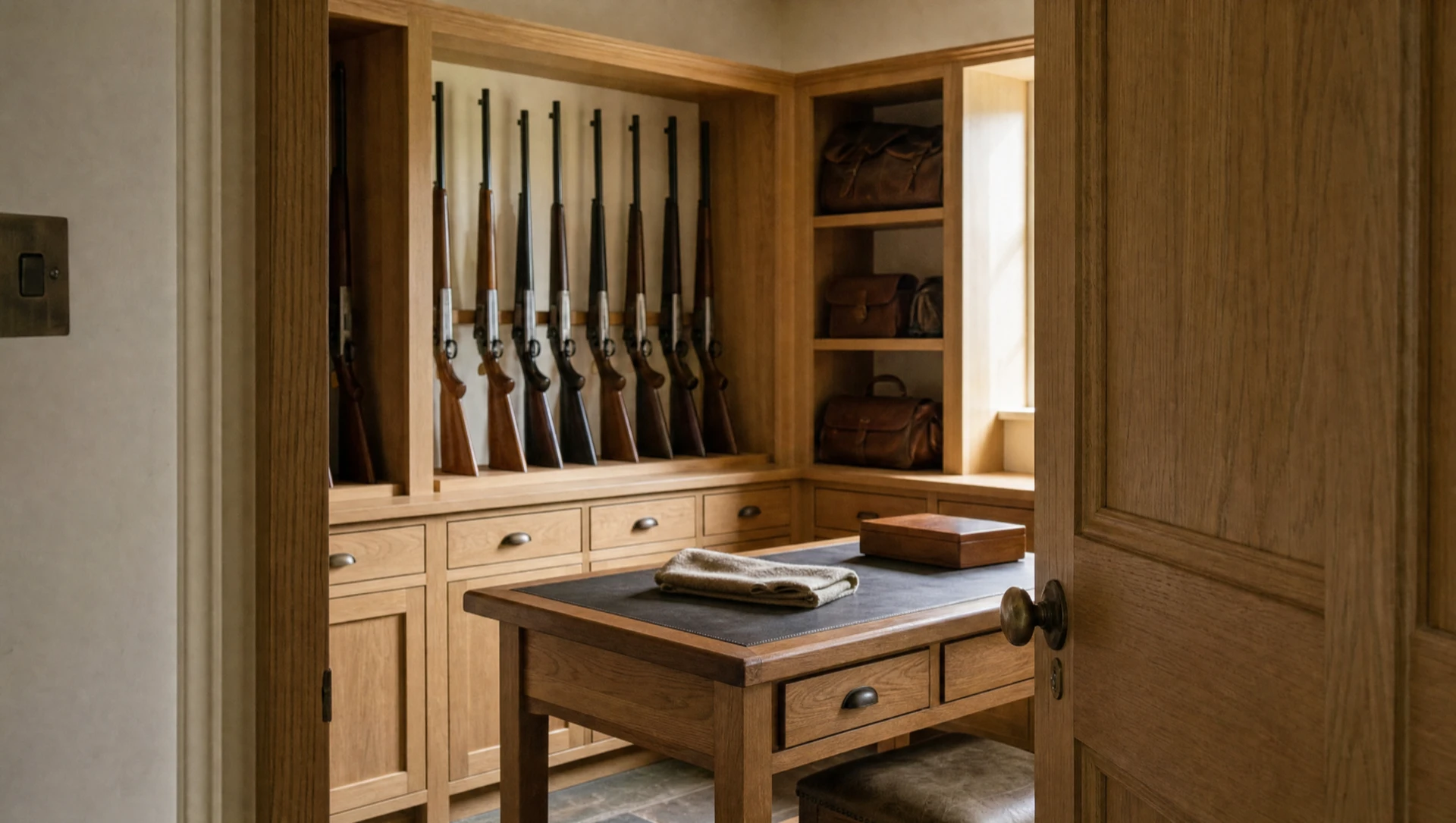
Download these questions as a printable comparison sheet — our answers printed, two blank columns for the makers you are pricing against.
Comparing bespoke quotations is genuinely difficult. Everybody’s photographs look similar, everybody says handmade, and the words used to describe security — heavy-duty, high-security, virtually impregnable — are adjectives rather than facts. These questions produce facts.
The nine questions
- 1. What is the thinnest panel?
- 2. How is the hinge side secured?
- 3. Is the glass laminated, and how thick?
- 4. Does one key open everything?
- 5. Is ammunition separately locked, or optional?
- 6. Who fixes it to the wall, and into what?
- 7. Will you speak to my FEO before you make it?
- 8. What paperwork comes with it?
- 9. Who actually makes it, and where?
- Why ask any gun cabinet maker these at all
1. Not “how thick is the steel” — what is the thinnest panel?
This is the question, and almost nobody asks it in this form.
Cabinets are routinely described by their heaviest single component: a thick front, or a thick door. That tells you very little, because an attack does not politely choose the strongest face. If any panel of the enclosure — sides, back, top, base — is lighter than the headline figure, that panel is the real specification.
So ask for the thinnest panel, in millimetres, and ask whether the figure covers the whole enclosure or one face.
It is common to see a specification written as a heavier front over a lighter body — a 6mm (0.24in) front on a 3mm (0.12in) body, for instance. A heavier front is a real improvement to that one face, and we would not pretend otherwise. But it does not change what the sides, the back, the top or the base are, and those are the faces most likely to be reachable in a cupboard, an eaves space or against a stud wall. The number worth comparing is the smallest one.
Ours: 3mm mild steel (0.12in) throughout the lined carcass, formed and reinforced at the corners, with folded doors. Not a steel back panel, not a heavy front on a light box — the whole enclosure, and the thinnest panel is the same as the thickest.
2. How is the hinge side secured?
A door held only on the lock side has, in effect, been designed to be opened from the other one. Hinges can be attacked, and on a cabinet the hinge edge is often the least considered part of the whole piece.
The answer you want to hear is a folded return behind the frame — fixed steel pins on the hinge edge that engage into the frame as the door closes. They carry no load and do nothing in normal use. If the hinges are cut, drilled or removed, the door still cannot come away.
They cost very little. Every door we fit has them. If the answer to this question is “the hinges are very strong”, that is not the same answer.
3. Is the glass laminated — and how thick, in millimetres?
Glazed cabinets are frequently described with a phrase rather than a figure: reinforced, anti-bandit, security glass. Ask for the construction and the thickness.
The distinction that matters is laminated versus toughened, and they fail in opposite ways.
| Toughened | Laminated security | |
|---|---|---|
| How it fails | All at once, into small pieces | Cracks and stays in the frame |
| Afterwards | The aperture is completely open | The interlayer still resists |
| Sustained attack | One good blow | Designed to keep resisting |
Ours: laminated security glass, 26mm (1in) as standard. It is heavy and expensive, and it forces a heavier door frame and heavier hinges behind it — which is precisely why so few glazed cabinets are built this way.
4. Does one key open everything?
Ask specifically whether the locks are keyed alike — that is, whether a single key operates every lock on the piece.
Keyed-alike is convenient, and convenience is the whole argument for it. But it means one key opens the top, the bottom and, on many cabinets, the ammunition drawer as well. A key left in a coat pocket, lost on a shoot day, or copied, opens all of it. And it removes the separation between firearms and ammunition that the rest of the design is supposed to provide.
Ours: 8-lever safe locks to EN 1300 Class A, rated VdS Class 1 — with each bay locking independently on multi-bay cabinets, and ammunition always on its own separate lock. A single key turn should not open everything you own, and a lost key should mean replacing one lock rather than all of them.
Worth noting too that a lever count is a description of how a lock is built, while EN 1300 and VdS are tests of the finished lock against picking, drilling and force. A lock can be honestly described as five-lever, or eight-lever, and be nowhere near a certified safe lock.
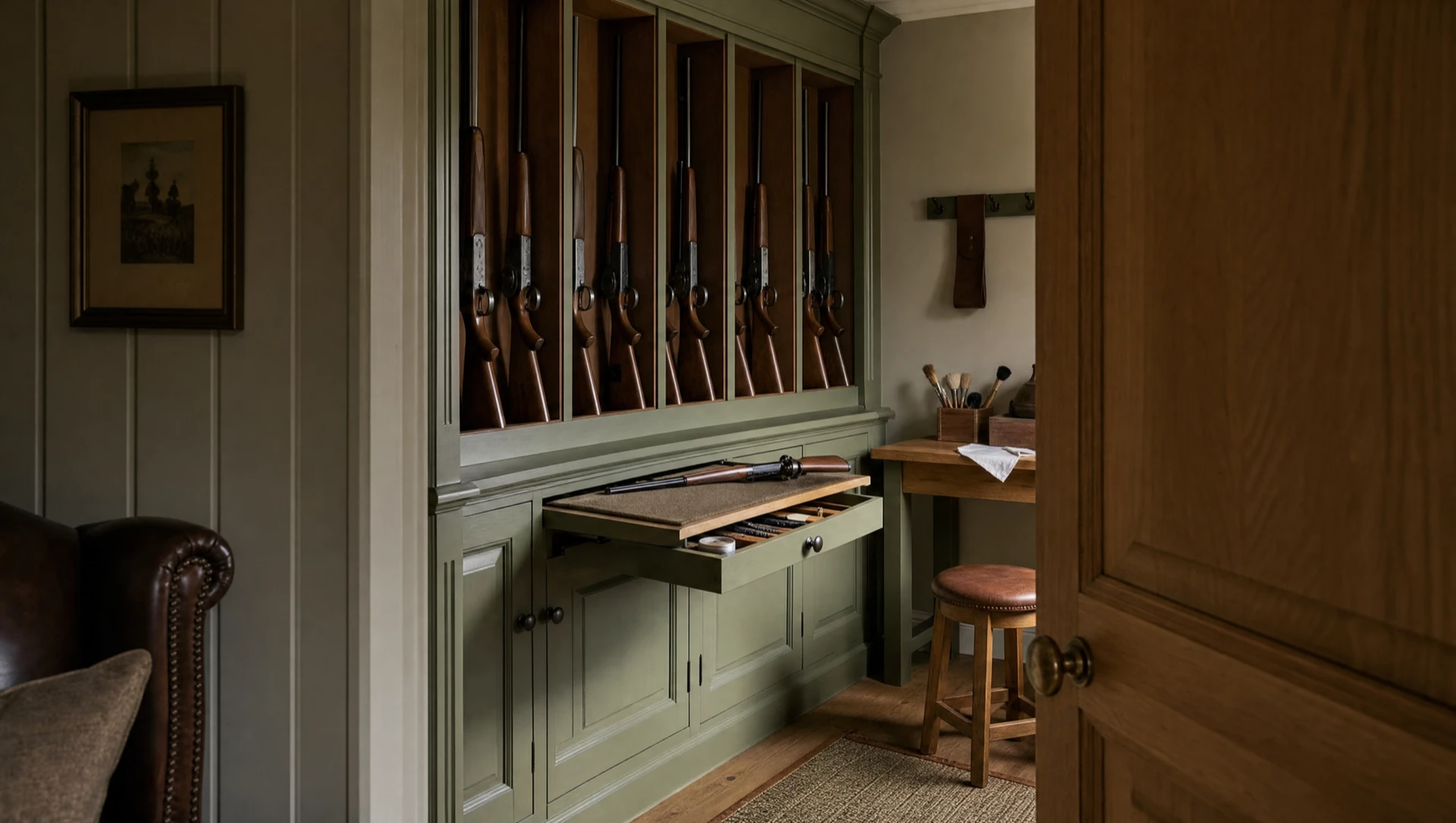
5. Is ammunition storage separately locked — and is it standard or optional?
Two separate questions inside one, and both matter.
Separately locked means its own lock, so that securing the ammunition does not depend on securing the firearms. Not a shelf. Not a drawer that opens when the cabinet opens. Not a compartment on the same key.
Standard or optional tells you how the maker thinks about it. Where separate ammunition provision is an extra, it is being treated as an accessory rather than as part of the design.
Ours: a separately locked ammunition compartment, with its own lock, in every cabinet and every room we build. It is not an option and it is not an upgrade. And where your certificate carries specific wording about ammunition, send us the wording and we build to it rather than to a general assumption.
6. Who fixes it to the wall, and into what?
A large part of the security of a cabinet is how it is attached to the building. A cabinet that can be removed from the wall is a cabinet that can be opened somewhere quieter, with more time and better tools.
So ask three things: who does the fixing, what the anchors go into, and at what centres.
Be alert to two answers in particular. “The cabinet has holes in the back for fixing” describes the cabinet, not the installation. And a fitting service offered “if you require it” means delivery-only is the default — which puts the most important part of the job onto you or a local handyman.
Ours: every cabinet is delivered and installed by our site team and mechanically anchored into masonry, or into located structural timber with backing added where needed, with floor fixings as well on tall or heavy pieces. Plasterboard is not a fixing. Anchor type and fixing centres are recorded and handed to you in writing. We do not sell delivery-only.
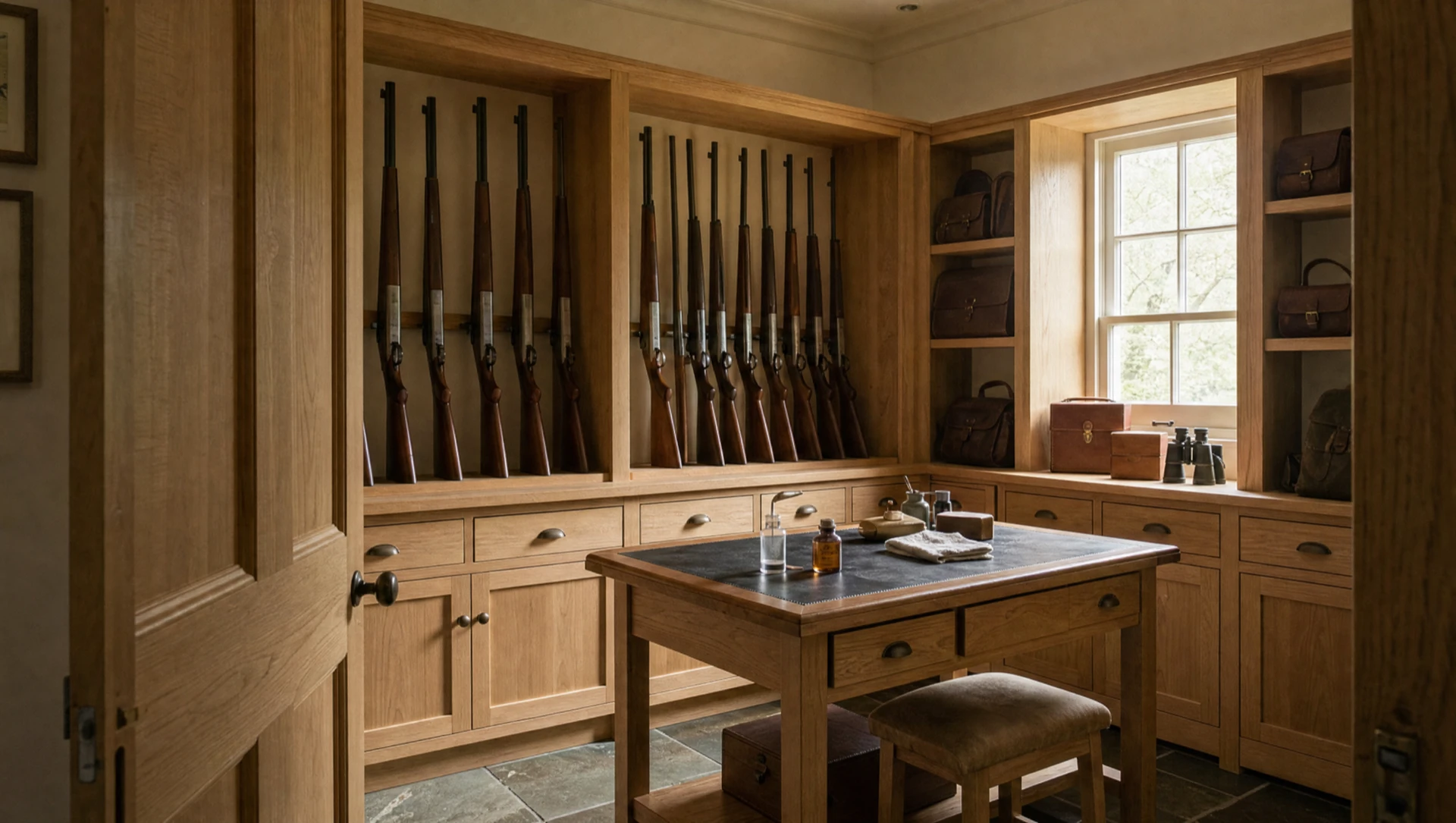
7. Will you agree the specification with my firearms enquiry officer before you make it?
The most useful question on this page, and the one that most reliably separates one supplier from another.
Most cabinets are sold, made, delivered, and only then presented to an FEO. At that point any disagreement is expensive and awkward, and the person holding the problem is you — because the condition sits on your certificate, not on the maker’s business.
Ours: we set the proposed specification out in writing — steel thickness, glass, lock model, fixing type and centres, ammunition provision, and where in the property it is going — and agree it with your licensing department before anything is made. It costs a telephone call.
While you are on the subject: “police approved”
There is no police approval scheme for gun cabinets in the United Kingdom. No force approves products, and no manufacturer can be approved by one. Your firearms enquiry officer assesses the arrangement at your address — the steel, the lock, the fixings, the property and its circumstances.
The phrase is used widely in this trade, in forms ranging from “police approved” to “designed to meet police approval”. It means nothing, and a supplier using it is telling you something about how carefully they write.
8. What paperwork comes with it?
Ask what you will actually be handed on the day.
If nobody is willing to write the specification down, consider why. A maker confident in what they have built has no reason not to put it on paper — and you will want it twice: once for your FEO, and again for your insurer, who increasingly asks for detail rather than a photograph.
Ours: a signed specification sheet stating steel thickness, glass specification, lock model, fixing type and fixing centres; drawings as installed; and care instructions written for the finish you actually have. On a gun room, photographs of the steel lining before cladding — the only record that will ever exist of what is behind the timber.
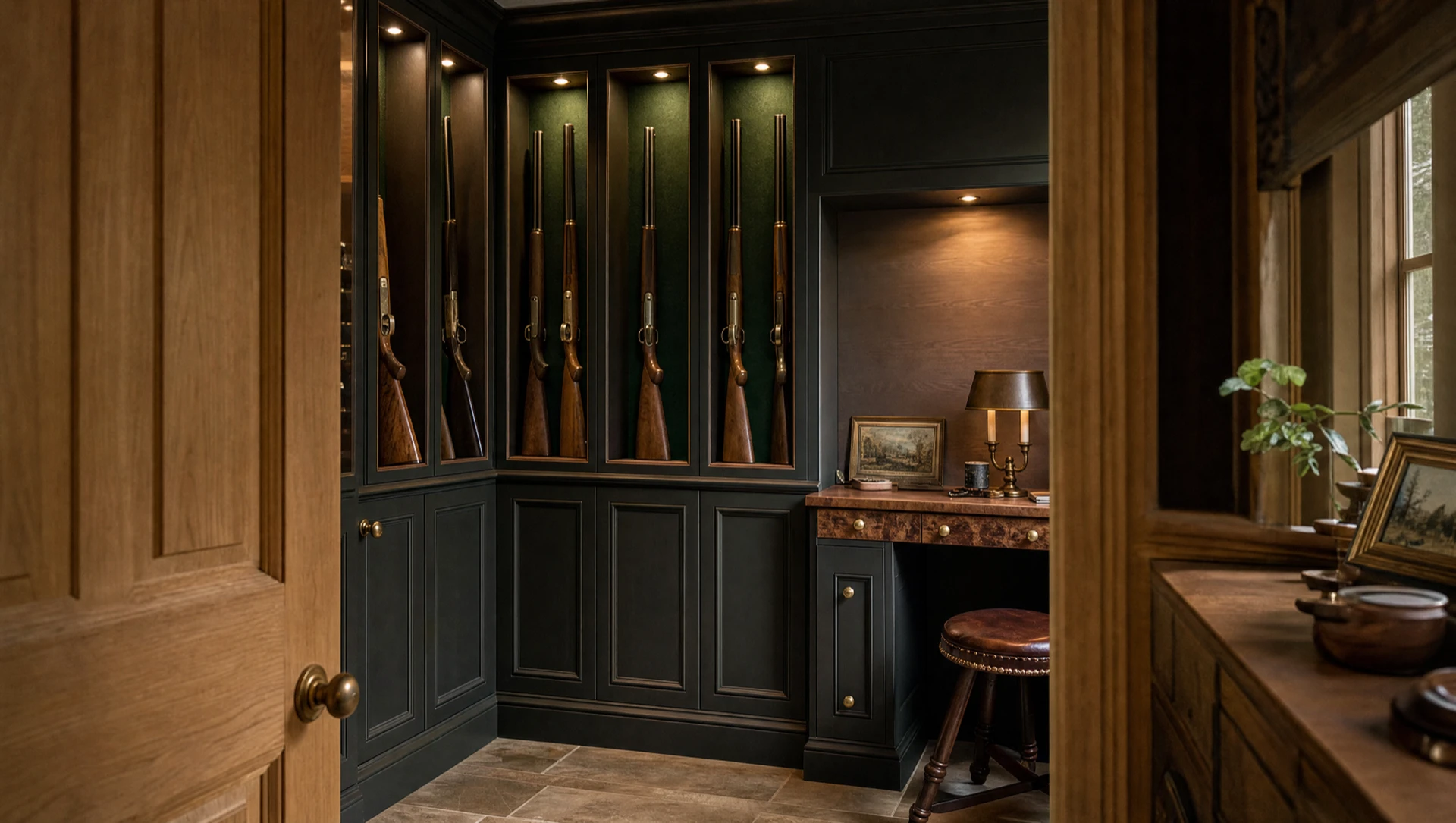
9. Who actually makes it, and where?
“Handmade in England” is a claim, not a fact, and it is compatible with a carcass from one supplier, a door from another and a finish from a third, assembled in a unit.
Three questions get past it:
- Where is the workshop, and can I visit it? The answer to the second half is more informative than the first.
- Is the finishing done in-house? Matching an existing piece is a finishing problem more than a timber problem. A firm that sends finishing out cannot promise a match and stand behind it.
- Can you machine a moulding to match ours? This is the one nobody expects. Matching existing joinery means running the moulding, which means owning a moulder and grinding cutters to your profile. Firms without one are choosing the nearest thing from a catalogue.
Ours: Mickfield, six miles north of Stowmarket in Suffolk. Machine shop, bench room and finishing shop on one site. Four cabinetmakers, a designer and a polisher. We run our own moulder. Come and see it — there are photographs of all of it here, and you are welcome by appointment.
Two questions we answer with “it depends”
For completeness, because a page of nine confident answers is not a credible page.
“How long will it take?” It depends on the piece and on the workshop programme when you commit. A single cabinet is typically weeks from approved drawings; a fitted room with concealment and matched joinery can run to several months. What we will do is give you a date at quotation and hold it.
“Will my FEO definitely accept it?” Nobody who makes cabinets can promise that, and anyone who does is telling you something. The decision is your licensing department’s, on the facts of your property. What we can do is agree the specification with them first and hand over documentation afterwards, which is why the answer is almost always yes.
Responsibility for meeting the security condition on your certificate rests with you as the certificate holder, and the adequacy of any storage arrangement is a matter for your local police firearms licensing department. Guidance on how that condition is usually met is in the Home Office Firearms Security Handbook, which is guidance rather than law. BS 7558:1992, the old British Standard for gun cabinets, was withdrawn on 7 November 2025 and is no longer maintained — a cabinet described today as made to it is being described against a retired document. Nothing on this page is legal advice.
Questions we are asked
What should I ask a gun cabinet maker about steel?
Ask for the thinnest panel in millimetres, and whether the figure covers the whole enclosure or a single face. Cabinets are routinely described by their heaviest component, which tells you very little — an attack does not choose the strongest face.
Are keyed-alike locks a problem?
They are convenient, and that is the whole argument for them. But one key then opens the top, the bottom and often the ammunition drawer, so a lost or copied key opens everything, and the separation between firearms and ammunition disappears. We lock each bay independently and always give ammunition its own lock.
Is any gun cabinet police approved?
No. There is no police approval scheme for gun cabinets in the United Kingdom. No force approves products. Your FEO assesses the arrangement at your address, not the product. The phrase is widely used and means nothing.
Should the maker fit the cabinet, or can I?
A large part of the security is how the cabinet is attached to the building, so it should be fitted by people who do it regularly, anchored into masonry or located structure at recorded centres. “Holes in the back for fixing” describes the cabinet, not the installation.
Is BS 7558 still a valid specification to ask for?
No. BS 7558:1992 was withdrawn on 7 November 2025 and is no longer maintained. Specify performance instead — steel thickness through the whole enclosure, EN 1300 Class A locking, certified security glazing with a stated product reference and EN 356 rating, and mechanical fixing into masonry or located structure.
What paperwork should come with a bespoke gun cabinet?
A signed specification sheet stating steel thickness, glass specification, lock model, fixing type and fixing centres; drawings as installed; and care instructions. If nobody will write the specification down, consider why.
Why ask any gun cabinet maker these at all
Because there is no standard to appeal to. There is no British Standard for a gun cabinet, no approval scheme, and no certification body — which means the only thing separating one quotation from another is the construction, and the only way to see the construction is to ask.
The Home Office Firearms Security Handbook is deliberately written in terms of outcomes rather than construction, because the assessment is meant to be made at your address by your firearms enquiry officer. That is sensible policy and it has one side effect: it leaves the market with no common vocabulary, and a vacuum in a market always fills with adjectives.
So: heavy-duty, high-security, premium, police-approved. The first three mean nothing measurable. The fourth is not a thing that exists.
How to score the answers
| Answer | Read it as |
|---|---|
| A number, immediately, without being pressed | They know their own product |
| “I’d have to check with the factory” | They are reselling, which is fine — ask who makes it |
| “It’s police approved” | Careless, or hoping you will not check |
| “It exceeds all standards” | There are no standards to exceed |
| “It depends” — followed by what it depends on | The best answer available on some questions |
Two questions to ask us, specifically
Why are you more expensive than a steel cabinet? Because we are not selling the same object — a locker satisfies most certificates perfectly well and costs a fortieth of what we charge, and we say so on our gun cabinets page. And: who actually made mine? A named cabinetmaker in Mickfield, and we will tell you which one.
Ask us all nine
Ring the workshop and put every question on this page to us. We would far rather have the technical conversation than the sales one — and if the answers send you elsewhere, at least you will have asked the right things.