
Sporting Cabinetmakers · Suffolk
Fishing Rooms and Rod Rooms
Gun rooms get designed. Fishing kit gets a corner of the boot room, a plastic tube behind the door and a reel in a drawer with the dog leads. That is the wrong way round, because tackle is just as good, just as expensive, and a great deal more easily ruined.
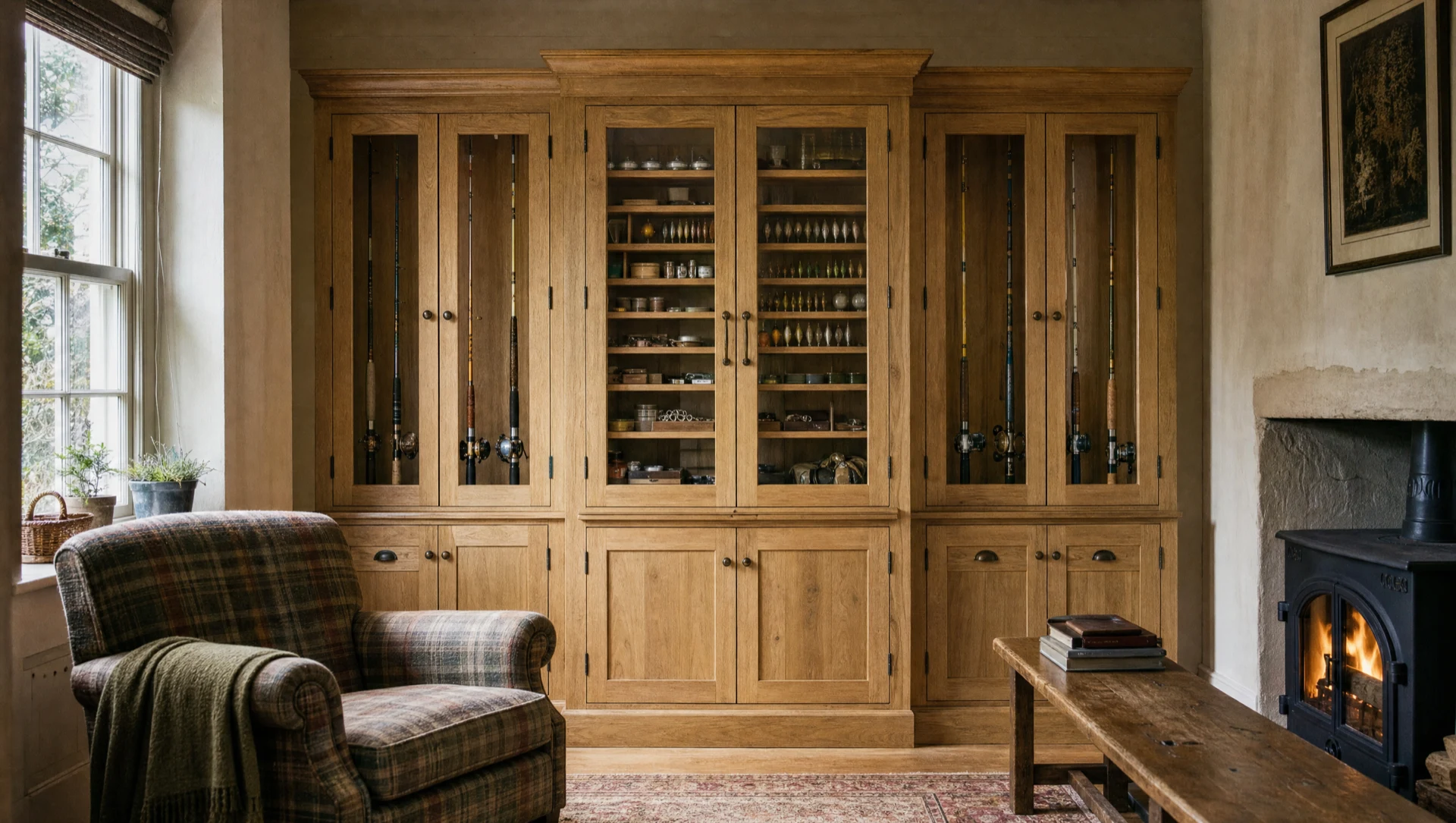
Our clients’ homes and gun cabinets are private, and most ask that they are not photographed or published. The images here are visualisations based on our own workshop drawings for commissions we have completed. If you would like to see drawings, samples and references for completed work, we will show them to you in person — visits to the Mickfield workshop are by appointment.
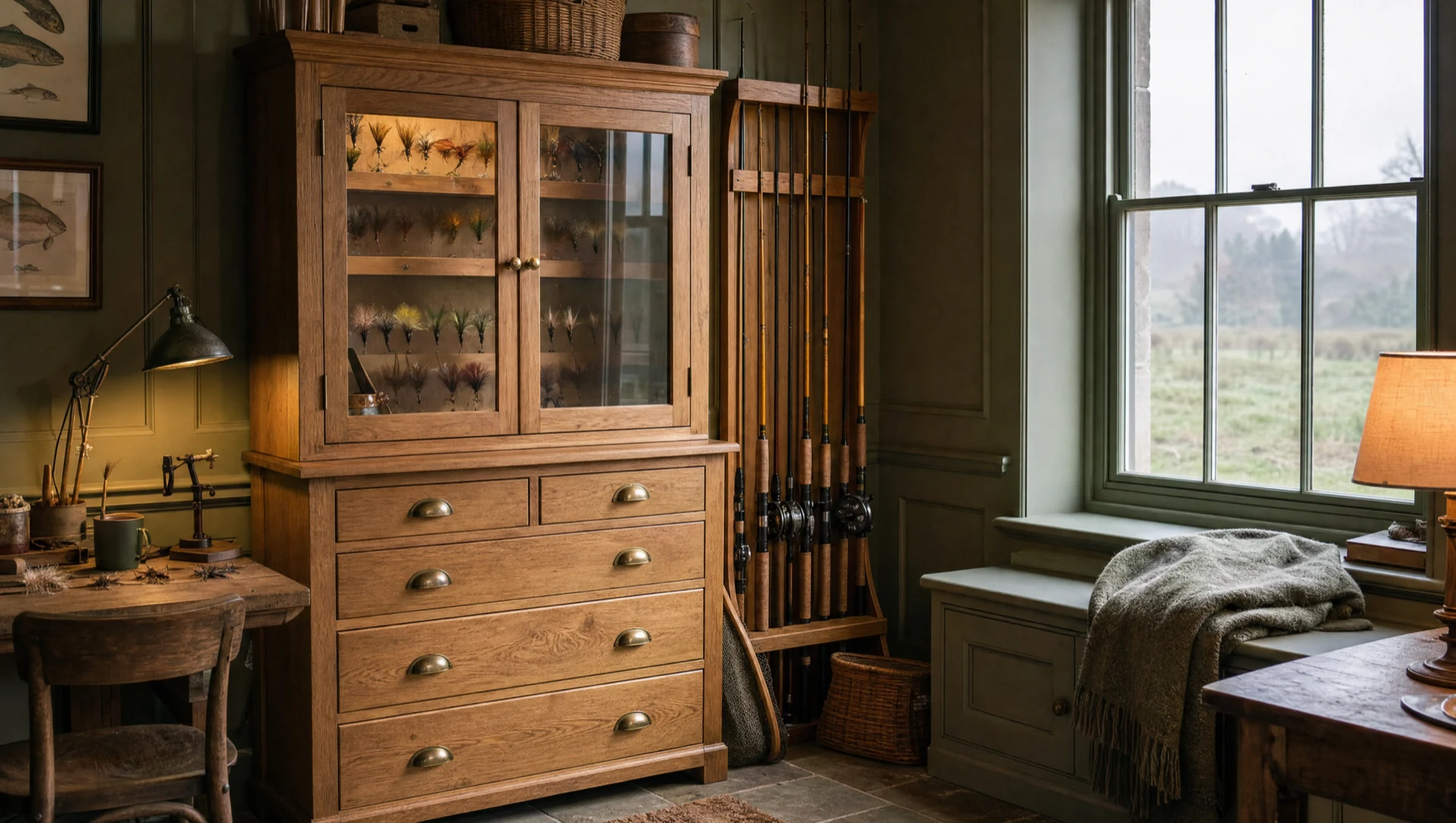
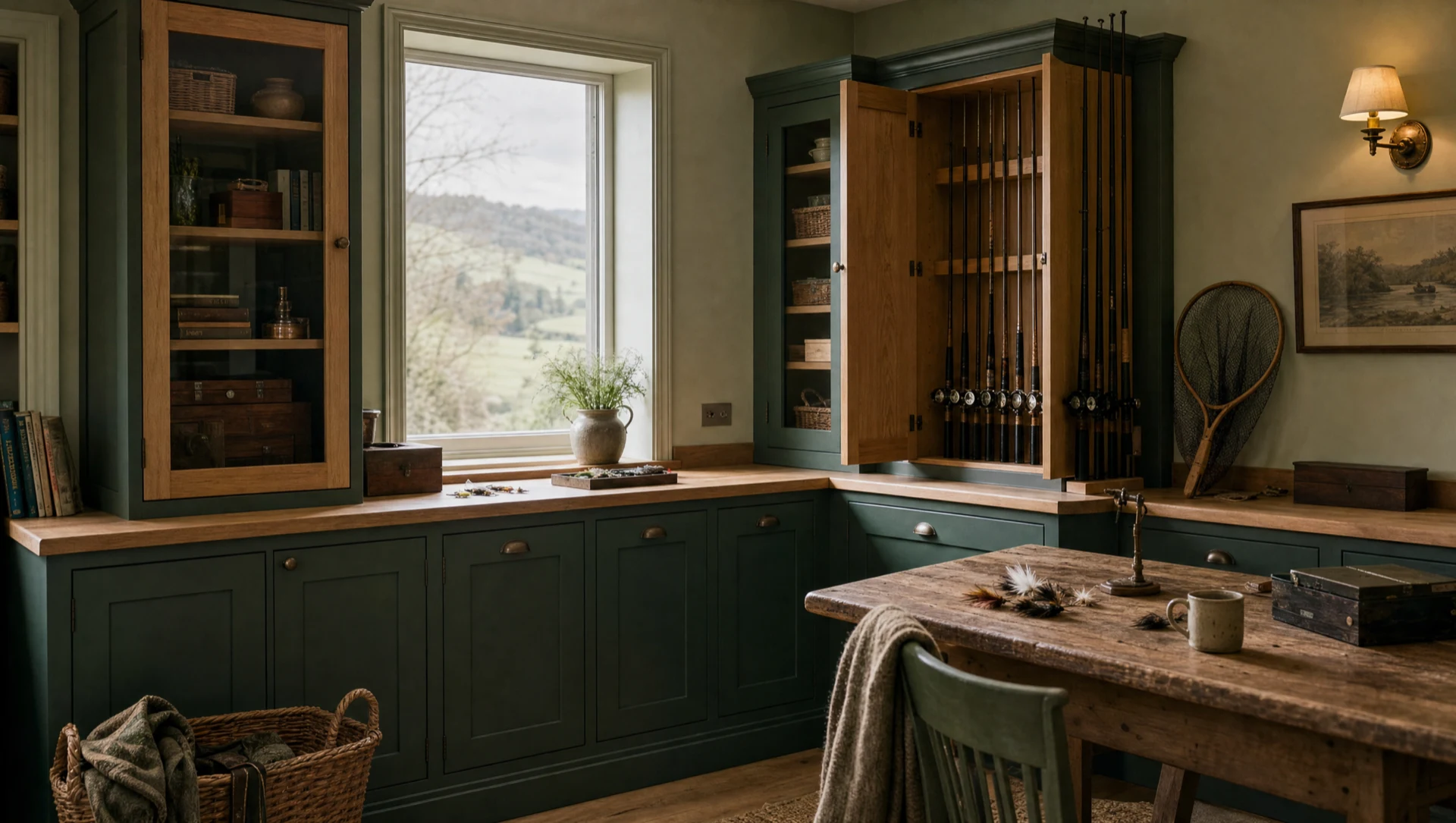
We came to this from the gun room side, and the first thing that struck us is that nobody is making proper furniture for it. There are plenty of racks, plenty of plastic, and a great deal of ingenious improvisation with dowel and pipe clips. There is very little in the way of joinery drawn around what fishing tackle actually needs — which is a shame, because the requirements are specific, they are interesting, and they are not hard to meet once someone bothers to ask.
On this page
What a rod room is for
Three jobs, and most improvised arrangements manage one.
Storing tackle without damaging it. Rods that are not resting on their tips, reels that are not knocking against each other, lines that are not sitting in the light, and leather and cork that are not going mouldy.
Drying things. Fishing produces more wet equipment than any other field sport, and the wet gear is exactly what ruins everything stored next to it. A room that stores without drying is a room that gets slowly worse.
Working. Rigging up, breaking down, tying, cleaning lines, changing reels — all of which needs a bench at the right height and light in the right place, and none of which happens on a shelf.
A well-drawn room does all three and looks like a room you would happily sit in. That is not much to ask of a joinery workshop and it is what we do all week.
Rods
The single most important detail in the whole room, and the one most commonly got wrong.
Nothing should ever bear on the tip. A rod stood on its tip in a corner, or a made-up rod hung with the tip taking any load at all, is a rod being slowly asked to take a set. Every rack we draw supports the butt and cradles the blank, and leaves the tip carrying nothing but itself.
Made up, or in tubes?
The answer decides the room, so it is the first thing we ask.
| Stored made up | Stored in tubes or bags | |
|---|---|---|
| Advantage | You can fish in two minutes | Compact, protected, travels |
| Storage form | Vertical rack or horizontal cradles | Pigeonholes, or a deep drawer bank |
| Space needed | Full rod length, floor to ceiling or wall run | Tube length — considerably less |
| Risk | Dust, knocks, sunlight on the blank | Damp trapped inside a closed tube |
| Suits | Water on the doorstep. Trout rods, everyday rods | Travelling rods, salmon rods, anything precious |
Most rooms want both: a vertical rack of made-up rods for the water you fish most, and pigeonholes or drawers for tubes.
Vertical racks
A butt cup or shaped seat takes the weight, and a sprung or lined upper retainer holds the blank without gripping it. Spacing is set to the rods you own — a rack drawn for trout rods will not take a double-handed salmon rod, and a rack drawn for salmon rods leaves trout rods rattling. We ask for the list.
Where the room is short of height, angled racks work well and often look better: a shallow lean, butt in a cup at the bottom, blank cradled at chest height. It reads as furniture rather than as storage.
Horizontal cradles
Better for a very fine rod and much better for display — a split-cane or a good salmon rod laid on lined cradles along a wall is one of the nicest things you can do in a room like this. It costs a great deal of wall for the number of rods it holds, which is exactly why it is worth doing with the four you care about rather than the fourteen you own.
Tube storage
Pigeonholes sized to your tubes, deep enough that nothing protrudes, with the openings set at a height you can actually reach across. Where tubes go into drawers, the drawer has to be full-extension — a tube you cannot get out without lifting is a tube you will leave out.
Two rules for rods, whatever the form
Never store a rod wet, and never store one under tension. Damp under a cork handle and inside a ferrule is where trouble starts, and a rod left flexed against a wall will hold that shape long after you have forgotten leaning it there.
Reels
Reels want drawers, not shelves. A shelf lets reels touch each other, which is how frames get marked, and it lets you stack them, which is how they get forgotten.
What we draw:
- Shallow, divided drawers, lined in felt or baize, with one reel to a compartment and nothing touching.
- Divisions sized to your reels rather than to a standard, so a big salmon reel and a small trout reel each sit properly.
- Full-extension runners, so the back of the drawer is as usable as the front.
- Spool storage separately — spare spools in their own shallow drawer, not loose among the reels.
- Ventilation, because a closed drawer with a damp reel in it is a small, effective corrosion chamber.
Where reels are worth displaying — and some are — a glazed section with lit shelving does the job, using the same laminated glass and lighting principles as a glazed gun cabinet.
Lines, leaders and flies
Small things, easily lost, and each with a preference.
Lines want dark, cool and loose. Ultraviolet light and heat are what age a fly line, so the worst place for spare lines is a sunny windowsill and the second worst is above a radiator. A lined drawer in a shaded part of the room is all they need.
Leaders and tippet want a divided shallow drawer or a set of small pigeonholes, sorted by breaking strain, where you can see all of them at once. Anything stored two deep is invisible.
Flies want the boxes stored flat and open occasionally. A rack sized to your boxes, so they stand on edge and can be pulled out individually, beats a drawer they get piled into. If a box has gone away damp — and after a day’s fishing at least one has — it needs opening to dry rather than closing on the problem.
The fly-tying bench
A desk with unusually specific demands, and the piece clients enjoy most.
- Height set to you, sittingNot standard desk height. Elbows down, shoulders relaxed, vice at eye-to-hand distance without leaning in.
- A solid, fixed vice positionEither a purpose-made hole and collar in the top, or a bench edge thick and true enough to take a clamp without flexing. A vice that moves is a vice you fight.
- Light in front, not behindA task light at the front edge so your hands do not cast a shadow onto the hook. Daylight-balanced, because colour matters when you are matching a dubbing.
- Materials within reach and visibleShallow drawers and small pigeonholes rather than deep boxes. What you cannot see, you will buy again.
- A hard, pale, wipeable topOr a replaceable insert. Head cement, varnish and dye all end up on it.
- Somewhere for hooksSmall, divided, labelled, and not in with anything else.
- A bin under the front edgeA tying bench without one puts trimmings on the floor, and trimmings on the floor go into a dog.
Where space is tight, the whole bench can be built as a fall-front or a pull-out, so the tying station disappears into a run of joinery when it is not in use. That is a nice piece of cabinetmaking and it is often the difference between having one and not.
Waders, boots and wet gear
The part everybody underestimates, and the part that quietly ruins the rest of the room.
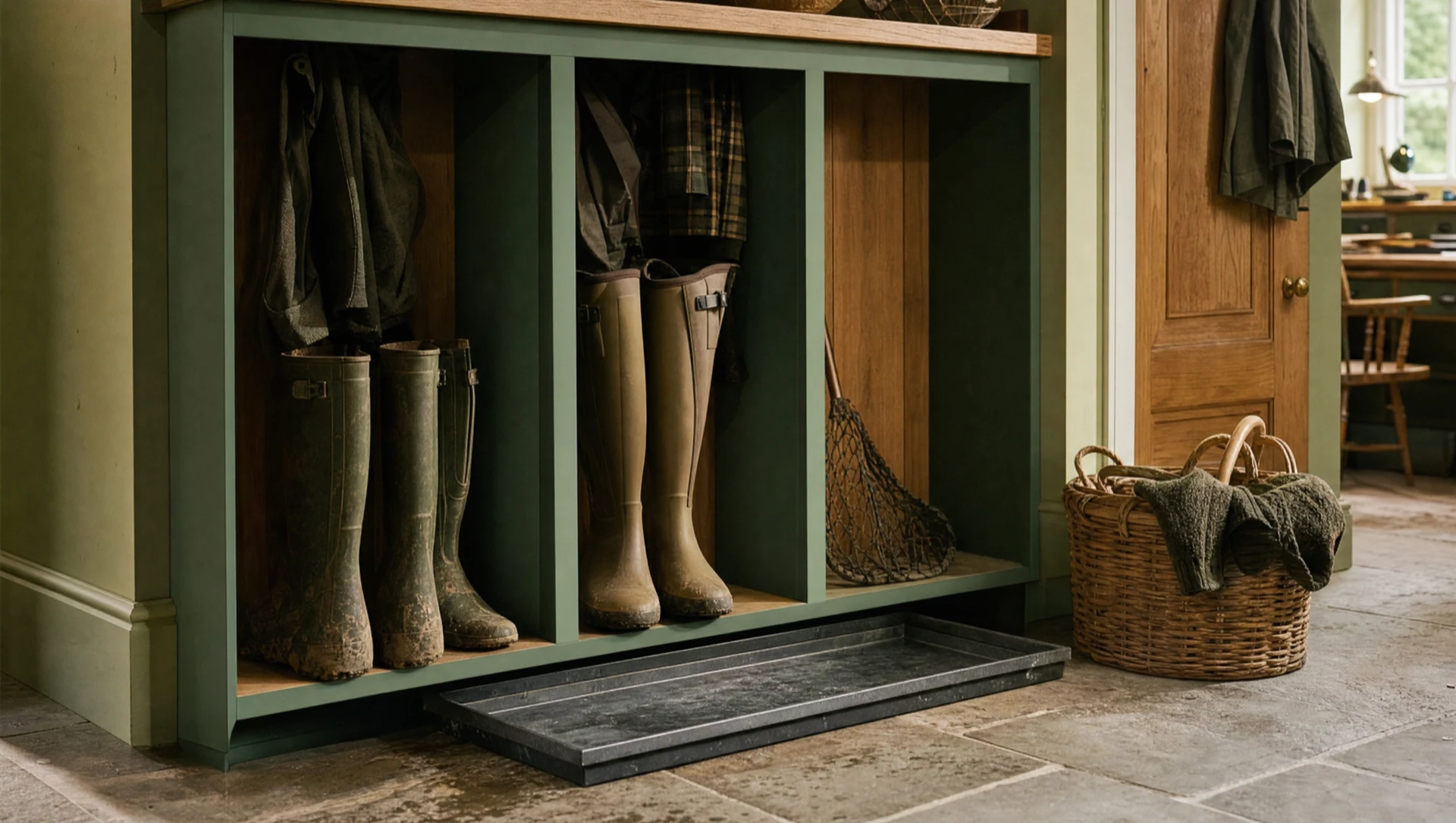
Waders come off wet inside as well as out, and folded wet waders are how you get delamination, mould and a smell nobody wants to discuss. They need hanging — inverted, or over a broad former, with air able to reach inside — and they need air movement rather than heat. Boot dryers and gentle warm air are fine; a radiator is not, because concentrated heat is unkind to boot glue and to breathable membranes.
What we build for:
- Hanging with air all round, not hooks in a cupboard.
- A drip tray or a floor that will take water, which is a decision for your builder as much as for us.
- Boot storage above a tray, not on the floor.
- Separation from the dry storage, because putting wet gear in the same enclosure as rods, reels and leather is the single most common design mistake in this kind of room.
Where the space allows, the best arrangement is two zones: a wet end near the door with hanging, boot storage and a tolerant floor, and a dry end with the racks, drawers and bench. Where it does not, the wet gear should go somewhere adjacent instead — a back lobby, a porch, a utility.
Nets, bags and the rest
Landing nets want hanging by the handle with the net free rather than crushed. Bags and vests want hooks with air around them, and they want emptying — a vest hung full of damp fly boxes is a vest drying nothing. Wading staffs, priests, scales and cameras want a shallow divided drawer near the door, because that is where you will be standing when you want them.
And somewhere to put a hat. Every room like this needs somewhere to put a hat.
Damp, which is the whole problem
Everything above comes back to this. Fishing tackle spends its life getting wet and then being put away, and almost every failure — mouldy leather, delaminated waders, corroded reel feet, a cork handle going black, a fly box gone green — is a drying failure rather than a storage failure.
The requirements are the same as for a gun room and for the same reasons: air movement, gentle background heat rather than warmth, and stability rather than swings. A cold sealed room that receives a load of wet gear every Saturday is the worst possible arrangement.
- Ventilation — trickle, humidistat-controlled extract, or dehumidification. Your builder or M&E consultant specifies it; we make sure the joinery does not obstruct it.
- Gentle background heat, away from the joinery and away from anything with glue or a membrane in it.
- Cabinets ventilated internally as standard. Nothing sealed.
- A hygrometer in the room, because it turns an argument into a reading.
There is a fuller treatment on lighting, heating and ventilation and on humidity, damp and blued steel — written for guns, but the physics is identical and so is the answer.
Security and value
Fishing tackle is not licensed and there is no certificate condition to satisfy, so this is a matter for you and your insurer rather than for a licensing department. But a serious rod room can hold as much value as a gun cabinet, and it is worth thinking about deliberately rather than by default.
We build lockable provision wherever it is wanted — a locked cabinet within the room for reels and the best rods, or a locked section within a run of joinery. Where you want the room itself secured to the standard we build gun rooms to, we can do that too: steel-lined walls, a steel door clad in timber, the full specification. It is the same work, and it is described on steel-lined gun rooms.
Most clients want something between the two: a beautiful room, and one cabinet in it that locks.
Where the room goes
Close to the way in from the water, and close to the way out. A rod room at the far end of a carpeted hall is a room you will walk past on the way to leaving your rod in the porch.
Other things worth weighing:
- A floor that tolerates water, at least at the wet end.
- Height, if rods are stored made up. This is the one dimension that rules rooms out.
- Light, for tying — a north window is a gift, and direct sun on stored lines and blanks is not.
- Adjacency to the boot room, because in most houses these are the same room whether you planned it or not.
- Dogs, who will be in there. Build for it rather than against it.
What it costs
Fishing commissions vary more than gun cabinets do, because they range from a single rod rack to a fitted room. As a guide, a bespoke rack or a reel cabinet is a piece of furniture and prices like one; a fully fitted rod room with racks, drawers, a tying bench and wet-end joinery sits in the same territory as a fitted gun room.
We will give you an indicative figure before anybody commits to a survey, and a fixed, itemised price against approved drawings after it. There is a fuller breakdown on prices, and the process is the same as for everything else we make — see how a commission works.
For a room drawn round a working collection, see a fishing room for a chalk stream house.
Questions we are asked
What is a rod room?
A room fitted out for fishing tackle: rod storage that supports the butt and cradles the blank without loading the tip, lined and divided drawers for reels and spools, storage for lines and flies out of the light, a fly-tying bench at the right height, and somewhere waders and boots can actually dry.
Should rods be stored made up or in tubes?
Both, usually. Made-up rods in a vertical or angled rack for the water you fish most, and tubes in pigeonholes or full-extension drawers for travelling rods and anything precious. Made-up storage needs full rod height, which is the dimension that most often rules a room out.
Why should reels go in drawers rather than on shelves?
Because a shelf lets reels touch each other, which marks frames, and lets you stack them, which means you forget what you have. Shallow felt-lined drawers with divisions sized to your reels, on full-extension runners, and ventilated — a closed drawer with a damp reel in it corrodes quietly.
How should waders be stored?
Hanging, inverted or over a broad former, with air able to reach inside, and dried with air movement rather than heat. Folded wet waders delaminate and go mouldy. Keep them at a wet end with a tolerant floor, separate from rods, reels and anything leather.
What height should a fly-tying bench be?
Set to you, sitting, with your elbows down and the vice at comfortable hand distance without leaning in — not standard desk height. Light at the front edge so your hands do not shadow the hook, materials visible in shallow drawers, and a bin under the front.
Does a fishing room need to be secure?
There is no licensing requirement as there is for firearms, so it is a matter for you and your insurer. Most clients want a lockable cabinet within an otherwise open room. Where the whole room is to be secured, we can build it to the same standard as a gun room — steel-lined walls and a clad steel door.
Can it be part of the boot room?
Usually it already is. The trick is designing two zones: a wet end near the door with hanging, boot storage and a floor that takes water, and a dry end with the racks, drawers and bench. Mixing the two is the most common mistake in this kind of room.
Fishing rooms, licences and the paperwork end of it
Unlike a gun room, a fishing room carries no statutory storage requirement at all. Nobody inspects it, nothing has to be locked, and there is no equivalent of a firearms enquiry officer. That freedom is why so many fishing rooms are badly done — there is no external discipline forcing anyone to think about it.
Two pieces of paperwork are worth a mention because they change how the room is used. A rod licence is required to fish for salmon, trout, freshwater fish, smelt or eel with a rod and line in England and Wales, and is available from gov.uk; Scotland handles salmon and sea trout through permits rather than a national licence. Most clients keep licences, permits, syndicate cards and beat maps in the fishing room, which is why we build a shallow paper drawer into almost every scheme — A4, felt-lined, immediately under the tying bench.
Value, insurance and the security question
A serious tackle collection is quietly expensive. Six cane rods, a dozen reels and a fitted bag can run past £36,000 without anybody noticing it happening, and it is almost never separately scheduled on a household policy. Two things follow.
- Photograph and schedule it. Reel by reel, with serial numbers where they exist. We build a shallow drawer for the schedule itself because otherwise it lives on a phone that gets replaced.
- Lock the reels, not the rods. Reels are small, valuable and portable; rods are none of those things. A locked reel drawer bank inside an unlocked room is the right balance for nearly every house, and it costs very little.
Where fishing rooms go wrong
In descending order of how often we are asked to fix them: rods stored with weight on the tip; wet waders put away in a cupboard; reels in a drawer with the dog leads; fly boxes stored on edge so the dressings crush; and a room with no heat, so that everything in it is faintly damp from October to April. Every one of those is a design problem rather than a discipline problem, which means it can be built out.
Send us your rod list
What you own, how you store it now, and a few wide photographs of the room including the ceiling height. That is enough for us to tell you what we would build and roughly what it would cost.
Rods, reels and lines: storing fishing tackle properly · Fly tying benches and desks · Rod racks and rod storage