
Solid Timber Gun Cabinets
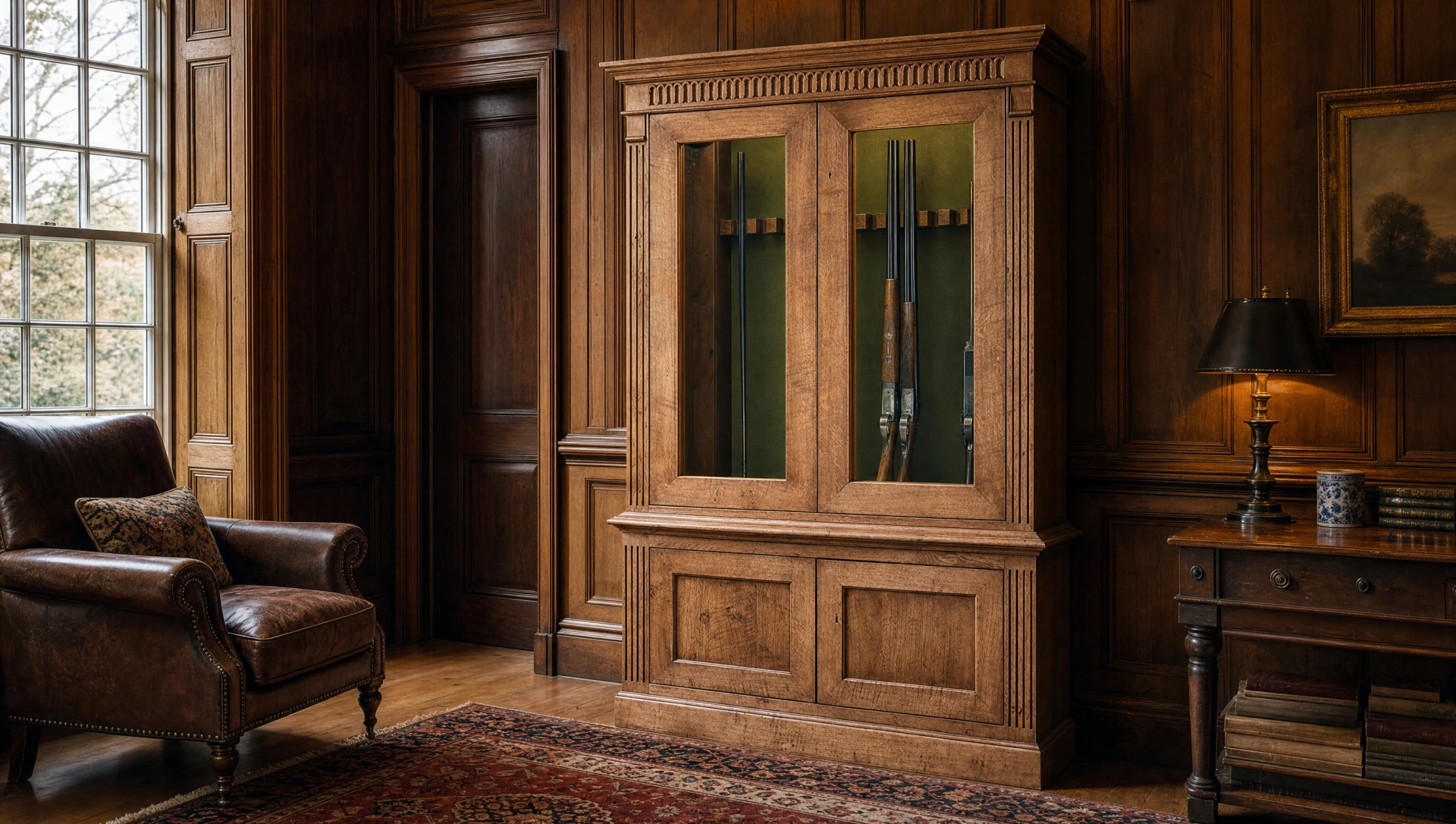
A solid-fronted cabinet is the quiet answer. It reads as a linen press, a hall cupboard or a panelled press, it tells nobody what is inside it, and it is where the cabinetmaking actually shows — because with no glass to look through, the timber has to carry the whole piece.
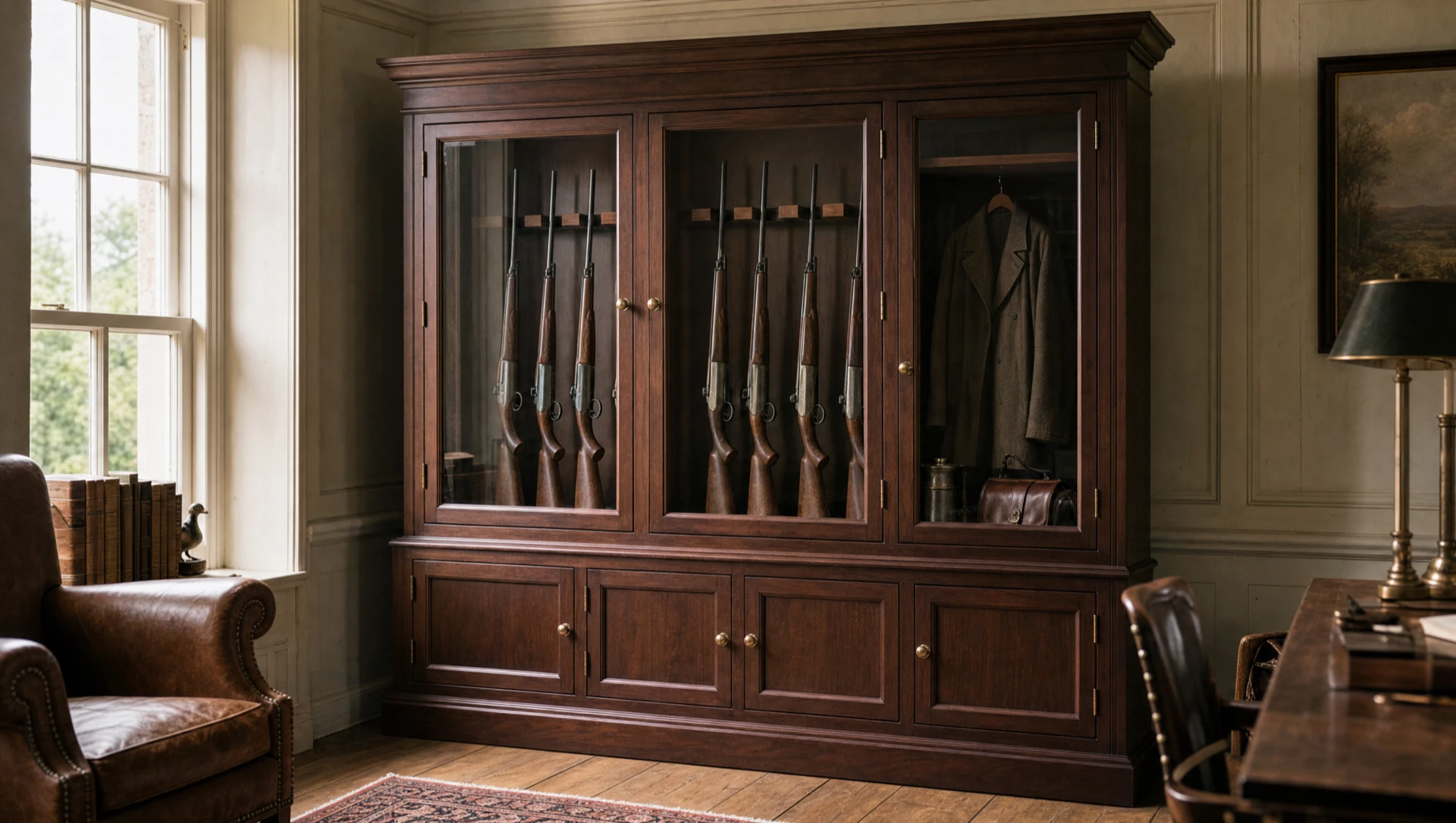
We make roughly as many solid cabinets as glazed ones, and clients who choose solid almost always cite the same two reasons: the room in question is used by people who do not live there, and they would rather a beautiful cupboard than an obvious cabinet.
On this page
The case for solid
Three arguments, in the order clients tend to make them.
Discretion. A glazed cabinet shows the collection to everyone who walks past — visitors, contractors, cleaners, delivery drivers, your children’s friends. A solid cabinet is a cupboard. It is no more secure than the glazed version, but it is information you are not giving away, and information travels further than people expect.
Placement. A solid piece can go where a glazed one cannot: a hall, a landing, a dressing room, a study used for meetings. It sits in a scheme rather than announcing itself within one.
Cost. Glazing is the single biggest step in a cabinet price — 26mm (1in) laminated security glass is expensive, extremely heavy, and it drives a heavier door frame and heavier hinges behind it. A solid cabinet of the same size, in the same timber, to the same steel specification, is a materially lower figure. If budget is the constraint, this is the sensible reduction rather than reducing the steel.
Timber
Quarter-sawn solid oak, walnut or mahogany, or a hardwood prepared specifically for paint.
Quarter-sawn means the boards are cut radially from the log rather than through and through. It wastes more timber and costs more, and in return it moves far less across its width and shows medullary ray — the flecked figure that people recognise in good English oak without knowing its name. On a piece that will live in a heated house for fifty years, stability is not a luxury.
Book-matching means adjacent boards are opened like a book so the figure mirrors across a pair of doors and runs continuously rather than stopping at the join. It requires the boards to be selected and set out together before anything is cut, and it is the single detail that most reliably distinguishes a made piece from a bought one.
| Timber | Character |
|---|---|
| English oak | The default, and rightly. Ages beautifully, takes antiquing, sits in almost any house |
| Walnut | Darker, more figured, more expensive. Extraordinary book-matched across a pair of doors |
| Mahogany | Formal and period-correct in a Georgian or Regency room. Polishes to a depth nothing else reaches |
| Hardwood for paint | Where the room is painted. Grain filled properly, so it reads as painted furniture rather than painted board |
Waste timber from the workshop heats the building, which is a small thing but it is our own offcuts warming our own benches rather than filling a skip.
Panels and proportion
With no glass, the door is the piece — so the panel layout is the design.
- Fielded panels — raised and bevelled, the traditional English answer, with a shadow line that changes through the day.
- Flat panels with a bolection or ovolo moulding — quieter, and correct in a more formal room.
- Arched or gothic heads — where the house is old enough to want them. A tall single-door cabinet with an arched panel is one of the best-looking pieces we make.
- Linenfold or carved detail — occasionally, where there is existing carving to answer to.
- Flush and unmoulded — for a modern scheme, where the figure of the timber does all the work.
Proportion matters more than ornament. A gun cabinet has an awkward brief — it must be tall enough for a gun and deep enough for a lock — and left undrawn it becomes a tall box. The fixes are the ones cabinetmakers have used for three hundred years: a base cupboard with drawers to give the piece a foot, a cornice to give it a head, and a break in the elevation so the eye reads two elements rather than one very tall one.
Finishes
All applied in our own finishing shop, by our own polisher. That is the reason we can match an existing piece and be confident about the match — finishing is where matching actually happens, and it is not something you can subcontract and then stand behind.
French polish. The deepest finish available and the one that repairs best. Built up by hand over days. Correct on mahogany and on anything period.
Hand-oiled. A lower sheen that shows grain and takes handling well. The most forgiving finish in a working room, and the easiest to touch up yourself.
Hand-painted. Any colour, on hardwood, with the grain filled properly. Matched to a paint reference or a physical sample — we will not guess a colour from a photograph.
Antiqued. Done by hand and done sparingly, where a new piece would otherwise sit awkwardly in an old room. Overdone antiquing is worse than none.
Ironmongery
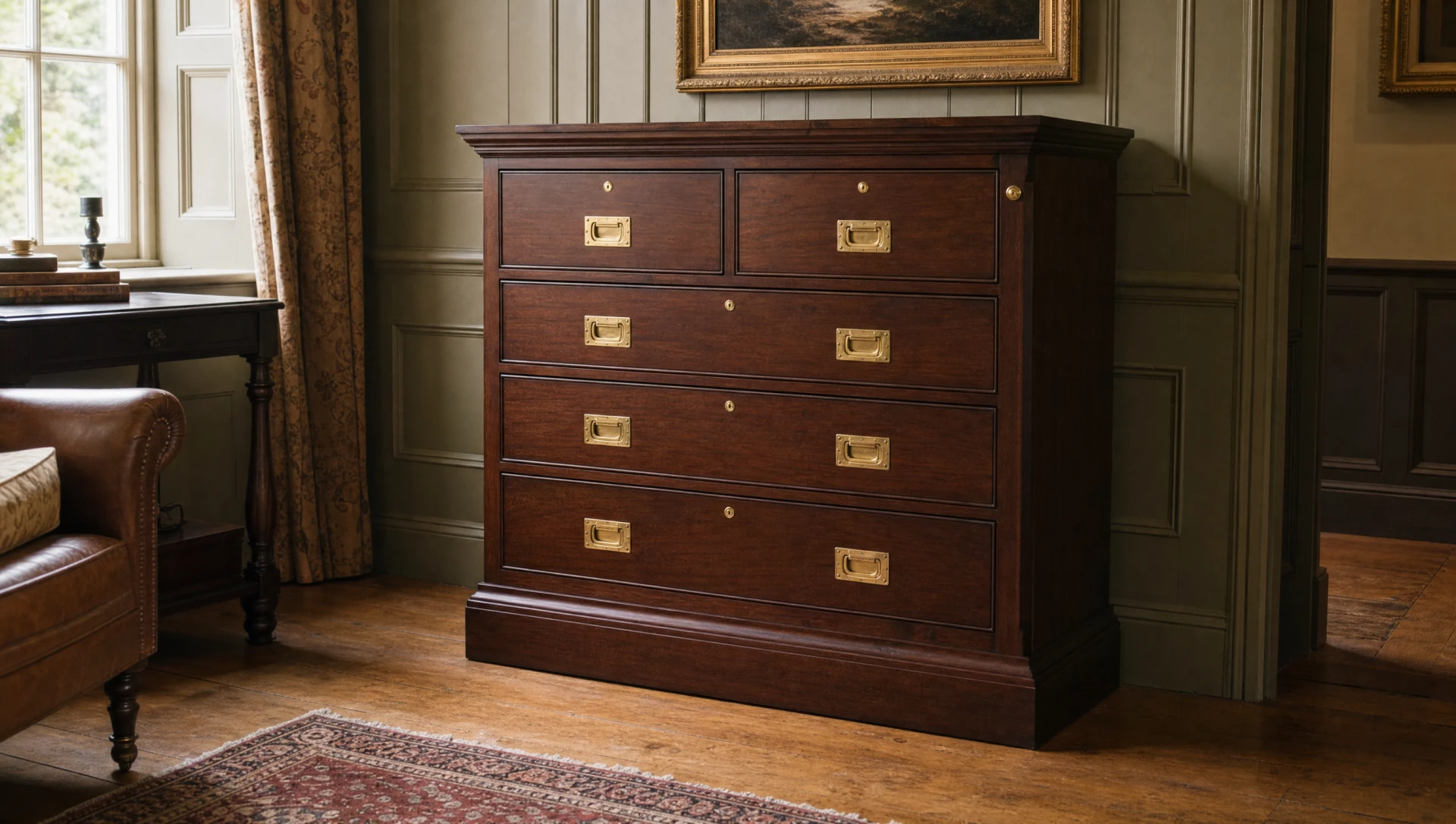
Solid brass or bronze, aged if you want it aged. On a solid cabinet the ironmongery is one of only two or three things the eye lands on, so it is worth spending on and worth choosing deliberately rather than from a default.
Escutcheons, hinges where they are visible, handles or knobs, and the key itself. Clients frequently ask for the key to be a proper cast key rather than a stamped blank, and they are right to — it is the part of the cabinet you touch most often.
Matching what you already have
A significant part of our work is making a new piece that looks as though it has always been in the room.
That means matching timber and figure, matching mouldings section for section, matching ironmongery, and — hardest of all — matching a finish that has been ageing for forty years. Send us photographs to start with, and then, where possible, a physical sample: an offcut, a spare moulding, a drawer front, or a paint reference. A moulding matched from a photograph is a moulding that is nearly right, and nearly right at close range is worse than deliberately different.
Where the cabinet is going into an existing run of joinery rather than standing beside it, see fitted gun cabinets.
Inside
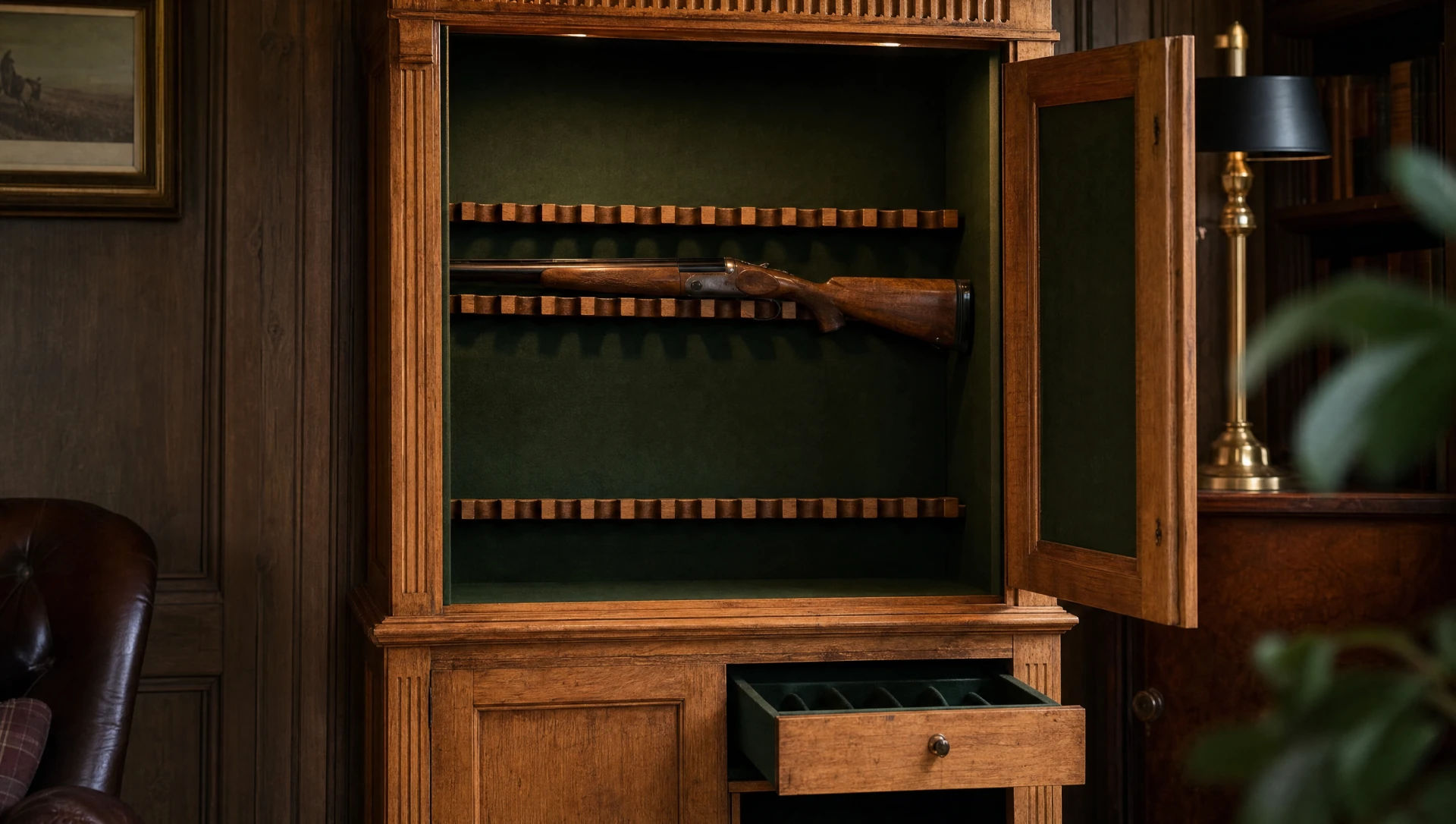
Solid does not mean plain inside. The interior is drawn from your gun list exactly as a glazed cabinet’s would be: racks cut to your guns so nothing touches, clearance for rifles with scopes left mounted, baize or felt lining, a felt-lined cleaning rack, a separate lockable ammunition compartment, drawers on full-extension runners, and lighting on a door switch.
If anything, the interior of a solid cabinet is more of a pleasure, because it is a surprise. A plain oak press that opens onto oxblood baize and a rack of guns is a better piece of theatre than a glazed cabinet that has been showing you the same thing all week.
The specification is unchanged
Nothing about choosing solid over glazed reduces what is behind the timber.
- 3mm mild steel (0.12in) throughout the lined carcass
- Folded steel doors whose folded return passes behind the frame on the hinge side
- 8-lever safe locks to EN 1300 Class A, more than one on taller doors
- A separately locked compartment for ammunition
- Mechanically anchored into masonry or located structural timber, at recorded centres
- A signed specification sheet on completion
The full detail, and the questions worth asking anybody else who is quoting, are on the specification page.
Responsibility for meeting the security condition on your certificate rests with you as the certificate holder, and the adequacy of any storage arrangement is a matter for your local police firearms licensing department. We agree the specification with your firearms enquiry officer before we make anything — see the FEO process. Nothing on this page is legal advice.
Questions we are asked
Is a solid timber gun cabinet less secure than a glazed one?
No. The steel carcass, doors returned behind the frame, EN 1300 Class A locking, separate ammunition compartment and masonry fixings are identical. The difference is glass, and glass is the expensive part rather than the strong part.
Which timber should I choose?
English oak is the default and suits almost any house. Walnut is darker and more figured, and exceptional book-matched across a pair of doors. Mahogany is period-correct in a Georgian or Regency room. Hardwood prepared for paint is right where the room itself is painted.
What does quarter-sawn mean, and does it matter?
Boards cut radially from the log rather than through and through. It wastes more timber and costs more; in return it moves far less across its width and shows the flecked medullary ray figure in oak. On a piece living in a heated house for decades, that stability matters.
Can you match our existing furniture?
Yes — it is a large part of what we do. Send photographs to start, then a physical sample where possible: an offcut, a spare moulding, a drawer front or a paint reference. We will not match a moulding or a colour from a photograph alone.
Is solid cheaper than glazed?
Yes, materially. 26mm laminated security glass is expensive and heavy, and it forces a heavier door frame and heavier hinges. If budget is the constraint, dropping the glazing is the sensible reduction — reducing the steel is not.
Will it look like a gun cabinet?
It should not. A well-proportioned solid cabinet reads as a linen press, a panelled cupboard or a hall press. If you want it to disappear entirely rather than simply be unremarkable, see concealed gun storage.
Solid timber gun cabinets and the movement problem
Solid timber moves. It always has and it always will, and building solid timber gun cabinets around a steel carcass that does not move is the whole technical problem of this piece of furniture. Get it wrong and you have splits in the panels within two heating seasons; get it right and nothing happens for a century.
The figures: English oak moves roughly 2.5% tangentially across its width between 8% and 16% moisture content. On a 400 mm panel that is 10 mm — enough to split a glued panel or push a door out of its opening. Quarter-sawn stock halves it, which is the real reason we use it, and framed-and-panelled construction absorbs the rest by letting the panel float.
So: panels are never glued into their grooves; they are sized dry, set with the growth rings the right way round, and given room to move at the sides but not the ends. Frames are jointed with drawbored mortice and tenon rather than dowels. The steel carcass is fixed to the timber case at a small number of points, slotted rather than round, so that the timber can move across the steel instead of being restrained by it. That last detail is the one that separates a cabinet built by cabinetmakers from a steel box with a timber front screwed to it.
Timber selection, board by board
Doors on the same cabinet come from the same board wherever a piece will take it, and a pair of doors is book-matched from a single leaf so the figure runs across the pair. That decision is made at the rack, months before anything is cut. Where we cannot get enough of one board, we would rather change the design than mismatch the fronts.
Our oak, walnut and mahogany all come through UK merchants with documented chains of custody, and we ask for FSC certified stock where the species and grade allow it. Where it does not — some of the best European walnut simply is not certified — we say so rather than imply otherwise.
Tell us if the room has underfloor heating. It is the single biggest influence on how we build a solid piece, and it changes panel clearances, moisture content at the bench and the finish we would recommend.
The solid-doored cabinet in the standard range
The Deben Solid is this cabinet published with its sizes and prices — raised-panel doors in place of the glazing, in one to four bays. It sits alongside the six other published designs in the standard range.
Send us your gun list
And a photograph of the room, including any joinery we would be matching. We will tell you what we would build and roughly what it would cost before anybody draws anything.