
Sporting Cabinetmakers · Suffolk
Guides
Our gun storage guides: everything we know about keeping guns, rods and the rest of it properly, written out in plain English, with the figures included, and without the phrase “police-approved” anywhere in them.
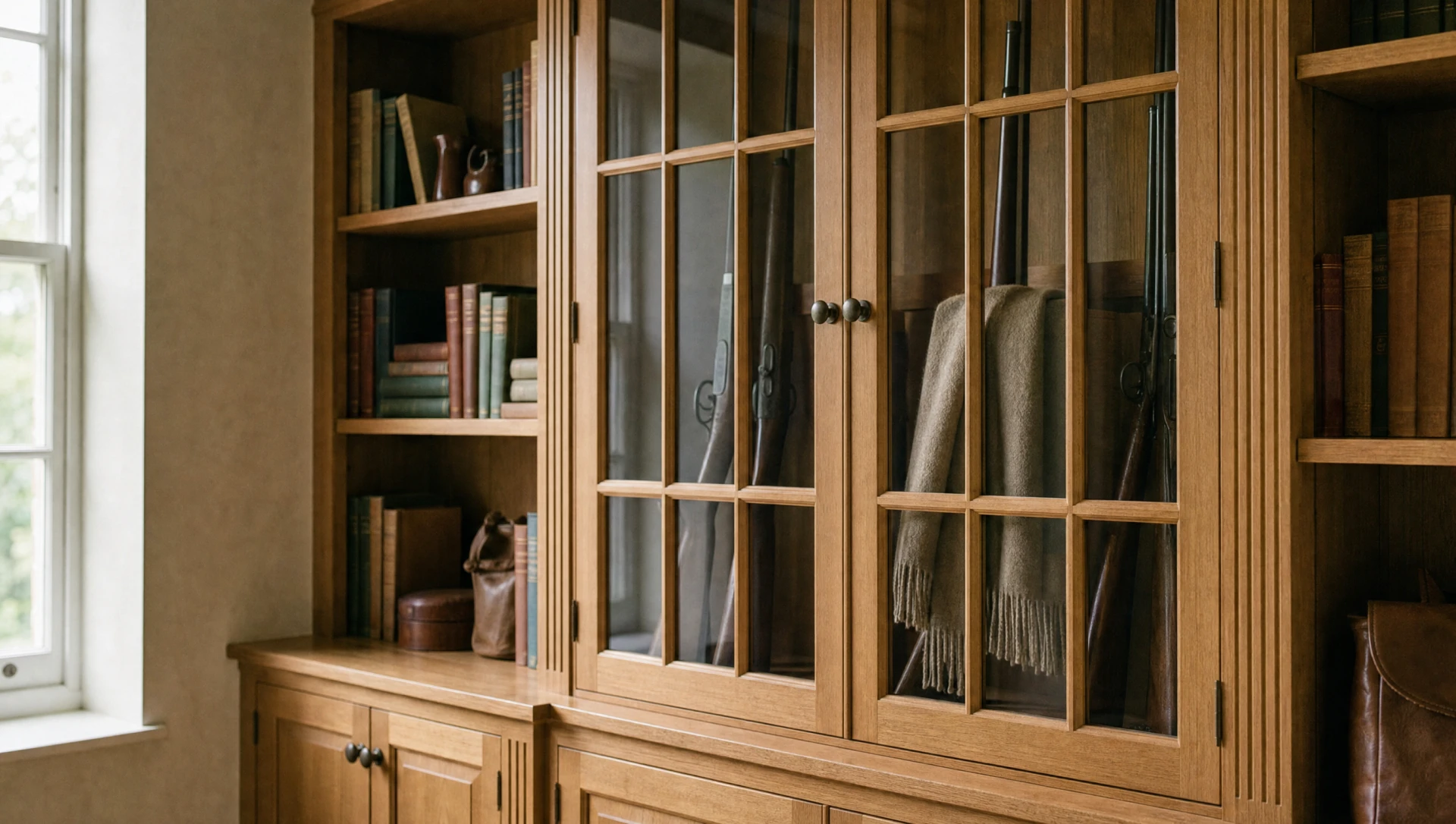
This part of the site exists because the information available to somebody buying a gun cabinet in this country is poor. It is either advertising copy dressed as advice, or it is a forum thread from 2011 quoting a standard that has since been withdrawn. Neither is much help when you are about to spend five figures.
So we have written it down ourselves. Some of it is uncomfortable for us — the page on what to ask any maker will help you interrogate our quotation as effectively as anybody else’s, and one or two of the answers below cost us work. We would rather that than the alternative.
The guides
How to use these gun storage guides
They are written to be read in any order and to be useful to somebody who is not buying anything from us. If you take one thing from the whole set, take this: there is no approval scheme for gun cabinets in the United Kingdom. No police force approves products and no manufacturer can be approved by one. What exists is the Home Office Firearms Security Handbook, which is guidance to forces, and the conditions written on your own certificate, which are binding on you.
Anyone using the phrase “police approved” is either careless or hoping you will not check. It is the fastest way to sort the trade.
If you are just starting
- Read What to ask any gun cabinet maker first. Nine questions, and they will tell you more about a supplier than an hour on their website.
- Then the specification, so you know what the answers ought to sound like.
- Then the FEO process, because agreeing the arrangement before anything is made removes the only genuinely unpleasant surprise in this business.
- If anything you own is blued and you live anywhere damp, read humidity, damp and blued steel. It is the least glamorous page here and the one that saves the most money.
See the work
Finished cabinets, interiors, a timber-faced firearms door and workshop making, shown with the discretion this work requires.
What these guides deliberately do not do
They do not tell you what your firearms enquiry officer will accept, because we do not know and neither does anyone else selling you a cabinet — that assessment is made at your address, on your arrangements, by your force. They do not give security advice on siting relative to your own household, which is a conversation for your FEO. And they do not quote a standard that does not exist. Where there is a real standard — BS EN 1300 for locks, for instance — we name it and give the class.
Corrections
If you find something here that is wrong, tell us and we will change it and say that we have. Several figures on these pages have been corrected since publication for exactly that reason.
Who writes these gun storage guides
We do — the people who make the cabinets, not an agency. Everything on them comes from work we have actually done, quotations we have actually written, or the published guidance, which we name and link to rather than paraphrase. Where we are uncertain we say so, and where a figure has been corrected we leave a note rather than quietly changing it.
They are written for three sorts of reader: somebody buying a first proper cabinet and trying to work out what the words mean; an architect specifying a gun room and needing the builder’s works and the dimensions; and somebody who already owns good guns and has noticed that one of them has started to bloom.
Four things worth knowing before you read anything else
1. There is no police-approved gun cabinet
This is the single most common misunderstanding in the trade, and a good deal of advertising leans on it.
Secure storage is a condition attached to your firearm or shotgun certificate under the Firearms Act 1968 and the Firearms Rules 1998. Neither the Act nor the Rules names a product, a manufacturer, a steel thickness or a British Standard. There is no approval scheme, no register of approved cabinets, and no body that issues an approval. A maker who says their cabinets are police-approved is describing something that does not exist.
What does exist is your local police firearms licensing department, and its view of the arrangement at your particular address. That view takes account of the cabinet, but also of where it is, what it is fixed to, how the house is secured, how many guns there are and what sort. Two identical cabinets in two different houses can attract two different answers, and both answers are legitimate.
The practical conclusion is that the useful conversation is with your firearms enquiry officer, not with a certificate on a website. We have that conversation for you, in writing, before anything is made.
2. The Home Office publishes guidance, and guidance is not law
The Firearms Security Handbook is published by the Home Office as guidance for police forces and certificate holders on the security of firearms and ammunition. The current edition is the 2020 handbook, published on 1 October 2019 and last updated on 20 January 2021.
It is worth reading, and licensing departments do work from it. But it is guidance rather than statute: it does not create legal duties in itself, and it describes levels of security appropriate to different circumstances rather than issuing a single specification everybody must meet. Anyone quoting it at you as though it were a rulebook with one right answer has not read it.
3. The lock standard that matters is European, and the old cabinet standard is withdrawn
Two standards come up repeatedly in this trade, and they are in very different states.
EN 1300 Class A is the European standard for high-security locks on secure storage units, and VdS Class 1 is the German certification that European insurers work from. That is what our 8-lever safe locks are certified to. Both are current, and both are recognised well beyond Britain.
BS 7558:1992, the standard that covered secure cabinets for firearms, was withdrawn on 7 November 2025. A withdrawn standard is no longer maintained or published by BSI. Cabinets built to it are not thereby unsafe or unlawful — but a maker still advertising compliance with BS 7558 as a live credential in 2026 is either not paying attention or hoping you are not.
This is one of the reasons we publish a specification in millimetres rather than a standard number. A figure you can measure does not get withdrawn.
4. Air weapons are a separate question, and the answer depends where you live
Air weapon law is not uniform across the United Kingdom, which catches people out when they move house or buy for a second property.
In Scotland, air weapons are licensed under the Air Weapons and Licensing (Scotland) Act 2015, and holding one generally requires an air weapon certificate. In England and Wales the position is different: most air weapons are not certificated, but there are duties around preventing access by under-18s — the Home Office set these out in Circular 005/2023, published on 31 July 2023.
In practice, a good many of our clients want air rifles behind a lock whatever the strict position, because the household includes children, or a gundog, or both. It is a reasonable instinct and it costs very little to design for.
None of the above is legal advice, and we are cabinetmakers rather than solicitors. Responsibility for meeting the security condition on your certificate rests with you as the certificate holder. Where the answer matters — an unusual collection, a listed building, a property in more than one jurisdiction — check it with your firearms licensing department directly.
How we think about security, in one paragraph
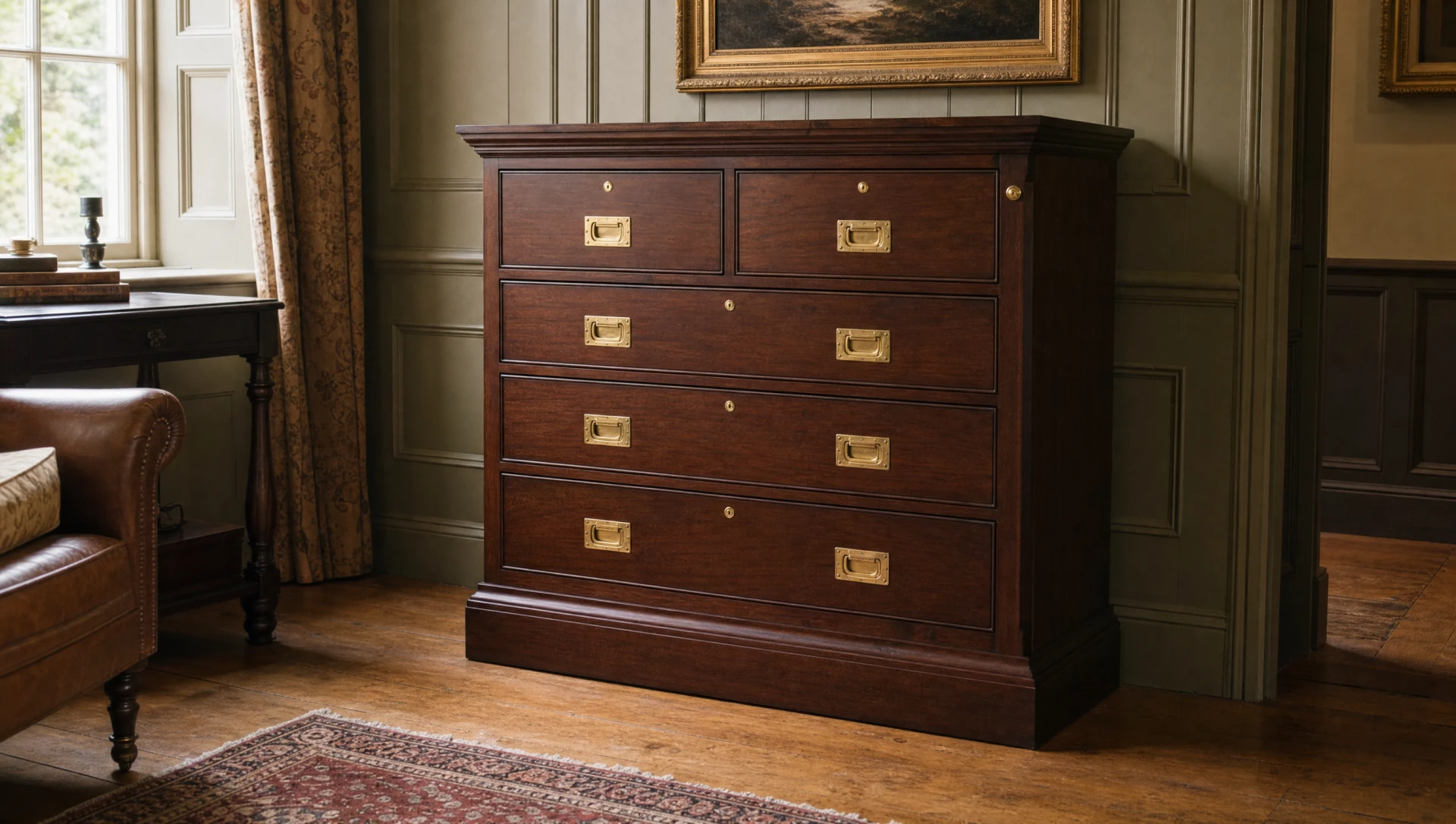
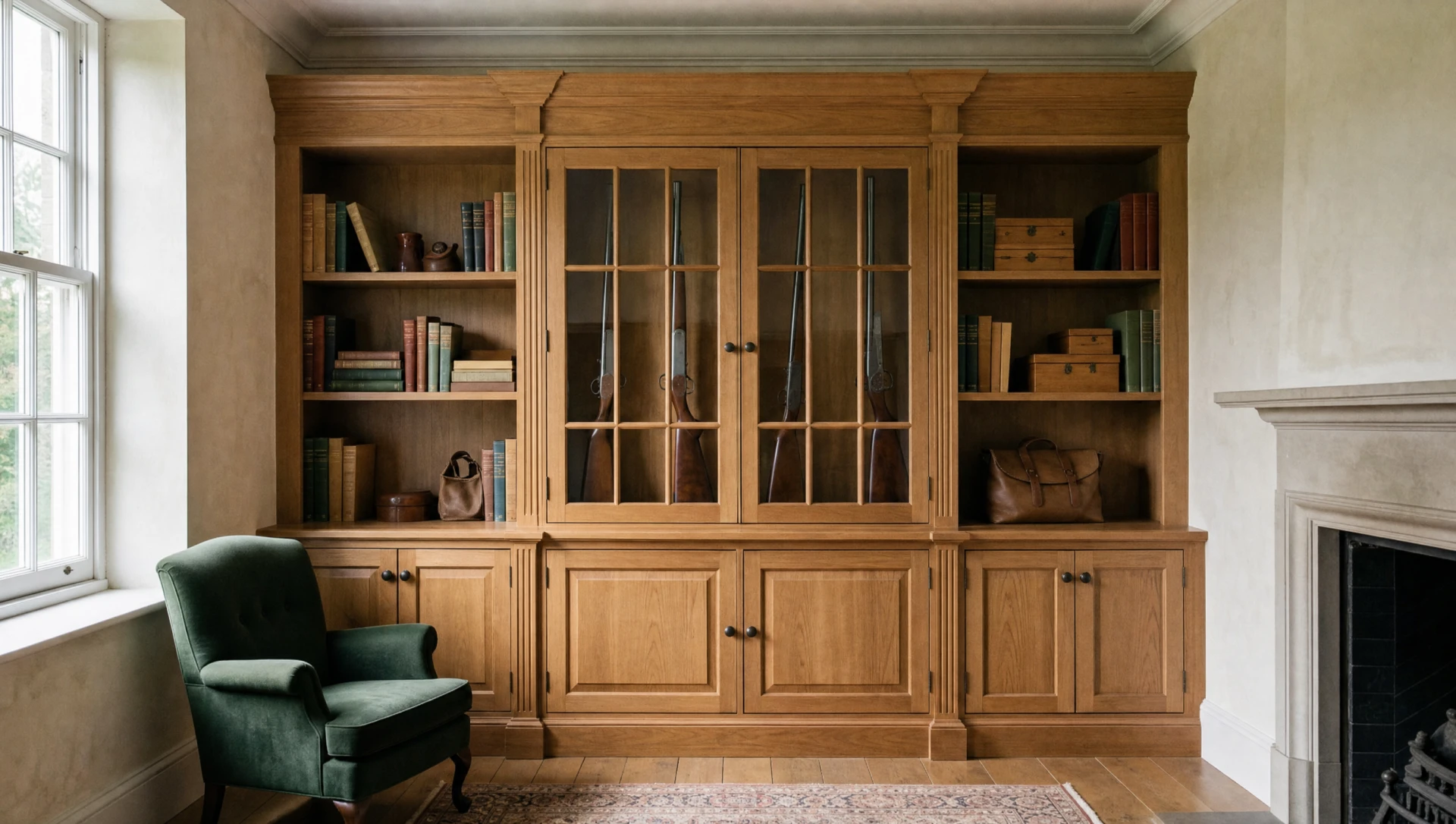
A cabinet is not a vault and nobody should sell you one as if it were. What good storage does is buy time and remove opportunity: it defeats the casual attempt entirely, it makes the determined attempt slow, loud and awkward, and it means that a burglar who finds it cannot simply carry it out of the house. That is why we build the whole enclosure in 3mm mild steel (0.12in) rather than putting the weight into one face, why every door is folded to pass behind the frame on the hinge side as well as a certified safe lock on the other, and why we will not sell a cabinet delivery-only. A cabinet standing free on a floor is furniture.
Ask us the awkward questions
We would far rather answer them before you commission than after. Send your gun list and whatever you are unsure about, and we will give you a straight answer even where it is not the one that sells a cabinet.
Common questions
Is there such a thing as a police-approved gun cabinet in the UK?
No. Secure storage is a condition of your certificate under the Firearms Act 1968 and the Firearms Rules 1998, but no statute names a product, a manufacturer or a steel thickness, and there is no approval scheme or register. What matters is whether your local police firearms licensing department is satisfied with the arrangement at your address.
Is the Firearms Security Handbook the law?
No. It is Home Office guidance for police forces and certificate holders. The current edition is the 2020 handbook, published on 1 October 2019 and last updated on 20 January 2021. Licensing departments work from it, but it describes levels of security appropriate to different circumstances rather than one specification everybody must meet.
Should a gun cabinet comply with BS 7558?
BS 7558:1992 was withdrawn on 7 November 2025 and is no longer maintained or published by BSI. Cabinets built to it are not thereby unsafe, but it is no longer a live credential. We publish our specification in millimetres instead — 3mm mild steel throughout, 26mm (1in) laminated security glass where doors are glazed, and 8-lever safe locks to EN 1300 Class A, which is current.
Do I need a certificate for an air rifle?
It depends where you are. In Scotland, air weapons are licensed under the Air Weapons and Licensing (Scotland) Act 2015 and generally require an air weapon certificate. In England and Wales most air weapons are not certificated, but there are duties around preventing access by under-18s, set out by the Home Office in Circular 005/2023 on 31 July 2023. Check your own position with your licensing department.
How thick should the steel in a gun cabinet be?
No statute or standard sets a figure, so the useful question is not how thick the steel is but what the thinnest panel is. Cabinets are often described by their heaviest single component — a thick front over a lighter body — which tells you very little about the sides, back and base. Ours is 3mm mild steel throughout the enclosure, so the thinnest panel is the same as the thickest.
Oak, walnut or mahogany: choosing a timber — how the four behave over time, and which suits which room.