
Where We Work
Throughout the United Kingdom from the workshop in Suffolk, across Europe, and to the United States. What changes with distance is the logistics and the paperwork. What does not change is who makes it, or how.
Almost every enquiry that comes from more than two hours away opens with the same question, politely disguised: is this going to be a nuisance?
The honest answer is that distance costs money and time rather than quality, and it is entirely predictable if it is planned at the start. We would rather set that out plainly here than have it emerge at quotation stage.
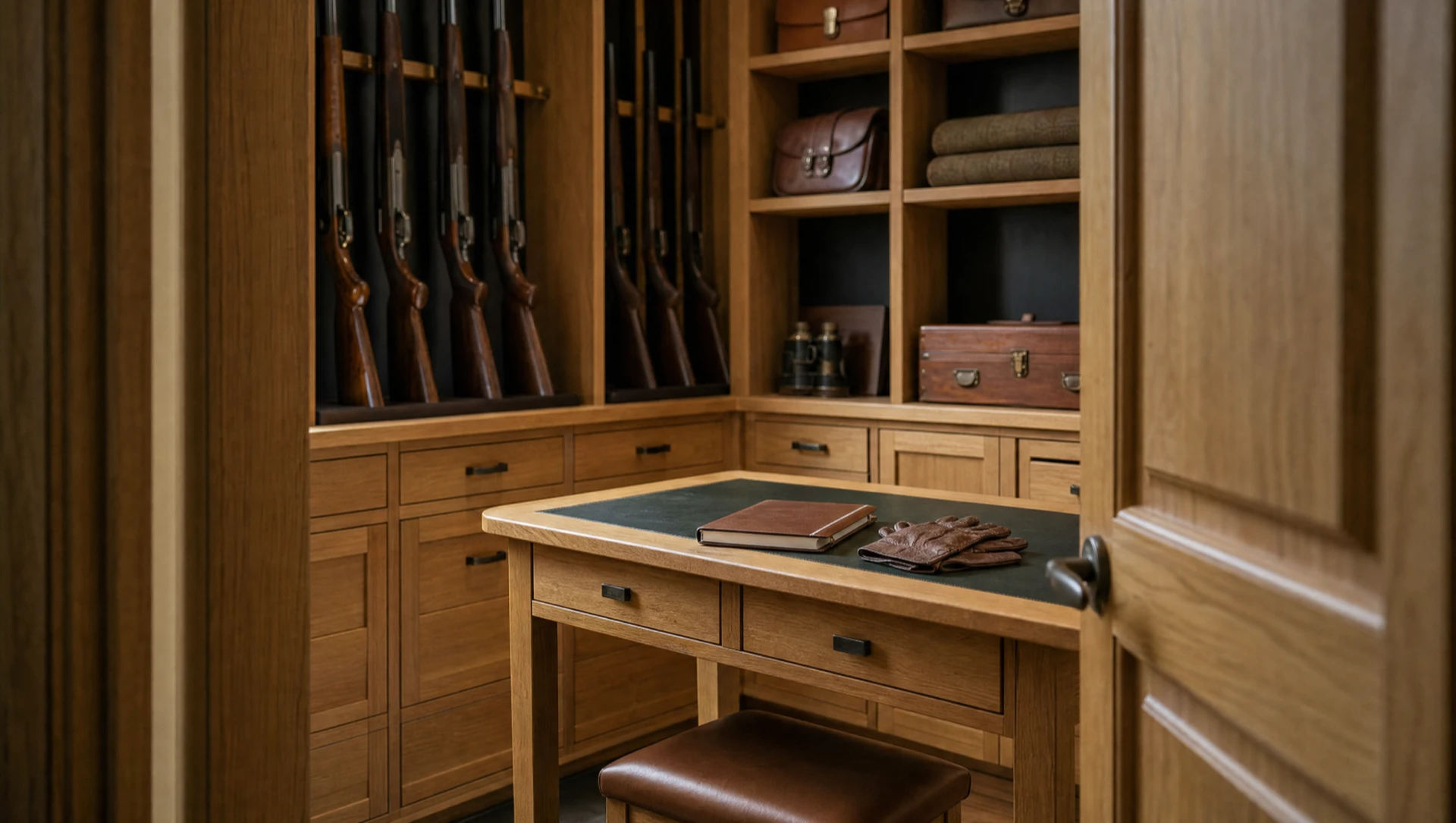
The United Kingdom
We work nationally and we always have. From Mickfield it is a straightforward day to London and the Home Counties, and we have worked west into the Cotswolds and the West Country, north through the Midlands and Yorkshire, and into Wales and Scotland.
Nothing about the piece changes with distance. Same drawings, same timber, same bench, same polisher, same fitters. What changes is the number of visits and how they are grouped.
| Distance from Suffolk | How it usually runs |
|---|---|
| Within about two hours East Anglia, London, the Home Counties, the East Midlands | Survey, a second visit if the room is complex, then installation. No premium. |
| Two to five hours The South West, the Midlands, Wales, the North | Visits are combined — survey and template in one trip. Installation may run over more days simply to avoid travelling back and forth. Costed openly as travel and accommodation, at cost. |
| Scotland and the far North | As above, planned around a single longer installation visit. Worth being generous with the programme; ferry and weather have both cost us a day before now. |
| Islands and remote addresses | Entirely possible and we have done it. Access is the question, not distance — see below. |
Travel and accommodation are shown separately on your quotation, at cost, rather than buried in a rate. You can see exactly what distance is costing you.
What actually matters more than distance
Access. Repeatedly and by a distance.
A gun cabinet is heavy before it has anything in it — steel-lined, solid timber, and on glazed pieces a 26 mm security pane that weighs more than most people expect. A cabinet that cannot get up the stairs is not a cabinet, however well made.
So at survey we measure the route, not just the room: the door widths, the turn at the bottom of the stairs, the half-landing, the ceiling height on the turn, and whether a window can come out if all else fails. Where the route defeats us, we build the piece to be assembled in the room instead — which is a design decision, not an afterthought, and it has to be made before anything is cut.
The three things that change a quotation more than mileage
- Access. A first-floor room with a tight stair turn is a different piece from a ground-floor room with double doors.
- The wall. Masonry is straightforward. Timber frame needs locating and backing. Listed fabric needs a conversation before anybody drills anything.
- Whether a builder is involved. A fitted gun room needs the room prepared first. We fit out; we do not carry out building work, and we are precise about where that line falls.
Europe
We take commissions in Europe and are actively looking for more of them. An English-made gun room is bought in Europe for the same reason it is bought here — because the alternative is a steel box with a timber front.
The practical differences are customs paperwork, transport, and the fact that we will want two visits rather than three. How a European commission works.
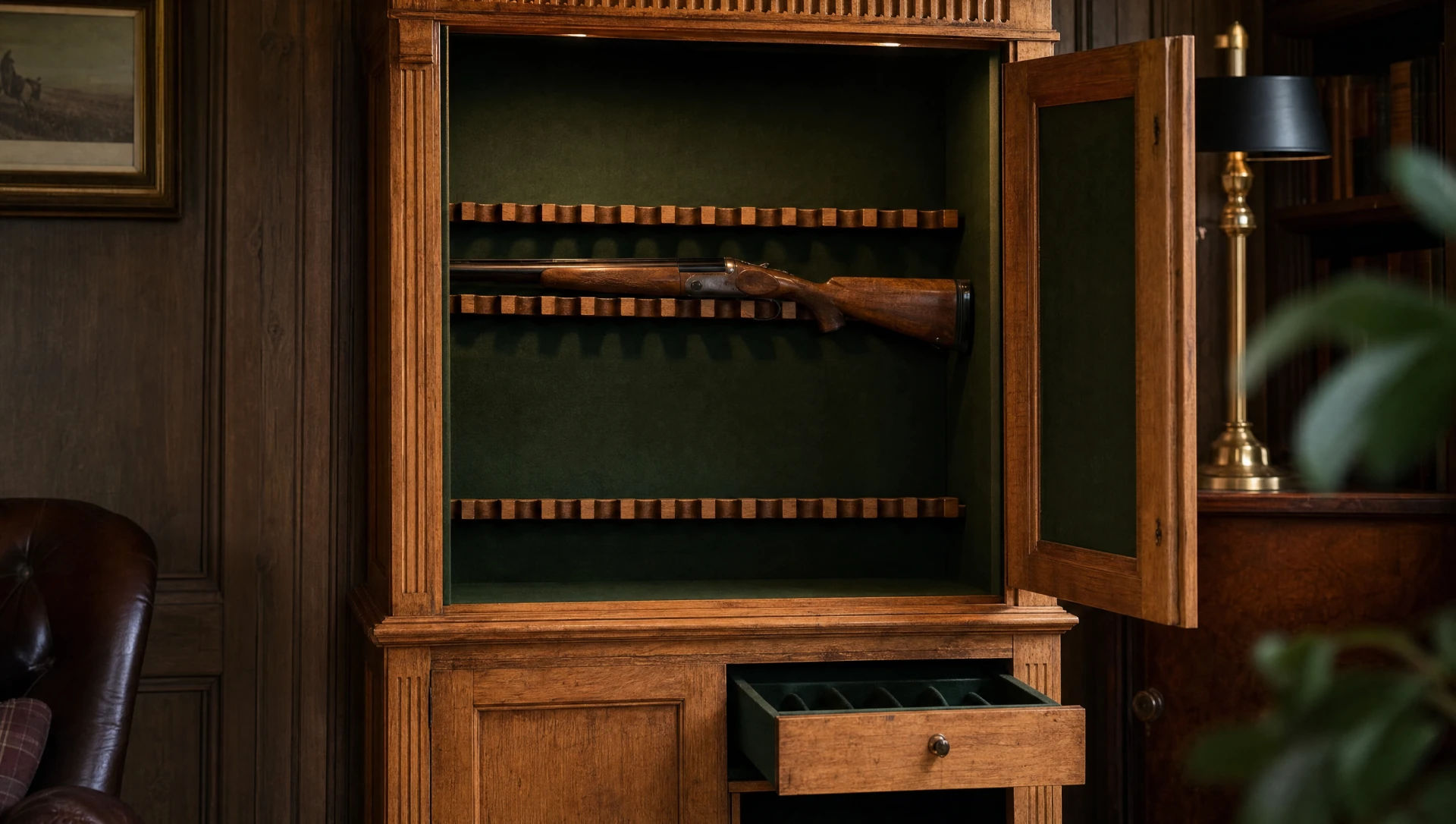
The United States
We ship to the United States, where an English-made cabinet is bought for what it is rather than to satisfy a certificate condition.
American firearms storage law is completely different from ours, it varies state by state, and one state in particular has a specific technical standard that we do not currently meet as standard. We would rather say that on the page than discover it after you have paid a deposit. What an American buyer needs to know, including where we fall short.
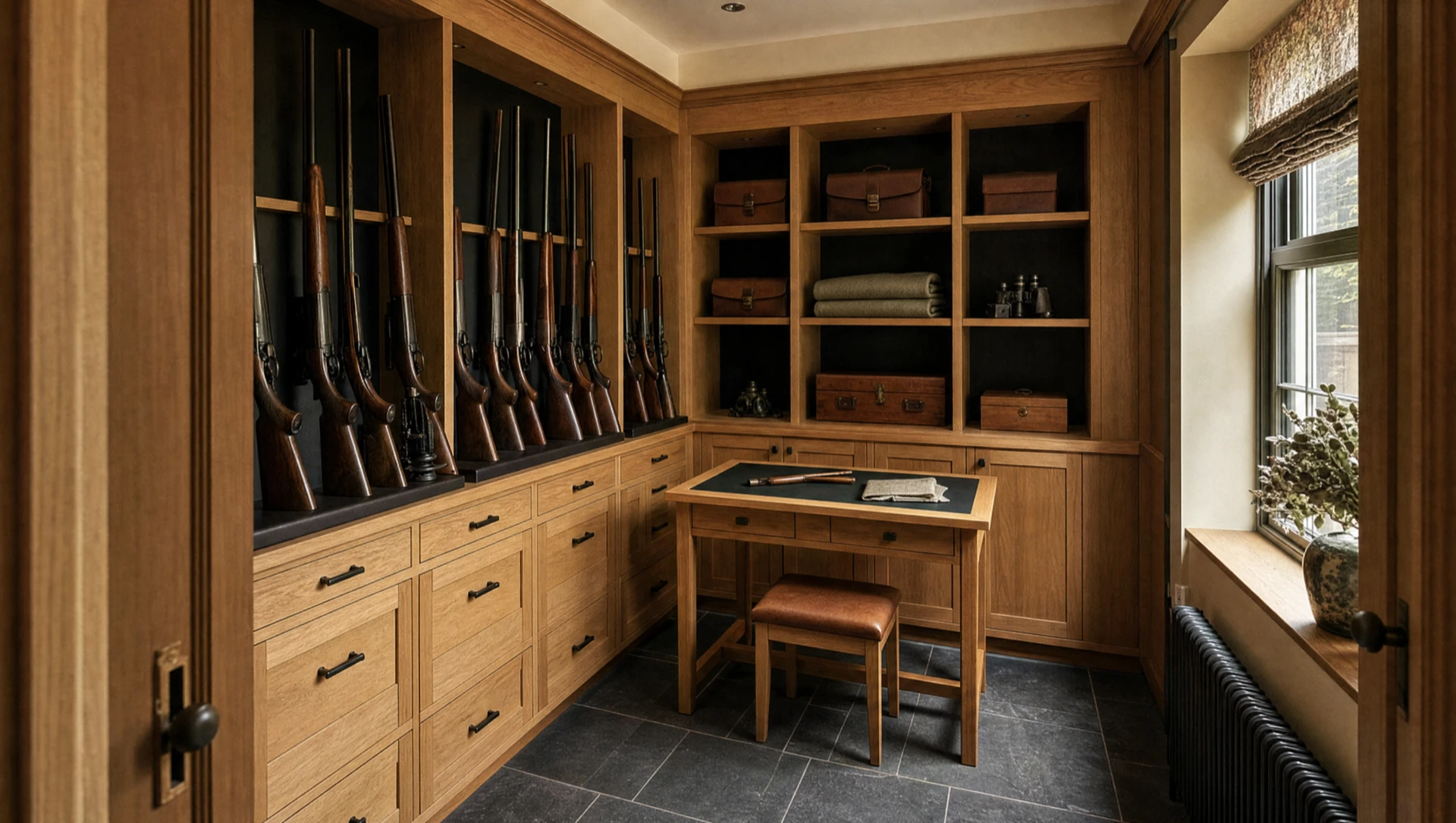
How a distant commission actually runs
- Gun list and photographs firstBefore anybody travels anywhere. Wide photographs from the corners of the room, rough dimensions, and your gun list. We can tell you a great deal from that.
- A long telephone callTwenty minutes settles what a fortnight of email will not. This is where we work out whether you need a cabinet, a run of them, or a room.
- One survey visit, doing everythingMeasured survey, access route, wall construction, power, and the awkward corners. For distant work we template as well, in the same visit.
- Drawings and a fixed priceIncluding travel and accommodation, shown separately. Nothing is cut until you have approved it.
- Installation by our site teamNot a courier and not a local subcontractor. The people who fix it to your wall are the people who made it.
What we will not do
We will not sell a cabinet delivery-only, at any distance. A cabinet has to be anchored into the structure of the building to do its job, and a cabinet standing free on a floor is furniture. If we cannot install it, we would rather not take the commission.
The exception is genuinely long-haul freight, where installation by our site team is impractical. In that case we say so before you commit, we supply the fixings and a written fixing specification, and we talk to whoever will be doing the work. It is a compromise and we describe it as one.
Common questions
Do you charge more for work a long way from Suffolk?
Not for the piece itself. Travel and accommodation are shown separately on the quotation, at cost, so you can see exactly what distance is costing rather than having it built into a rate. What raises a price is usually access or wall construction, not mileage.
Do you work in Scotland?
Yes. It is planned around a single longer installation visit rather than several short ones. Note also that Scotland licenses air weapons separately under the Air Weapons and Licensing (Scotland) Act 2015, which occasionally changes what a client wants locked away.
Can you deliver without installing?
Not within the UK or Europe, no. Fixing is a large part of the security and we are not willing to have it be somebody else’s problem. On long-haul freight where installation by our site team is impractical, we say so in advance and supply a written fixing specification.
What if the cabinet will not fit up the stairs?
Then we design it to be assembled in the room, which is a decision made at drawing stage rather than discovered on installation day. At survey we measure the route as well as the room — doors, stair turns, half-landings and ceiling heights.
Do you work with the client’s architect or builder?
Frequently, and we prefer it. We work to somebody else’s drawing set without difficulty and we are precise about where our scope starts and stops. There is a page written for them.
Where we work, county by county
Everything is made in Suffolk and installed by our site team, so distance is a logistics question rather than a quality one. What follows is simply how the diary works out in practice.
| Region | Survey | Installation | Travel charged |
|---|---|---|---|
| Suffolk, Norfolk, Essex, Cambridgeshire | Within a fortnight | Day trips | Included |
| London and the Home Counties | Within three weeks | Day trips or one night | Included above £18,000 |
| The Midlands, the South West, Wales | Three to four weeks | Two to four nights | Shown as its own line |
| The North and Scotland | Three to four weeks | Three to five nights | Shown as its own line |
| Ireland | By arrangement | Ferry, our own van | Shown as its own line |
| Europe | One visit | Two to five days | £2,160–£5,400 typical |
| United States | One visit, or remote where drawings allow | One week | £7,200–£16,800 typical |
Figures include VAT at 20% for United Kingdom addresses. VAT treatment outside the United Kingdom is confirmed in writing at quotation.
What actually matters more than distance
Three things, none of them mileage. Whether there is a main contractor and whether we are talking to them early. Whether the room is dry and at working temperature before we arrive. And whether the access route was measured at survey — a cabinet that will not go up a staircase is a problem that distance has nothing to do with, and it is the one that has cost us most over the years.
Scotland, and one thing to raise early
Air weapons above a low power threshold require a certificate in Scotland and do not in England and Wales, and the storage conditions follow the certificate. If you are moving guns to a Scottish address or commissioning for a Scottish house, mention it at the outset. The guidance your force works from either side of the border is the Home Office Firearms Security Handbook, but the certificate conditions are not identical.
What we will not do
Supply-only to a fitter we do not know, anywhere. Every piece we make is installed by our site team, because the anchoring is part of the security and we are not prepared to have our name on a cabinet that somebody else has screwed to a plasterboard wall.
Access, which is the real constraint
Distance is a cost. Access is a design decision, and it is the one that most often changes what we build. A 1,200 mm wide glazed cabinet will not go round a half-landing in a Georgian townhouse, and finding that out on installation day is the most expensive mistake available in this trade.
So at survey we measure the route, not just the room: the front door, every doorway, the tightest turn on the stair, the ceiling height at that turn, and whether there is a window that could be taken out if it comes to it. Fitted work is then made in sections sized by the tightest point, and freestanding work is designed so the case, the doors and the plinth travel separately and assemble in the room. Neither costs more; both have to be decided at drawing stage rather than in the van.
Tell us where it is going
Send your gun list and a few wide photographs of the room, wherever it is. We will tell you what we would build, roughly what it would cost, and what distance adds.