
Freestanding Gun Cabinets
A freestanding cabinet is a piece of furniture rather than part of a building. It is still bolted to the wall — every cabinet must be — but it is a whole object, made in the workshop, delivered complete, and it will move house with you.
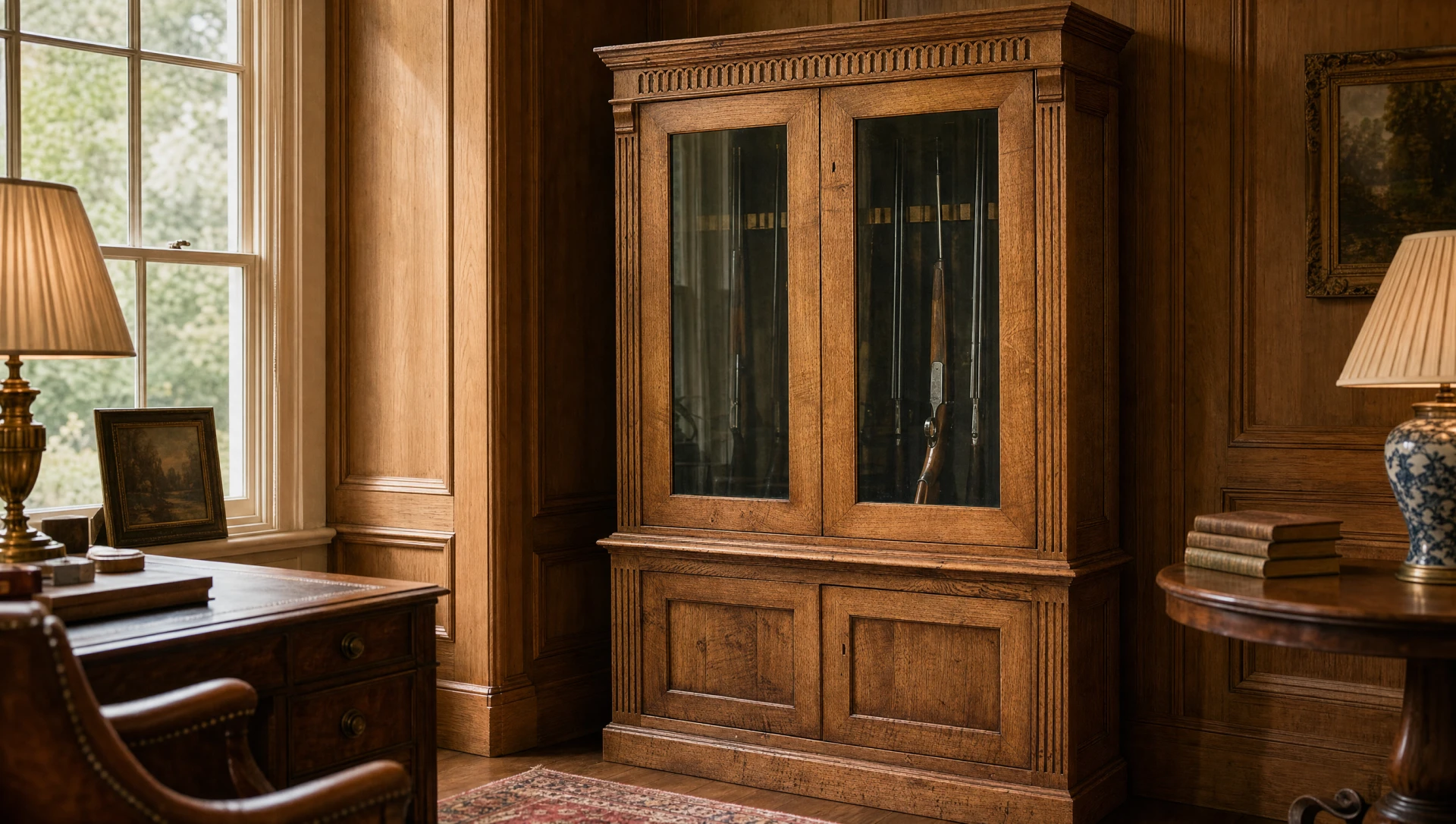
This is where most commissions start, and for a great many people it is where they should finish. A well-drawn freestanding cabinet in the right timber will hold a serious collection, satisfy a licensing department, look like it belongs in the room, and cost a fraction of converting a room.
On this page
What freestanding actually means
It means the cabinet is complete in itself. It has its own carcass, its own back, its own base and its own cornice, and it does not rely on the wall behind it or the joinery beside it to make it a finished object.
The practical consequences are what matter:
- No builder is involved. It goes into a room that already exists, as it is.
- No scribing to a wall that is out of true. The piece is square even if the room is not.
- It can be lifted and refitted — by us — if you move, redecorate or change your mind about the room.
- It is valued as furniture, which matters for insurance and, eventually, for whoever inherits it.
It is still bolted to the wall
Freestanding is a description of how the piece is made, not of how it is installed. Every cabinet we build is delivered and installed by our site team and mechanically anchored into the structure of the building. A cabinet standing free on a floor is furniture, not security.
Fixings go into masonry wherever masonry exists, at centres appropriate to the piece. Where the wall is timber-framed we locate studs and noggins and fix into those, adding backing where the frame does not give us enough — and we tell you that at survey, not on the day. On tall or heavy pieces we use floor fixings as well as wall fixings.
Fixing type and centres are recorded and go onto the signed specification sheet you receive at handover. Your firearms enquiry officer can then verify how it is held to the wall rather than take anyone’s word for it.
Why we do not sell delivery-only
Because a large part of the security of a cabinet is how it is attached to the building, and because a cabinet delivered to a hall by a courier becomes somebody else’s problem at exactly the point where the work matters. Our site team brings it in, positions it, anchors it, and hands over the paperwork.
Forms
| Form | Notes |
|---|---|
| Single door, full height | The narrowest footprint. Suits a corner, a chimney breast return, a landing |
| Double door, full height | The workhorse. Holds a real collection in one piece of furniture |
| Glazed above, panelled below | Our most-made form. Guns on display, cartridges and kit hidden beneath |
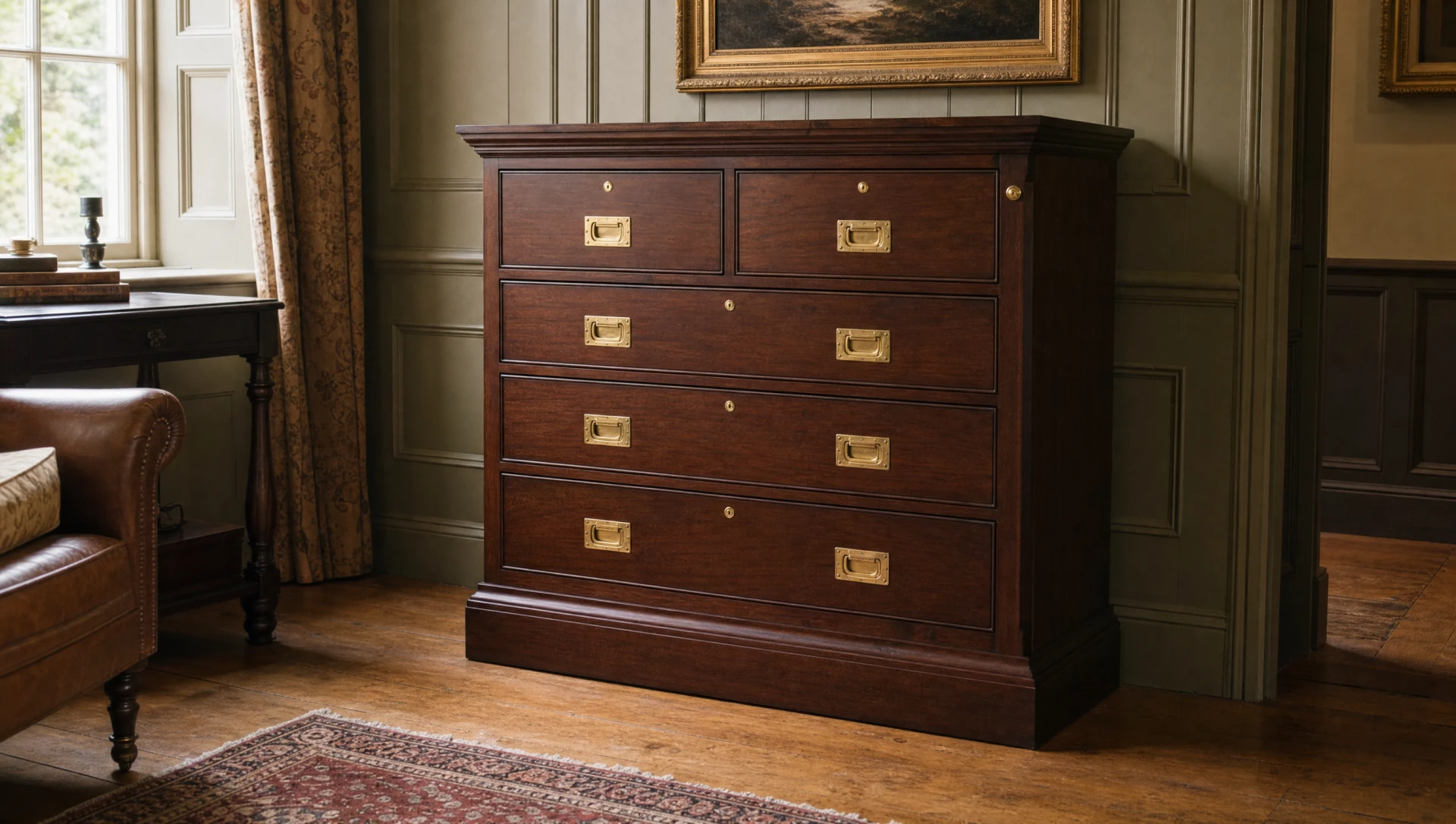
| Press or linen-press proportion | Base with drawers, upper case above, cornice on top. Reads as antique furniture |
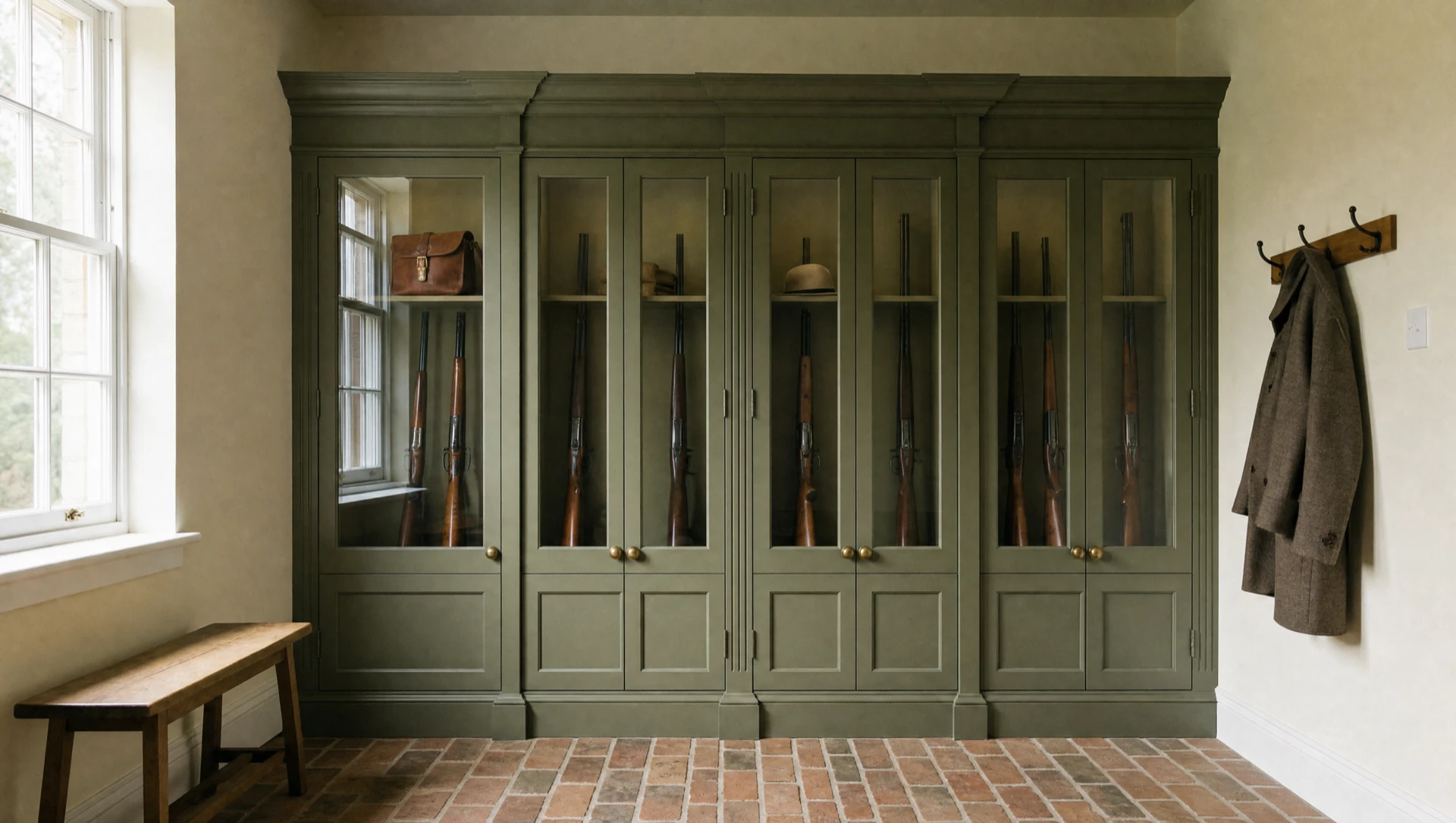
| Four-door and multi-bay | Larger collections, each bay locking independently |
| Wellington chest | Drawers rather than racks. Cartridges, ammunition and kit |
Every one of them is drawn for the room and for the collection. There is no range and there are no sizes.
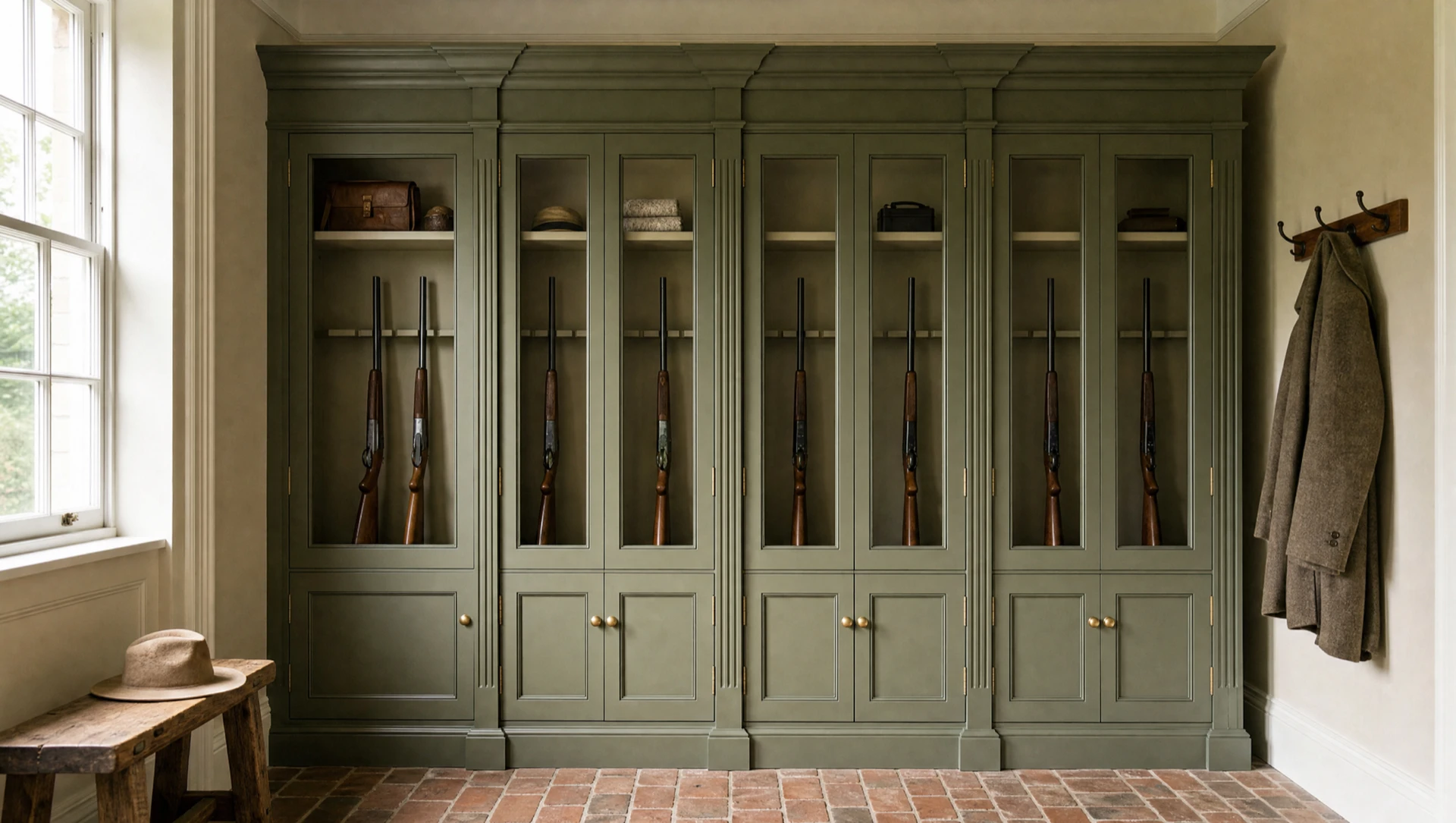
Proportion — the real problem
The design problem with a freestanding gun cabinet is not security, it is that the brief produces bad proportions unless somebody fights them.
A cabinet must be tall enough to stand a gun in and deep enough to take a lock and a rack. Left undrawn, that produces a tall, narrow, deep box — the proportion of a wardrobe stood on its end, which is why so many gun cabinets look like appliances.
The fixes are the ones cabinetmakers have used for three centuries:
- Give it a footA base cupboard or a bank of drawers under the main case, so the piece sits on the floor rather than standing on it.
- Give it a headA cornice, and where the room takes it, a pediment. It stops the eye at the top instead of letting the box run out.
- Break the elevationA waist moulding, so the eye reads two elements of civilised proportion rather than one very tall one.
- Set the depth honestlyDeep enough to work, no deeper. Every extra 50mm of depth reads as bulk from across the room.
- Let the timber do workBook-matched figure across a pair of doors gives the front a centre, which a plain front does not have.
Access, which defeats more installations than size
The commonest thing that stops a freestanding cabinet is not the room. It is the route to the room.
We survey the access as carefully as the wall: doorways, the turn at the bottom of the stairs, the half-landing, ceiling height on the turn, the width at the newel post, and whether a door can be taken off its hinges. Older houses in particular are full of routes that will take a person and a ladder but not a finished cabinet.
Where a piece will not physically reach the room in one, we design it to be assembled in the room, with the joints falling where they would anyway — on a waist moulding, a cornice line or a scribe. Done at drawing stage this is invisible afterwards. Done on the day it is a problem. Tell us early about tight stairs and we will design around them.
Installation day
Worth describing, because people are often surprised by how little disruption there is and occasionally surprised by how much space we need for an hour.
Our site team arrives with the piece, protection for your floors and the fixings for your wall — established at survey, not guessed at on the day. The cabinet comes in, usually on its back on a board, and that is the moment when the access route matters. It is then stood, positioned, checked for plumb and level against a room that will not be either, packed where necessary so it stands true, and anchored into the structure.
Then the interior goes in: racks, baize, cleaning rack, drawers, ammunition provision, lighting. Doors are hung and adjusted last, once the carcass has settled onto its fixings, because a door hung before the piece is anchored will need adjusting afterwards anyway.
You get the keys, the signed specification sheet listing steel thickness, glass specification, lock model, fixing type and centres, drawings as installed, and care instructions for the timber. We take the packaging away with us rather than leaving it in your skip.
Most single cabinets are a half day. A larger piece, or one that has to be assembled in the room, is a full day. If the electrician needs to make a final connection to the cabinet lighting, that is the one thing we cannot do ourselves — so it is worth having them available or arranging it for shortly after.
Moving house
One of the real advantages of a freestanding piece, and one worth handling properly.
The cabinet is furniture and it can come with you. What cannot come with you is the assessment: your storage was approved at your old address, and a new address is a new assessment. A cabinet that was entirely satisfactory in a town house may prompt a different conversation in an isolated farmhouse — the property, its occupancy and its circumstances are all part of what your licensing department weighs.
Two things to do, in this order:
- Tell your licensing department before you move, not after.
- Have it lifted and refitted by our site team. The fixings are a large part of the security and refitting is not removals work. We will re-anchor it properly at the new address and reissue the specification sheet with the new fixing detail on it.
Freestanding or fitted?
We make both, and the honest answer depends on how permanent the house is.
Freestanding suits you if the cabinet may move, if there is no existing joinery to match, if you want the piece valued as furniture, or if you simply want it done without involving anybody else’s programme.
Fitted suits you if there is a run of panelling, shelving or cupboards it should become part of, if the room is being done anyway, or if you want the cabinet to disappear into the architecture rather than sit against it. Fitted work makes better use of an awkward space — an alcove, a chimney return, a boot-room wall — and it is the route to concealment.
If you are between the two, send us a photograph of the wall. It is usually obvious within a minute.
Responsibility for meeting the security condition on your certificate rests with you as the certificate holder, and the adequacy of any storage arrangement is a matter for your local police firearms licensing department — including after a move. We agree the specification with your firearms enquiry officer before we make anything. Nothing on this page is legal advice.
Questions we are asked
Does a freestanding gun cabinet still have to be fixed to the wall?
Yes. Freestanding describes how the piece is made, not how it is installed. Every cabinet is anchored into masonry or located structural timber by our site team, with floor fixings as well on tall or heavy pieces, and the fixing type and centres recorded on your specification sheet.
Can I take it with me if I move?
Yes — that is one of the advantages. But tell your licensing department before you move rather than after, because a new address means a new assessment, and have us lift and refit it. The fixings are a large part of the security and refitting is not removals work.
What if it will not fit up the stairs?
We survey the access route as carefully as the wall. Where a finished piece will not reach the room in one, we design it to be assembled in the room with the joints falling on a waist moulding or cornice line, so it is invisible afterwards. Tell us about tight stairs at the outset.
Why do so many gun cabinets look like appliances?
Because the brief produces bad proportions unless someone fights them — tall enough for a gun and deep enough for a lock is a wardrobe on its end. The fixes are a base to give it a foot, a cornice to give it a head, a waist moulding to break the elevation, and honest depth.
Freestanding or fitted?
Freestanding if the cabinet may move, if there is no joinery to match, or if you want it valued as furniture. Fitted if there is panelling or shelving it should become part of, if the room is being done anyway, or if you want it to disappear into the architecture.
Do you deliver outside East Anglia?
Yes — we deliver and install throughout the United Kingdom from the Suffolk workshop, and ship internationally including to the United States. Distance is a cost line on the quotation rather than an obstacle.
How freestanding gun cabinets are actually anchored
The word freestanding describes how the piece is made and moved, not how it is secured. Every cabinet we make is bolted back into the building, and the Firearms Security Handbook treats the fixing as part of the security rather than an afterthought. It is worth knowing what good looks like, because it is the detail most often skipped.
- Four anchors minimum, two high and two low, through the back of the steel carcass — not through the timber case around it.
- M10 through-bolts or resin-anchored studs into masonry. Plastic plugs and coach screws are not anchoring; they are hanging a picture.
- Anchor plates on the inside face, so the bolt head cannot be pulled through the steel.
- Into structure, not into finish. Dot-and-dab plasterboard leaves a 15–25 mm void; the fixing has to be sleeved through it and land in the block, or it is a lever waiting to be used.
- Into the floor as well where the wall is poor, which happens more often in period houses than anyone expects.
Moving house with it
This is the reason most people choose freestanding, so it is worth setting out what actually happens. We unbolt, make good the wall, wrap and move the piece, survey the new position and re-anchor it. Moving and re-fixing an existing cabinet is quoted by distance from the workshop. What we will not do is hand you the bolts and let you take it yourself — not because we want the fee, but because a cabinet re-fixed into the wrong substrate is a cabinet that is no longer secure, and your certificate conditions follow the cabinet to the new address.
Tell your firearms enquiry officer before you move, not after. A change of address is a certificate variation, and the storage at the new house will be checked. We will supply a fresh specification sheet for the new position at no cost.
Freestanding designs in the standard range
Most of the published range is freestanding: The Deben and The Deben Solid as upright cabinets, The Brett as a low chest for cased guns lying flat, and The Orwell as a Wellington chest for cartridges. Sizes and prices are in the standard range.
Send us your gun list and a photograph of the wall
Include the route in from the front door if the stairs are tight. That is enough for us to tell you what we would build and roughly what it would cost.
If a move is coming, moving house with a collection covers what to plan for before the new house is committed to.
>