
Cigar Storage
Cigar Cabinets and Humidor Tables
Three drawn starting points and a full-height cabinet, all of them bespoke. The capacities below are the honest ones — what the piece actually holds in boxes and singles, not the number a catalogue would print.
Every maker quotes a capacity, and every quoted capacity assumes cigars packed like pencils in a tin. We give two numbers. The nominal figure is the volume calculation, which is the one the trade uses. The real figure is what fits once you allow for trays with sides, boxes stood up, air moving round the stack and the fact that nobody fills a humidor to the lid. Order against the real number.
The Stonham — a writing table that holds cigars
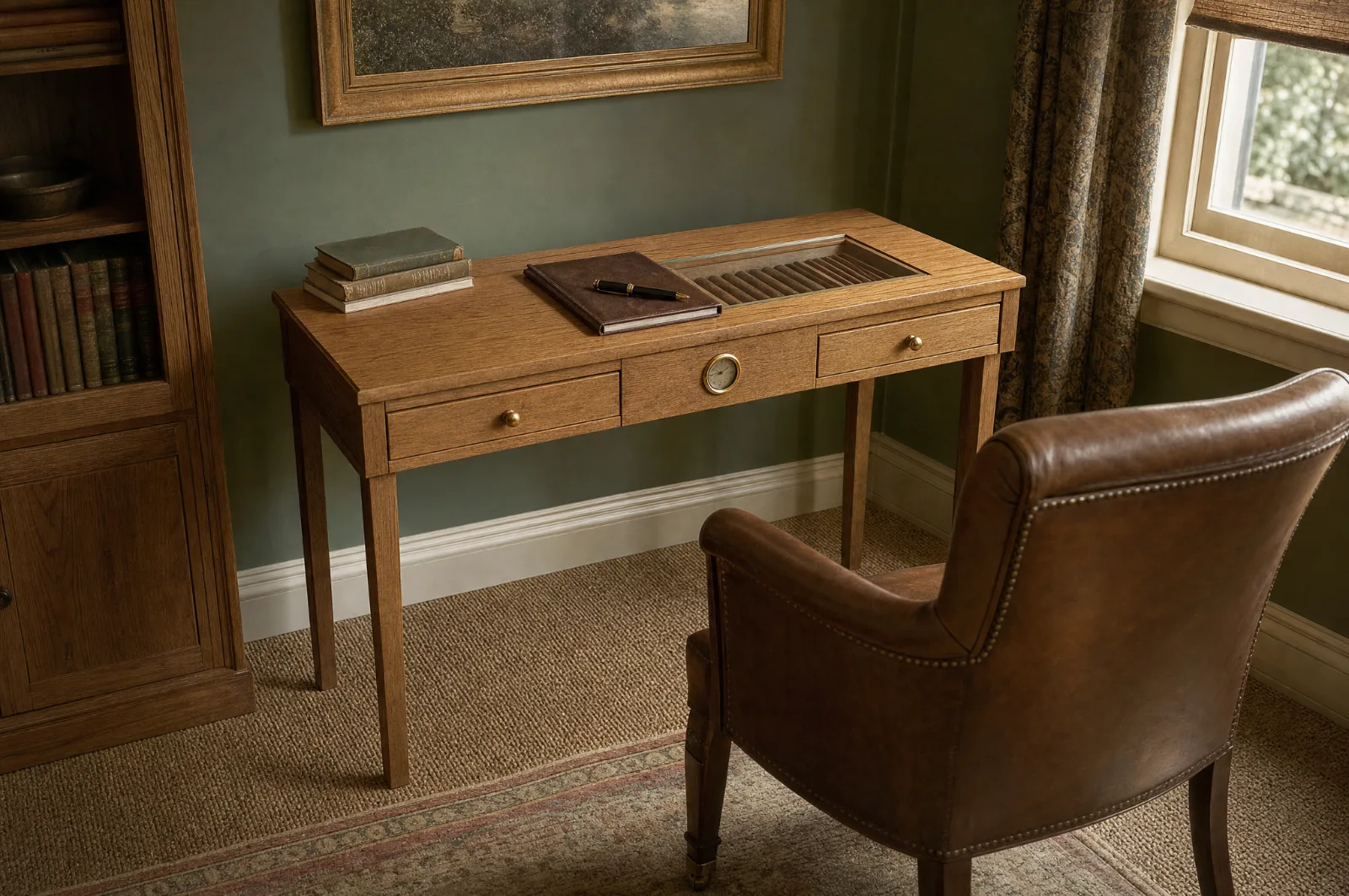
A side table or desk with a sealed, cedar-lined bay let into the top under flush glass, a hygrometer set into the front rail and drawers either side for cutters, lighters and the rest of it. Twenty-five nominal, eighteen real, in one layer with no tray to lift out. Passive humidification in the plenum, changed twice a year.
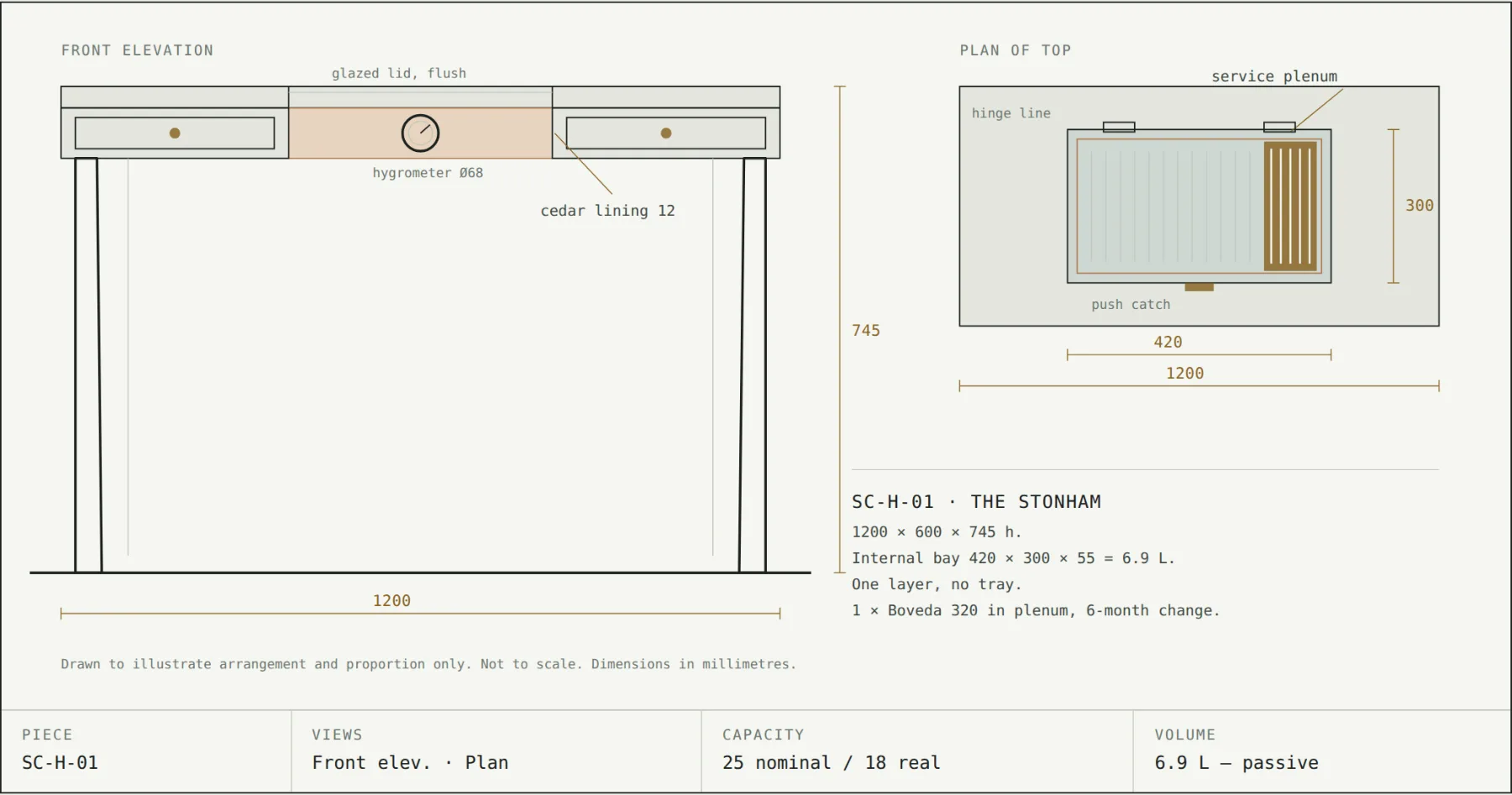
The Helmingham — a low table beside a chair
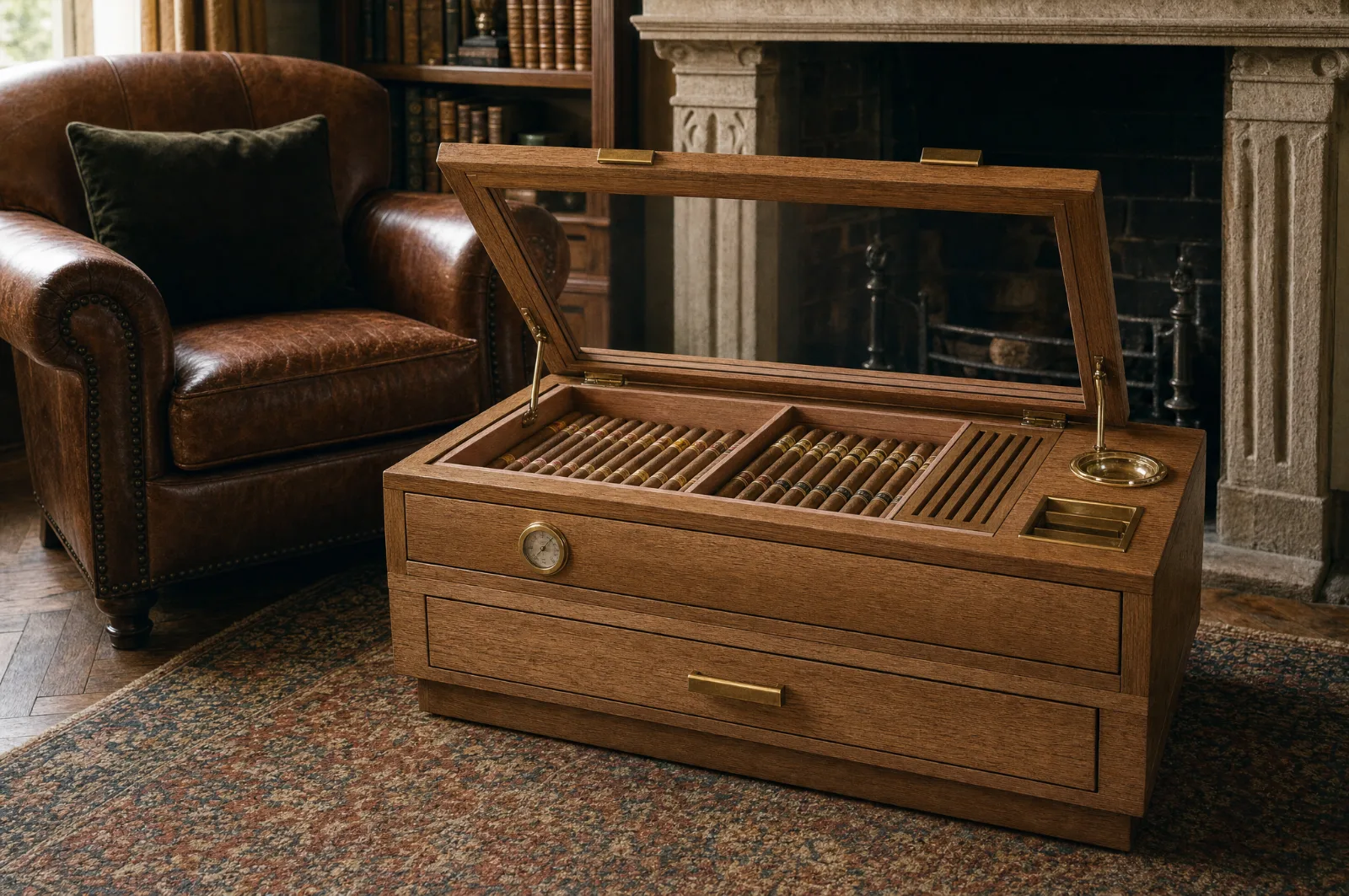
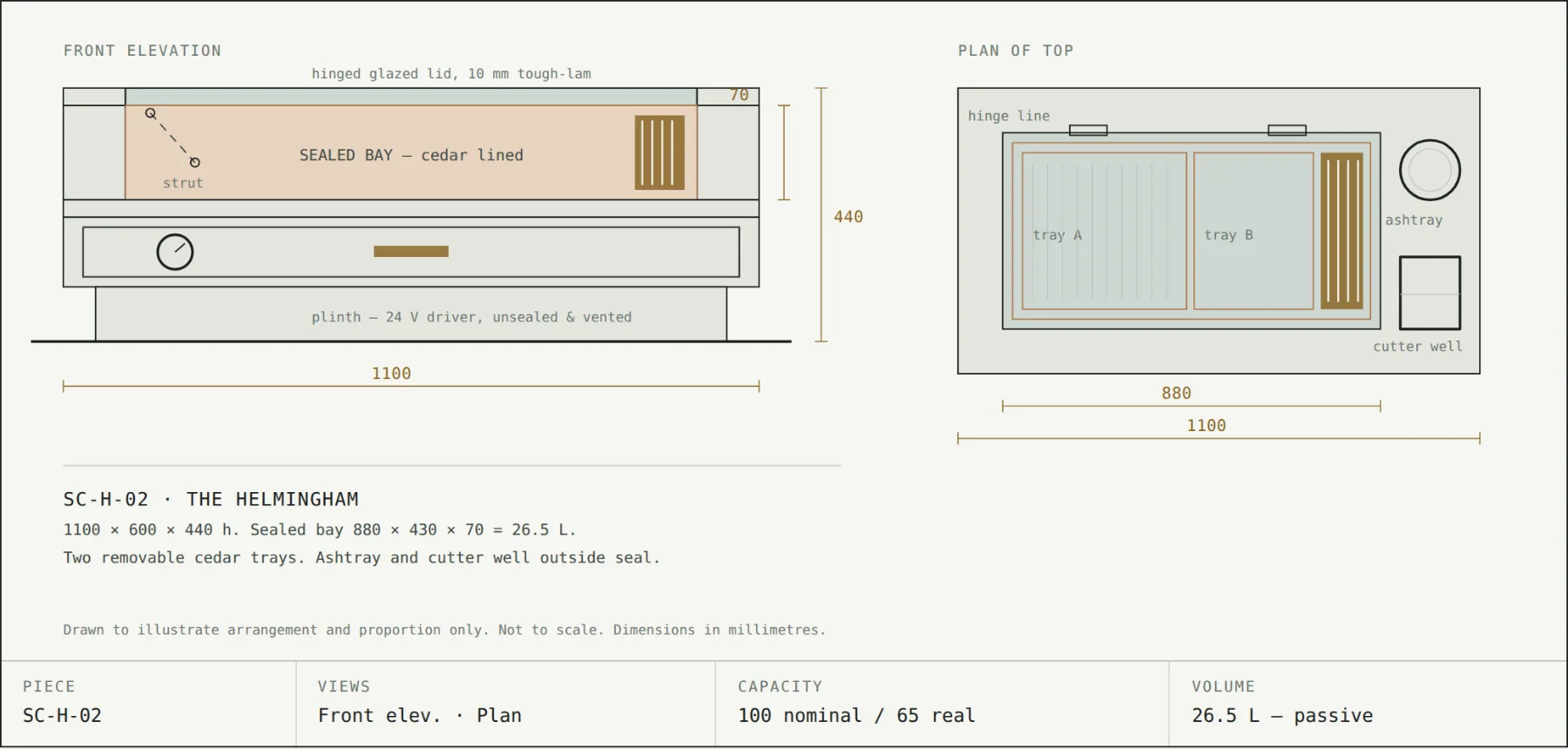
Coffee-table height, with a hinged glazed lid on a strut so the whole bay opens and everything in it is visible at once. A hundred nominal, sixty-five real, across two removable cedar trays. The ashtray well and the cutter well sit outside the seal in the top, so using them does not open the humidified volume.
The Framlingham — display over working storage
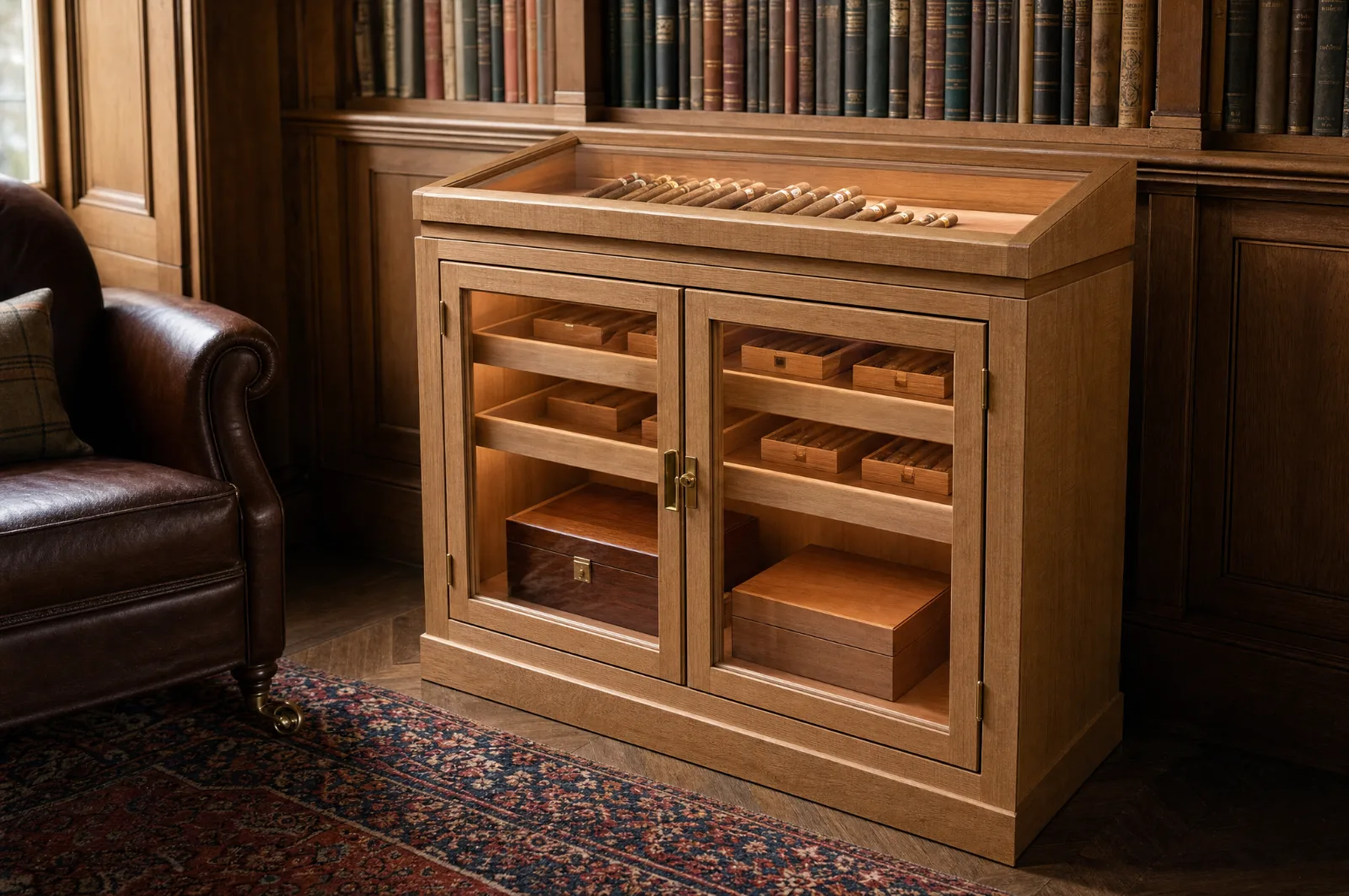
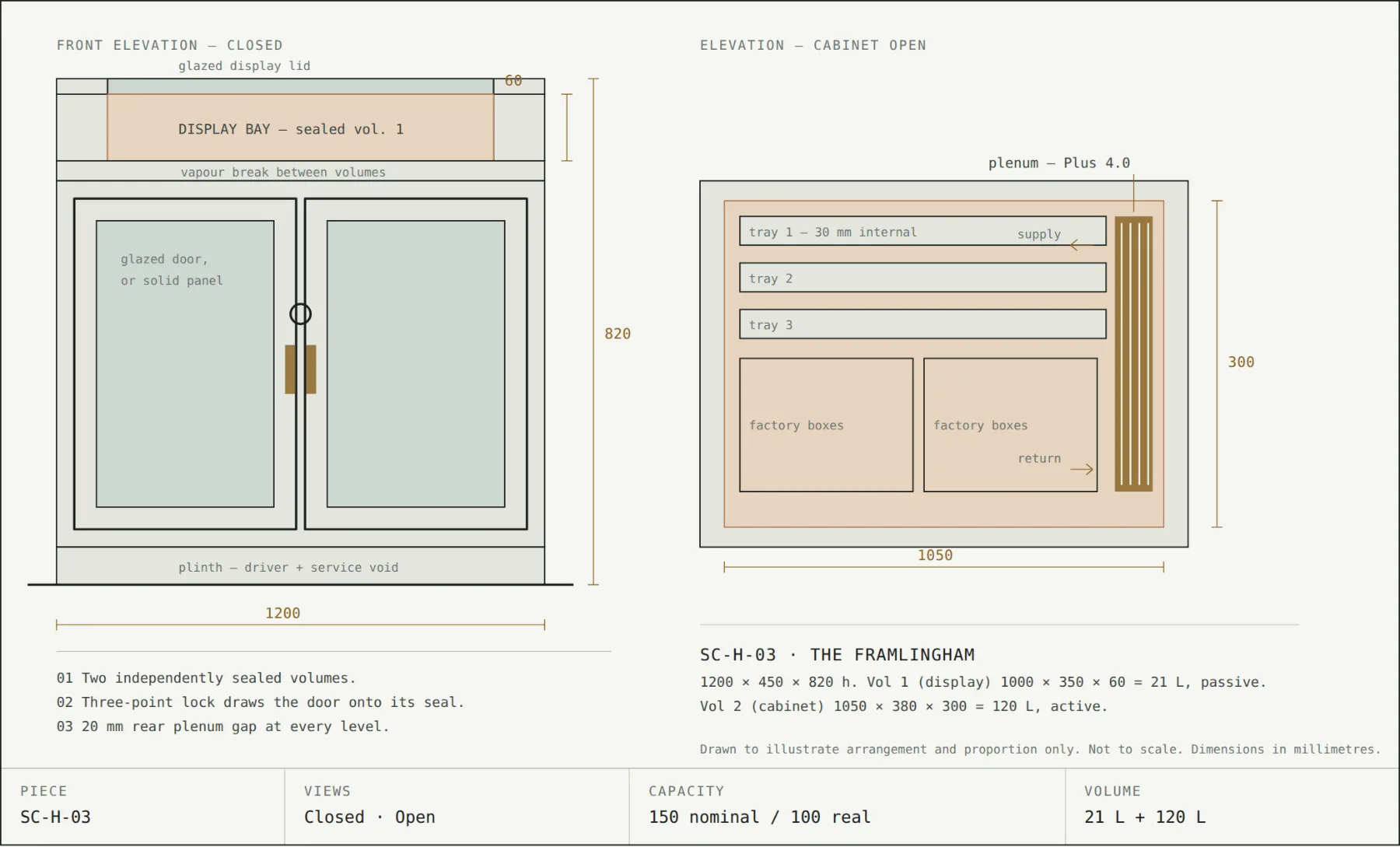
A glass-topped table cannot sensibly hold a hundred and fifty cigars; the volume gets too deep to control and you end up moving four trays to reach the bottom one. So the Framlingham splits vertically. A shallow glazed display bay sits over a cedar-lined cabinet with sliding trays and standing room for factory boxes, and the two are sealed as independent volumes with a vapour break between them. The display bay runs passively. The cabinet below is actively humidified with a rear plenum and a twenty millimetre air gap at every level, so air moves round the stack rather than past the front of it.
A hundred and fifty nominal, a hundred real. The doors are glazed or solid panel, and a three-point lock draws the door squarely onto its seal rather than relying on the catch alone.
Full-height cabinets
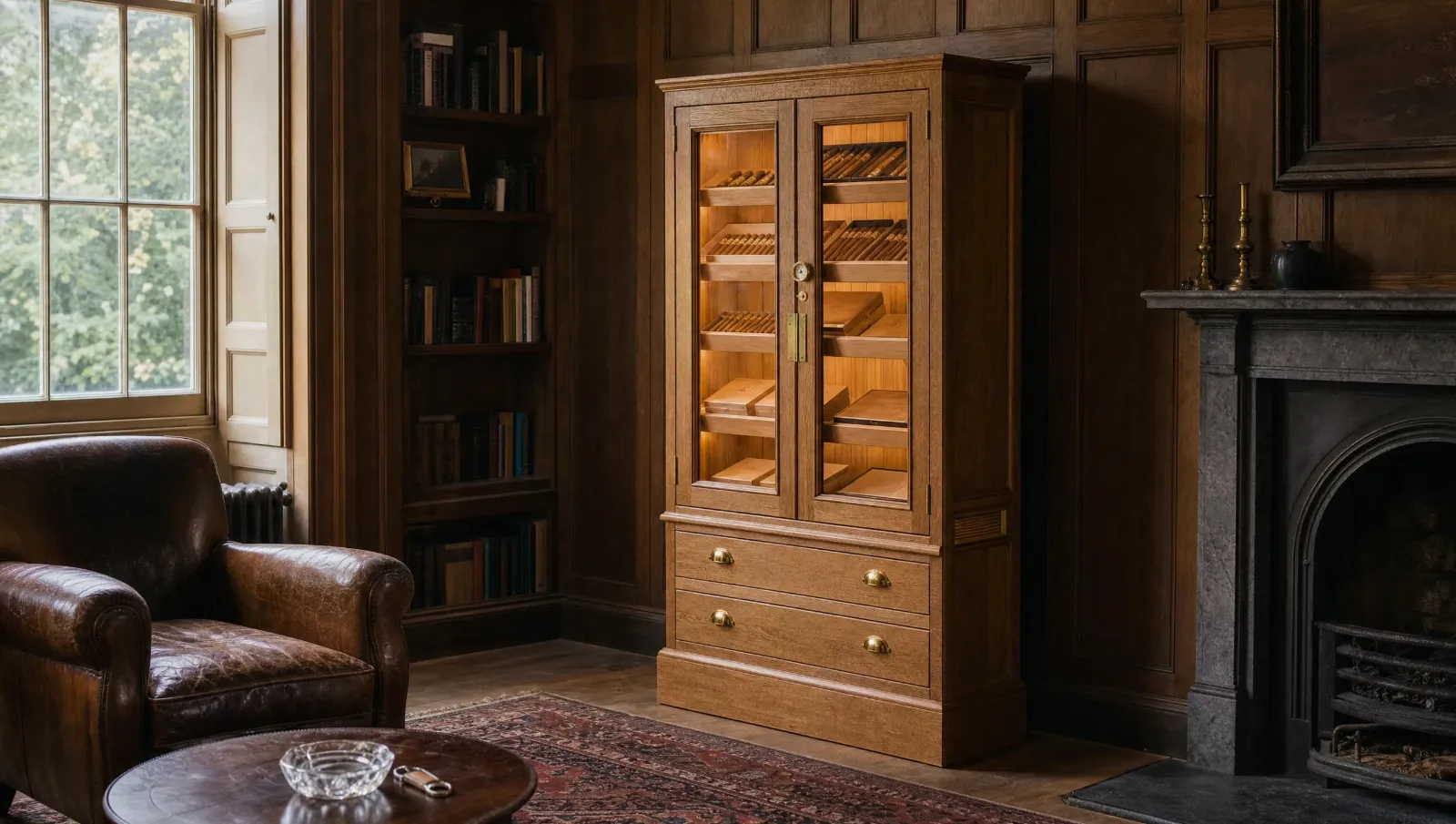
Above those three there is the cabinet proper: a glazed upper section on a drawer base, lit inside, with sliding cedar trays and standing room for boxes behind the doors and lay-flat drawers underneath. This is the piece for a collection that is genuinely being laid down rather than smoked through in a season, and it is where active humidification earns its place. Oak, cherry, walnut or hand-painted, with the glazing bars and mouldings drawn to the room.
The two details that decide whether it works
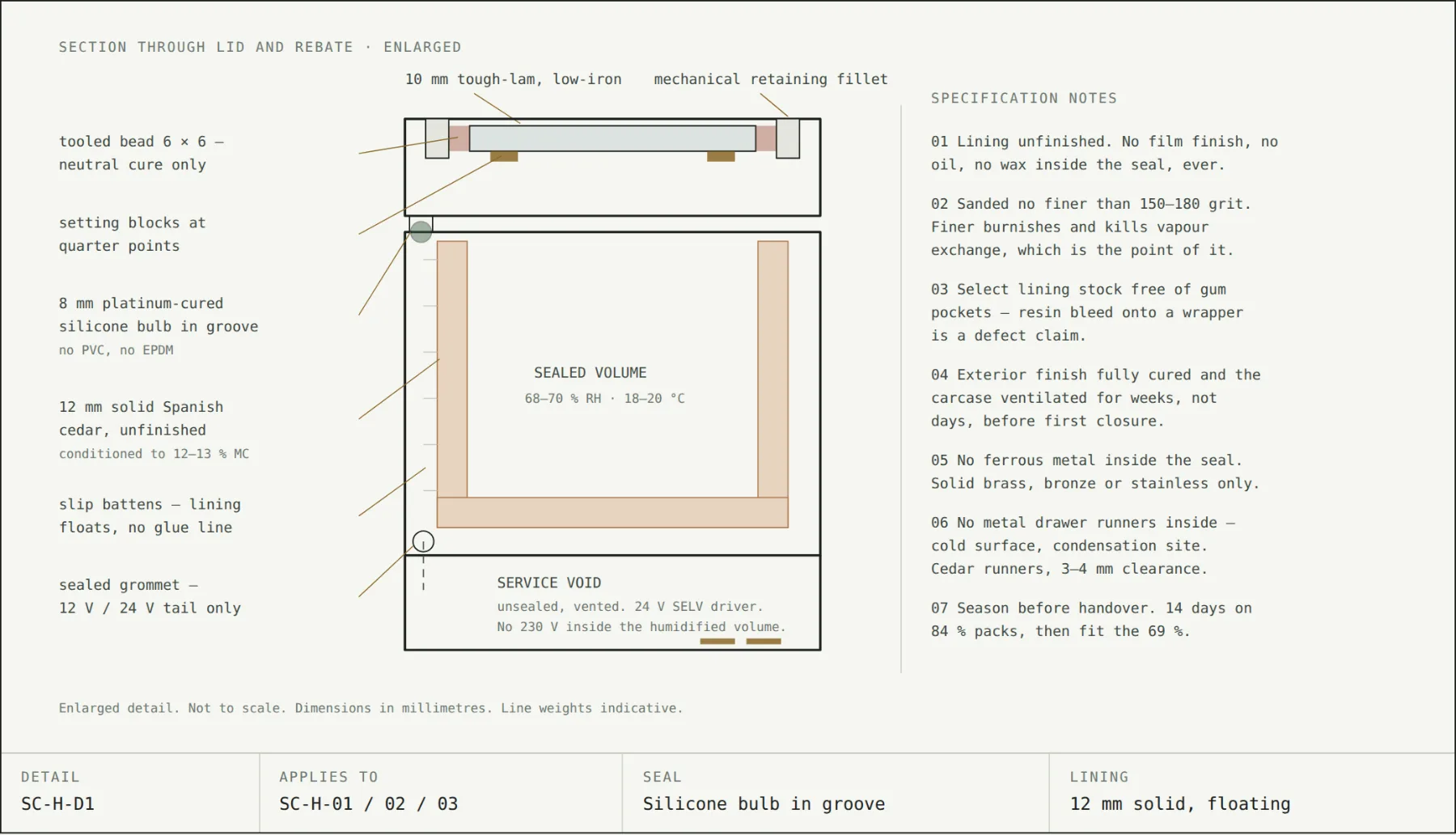
The first is the seal and the lining. A silicone bulb in a machined groove compresses evenly and stays flexible for years; a self-adhesive foam strip does neither. The lining floats on slip battens with no continuous glue line, so twelve millimetres of solid cedar can take up and give back moisture without splitting the carcase apart. And the exterior finish is fully cured and the carcase ventilated for weeks — not days — before the piece is closed up for the first time, because solvent trapped in a sealed cedar box goes into the cigars.
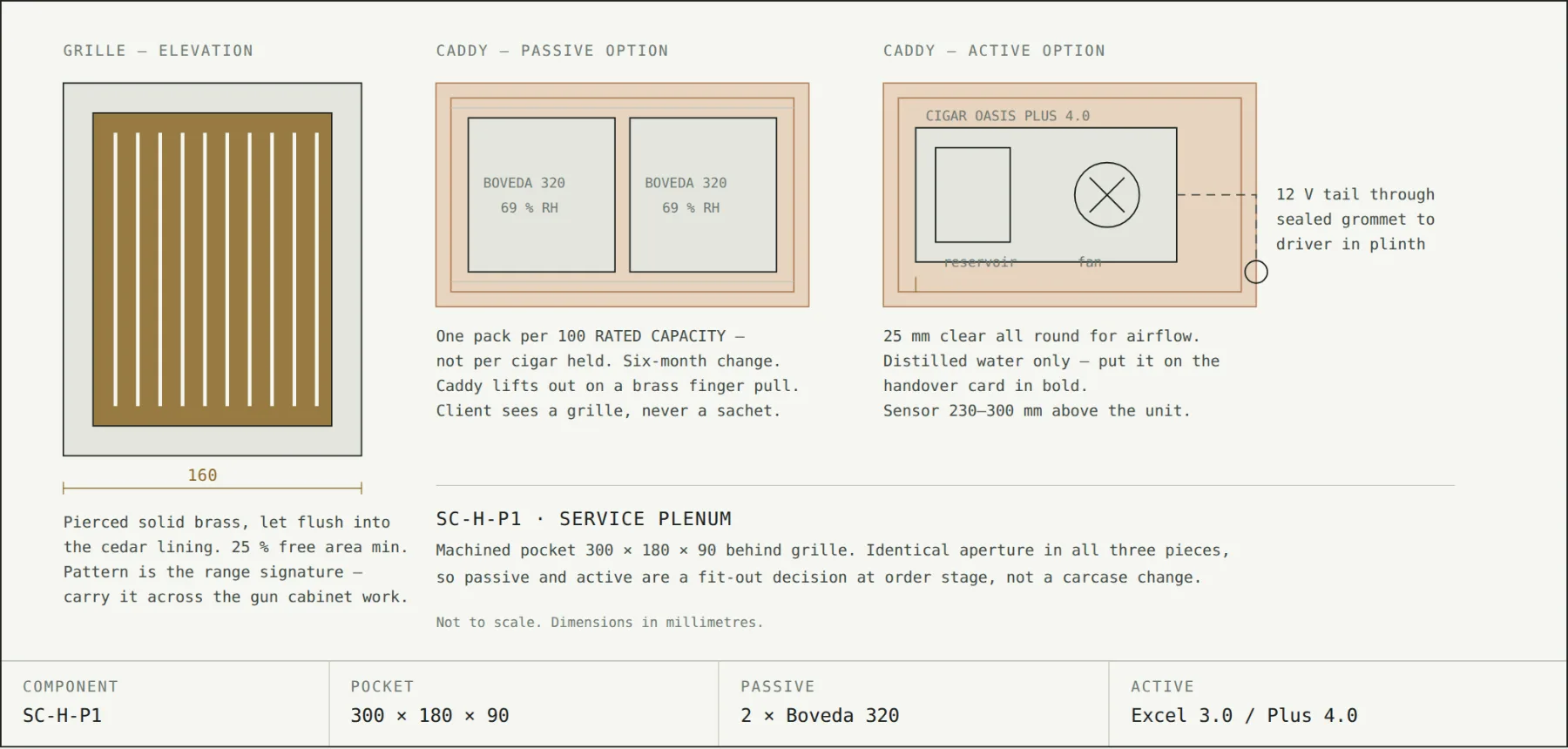
The second is where the humidification lives. Every piece gets the same machined pocket behind the same pierced brass grille, so the decision between passive packs and an electronic unit is made at order stage and can be changed later without touching the carcase. Passive packs are sized on the rated capacity of the box, not on how many cigars are in it — a cabinet rated at a hundred needs its full complement even when it is holding thirty. Where a unit is fitted, it takes distilled water only, and that goes on the handover card in bold.
Before it leaves us
Every piece is seasoned in the workshop before handover: a fortnight on high-humidity packs to bring the cedar up, then the running packs fitted and the piece held and logged until it is steady. A humidor delivered dry, with a note telling the client to season it themselves, is a humidor that will be blamed for the first box of cigars it ruins.
Commission a piece
Tell us how many cigars, whether they are boxes or singles, and what the room is. We will come back with a drawing and a price rather than a brochure.
Walk-in cigar rooms · Ventilation and filtration · Timber · Prices and lead times
Questions we are asked
How many cigars does each piece hold?
The Stonham holds twenty-five nominal and eighteen real, in one layer with no tray to lift out. The Helmingham holds a hundred nominal and sixty-five real across two removable cedar trays. The Framlingham holds a hundred and fifty nominal and a hundred real. Order against the real number.
Why do you quote two capacities?
Every maker quotes a capacity, and every quoted capacity assumes cigars packed like pencils in a tin. The nominal figure is the volume calculation, which is the one the trade uses. The real figure is what fits once you allow for trays with sides, boxes stood up, air moving round the stack and the fact that nobody fills a humidor to the lid.
What size is the Helmingham?
1100 × 600 × 440 high, with a sealed bay of 880 × 430 × 70 — twenty-six and a half litres. The ashtray well and the cutter well sit outside the seal in the top, so using them does not open the humidified volume.
Why does the Framlingham split into two sealed volumes?
A glass-topped table cannot sensibly hold a hundred and fifty cigars; the volume gets too deep to control and you end up moving four trays to reach the bottom one. So a shallow glazed display bay sits over a cedar-lined cabinet, sealed as independent volumes with a vapour break between them. The display bay runs passively and the cabinet below is actively humidified.
Humidity, seasoning and holding sixty-eight — the fortnight after a new cabinet arrives matters as much as the joinery.
Cedar, and what it actually does — why it is never sealed, and why it has to be free to move.