
Concealed Gun Storage
The best security is a lock nobody tries, and the best cabinet is one nobody knows is there. But concealment is an addition to a specification, never a substitute for one — and a firm that sells you the disguise instead of the steel has sold you a magic trick.
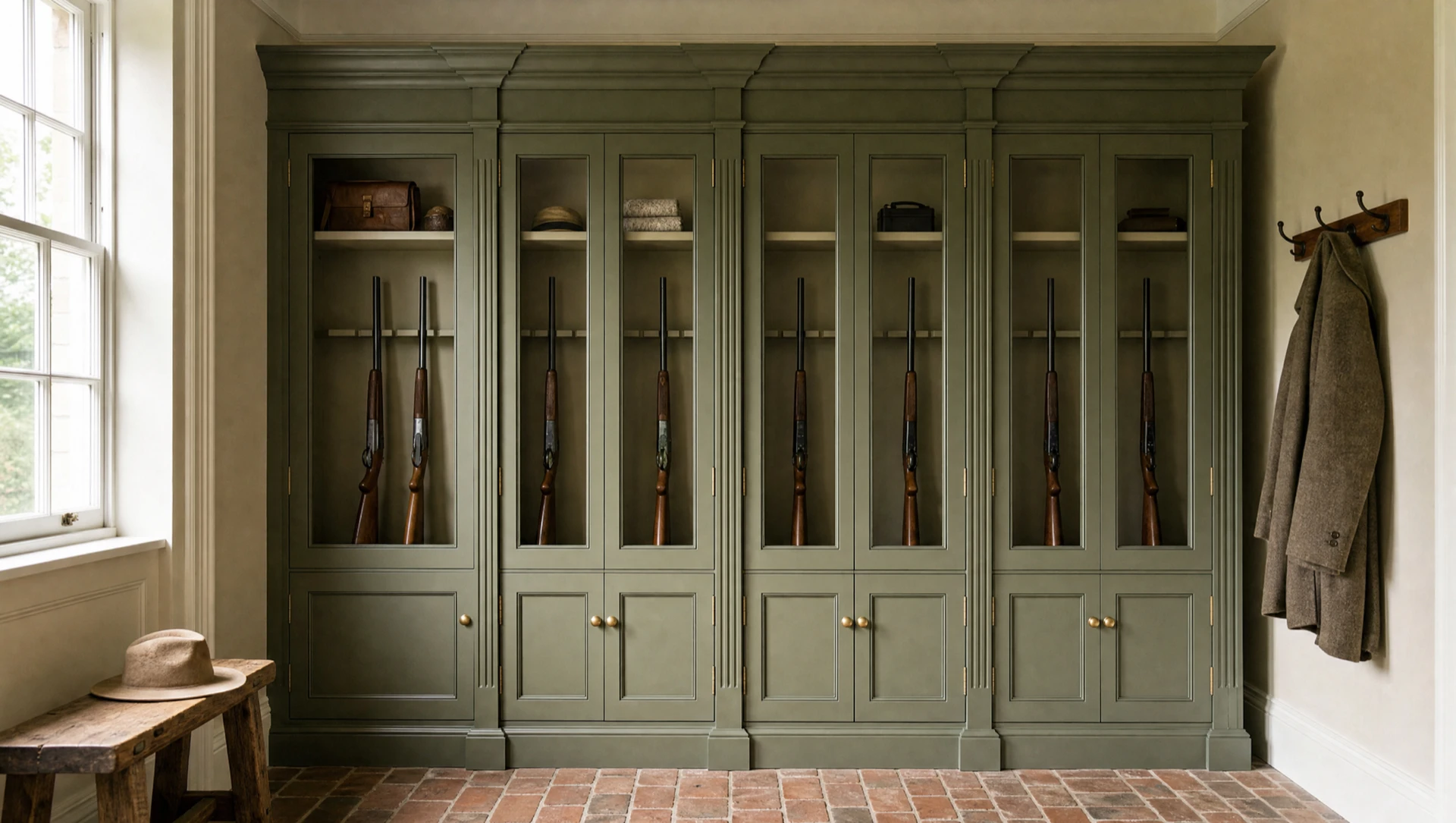
Let us be clear about that at the top, because it is the point on which this whole category is usually mis-sold. Every concealed piece we make carries the full specification: 3mm (0.12in) steel throughout, folded doors returned behind the frame, 8-lever safe locking to EN 1300 Class A, and mechanical anchoring into masonry or located structure. The concealment sits on top of that. If the disguise is ever discovered, what is found underneath is a proper cabinet, not a cupboard.
On this page
Why conceal at all
Three reasons, and only one of them is romance.
Visibility invites attention. A cabinet that is obviously a gun cabinet tells everyone who sees it what is in the house. Contractors, cleaners, delivery drivers, party guests, a child’s friends and everyone those people talk to. Concealment does not make a cabinet stronger; it reduces the number of people who ever think about it.
The room does not want it. Some rooms simply will not take a gun cabinet, however well it is made. A drawing room, a principal bedroom, a panelled library with a fixed scheme. Concealment lets storage go where it is convenient rather than where it is tolerable.
Because it is a lovely piece of joinery. A bookcase that swings, a panel that releases, a top that rises — these are the pieces our cabinetmakers most enjoy making, and they are the ones clients show people. That is a legitimate reason and we will not pretend otherwise.
Discreet, or concealed
Two different briefs at two different prices, and worth separating before anybody quotes.
Discreet means the piece is furniture. A panelled cupboard, a linen press, a Wellington chest — recognisable as a piece, unremarkable in the room, and giving no clue to its contents. Most clients want this, most of the time, and a solid-fronted timber cabinet achieves it at ordinary cabinet prices.
Concealed means there is no piece. The storage is inside something else — a run of shelving, a wall of panelling, the back of a wardrobe, the carcass of a window seat — with no visible door, no frame, no architrave and no handle. It is a considerably harder job and it is priced accordingly.
Ways it is done
Everything is drawn for the room, so this is a vocabulary rather than a range.
| Method | Notes |
|---|---|
| Bookcase door | A section of full-height shelving that swings as a leaf. The most convincing, and the heaviest — the shelves and their contents travel with it, so the hardware is doing serious work |
| Panelled wall | A panel or run of panels that releases. Shut lines fall on joints the panelling would have had anyway, which is what makes it invisible |
| Wardrobe or cupboard back | Storage behind an ordinary-looking cupboard. Simple, effective, and easily the least expensive of the genuinely concealed options |
| Rising or lifting top | A chest, window seat or console whose top lifts to reveal baize-lined racking beneath. Excellent where wall space is not available |
| Drawer-fronted | What reads as a bank of drawers is a single locked front. Suits cartridge and ammunition storage particularly well |
| Within an existing scheme | Built into joinery already in the house, matched in timber, moulding and finish. This is ordinary work for a bespoke workshop and it is where concealment is most convincing |
Where a whole gun room is being concealed rather than a cabinet, the same thinking applies to the firearms door — a steel door and anchored frame, built into a run of joinery with a concealed release.
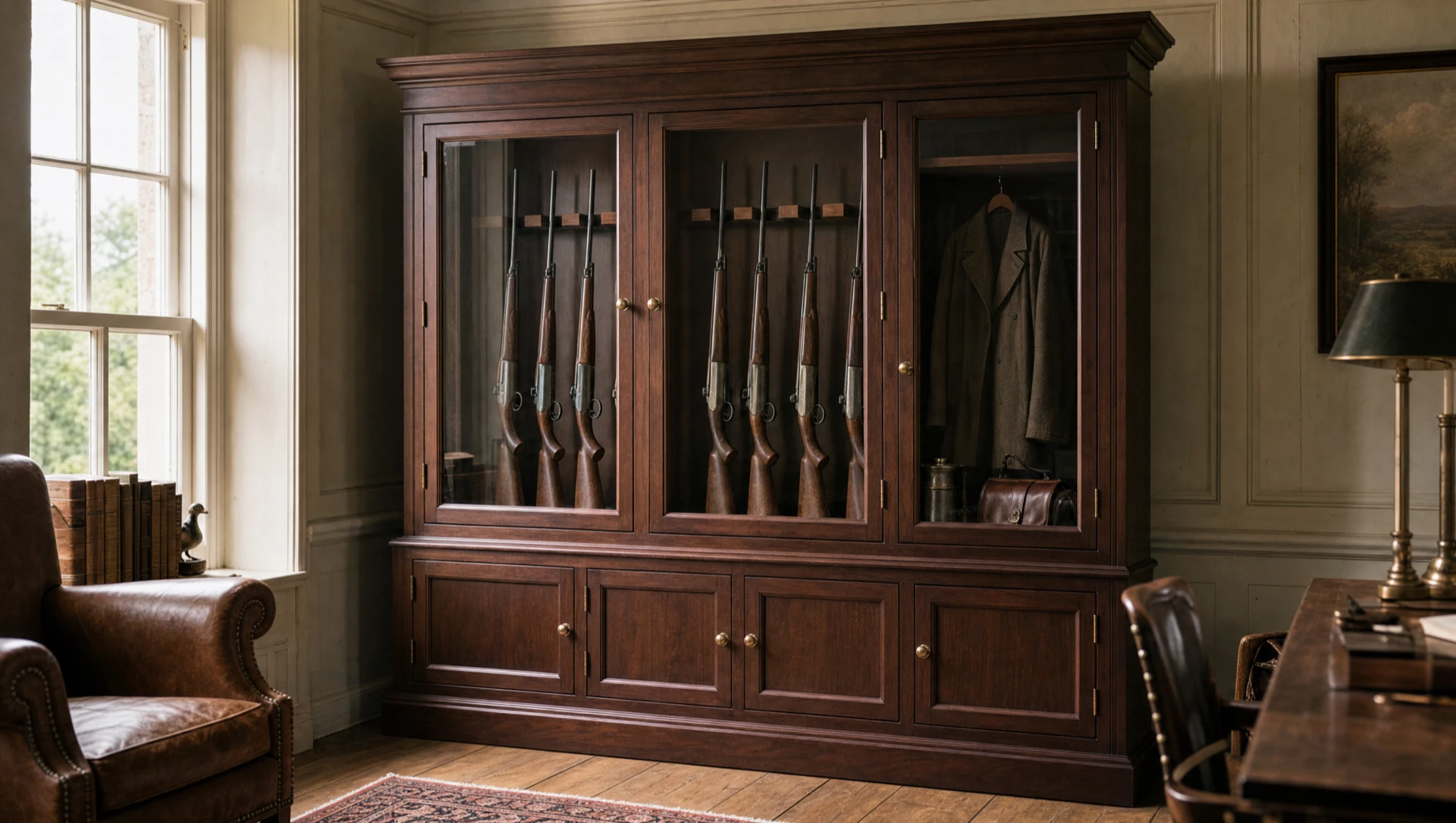
Releases
We will not publish a catalogue of release mechanisms, for reasons that are probably obvious. What is worth saying is how we think about them.
- The release is not the security. The lock is the security. A release is a way of opening a disguise, and it is designed for convenience and discretion, not resistance.
- It has to be reliable for decades. A mechanism that jams once is a mechanism you stop trusting. We use hardware sized well above the load, and we would rather a slightly heavier action than a clever light one.
- It has to work in the dark, one-handed. If you have to hunt for it, you will end up leaving the thing ajar, which defeats the entire purpose.
- Somebody else has to be able to find it. In an emergency, or in twenty years. We give you the detail in writing at handover; keep it with your certificate paperwork rather than in your head.
Beyond that, the arrangement is agreed with you privately and does not appear on this website or in any document that leaves our office except your own handover pack.
What it demands of the design
Concealment is a plan-stage decision. Left late, it either does not happen or it happens badly.
- SpaceA concealed door needs depth behind it and swing in front of it. Clients consistently underestimate this — a bookcase leaf is thick, and it has to clear the floor, the skirting and whatever is beside it.
- StructureThe disguise is heavy and the steel behind it is heavier. Both need something real to hang on. This is why the wall substrate is settled at survey.
- Shut linesThe whole trick lives here. Lines must fall where the joinery would have had a joint anyway. Get this right and it is invisible; get it wrong and it is a door with a bookcase on it.
- Timber movementA concealed leaf has to keep its shut lines for decades while solid timber moves seasonally. That governs how it is built, and it is the reason engineered substrates appear behind wide painted faces.
- FloorsA leaf that swings over an uneven or rising floor will catch. Threshold detailing matters more here than anywhere else.
- ServicesLighting inside, and any alarm contact, must be routed before anything closes up.
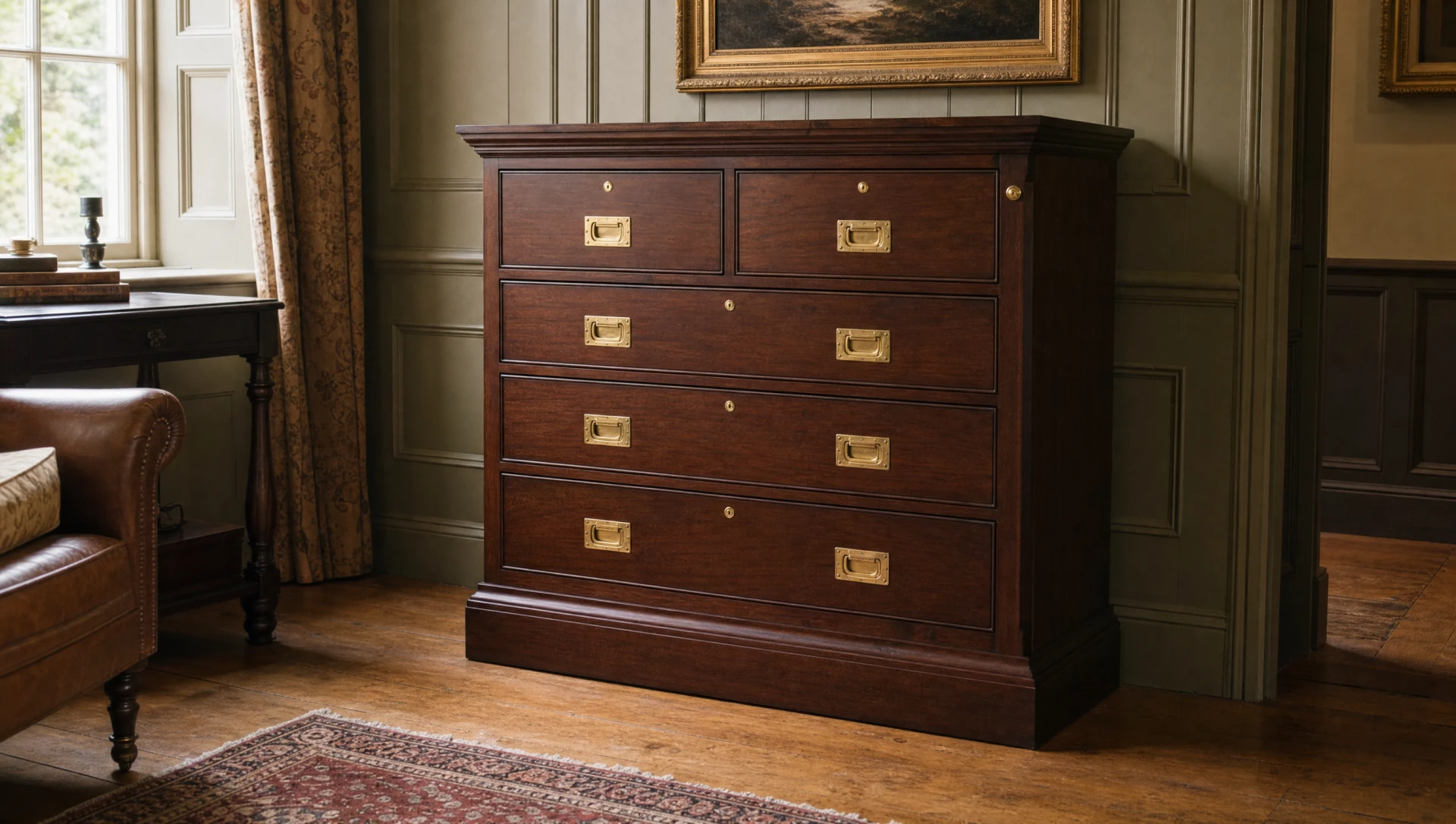
What your FEO makes of it
The honest answer, and it is not the one some of this trade gives: concealment counts for nothing in the assessment.
Your firearms enquiry officer assesses whether firearms are stored securely — the steel, the lock, the fixings, the property and its circumstances. A disguise is not a security feature in that framework, and no licensing department is going to accept a weaker cabinet on the grounds that it is well hidden.
That is exactly why we build every concealed piece to the full specification. It has to satisfy the FEO on its own merits, with the disguise disregarded entirely. When we set out the specification for your licensing department we describe the cabinet — steel thickness, glass, lock model, fixing type and centres — and treat the concealment as what it is: joinery.
We agree that specification before we make anything. See the FEO process.
Responsibility for meeting the security condition on your certificate rests with you as the certificate holder, and the adequacy of any storage arrangement is a matter for your local police firearms licensing department. Concealment is not a substitute for compliant storage and should never be presented as one. Nothing on this page is legal advice.
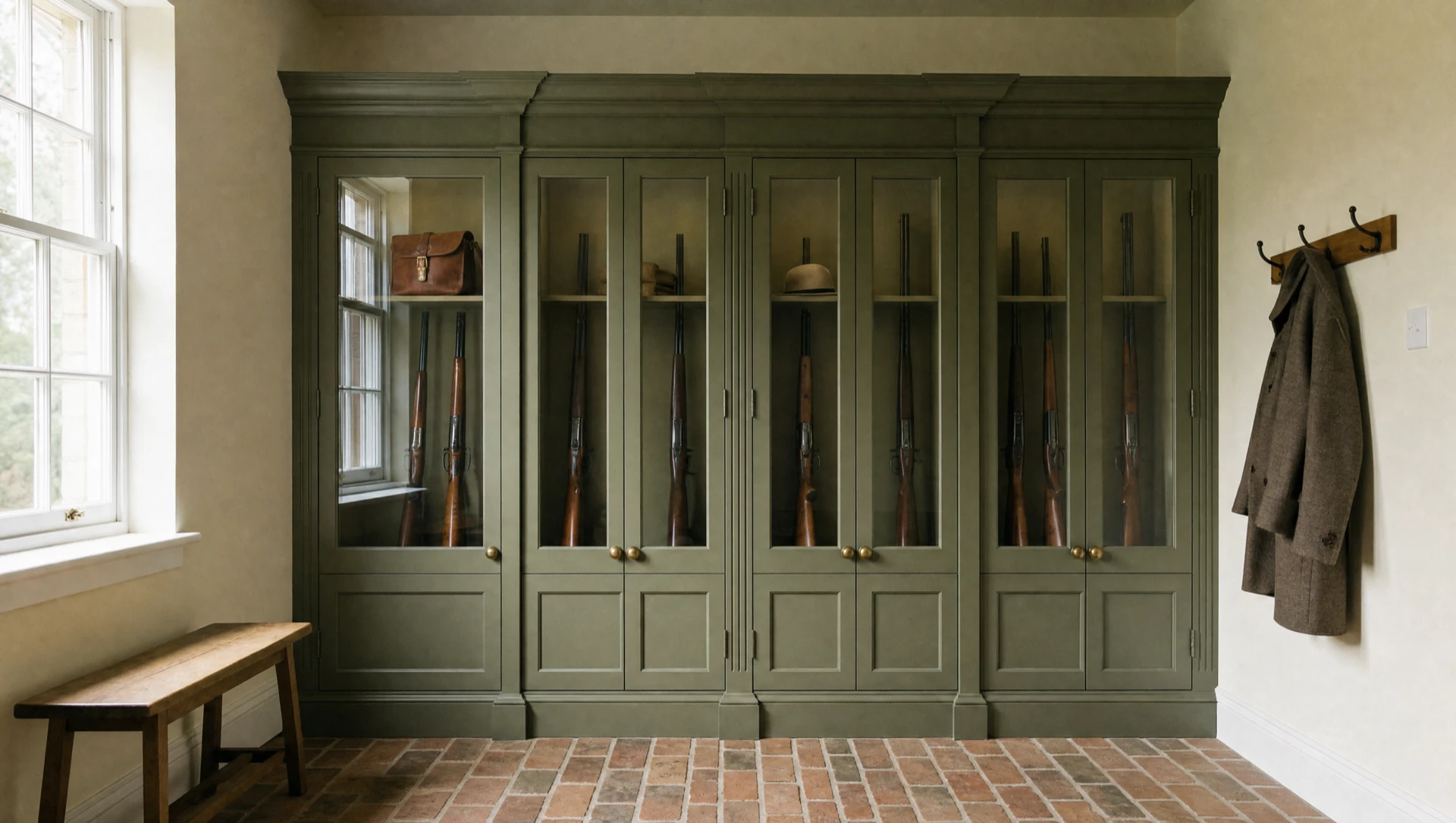
Living with it
Four things clients tell us afterwards, offered here so you can decide with your eyes open.
You will show people. Everybody does. Think about who, because the value of concealment falls with every person who knows.
It changes how often you open it. A concealed cabinet is marginally less convenient than an obvious one, and that is by design. If it is your everyday working storage, a discreet piece may serve you better than a concealed one — or have both, with the working guns behind a normal door and the best guns behind the clever one.
Mechanisms want using. Anything that moves is happier moved. A leaf that is opened weekly stays sweet; one opened twice a year stiffens.
Write it down. Where it is, how it releases, and where the keys are. Keep it with your certificate paperwork. The point of a concealed cabinet is that nobody finds it, and that includes the people you would want to.
What it costs
More than a comparable visible cabinet, and the difference is bench hours rather than materials.
A cabinet built into an existing run of cupboards is the least expensive route and is often surprisingly modest — the disguise already exists and we are fitting the specification behind it. A bookcase leaf or a panelled wall built from scratch, matched to existing joinery, with hardware sized for the weight, is at the other end.
Bespoke gun cabinets start at around £8,400 including VAT, delivered and installed; a concealed piece sits above that, and a concealed gun room above the £24,000 room starting point. There is a fuller breakdown on prices, and we will give you a figure before anybody draws anything.
Questions we are asked
Does a concealed gun cabinet still have to meet the same standard?
Yes, entirely. Concealment counts for nothing in a licensing assessment — your FEO judges the steel, lock, fixings and property, with the disguise disregarded. Every concealed piece we make carries the full specification: 3mm steel, a folded return behind the frame, EN 1300 Class A locking and mechanical anchoring.
What is the difference between discreet and concealed?
Discreet means the cabinet is furniture — recognisable as a piece but giving no clue to its contents. Concealed means there is no visible piece at all: no door, frame, architrave or handle, with the storage built inside a bookcase, panelling, a cupboard back or a rising top. Concealed is a considerably harder job.
How is a concealed cabinet opened?
By a concealed release agreed privately with you. We do not publish the arrangements. What we will say is that the release is for convenience and discretion — the lock is the security — and that it must work reliably, in the dark, one-handed, for decades.
How much space does a hidden door need?
More than clients expect. A bookcase leaf is thick and has to clear the floor, skirting and whatever is beside it, with depth behind and swing in front. It is a plan-stage decision, not a late one.
Can you build it into joinery we already have?
Yes, and it is often the most convincing and least expensive route — the disguise already exists and we fit the specification behind it. Matching existing timber, mouldings and finish is ordinary work for a bespoke workshop.
Will it still work in twenty years?
It should, and that governs how it is built — hardware sized well above the load, engineered substrates behind wide faces so shut lines hold as timber moves, and a slightly heavier action in preference to a clever light one. Mechanisms are happier for being used regularly.
Concealed gun storage in listed and historic houses
A good deal of our concealed gun storage goes into buildings where you cannot simply cut an opening and make good. Listed building consent is required for works affecting the character of a listed building, including internal joinery, and panelling in a principal room is very often the thing the listing describes. It is not a formality and it is not something to discover after the piece is made.
The practical route is almost always reversibility. Where a scheme can be shown to be removable — fixed back through existing joints, packed off the historic fabric, nothing cut that cannot be un-cut — conservation officers are generally receptive, because in ten years the room can be returned to what it was. Historic England’s guidance on making changes to a listed property is the clearest plain-English account of where the line sits, and your local authority’s conservation officer is the person who actually decides.
Three details that repeatedly make the difference:
- Fix into the secondary structure, not the historic joinery. Our fixings are into masonry or into modern studwork behind, never through a seventeenth-century panel.
- Match the moulding by taking a profile, not by choosing from a catalogue. We take a section from the existing run and cut a cutter for the moulder. It is the single most convincing thing you can do.
- Do not fake age. Conservation practice is that new work should be readable as new on close inspection, even where it is sympathetic at a distance. In practice this suits concealed gun storage very well, because the eye is not meant to stop on it at all.
Where the specification is not allowed to move
None of the above changes the steel. A concealed cabinet in a listed room is built to the same specification as one in a new house — 3 mm folded steel, EN 1300 Class A locking, anchored into structure — and if the structure will not take the anchors, we say so and the piece goes somewhere else in the room. Concealment that has been bought by weakening the fixing is worse than no concealment at all, because it looks like security and is not.
The concealed design in the standard range
The Lark is our concealed cabinet published with its sizes and prices — no glazing, no visible lock and no handle, sitting behind ordinary panelling or a bookcase front. It is one of seven designs in the standard range.
Tell us about the room
Send photographs of the space and the joinery it would need to disappear into, along with your gun list. We will tell you what is achievable, what it demands of the room, and roughly what it would cost.