
For European Houses
Gun rooms in Europe, made by hand in Suffolk and installed by our site team. Our locks are certified to the European standard rather than only to a British one, which turns out to matter a good deal — and the rest of what changes is logistics and paperwork, not craft.
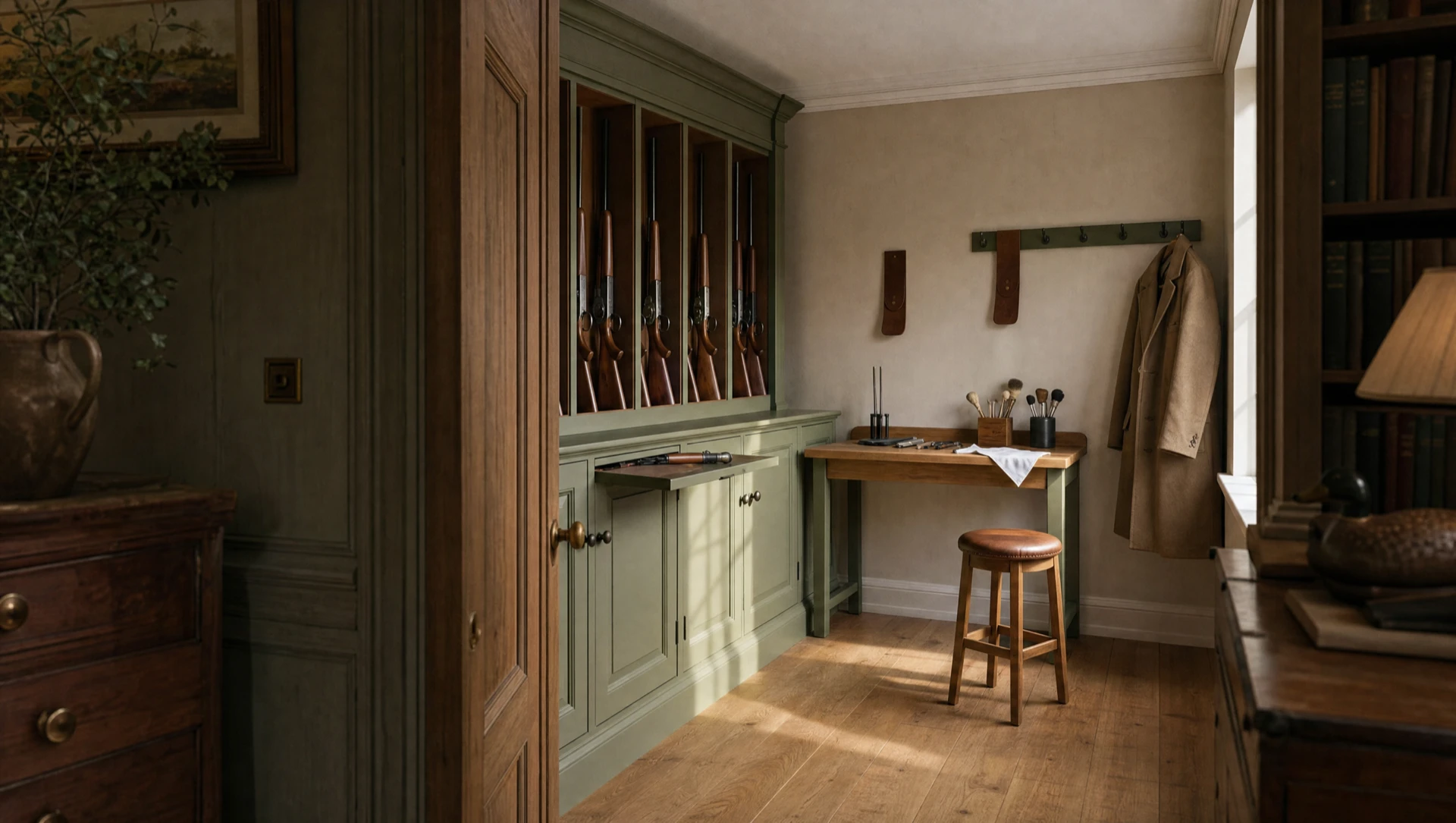
European shooting is older and in places grander than ours, and the houses that go with it are frequently older still. A driven shoot in Spain, a chasse in France, a jagdhaus in Austria or Bavaria, an estate in Hungary or the Czech Republic — the collections are serious and the buildings are usually more difficult than anything in England.
What is thin on the ground is somebody making the room rather than the box. That is the whole reason this page exists.
The standard our locks are made to is European
This is the part worth reading if you are buying from outside Britain, because it is where an English maker usually has to make excuses and we do not.
Our locks are 8-lever high-security safe locks certified to EN 1300 Class A and rated VdS Class 1, with 80,000 differs and anti-pick levers fitted as standard.
Those are not British standards dressed up for export. EN 1300 is the European standard for high-security locks on secure storage units, recognised across the EU. VdS is the German certification body whose approvals German and Austrian insurers work from, and whose classifications are understood well beyond Germany.
In practice that means when your insurer or your local authority asks what the lock is, the answer is a specification they already recognise, rather than a British standard they have to go and look up. It is a small thing that removes a large amount of friction.
A word of caution about national requirements
Firearms storage law across Europe is not harmonised. Germany’s requirements are set out in its own weapons law and are specific about resistance grades; France, Spain, Italy, Austria and the Nordic countries each have their own rules; and several are stricter than the United Kingdom’s.
We build to a published specification and we will give you the lock certification in writing. What we will not do is claim your national requirement is satisfied, because that depends on your country, your collection and sometimes your commune. Check it locally, and tell us what it says — we will build to the answer rather than to an assumption.
What does not change
The piece itself. 3mm mild steel throughout the enclosure, folded doors whose folded return passes behind the frame on the hinge side, 26mm laminated security glass where doors are glazed, and an interior drawn from your own gun list.
Quarter-sawn solid oak, walnut or mahogany, book-matched across pairs of doors. French polished, hand-oiled, hand-painted or antiqued by hand. Made at our own bench by our own cabinetmakers and finished by our own polisher, in one workshop in Suffolk. Nothing subcontracted, nothing imported and badged.
What does change
| What | How we handle it |
|---|---|
| Number of visits | Two rather than three. Survey and template are combined into one longer visit, and installation is the second. |
| Customs and paperwork | Post-Brexit this is real but routine. We supply commodity codes, weights and dimensions so you can get a proper landed-cost figure before committing. Duties and import VAT are yours. |
| Transport | Road freight for most of Western Europe, properly crated. Timber and steel at this weight need a crate built for them. |
| Timescale | Add a few weeks to a UK programme. Not months. |
| Language | We work in English. Drawings are dimensioned in millimetres and are perfectly legible to any European joiner or architect. |
| Old buildings | Frequently the real complexity. Thick masonry, walls that are not plumb, and fabric nobody wants drilled without a conversation first. |
Working with your architect
Most of our European enquiries arrive through an architect or an interior designer, and that suits us. We are used to working to somebody else’s drawing set, we are precise about where our scope starts and stops, and we do not need managing.
A gun room is a specialist package within a larger project. What we need from the main contractor is a room prepared to a stated condition and a slot in the programme; what we deliver is the steel lining, the firearms door and frame, the cladding and all the joinery. The page written for architects and builders sets out the interfaces properly.
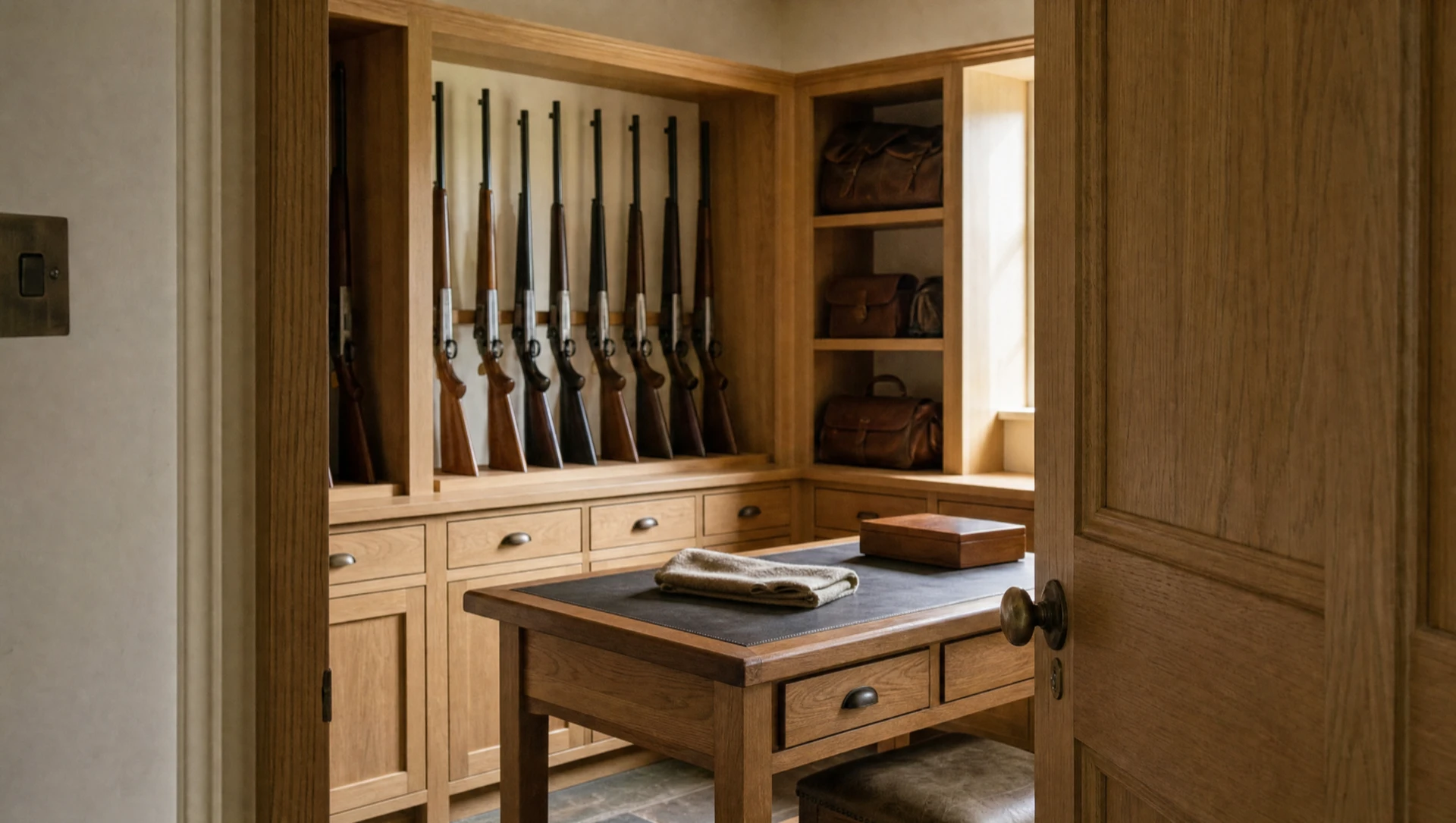
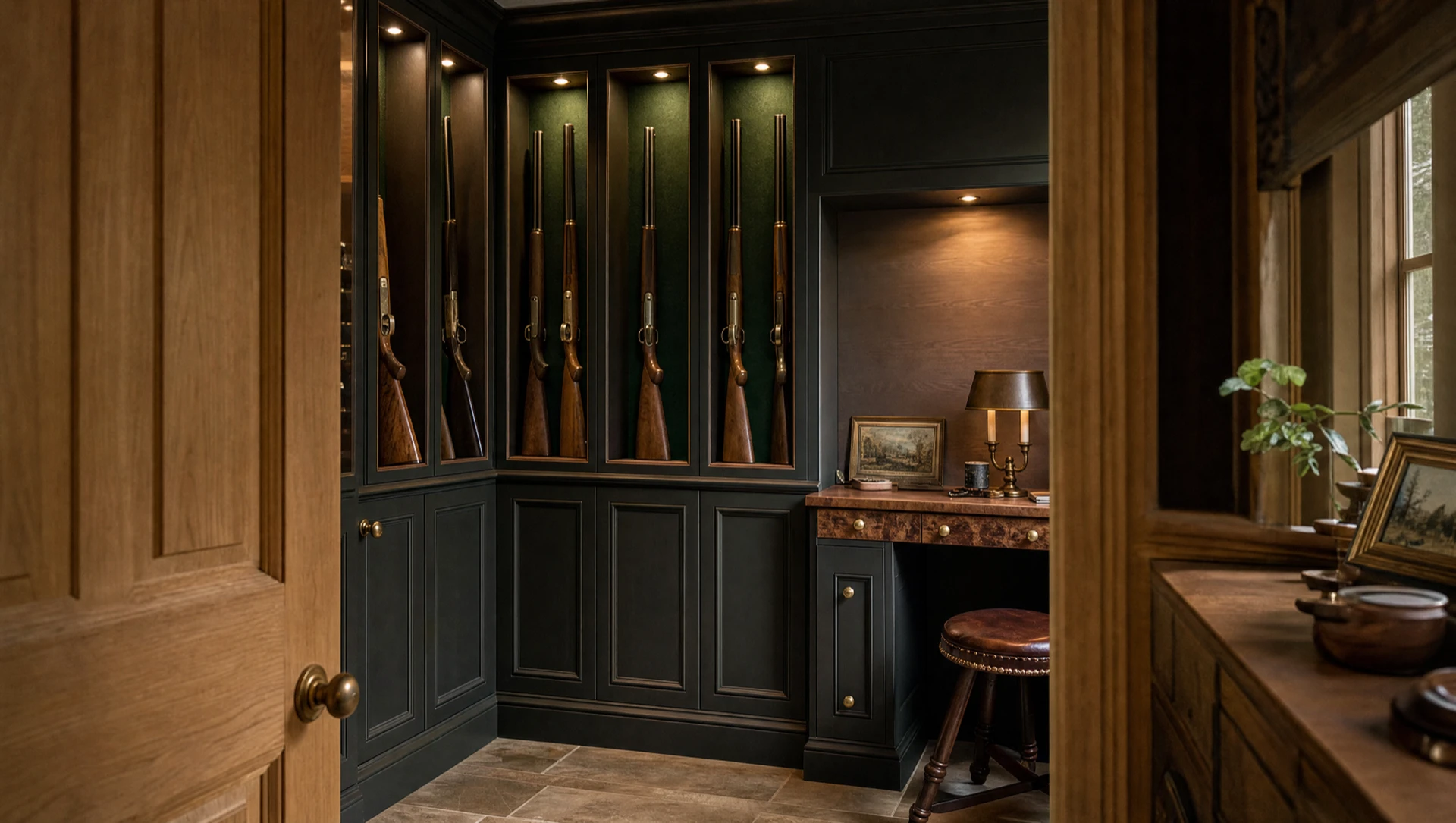
Installation
By our site team, as everywhere else. For a fitted room that is a longer visit — steel lining, the firearms door and frame, timber cladding over both, then the joinery. We will not sell a cabinet delivery-only into Europe any more than we will in England: a cabinet that is not anchored into the structure is furniture.
Common questions
Do your cabinets meet German, French or Spanish requirements?
We build to a published specification — 3mm steel throughout, folded doors returned behind the frame, EN 1300 Class A and VdS Class 1 locks, 26mm laminated security glass — and we provide the lock certification in writing. Whether that satisfies your national requirement depends on your country and your collection, and we will not claim otherwise. Check locally and tell us the answer; we will build to it.
What certification do the locks carry?
8-lever high-security safe locks certified to EN 1300 Class A and rated VdS Class 1, with 80,000 differs and anti-pick levers as standard. EN 1300 is the European standard for high-security locks on secure storage units; VdS is the German certification body whose approvals German and Austrian insurers work from.
Is Brexit a problem?
It is paperwork rather than an obstacle. We supply commodity codes, weights and dimensions so you can obtain a landed-cost figure before you commit. Duties and import VAT are yours and should be quantified at the start rather than discovered at the border.
How many visits will you make?
Two. Survey and template are combined into one longer visit, and installation is the second. We would rather do more in a single trip than travel repeatedly.
Will you work with our architect?
Yes, and most of our European work arrives that way. We work to an existing drawing set without difficulty and we are precise about where our scope starts and stops.
Gun rooms in Europe: what changes country by country
The furniture does not change. The regulatory frame around it does, and it is worth being clear that we build to a specification and your own authority decides whether it satisfies your licence. We do not certify anything, and nor can any maker.
What we can do is build to the standard your insurer and your authority are most likely to recognise. In practice that means locks certified to BS EN 1300 Class A — the same European standard across all member states — and, where a certificated cabinet is required rather than a specification, a VdS-certified safe body dressed in our joinery rather than a cabinet of our own construction.
Germany and Austria
Germany is the strictest market we work in and the one where the distinction above matters most. German law requires storage to a certified grade — commonly VdS/EN 1143-1 Grade 0 or Grade 1 depending on quantity and category — and that certification attaches to a tested safe body, not to a specification sheet. For a German house we therefore case a certified body in our joinery, so the room looks like a room and the certificate still stands. Austria works similarly in practice.
France, Belgium and the Netherlands
France requires firearms to be held in a strongbox or a fitted-out room, with the room route explicitly permitted — which is precisely what we build. Belgium and the Netherlands are broadly comparable. In all three, our standard construction with EN 1300 Class A locking is normally accepted on its own, and the ammunition separation we build as standard is a requirement rather than a nicety.
Spain, Portugal and Italy
Southern Europe brings a different problem, which is climate rather than law. A steel-lined room in a stone house in Andalusia or the Alentejo will condense in spring unless it is ventilated and gently heated, and the cabinets need cross-ventilation designed in from the start. It is the same physics described on our humidity page, only faster.
Switzerland and Scandinavia
Both are straightforward and both are markets where quarter-sawn oak and hand-applied finishes are properly understood, which makes for enjoyable projects. Norway requires certified storage above certain quantities on the same pattern as Germany.
How a European commission actually runs
- Gun list and photographs by email. Enough for an outline scheme and an honest price band without anybody flying anywhere.
- One survey visit. A full day at the house, measured and photographed properly. We fly from Norwich or Stansted, or drive if the project is large enough to warrant bringing the van.
- Drawings and a fixed quotation. In millimetres, with a set your architect can work to.
- Made in Suffolk. Twelve weeks in the workshop, up to sixteen when we are busy, confirmed on order.
- Delivered by road, installed by our site team. Two to five days on site for most schemes. We do not subcontract installation.
Shipping and travel are quoted separately and shown as a line of their own, so you can see exactly what the distance is costing. For most of western Europe it adds between £2,160 and £5,400 to a cabinet commission and rather less proportionally to a full room.
Two things worth knowing before you start
Timber moves in a new climate. A cabinet made at 10–12% moisture content in Suffolk and installed in a heated Alpine chalet at 30% relative humidity will shrink. We build for the destination, not for the workshop, which means panels are set in with more room to move and doors are hung with a slightly different clearance. Tell us the house has underfloor heating and we will change the construction.
Get us to your architect early. The single most expensive thing on a European project is a room that has been finished before we see it. Steel lining, cable routes and a firearms door frame all need to be in the builder’s programme, and that conversation costs nothing in month one and a great deal in month nine.
Insurance and valuation for European commissions
Two practical points that come up on almost every European project and on almost no British one.
First, insurers on the Continent are generally more prescriptive about certified storage than British ones, and several will specify a grade rather than assess an arrangement. Ask your broker what grade they require before we draw anything, because it determines whether we build our own carcass or case a certified body — and that decision changes the price by several thousand pounds. It is a five-minute conversation that is expensive to have late.
Second, transit. A cabinet in a dedicated crate travelling by road to a European address is covered under our goods-in-transit cover to its full value until it is installed and signed off. We do not ask you to insure it in transit and we do not use a third-party pallet network for finished work.
Language, drawings and units
Drawings are issued in millimetres, which is universal across the European construction industry, and we are comfortable working to a set produced by a Continental architect. Correspondence is in English; where a main contractor’s site team does not work in English we issue a marked-up setting-out drawing that carries the information graphically, because an installation detail misunderstood on site is expensive in a way a translation fee never is.
Ironmongery and electrical fittings are supplied to the destination’s standard — Schuko or French sockets, CEE plugs on any hard-wired item, 230 V throughout. It sounds obvious and it is the single most common thing forgotten on a first European commission.
Start with your gun list
Send what you own and a few wide photographs of the room. We will tell you what we would build, roughly what it would cost, and what the freight and paperwork add.