
Watch Storage
Security, Glass and Locking
A watch you want to look at has to sit behind glass, and glass is the obvious way in. So the glass is 42 mm ESG Secure laminated security glass, it can be switched opaque at the flick of a control, and the door behind it is held by bolts that are driven rather than latched.
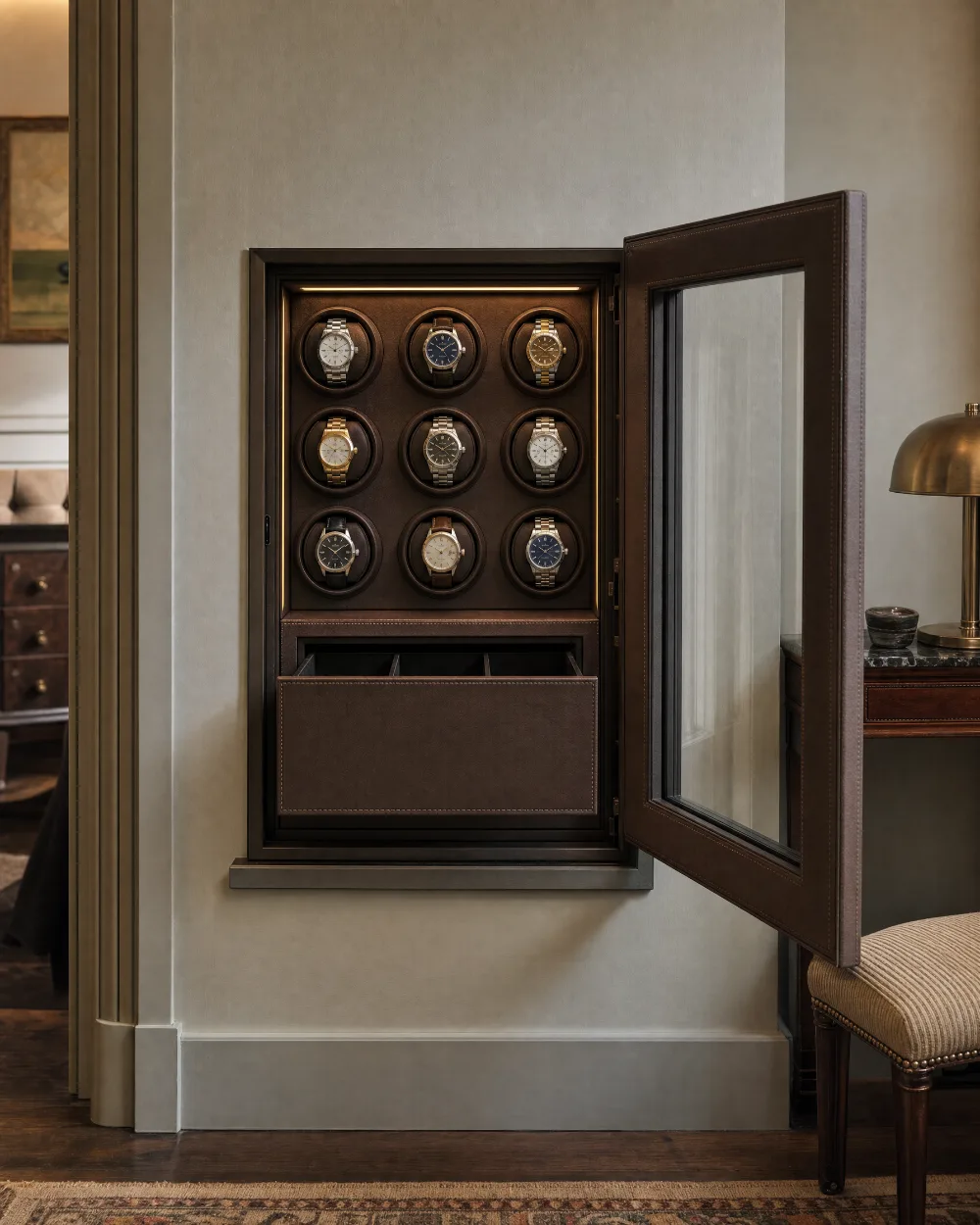
The glass
The display face is ESG Secure 224/42T: a 42 mm laminated panel of glass, polycarbonate and specialist interlayers with a switchable LCD interlayer, rated beyond the top class of EN 356 for manual attack, LPS 1270 rating 224, and bullet resistant to EN 1063 BR4. The certificates belong to the pane, not to the safe, and we say so in writing. Laminated glass does not fail like toughened glass: it does not go to crumbs and leave an opening, it stays in its frame and keeps taking hits, which is what buys the time that matters. It is captive in the door, held mechanically rather than bedded in and hoped for, so it cannot be pushed out of its frame as a sheet.
The unit can be specified with a switchable interlayer. Powered, the glass is clear and the collection is lit and on display. Switch it off and the glass goes solid opaque — nobody standing in the room can see that there is anything behind it at all, and there is nothing to advertise. On a piece we built recently that switch is the detail the client uses most: the safe is a lit display when the house is theirs, and a blank oak-framed panel when it is full of people they do not know.
Locking
The door is held by solenoid bolts driven into the steel frame, released electrically. A standalone keypad on the outside of the safe is the usual arrangement, with multiple codes so different people can be given their own and one can be withdrawn without changing everybody else’s. A fob or a card reader does the same job where a keypad is not wanted on show.
The bolt is monitored, which means the safe knows whether it is actually locked rather than assuming it. That signal can be brought back to the house alarm or the estate management system, so an unlocked safe shows up on the panel with everything else. All of it runs on a low-voltage supply, with the transformer and the power supply sitting outside the safe, in the wall, so there is nothing to interrupt from the room.
Where a client prefers no electronics at all, a safe can be built round a mechanical lock instead — the same thinking we apply to gun cabinets, where a keyed lever lock and a fixed set of keys is often what an insurer and an owner both want. It is a conversation about how the house is run, not a fixed rule. Bear in mind that an electrically released door needs a stated fallback for a power cut, and we will set out what that is for your piece before you order it.
The box itself
None of the above is worth anything if the shell can be opened up. The carcase is folded and continuously welded steel with no fixings to attack, the hinges are purpose-made parts set inside the oak surround, and the body is fixed through the back into masonry, never into plasterboard or a stud partition alone, so it is not a box that leaves the house under somebody’s arm. The cable enters through the base inside the wall.
Insurance and ratings
Be straight with us about what your insurer or broker has asked for, and do it early. A watch collection above a certain value usually carries conditions — a rated safe, a specified lock type, an alarm connection, sometimes a surveyor’s visit — and those conditions decide the specification. We are cabinetmakers and metalworkers, not underwriters: we will build to what your policy requires and we will say so plainly if what you are asking for will not meet it. Where a certified cash-rated or jewellery-rated unit is the condition, the right answer is a certified unit built into our joinery rather than our steelwork dressed up as one.
Discreet by default
We do not photograph clients’ houses, we do not publish addresses, and we do not discuss whose collection is where. The same goes for the drawings: the one shown on these pages has had the project and the client taken off it.
Watch winder modules · How a watch safe is made · How our cabinets are specified
Questions we are asked
What glass is used on the display face?
ESG Secure 224/42T, a 42 mm laminated security panel with a switchable interlayer, rated beyond the top class of EN 356, LPS 1270 rating 224 and EN 1063 BR4. Laminated glass does not fail like toughened glass: it does not go to crumbs and leave an opening, it stays in its frame and keeps taking hits. It is captive in the door, held mechanically, so it cannot be pushed out of its frame as a sheet.
Can the glass be switched opaque?
Yes. The unit can be specified with a switchable interlayer. Powered, the glass is clear and the collection is lit and on display. Switch it off and the glass goes solid opaque, so nobody standing in the room can see that there is anything behind it at all.
How does the safe lock?
The door is held by solenoid bolts driven into the steel frame and released electrically, usually with a standalone keypad carrying multiple codes so one can be withdrawn without changing everybody else’s. The bolt is monitored, and that signal can be brought back to the house alarm. Where a client prefers no electronics, a safe can be built round a mechanical lock instead.
Where a watch safe goes — siting, discretion and the first-fix cable route.
Leather, trays and lighting — the interior behind the glass.