
Gun Room Lighting, Heating and Ventilation
A steel-lined room is a cold room, and a cold room with no air movement is where blued steel goes to rust. Gun room ventilation, gentle background heat and lighting on a door switch are the least glamorous items on this website, and they are the ones that will save you the most money.
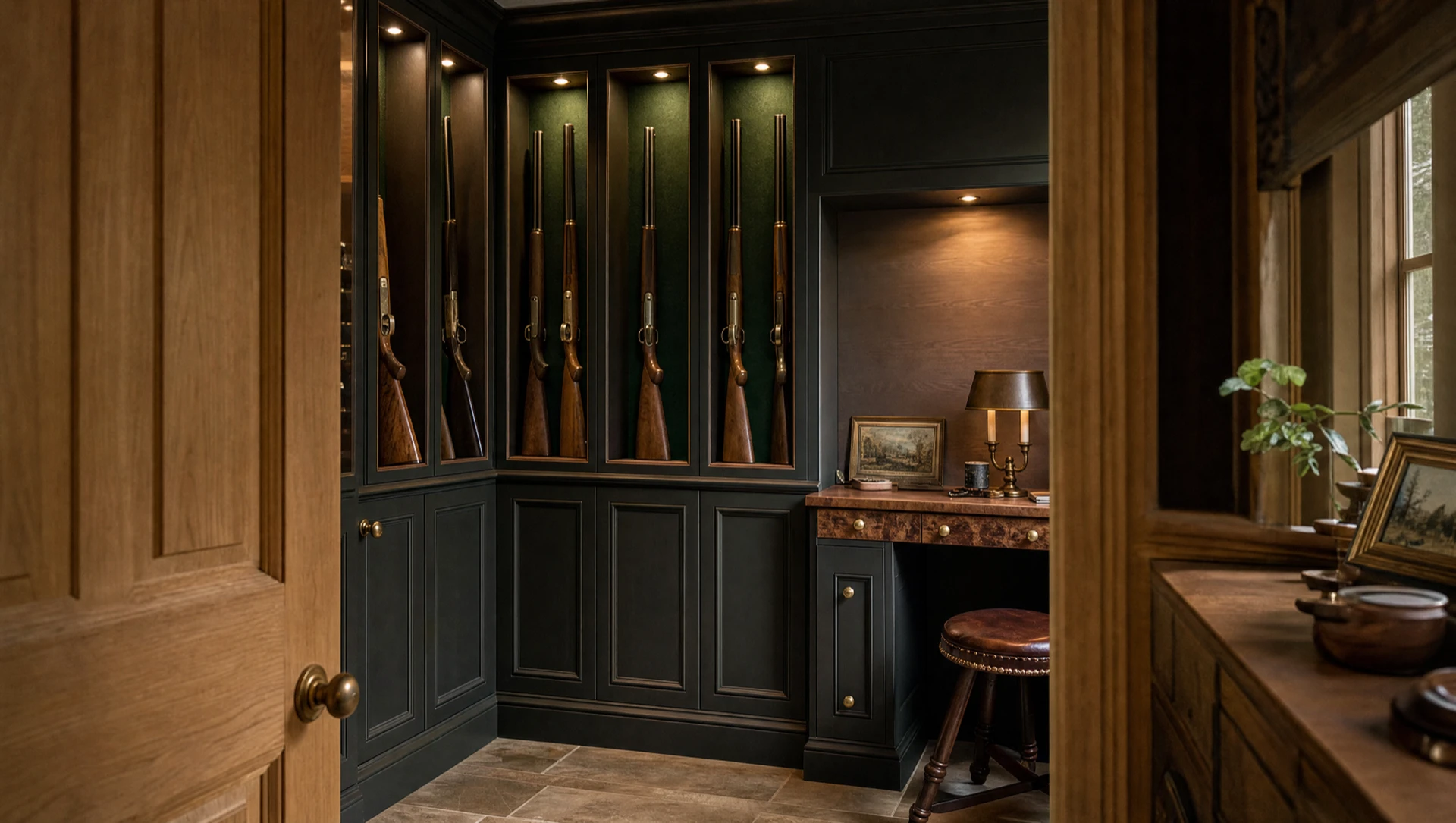
Of the gun rooms we are asked to look at and put right, more have a damp problem than a security problem. The reason is structural to how these projects run: security is specified by somebody, joinery is specified by somebody, and the environment is specified by nobody. It falls between the architect, the M&E consultant, the builder and the joiner, and it lands on the floor.
On this page
Why lined rooms are damp rooms
Three things happen at once when you line a room in steel and clad it in timber.
It gets colder than the rooms around it. A gun room is usually internal, usually unheated or barely heated, and usually shut. It sits several degrees below the rest of the house for most of the year.
It stops breathing. A sealed door, a lined perimeter and no trickle ventilation means the air in there is the air that was in there yesterday.
Warm moist air keeps arriving anyway. Every time you open the door, air from a heated house comes in. It cools. Cool air holds less moisture than warm air, so the moisture has to go somewhere, and it goes onto the coldest surface available. In a gun room the coldest surfaces are usually the steel and, unfortunately, the guns.
That is condensation, and it does not need a leak, a damp wall or a fault anywhere in the building. It is simply what happens when you make a cold sealed box inside a warm house and then walk in and out of it. The rust people find in February was formed by physics, not by neglect.
Ventilation
The room needs air movement. That is the whole requirement, and there is more than one acceptable way to meet it.
| Approach | Where it suits |
|---|---|
| Trickle ventilation | Simple, passive, no running cost. Adequate in a benign room |
| Mechanical extract, humidistat-controlled | Runs when it needs to. Good where the room is used regularly |
| Ducted supply and extract | Where the room forms part of a whole-house ventilation strategy |
| Standalone dehumidifier | Effective, but it is a machine with a tank and someone has to care about it |
| Dehumidifier rods in cabinets | Useful supplement, never a substitute for the room being right |
Which of those is correct is your M&E consultant’s or your builder’s decision, not ours — we are cabinetmakers and we will not pretend otherwise. What we will do is make sure the joinery does not obstruct whatever is specified, and refuse to let the question go unanswered.
The one thing that is always wrong is nothing at all.
Humidity, and the number
The figure usually quoted for storing firearms is somewhere in the region of 45 to 55 per cent relative humidity. It is a reasonable target and it is worth knowing.
But the number is less important than people think, and stability matters more than the value. A room that sits quietly at 60 per cent all year is kinder to guns, cases and timber than one that swings between 35 and 70 as the heating comes on and off. Swings are what move timber, split stocks, lift veneer and drive condensation cycles.
Put a hygrometer in the room. They cost almost nothing, and it turns an argument into a reading. If you tell us the room runs at 70 per cent, that changes what we recommend; if you tell us you think it feels damp, it does not.
Heat
Gentle background heat, not a warm room.
The purpose of heating a gun room is not comfort — you are in there for twenty minutes at a time. It is to keep the surfaces in the room above the dew point of the air that arrives when the door opens, and to stop the room becoming the coldest place in the house.
A low-output background heat source on a frost or low thermostat setting does that. A radiator on the house circuit, running at the same temperature as the drawing room, does something else: it dries the timber, moves the joinery, and creates a bigger temperature difference every time the door is shut.
Three practical points:
- Keep heat away from the joinery. A radiator immediately below a run of racking will move it. Position is a design decision.
- Underfloor heating is fine, and its evenness is an advantage — but tell us, because it changes how we allow for movement in solid timber.
- Do not heat and seal. Heat without ventilation moves the problem rather than solving it.
Inside the cabinets
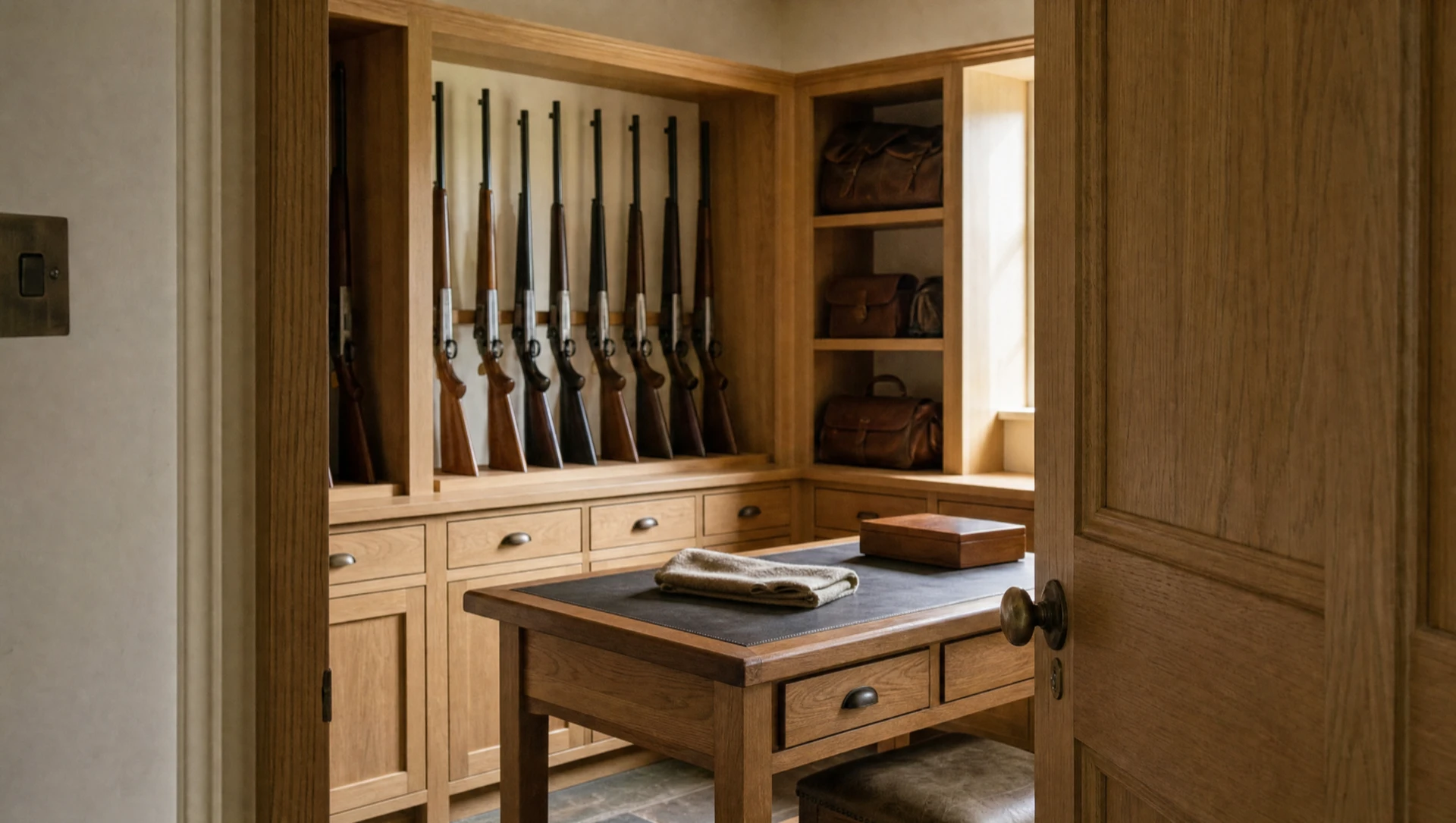
Cabinets within the room are ventilated internally as a matter of course. A sealed cabinet is a small version of the same problem — and a gun put away slightly damp into a sealed box is the classic way to find a bloom of rust on something you were certain you had cleaned.
Two habits worth more than any equipment:
- Never put a gun away wet. Obvious, universally known, and still the most common cause of damage.
- Let a cold gun warm up before it goes in the slip. A gun brought in from a frosty morning will condense on itself in a warm room. Leave it out for an hour.
Leather cases and slips deserve a mention of their own: they hold moisture, they mould, and they are usually the first thing in the room to show it. They want air around them rather than to be stacked, which is why we hang slips rather than shelve them.
There is a fuller treatment of all of this on humidity, damp and blued steel.
Lighting
Four rules, and they are all about being able to see what you are reaching for.
- On a door switchThe light comes on when the door opens. Nobody should be feeling for a switch with a gun in their hand.
- Aimed at the racks, not the glassA glazed door lit from the wrong angle shows you a reflection of yourself. Light from above and in front of the cabinet face, not from behind your head.
- Low-heat LEDWarmth in a cabinet is not wanted, and heat close to timber over years is not kind to a finish.
- Task light over the benchIn front of you, so your own shadow does not fall on the work. This is the light you will actually use.
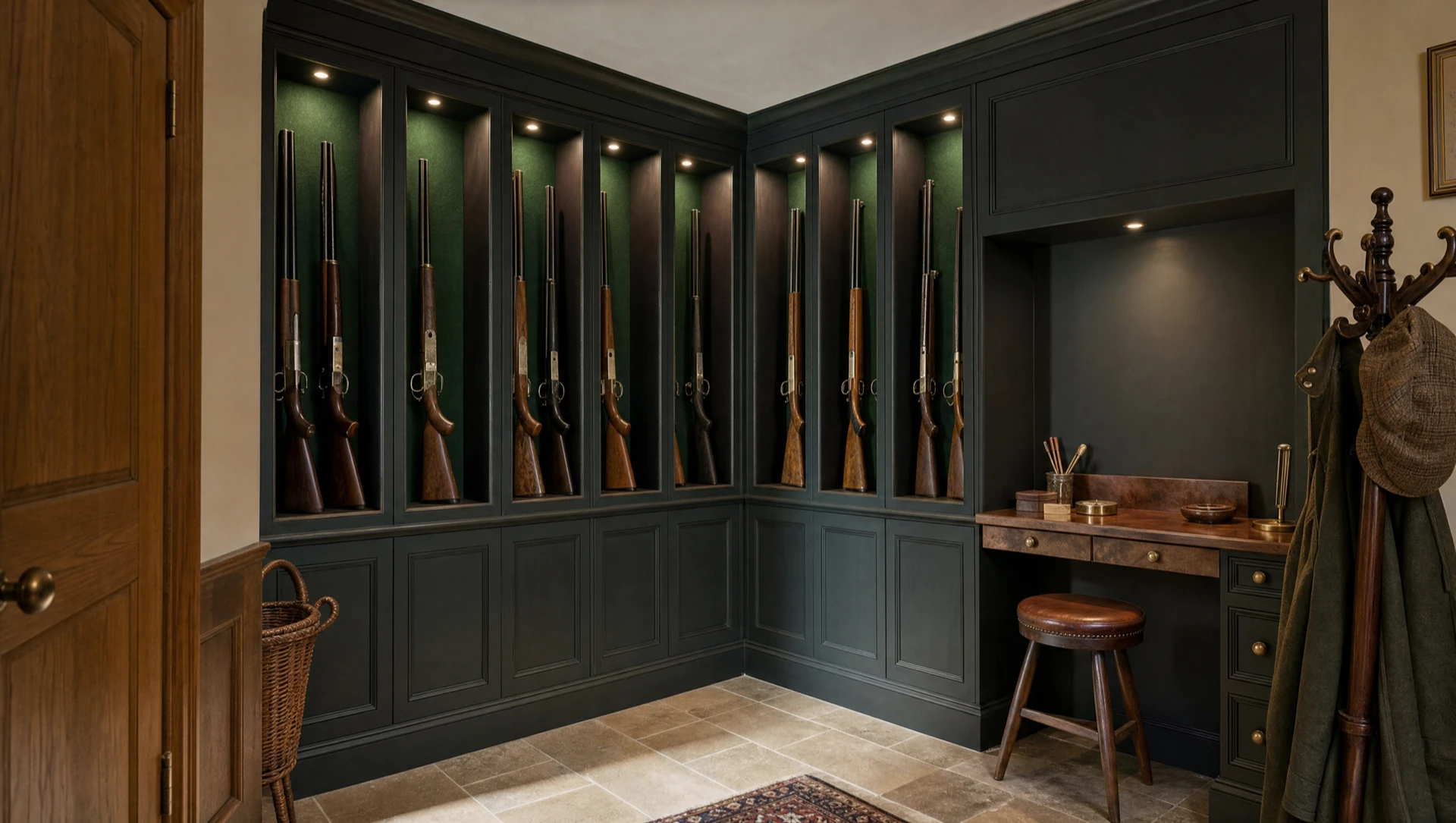
Beyond that it is a matter of taste. Lit racks look extremely good and are the reason to glaze a cabinet at all; a wall of unlit guns behind glass is a dark rectangle. If you are spending money on 26mm (1in) security glass, spend a little more on lighting what is behind it.
Who owns this on your project
Nobody, unless you say so. That is the entire problem, and it is why this page exists.
On a project with an architect and an M&E consultant, ask for the gun room’s ventilation strategy in writing at design stage, alongside the lighting circuits and the door switch. It is a five-minute conversation in month one and a chased wall in month nine.
On a project without one, ask your builder and your electrician the same question, and give them a target: air movement, gentle background heat, lighting on a door switch, cable routes agreed before the steel lining goes on. Once the lining is up, adding any of it is difficult.
We will coordinate with whoever it is, and we will not put steel on a wall until we know what has to pass through it. What we will not do is specify your ventilation, because that is somebody else’s competence and pretending otherwise would be the same overreach we complain about elsewhere on this site.
Questions we are asked
Why do guns rust in a gun room?
Condensation, usually. A lined room runs colder than the rest of the house and is effectively sealed. Every time the door opens, warm moist air enters, cools, and deposits its moisture on the coldest surfaces — which are often the steel and the guns. It needs no leak or fault anywhere in the building.
What humidity should a gun room be kept at?
The figure usually quoted is around 45 to 55 per cent relative humidity, but stability matters more than the exact value. A room sitting quietly at 60 per cent all year is kinder to guns and timber than one swinging between 35 and 70. Put a hygrometer in the room — they cost almost nothing.
Should a gun room be heated?
Gently, yes — enough to keep surfaces above the dew point of incoming air and stop the room being the coldest place in the house. Not to drawing-room temperature, which dries timber and increases the temperature difference every time the door shuts. And never heat without ventilation.
Do I need a dehumidifier?
Sometimes. It is effective but it is a machine with a tank that somebody has to care about. Trickle or humidistat-controlled mechanical ventilation is usually the better first answer. Dehumidifier rods inside cabinets are a useful supplement, never a substitute for the room being right.
Should cabinets be sealed?
No — they are ventilated internally as standard. A sealed cabinet is a small version of the same condensation problem, and a gun put away slightly damp into a sealed box is the classic way to find rust on something you were sure you had cleaned.
Where should the lighting go?
On a door switch, low-heat LED, aimed at the racks rather than at the glass, with a separate task light over the cleaning bench in front of you rather than behind your head. Lighting positions need agreeing before first fix.
Gun room ventilation: the specification we ask for
This is the section to hand to your M&E consultant or your builder. It is short, it is cheap, and it has to be in the first-fix drawings because none of it can cross a steel lining afterwards.
| Item | What we ask for |
|---|---|
| Background ventilation | Continuous trickle, high and low, on opposite faces where possible. 8,000 mm² equivalent area minimum for a room up to 12 m². |
| Mechanical extract | Humidistat-controlled, set to run at 62% RH. Not a bathroom fan on a timer. |
| Background heat | Enough to hold the room 2–3°C above the adjacent unheated space. Usually a low-output electric panel on a frost stat, 300–500 W. |
| Target relative humidity | 45–55%. Below 40% and stocks shrink; above 60% and blued steel starts to bloom. |
| Monitoring | One logging hygrometer in the room and one inside a closed cabinet. They read differently, and the cabinet is the one that matters. |
| Lighting | 4000K, CRI 90+, on a door switch. Second circuit for cabinet interiors, low heat, aimed at the rack. |
| Cable routes | First-fixed and terminated outside the lined zone. Nothing penetrates the steel after lining. |
Why heat alone does not do it
Warming a room raises its capacity to hold water but does not remove any. Heat without ventilation simply moves the condensation somewhere else — usually to the coldest surface in the room, which in a lined room is the steel behind the cladding, where you cannot see it. Heat and air movement together are what work, which is why the two are specified as a pair and never separately.
The physics is the same as in any historic interior with a cold envelope, and Historic England’s guidance on moisture in traditional buildings is the best free explanation of it we know of. Our own page on humidity and blued steel takes the same argument down to the cabinet.
Tell us what the room runs at
A hygrometer reading and a note of how the room is heated tells us more than a description ever will — and it is the difference between a guess and a recommendation.