
For American Houses
An English gun room, made by hand in Suffolk and shipped to you. Dimensions in inches, an honest account of how American standards differ from ours, and a plain statement of where we currently fall short of one of them.
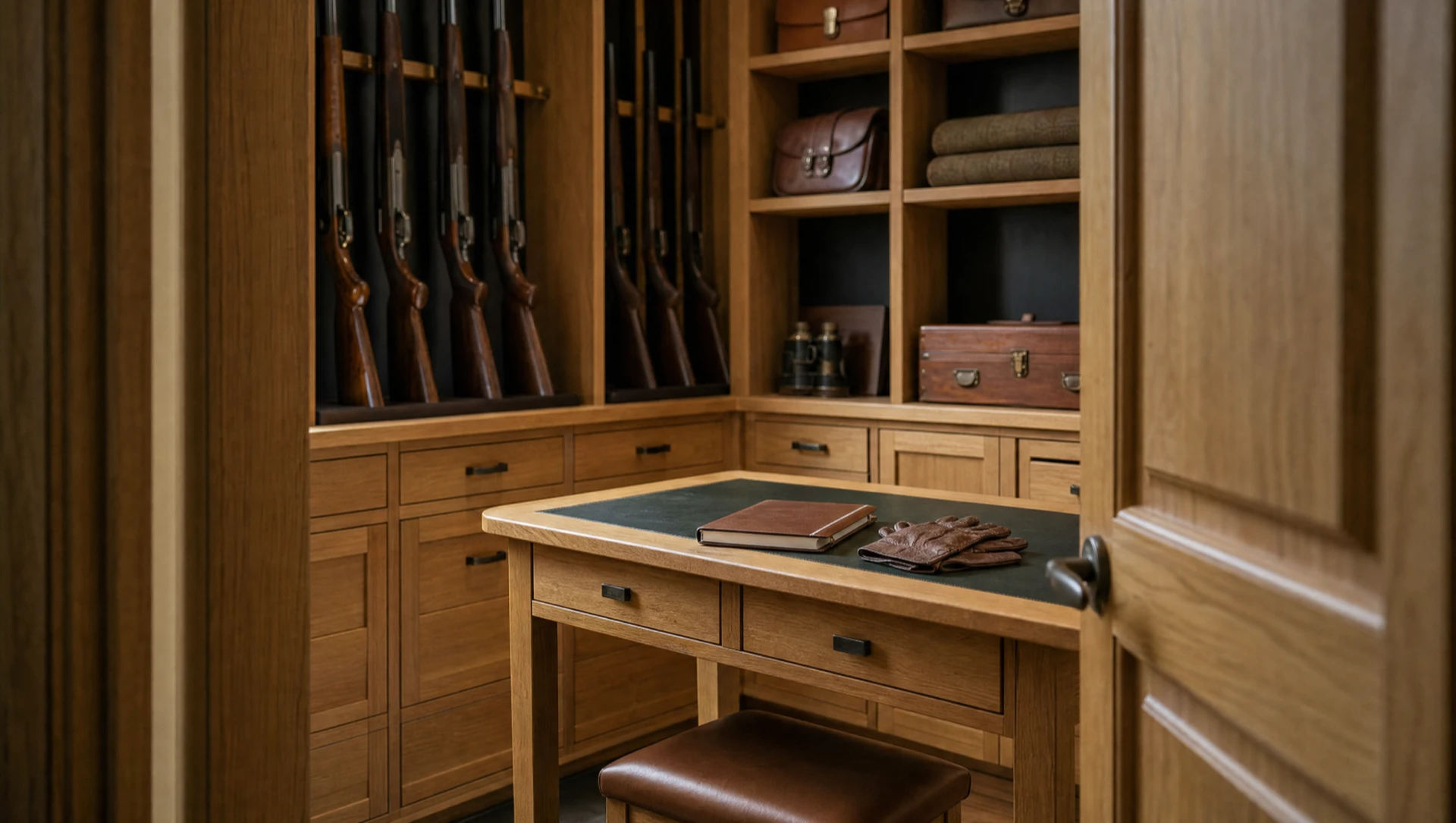
We are not going to pretend to be an American company. We are English cabinetmakers in a Suffolk village, and that is the entire proposition — a room built the way English gun rooms have been built for a very long time, by the people who drew it, in one workshop.
What we will do is be straight about what that means when the piece is going to Connecticut or Colorado rather than to Cheshire.
The specification, in inches
| Element | Imperial | Metric |
|---|---|---|
| Steel throughout the enclosure | 0.118in — approximately 11‑gauge | 3mm mild steel |
| Laminated security glass where glazed | 1in | 26mm |
| Doors | Folded steel with a returned edge, a folded return behind the frame on the hinge side | |
| Locks | 8-lever high-security safe locks, EN 1300 Class A and VdS Class 1, 80,000 differs | |
| Fixing | Anchored into masonry or located structural timber — never drywall | |
The steel figure is worth dwelling on, because American specifications are usually quoted in gauge and gauge runs backwards — a lower number is thicker. Our 3mm is a shade over 11-gauge. A great many cabinets sold as gun safes in the United States are 14-gauge (about 0.075in) or 12-gauge (about 0.105in). Ours is heavier than both, and it is the same figure on every panel rather than a heavy door on a light body.
How American storage law differs from ours — and why it matters here
In Britain, secure storage is a condition written onto your certificate, and your local police firearms enquiry officer decides whether the arrangement at your address satisfies it. There is no product standard and no approval scheme. Much of our website is about that conversation.
Almost none of that transfers. In the United States there is no certificate condition of that kind, no FEO, and no equivalent conversation. What exists instead is a patchwork: federal rules that mostly concern dealers rather than owners, state-level child access prevention and safe storage laws that vary enormously, and — critically — a live commercial standard that British makers do not have.
That standard is the Underwriters Laboratories Residential Security Container rating, usually shortened to RSC. It is the figure American buyers ask for, the one insurers recognise, and the one that appears on the label of most American gun safes.
We do not hold a UL RSC rating. Obtaining one means submitting a cabinet to a recognised testing laboratory to be attacked, and we have not done it. If an RSC mark is what you need, we are not currently the right maker and we would rather say so on this page than in an email after you have paid a deposit.
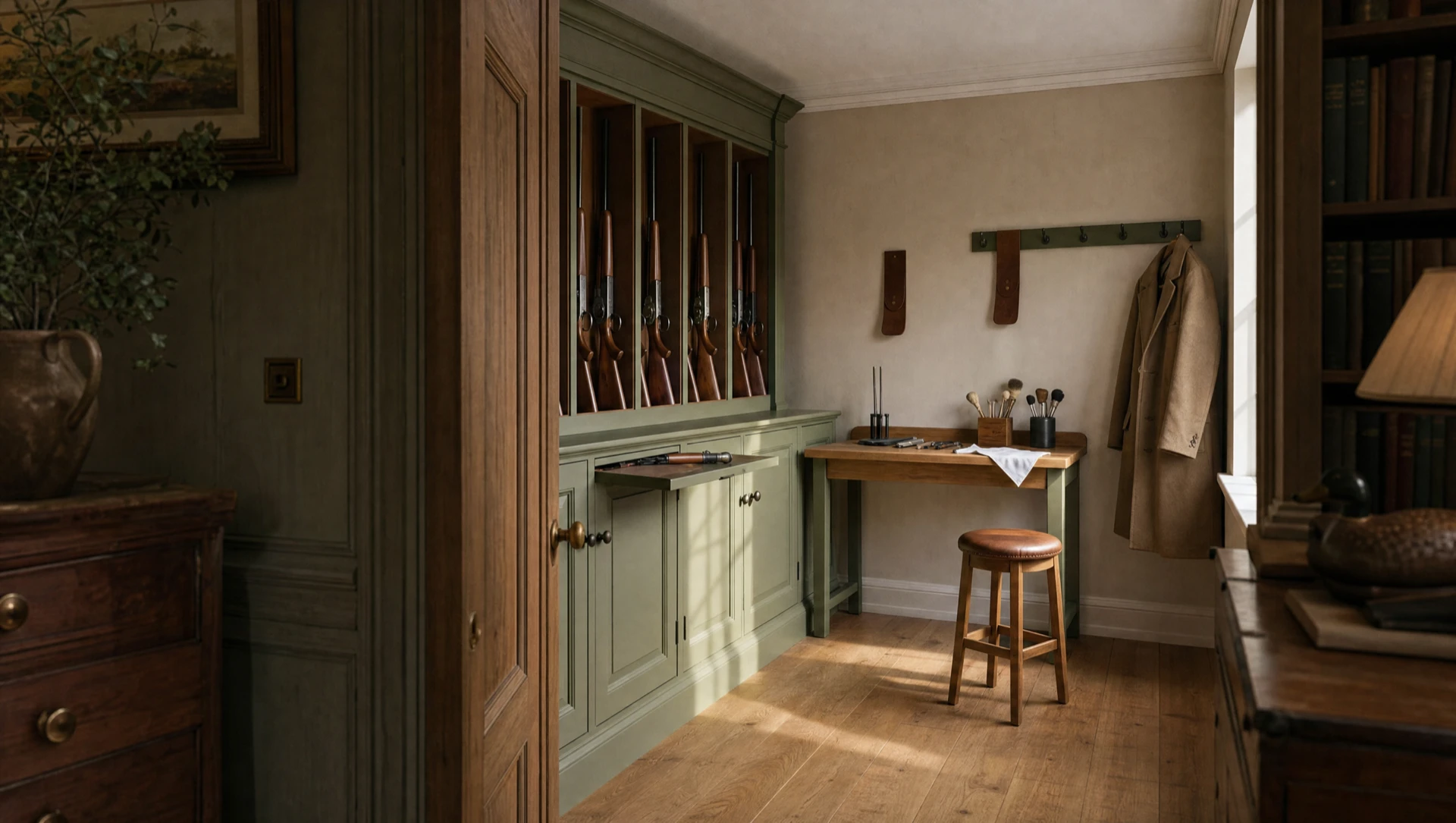
California, specifically
California is the strictest state and it is worth setting out precisely, because it is the one place where the gap is a matter of fact rather than judgement.
California maintains a standard for what may be sold as a gun safe. A container qualifies either by carrying a UL Residential Security Container mark, or by meeting the state’s own construction standard. That standard requires, among other things:
- Steel: at least 12-gauge if single-walled. Our 3mm is approximately 11-gauge, so we exceed this comfortably.
- The door: at least one layer of 7-gauge reinforced steel, or two layers of 12-gauge compound construction. Our folded 3mm door does not meet this as standard.
- Bolts: a minimum of three ½-inch steel locking bolts, thrown by a separate handle. We use mortice safe locks rather than a bolt-work, so we do not meet this as standard.
- The lock: a mechanical or electronic combination lock with at least 10,000 possible combinations of three or more numbers, letters or symbols. Ours is a key lock, so we do not meet this as standard.
Put plainly
As standard, our cabinets are not California DOJ-listed safes. Our steel is heavier than California requires. Our locking is a different architecture from what California specifies, and a key lock — however good — is not a combination lock.
That is a design difference rather than a quality one. Our locks are 8-lever high-security safe locks certified to EN 1300 Class A and VdS Class 1, with 80,000 differs and anti-pick levers — a serious European safe lock. But California’s regulation asks for a combination, and a European lever lock is not one.
If your state requires a listed safe, tell us at the outset. It is an engineering question — a combination lock and a bolt-work are things that can be specified — and we would rather scope it honestly than sell you something that does not do what you need.
We are cabinetmakers, not American attorneys, and firearms storage law in the United States varies by state and changes. Nothing here is legal advice. Check your own state’s position, and your insurer’s requirements, before you commission anything from anybody — including us.
What we are unusually good at, for an American house
Having been candid about the gap, here is the other side.
We build rooms, not boxes
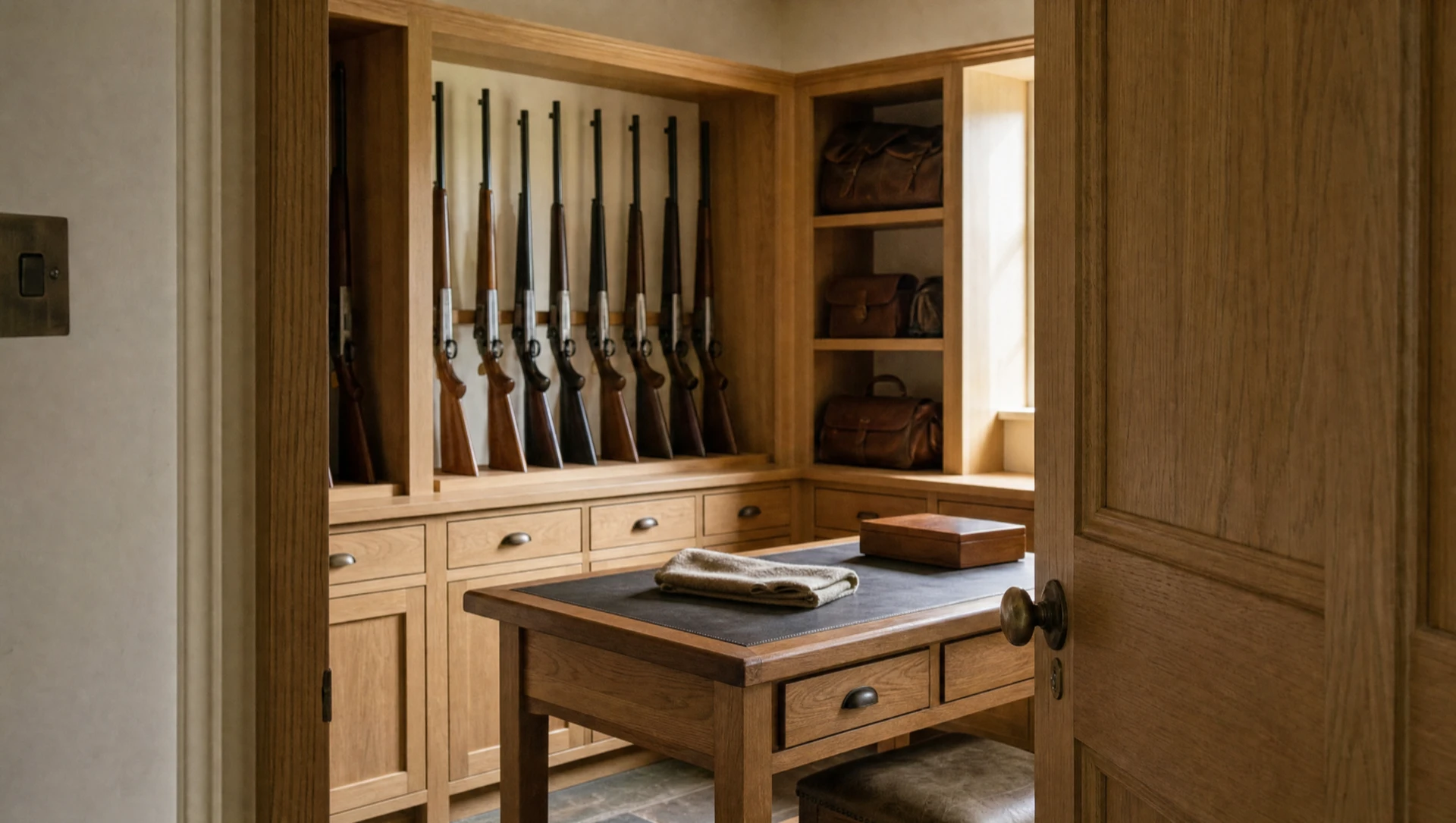
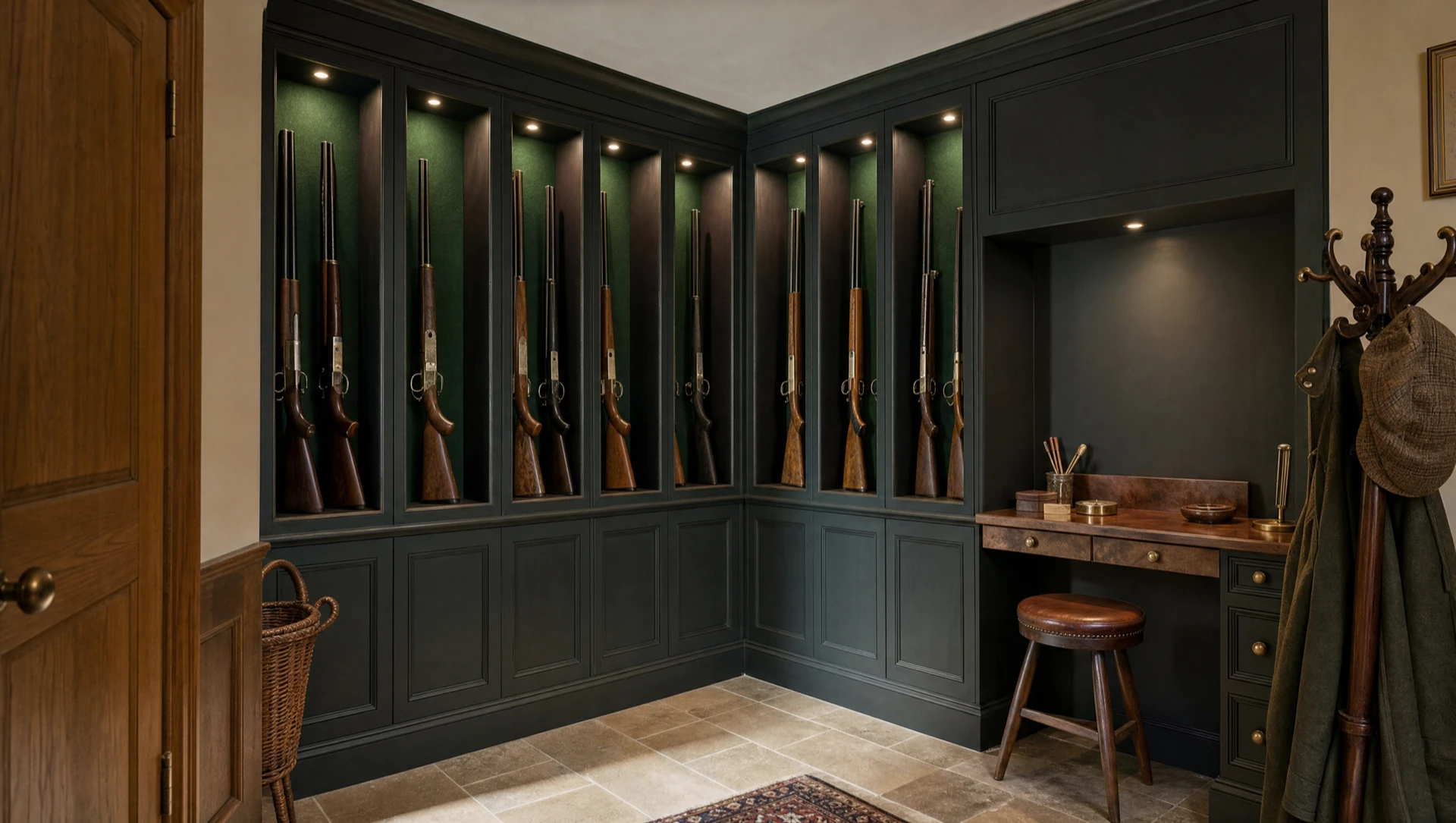
The American market is very well served for steel boxes and rather poorly served for gun rooms. If what you want is a panelled room in oak or walnut, with racking cut to your own guns, a cleaning table at the right height, glazed display for the pieces worth looking at, and a firearms door clad in timber so the room reads as a study — that is the whole of what we do.
The interior comes from your gun list
Racks cut to your guns rather than to an average. Rifles standing with optics mounted. Over-and-unders and side-by-sides at their own pitch. Long guns that actually fit. Ammunition separately locked. It is drawn around what you own, and it is the reason we ask for a list before we quote.
The timber is the point
Quarter-sawn solid oak, walnut or mahogany, book-matched across pairs of doors so the figure runs through the join. French polished, hand-oiled, hand-painted or antiqued by hand, in our own finishing shop by our own polisher. Solid brass or bronze ironmongery.
Climate, which American houses get wrong more often than English ones
Forced-air heating and air conditioning create larger and faster humidity swings than a British house does, and blued steel and walnut both notice. We design for air movement rather than sealing, and we build in provision for a low-output heater rod. The full explanation is here and it is worth ten minutes before you commission anything.
How an American commission runs
- Your gun list and photographsWide photographs from the corners, rough dimensions in feet and inches, and what you own. We work in both units and will quote in whichever you prefer.
- A telephone call, or WhatsAppSuffolk is five hours ahead of New York and eight ahead of California, so WhatsApp usually works better than trying to catch each other by telephone. It costs you nothing from the United States.
- Drawings and a fixed priceIn dollars if you prefer, though the contract is in sterling and the exchange rate is yours.
- Made in SuffolkTypically three to six months depending on the size of the commission.
- ShippedCrated properly — timber and steel of this weight need a proper crate, not a pallet and a prayer. Sea freight is normal; air freight is possible and expensive.
- InstalledThis is the one to discuss early. See below.
Installation, honestly
In Britain we will not sell a cabinet delivery-only, because fixing it to the structure is a large part of the security. Across the Atlantic that position has to bend.
Two options. We travel and install, which is entirely possible and is a real cost that goes on the quotation openly. Or we ship, supply the fixings and a written fixing specification, and talk directly to your contractor before and during. The second is a compromise and we will describe it as one rather than pretend otherwise.
Duties, taxes and customs clearance are yours, and they are not trivial on a piece of this value. We will give you the commodity codes and the weights to get a proper quotation before you commit.
Questions Americans ask
Is this a UL-rated gun safe?
No. We do not hold a UL Residential Security Container rating, which would require submitting a cabinet to a recognised testing laboratory for attack testing. If an RSC mark is what you need, we are not currently the right maker. What we publish instead are the measurable figures: 3mm steel throughout, approximately 11-gauge, on every panel rather than one face.
Will it satisfy California’s requirements?
Not as standard. Our steel exceeds California’s 12-gauge minimum, but the state also specifies a combination lock with at least 10,000 combinations, three half-inch locking bolts on a separate handle, and a heavier door construction. Ours is a key-locked cabinet with a different door architecture. If you are in California, tell us at the outset and we will scope what would be needed rather than sell you something that does not comply.
How thick is the steel, in gauge?
3mm, which is approximately 11-gauge or 0.118 inches, throughout the whole enclosure. Not a heavy door on a lighter body — the thinnest panel is the same as the thickest. Many cabinets sold as gun safes in the United States are 12 or 14-gauge.
Do you quote in dollars?
We will show you a dollar figure, but the contract is in sterling and the exchange rate risk is yours. Duties, taxes and customs clearance are additional and are not trivial at this value — we will supply commodity codes and weights so you can get a proper freight and duty quotation before committing.
Can you ship a fitted gun room, or only cabinets?
Both. A fitted room ships as a set of components with a fitting drawing, and it needs either our site team or a good joiner working to our set. It is the more demanding option across that distance and it wants discussing at the very start rather than at the end.
How long does it take?
Typically three to six months in the workshop depending on the commission, plus freight. Sea freight is normal and adds several weeks. We will give you a realistic date rather than an optimistic one.
English gun rooms and American storage law
The honest headline is that federal law imposes no general storage requirement on a private owner. What exists federally is a requirement on dealers to offer a compatible secure device with every handgun transfer, and the Child Access Prevention framework, which is a state matter. Storage obligations are therefore state law, and they vary enormously.
That matters to us in one specific way: several states — Massachusetts and California most notably — require firearms to be stored in a device that appears on a state-approved list, and those lists cover tested safes and locking devices, not bespoke cabinetry. We cannot get a piece of English furniture onto them and no honest maker would say otherwise.
California, specifically
California maintains a list of approved firearm safety devices and a separate standard for gun safes, published by the Department of Justice — the roster of certified gun safes is public. For a Californian house, the arrangement that works is a certified safe body cased in our joinery: the certification stays with the tested body, and the room looks like a room. It is exactly the arrangement we use in Germany, for the same reason.
What we are unusually good at, for an American house
- Rooms rather than boxes. Very little in the US market treats a gun room as cabinetmaking. Most of it is a safe in a closet.
- Matching existing joinery. We take a moulding section and cut a cutter for it. In an older East Coast house this is the difference between a piece that belongs and one that was bought.
- Climate. We build for the destination. A cabinet for Arizona and a cabinet for coastal Maine are not the same construction.
- Fishing rooms. Almost nobody makes them anywhere, and the American market for them is essentially unserved.
How an American commission runs
Drawings in inches as well as millimetres. One survey visit, or a detailed remote survey where the house is new-build and the architect’s drawings are good. Made in Suffolk over twelve weeks, up to sixteen when the workshop is busy, confirmed on order. Shipped in a dedicated crate by sea to the nearest port, cleared by a customs broker we work with, and installed by two of our site team who fly out for the week. Shipping, duty, brokerage and travel are quoted as their own lines — typically £7,200 to £16,800 for a cabinet commission, less proportionally for a room. Prices are quoted in sterling, and the VAT treatment on export is confirmed in writing at quotation.
Furniture is furniture for customs purposes and nothing we make is a controlled item. But storage duties are yours and they are state-specific, so please check your own state’s requirements before you commission — and tell us at the outset if you are in a state with a certified-device requirement, because it changes what we build.
Start with your gun list
Tell us what you own, what state you are in, and whether you need a listed safe or a gun room. We will tell you honestly which of those we can do.