
Sporting Cabinetmakers · Suffolk
Bespoke Gun Cabinets
A gun cabinet made properly is a steel box wearing a very good suit. The steel does the work. The timber is why you are willing to have it in the drawing room.
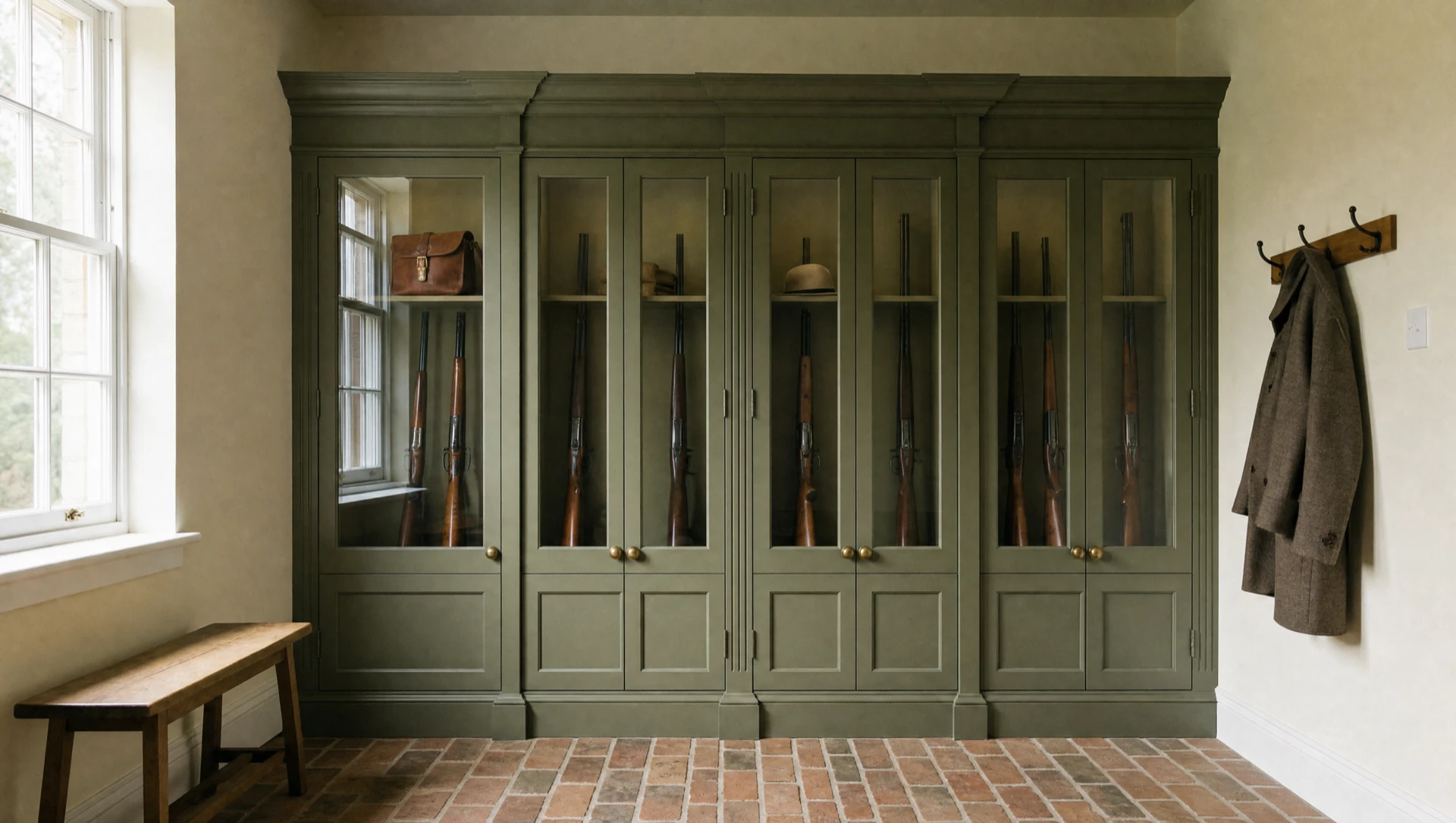
Our clients’ homes and gun cabinets are private, and most ask that they are not photographed or published. The images here are visualisations based on our own workshop drawings for commissions we have completed. If you would like to see drawings, samples and references for completed work, we will show them to you in person — visits to the Mickfield workshop are by appointment.
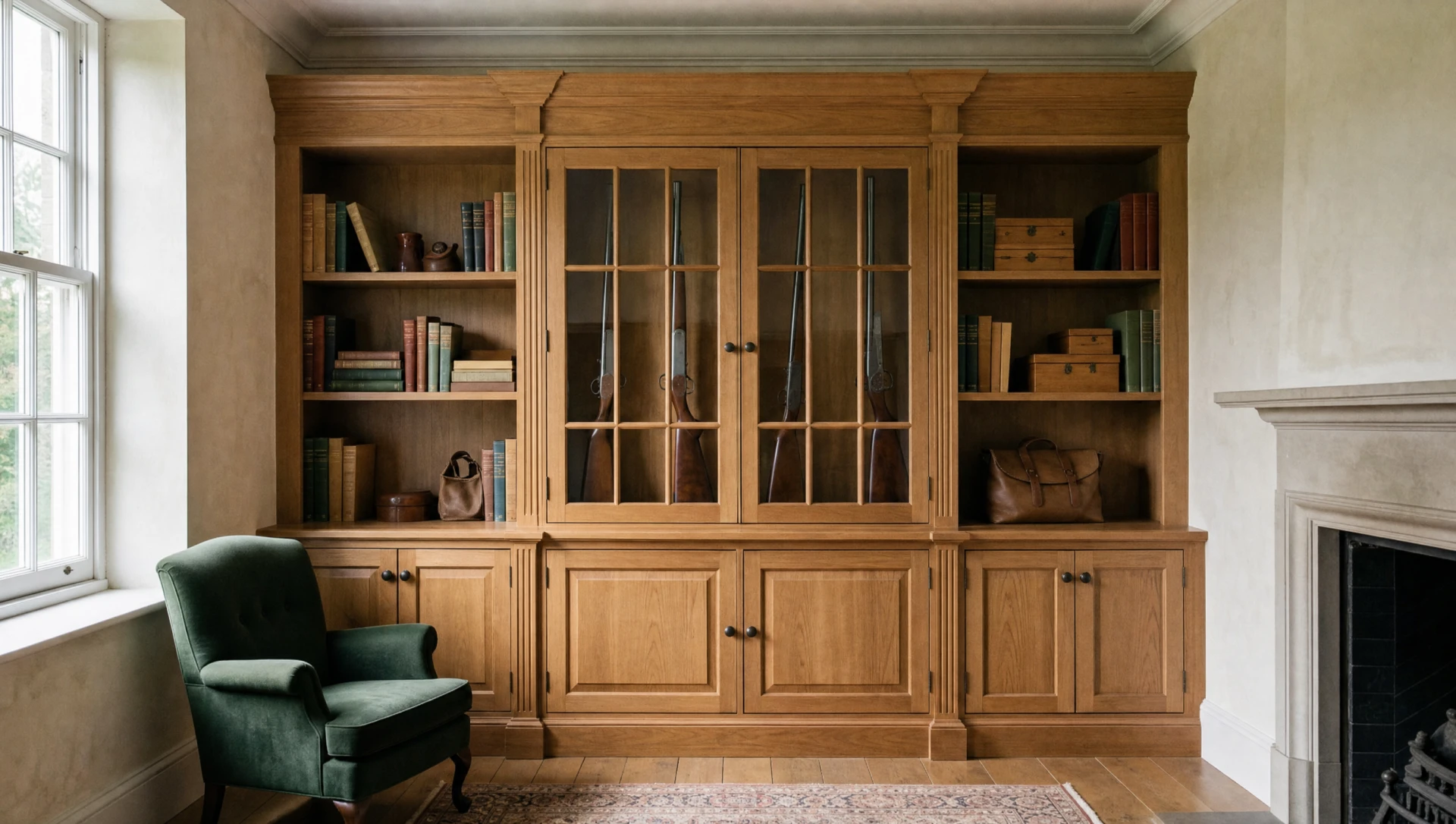
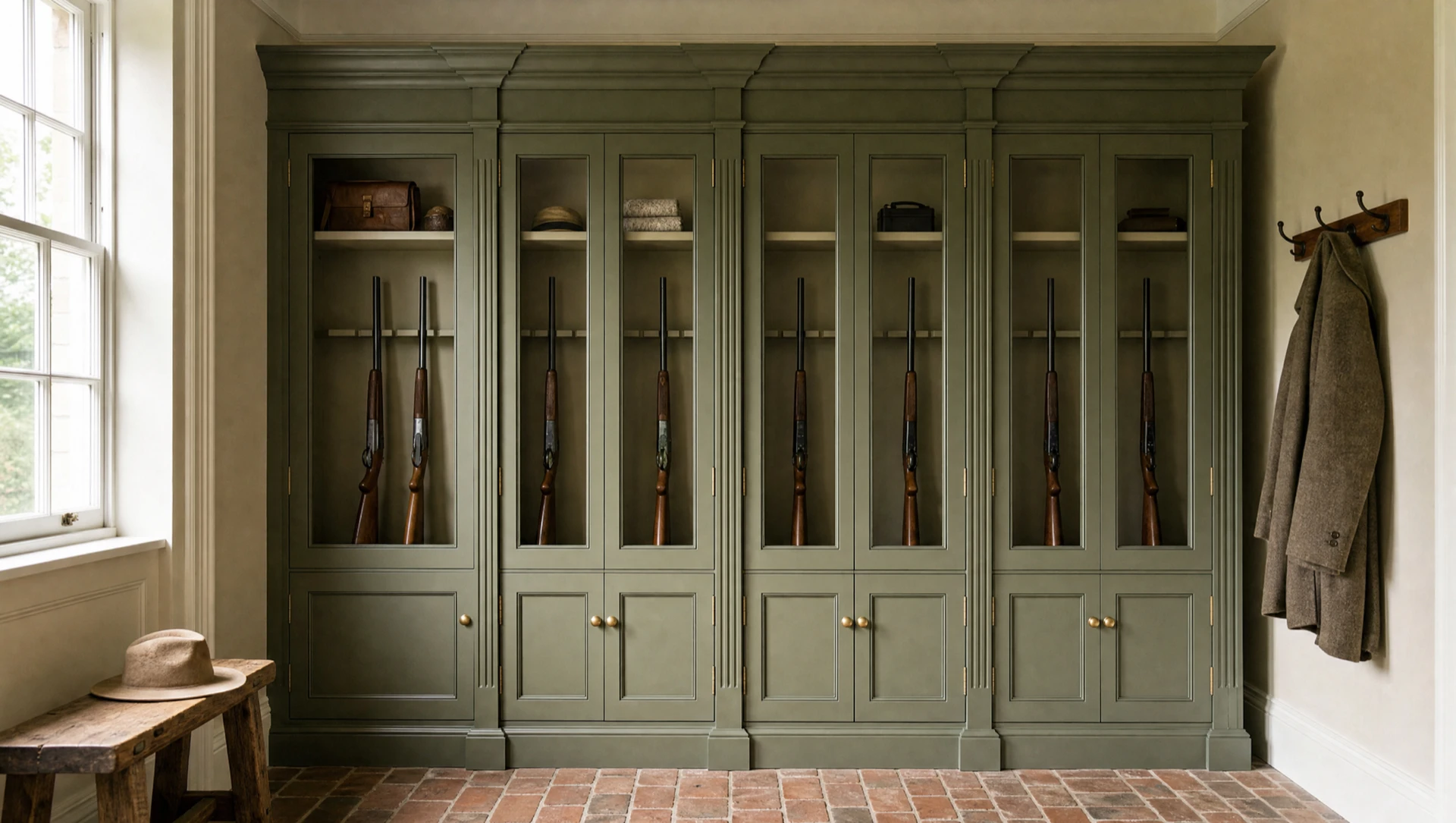
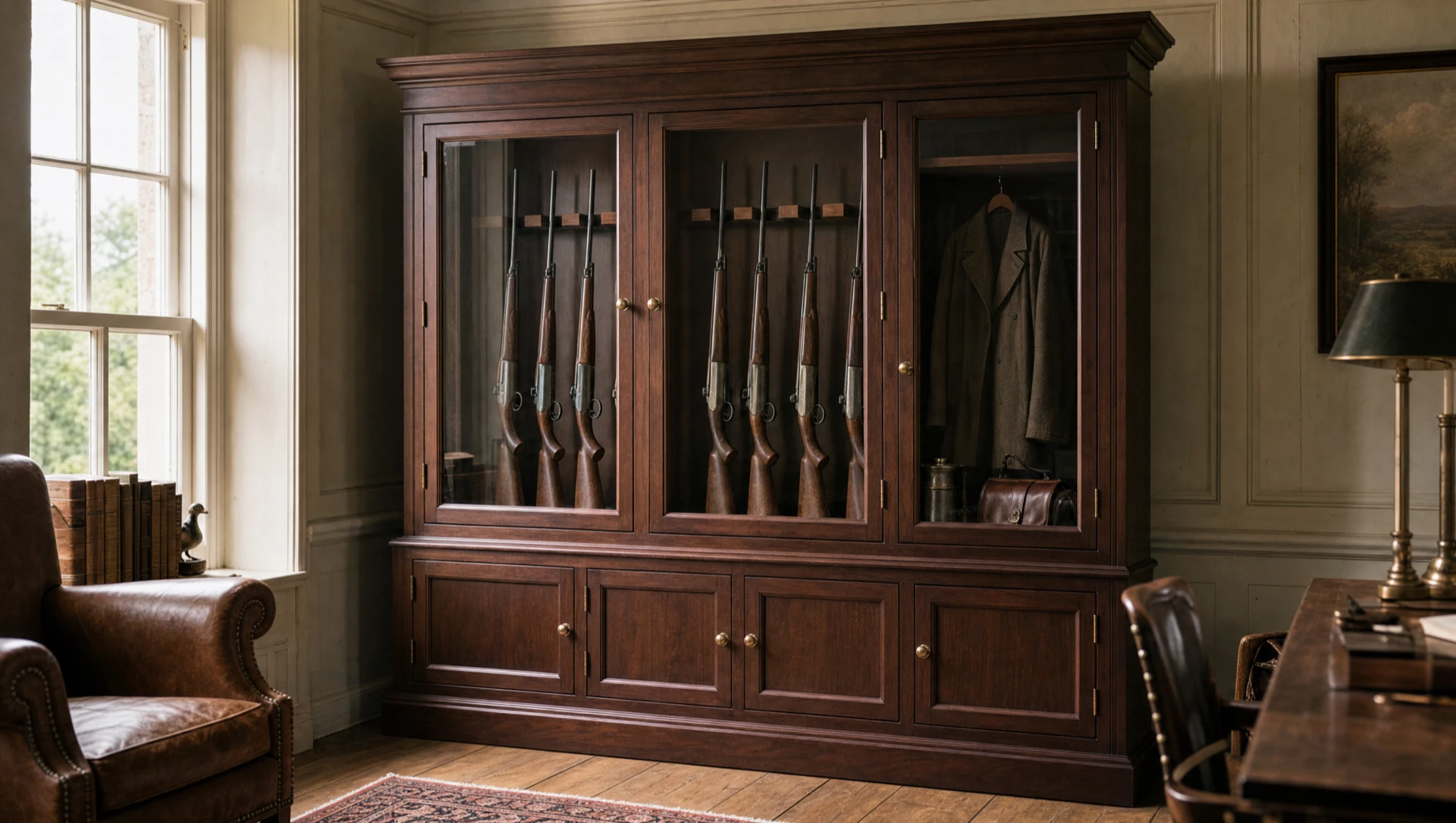
Almost every cabinet on the market is a steel locker that has had a timber front screwed to it. You can tell within about four seconds of opening one: the proportions are a locker’s proportions, the interior is a locker’s interior, and the timber is a veneer applied to a problem rather than the answer to it.
We build the other way round. We are cabinetmakers — the workshop has been making bespoke joinery in Suffolk since 2015, most of it for houses where the furniture is expected to outlive the owner. A gun cabinet is drawn as a piece of furniture, and then engineered so that it is also a safe. Both halves are done to the same standard, which is why the finished thing does not look like a compromise.
On this page
See the work
Finished cabinets, interiors, a timber-faced firearms door and workshop making, shown with the discretion this work requires.
The specification, in full
Most makers describe their cabinets in adjectives. We would rather publish the numbers, because the numbers are the argument.
Every cabinet we build
- 3mm mild steel (0.12in) throughout the lined carcass — not a steel back panel, the whole box.
- Folded steel doors returned behind the frame, so the hinge side resists attack as well as the lock side.
- 8-lever safe locks to EN 1300 Class A, VdS Class 1, with anti-pick levers and 80,000 differs.
- Laminated security glass where doors are glazed — 26mm (1in) as standard.
- Fixings anchored into masonry, never into plasterboard alone, at centres we record and hand over in writing.
- A separate lockable compartment for ammunition, so securing one does not depend on securing the other.
That is a good deal more than a domestic installation is ever likely to need. We build to it anyway, on every cabinet, because the difference in cost is small and the difference in what the cabinet will survive is not.
Why we over-engineer them
Three reasons, and none of them is marketing.
The economics are trivial at this end of the market. Going from adequate steel to genuinely heavy steel adds a modest amount to a cabinet costing several thousand pounds. Nobody has ever rung us afterwards and said they wished they had bought the thinner one.
Standards move, and cabinets don’t. BS 7558:1992, the old British Standard for gun cabinets, was withdrawn on 7 November 2025. Anything built tight to a minimum is hostage to the minimum changing. Build well above it and the question never comes up again — not on the next certificate renewal, not when a new firearms enquiry officer takes over the area, and not when the collection grows.
It is a piece of furniture that will be in the house for fifty years. Getting it wrong is not a matter of replacing a cabinet; it is a matter of taking a large piece of joinery off a wall it is bolted to, and putting another one up.
Withdrawal of a British Standard does not by itself change the condition on your certificate. Secure storage remains a condition applied by your local police firearms licensing department, and what satisfies it at your address is a matter for them. We would always rather you asked your FEO than took our word for it.
The inside
The interior is where a bespoke cabinet stops being a nicer-looking version of a stock one and starts being a different object entirely. It is built around what you actually own.
- Guns that do not touch. Side-by-sides and over-and-unders stand clear of each other. Barrels are supported, stocks are seated, and nothing rubs against its neighbour every time the door opens.
- Scopes left mounted. Rifles stand with their optics on. Zero is a thing you should have to set once, not every time you put the rifle away.
- A separate lockable ammunition drawer, with its own lock, kept apart from the guns.
- A felt-lined cleaning rack, so there is somewhere to lay a gun down that is not a table.
- Drawers for the rest of it — rods, jags, brushes, oil, chokes, keys, certificates, ear defenders. On full-extension runners, because a drawer you cannot see the back of is a drawer you do not use.
- Solid brass or bronze fittings, aged if you want them aged.
- Lighting on a door switch, low-heat LED, aimed at the racks rather than at the glass, so you can see what you are reaching for.
Baize or felt is chosen with the timber and the room — green, teal, oxblood, or something quieter. It is a small decision that people enjoy making, and it is the first thing anyone sees when the door opens.
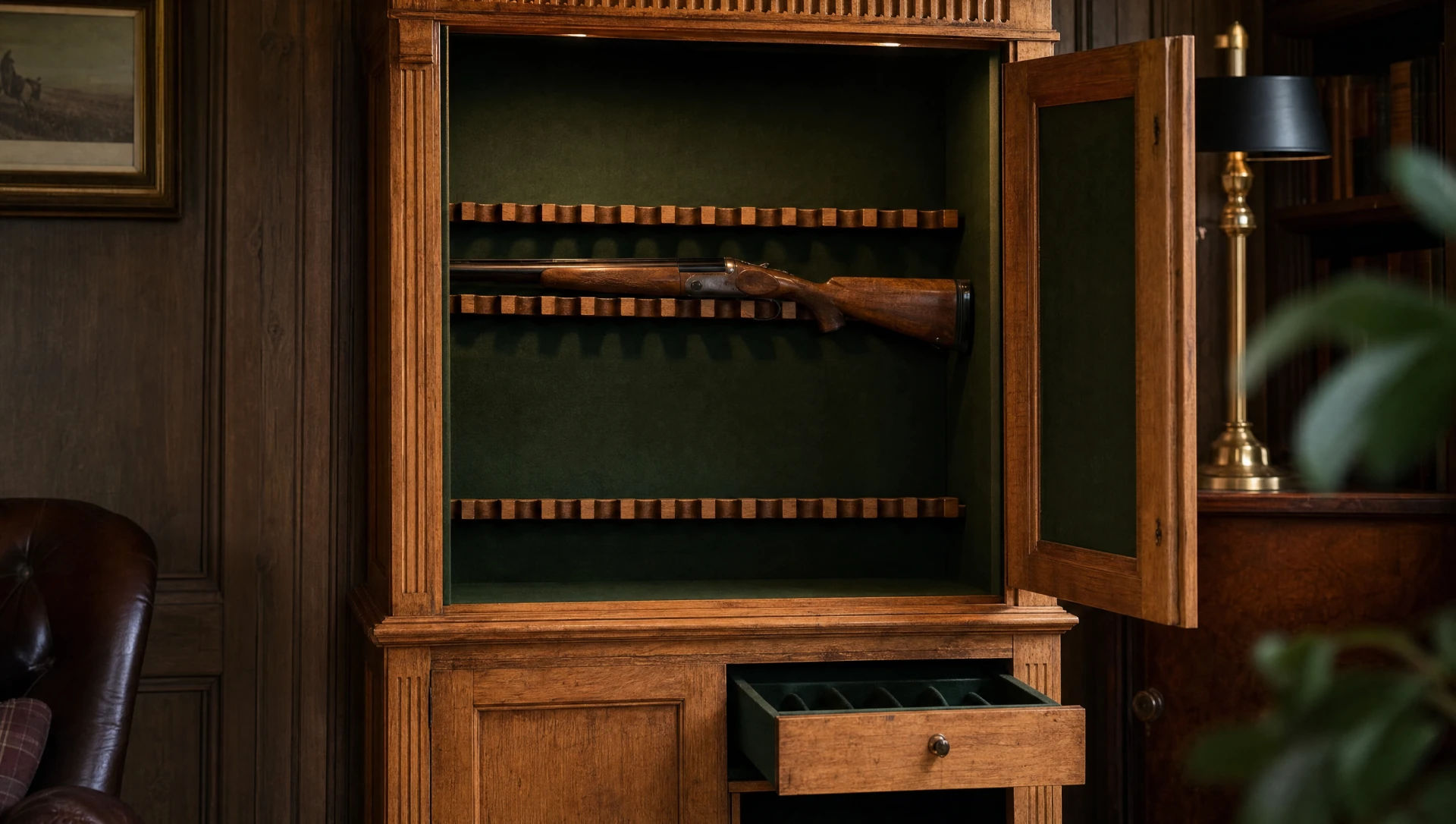
Racks cut to the guns, and a lockable ammunition drawer that is genuinely separate.
Styles we make
Everything is drawn for the room, so this is a starting vocabulary rather than a range.
| Style | Suits |
|---|---|
| Glazed, single or double door | Collections you want to look at. Laminated security glass, timber glazing bars, lit interior |
| Solid-fronted, panelled | Discretion. Reads as a linen press or a hall cupboard from across the room |
| Four-door and multi-bay | Larger collections that do not yet justify a room |
| Wellington chest | Cartridges, kit and ammunition in a proper chest of drawers |
| Fitted and built-in | Set into existing panelling or joinery so it becomes part of the wall |
| Concealed | No visible cabinet at all. Behind a bookcase, a panel or a wardrobe back |
A cabinet can also be built to match joinery that already exists — a run of library shelving, a boot room, a panelled hall — so that it disappears into a scheme rather than sitting next to one. That is ordinary work for us; matching existing timber, mouldings and finish is most of what a bespoke joinery workshop does all week.
Timber and finish
Quarter-sawn, book-matched solid oak, walnut or mahogany, or a hardwood built specifically for paint. Book-matching means the figure runs continuously across a pair of doors instead of stopping at the join — it costs more in timber and in setting-out, and it is the single detail that most reliably tells a made piece from a bought one.
- French polish — the deepest finish, and the one that repairs best. Traditional, and slow.
- Hand-oiled — a lower sheen that shows the grain and takes handling well.
- Hand-painted — any colour, on hardwood, with the grain filled properly so it reads as painted furniture rather than painted board.
- Antiqued — where the house is old enough that a new piece would sit awkwardly. Done by hand, and done sparingly.
We match to existing furniture, existing panelling or a paint reference you give us. We will not guess at a colour from a photograph; send us the reference or a sample and we will match it properly.
Delivery and installation
Every cabinet is delivered and installed by our site team. This is not an upsell — a cabinet has to be bolted to the structure of the building to do its job, and a cabinet standing free on a floor is furniture rather than security.
Our site team brings it in, positions it, and anchors it into masonry or into structural timber, at fixing centres appropriate to the piece. Plasterboard is not a fixing. Where the wall behind is not suitable we will tell you at survey, not on the day, and there is almost always a solution — a different wall, a different fixing strategy, or a change to the back of the cabinet.
You get a signed specification sheet on completion listing steel thickness, glass specification, lock model, fixing type and fixing centres. Your FEO can verify what has been built rather than take our word for it, and your insurer gets a document instead of a photograph.
What a bespoke gun cabinet costs
From around £8,400 including VAT, for a cabinet delivered and installed in the UK. That is a genuine starting point for a straightforward piece, not a headline that evaporates on enquiry.
| What moves the number | Why |
|---|---|
| Size and number of doors | Steel, glass and hardware all scale, and heavy doors need heavier hinges |
| Glazing | Laminated security glass is expensive and heavy, and it changes the whole door |
| Timber and figure | Book-matched figured walnut is a different material cost from painted hardwood |
| Finish | French polish and hand-antiquing are bench hours, not materials |
| Interior complexity | Mixed collections, cased pairs and scoped rifles take more drawing and more making |
| Matching existing joinery | Matching a moulding or a paint finish is skilled work and it is not quick |
| Installation distance | We install UK-wide from Suffolk; distance is a cost line, not an obstacle |
You get the price before we draw anything. If the brief changes, we tell you what the change costs before we make it. There is a fuller breakdown on prices.
How a commission runs
- Send us your gun listWhat you own, what you shoot, what stays cased, what has glass on it. Photographs of the room help enormously.
- SurveyWe measure, check the wall behind, and look at access. Access is the thing that catches people out, not size.
- Specification agreed with your FEOBefore anything is made.
- Design3D CAD drawings, so you see the piece in the room before it exists.
- Fixed quotationItemised, against the drawings.
- Made in SuffolkBy our own cabinetmakers. Not subcontracted, not imported, not badged.
- Delivered and installedBy our site team, and bolted in properly.
- Signed specification sheetHanded over on the day.
Working with your firearms enquiry officer
We agree the specification with your local firearms enquiry officer before we start. It costs a phone call and it removes the only genuinely unpleasant surprise available in this process.
Secure storage is a condition of your certificate under the Firearms Act 1968 and the Firearms Rules 1998. The Home Office Firearms Security Handbook is guidance on how that condition is usually met — it is not itself the law, and it does not bind your force to a particular product. What matters is that your licensing department is satisfied with the arrangement at your address. There is a full explanation on the FEO process.
Responsibility for meeting the security condition on your certificate rests with you as the certificate holder, and the adequacy of any storage arrangement is a matter for your local police firearms licensing department. Nothing on this page is legal advice.
Cabinet or gun room?
Worth being honest about, because we make both and we would rather you bought the right one.
A cabinet is a piece of furniture: made in the workshop, delivered whole, bolted to a wall. It starts at around £8,400 including VAT, it goes into a room that already exists, and it does not require your builder.
A fitted gun room is a room converted: steel lining to the walls, a steel firearms door clad in timber, and the entire interior fitted out in joinery. It starts at around £24,000, and the room has to be prepared by a builder before we arrive — we do not carry out building work.
For most collections a cabinet, or a wall of cabinets, is the right answer. You move to a room when the collection has outgrown the furniture, when there is nowhere to clean, or when a renovation makes it the obvious moment to do it once.
If the collection is heading towards a room rather than a cabinet, bespoke gun cabinet or fitted gun room sets out where the line usually falls.
Questions we are asked
What does a bespoke gun cabinet cost?
From around £8,400, delivered and installed in the UK. The figure moves with size, the number of doors, whether it is glazed, the timber and finish, how complex the interior is and how far the installation is from Suffolk. You get a fixed price before we draw anything.
How thick is the steel?
3mm mild steel throughout the lined carcass, on every cabinet — not just a steel back panel. Doors are folded steel with a folded return behind the frame on the hinge side.
What glass do you use in glazed doors?
Laminated security glass, 26mm as standard.
Do you deliver and install, or just deliver?
Both, always. A cabinet has to be bolted to the structure of the building to do its job, so our site team installs every cabinet, anchored into masonry or structural timber rather than plasterboard.
Will it satisfy my firearms enquiry officer?
We agree the specification with your FEO before we make anything and hand over a signed specification sheet on completion, listing steel thickness, glass, lock model, fixing type and centres. The decision remains theirs, which is why we involve them at the start rather than the end.
Can ammunition be stored in the same cabinet?
Yes, in a separate lockable compartment with its own lock, so securing one does not depend on securing the other. If your certificate carries a specific condition about ammunition, tell us what it says and we will build to it.
Can you match cabinetry we already have?
Yes. Matching existing timber, mouldings, ironmongery and finish is ordinary work for a bespoke joinery workshop. Send us a photograph and, where possible, a physical sample or a paint reference — we will not guess a colour from a screen.
Can rifles be stored with scopes fitted?
Yes. We draw the interior around your actual guns, including clearance for mounted optics, so nothing has to be stripped to be put away.
Is BS 7558 still relevant?
BS 7558:1992 was withdrawn on 7 November 2025. Our cabinets have always been built well above that specification, so the withdrawal changes nothing about what we make. Your certificate condition is applied by your licensing department, not by a withdrawn standard.
What bespoke gun cabinets are actually worth over thirty years
The honest case for bespoke gun cabinets is not that they are cheaper than a steel locker. They are not, by a factor of ten. The case is that they are the only version of this object that you do not eventually replace, hide, or apologise for.
A basic steel cabinet does the licensing job perfectly well. It also lives in a spare bedroom with a blanket over it, it rusts at the base where it meets a cold wall, its single lock opens everything including the ammunition, and it is worth nothing at the end. Most people who commission from us have owned two of them.
| Steel locker | Bespoke cabinet | |
|---|---|---|
| Thinnest panel | Often 1.0–1.5 mm | 3 mm throughout |
| Ammunition separately locked | Usually not | Standard |
| Lives in | Spare room, garage, loft | The room you use |
| Value at 30 years | Scrap | Furniture |
Set against a thirty-year life that is somewhere between £280 and £480 a year for a piece of furniture you look at daily, and it does not depreciate the way a kitchen does. We are not going to pretend that makes it a rational purchase for everybody — it plainly does not for most certificate holders, and the Firearms Security Handbook asks for nothing of the sort. It is a furniture decision that happens to also solve a security problem.
Who these are actually for
In practice, three situations. A collection that has outgrown two lockers and is now spread across the house. A room being built or reordered, where the cabinet can be designed in rather than added. And guns that are worth properly looking after — English guns, cased pairs, anything blued and old — where the environment inside the cabinet matters as much as the lock on it.
If none of those is you, buy a good steel cabinet, bolt it into masonry properly, and put a hygrometer in it. We would rather say that than sell you something you do not need.
Seven of them are published with prices
Everything here is bespoke, but the seven cabinets we build most often are set out in the standard range with their sizes, gun capacities and prices in four timbers. They are starting points rather than fixed products — yours is still cut to your own gun list — but you can see where you stand before you ring.
Send us your gun list
It is the fastest route to a real answer. Tell us what you own and where it needs to go, and we will tell you what we would build and roughly what it would cost — before anybody draws anything.
Other secure furniture from the same bench: watch winders and watch safes, and cigar cabinets and humidor tables. Cabinets from the standard range can also be ordered online.