
Fitted Gun Rooms
Gun Room Design and Layout
The security is the easy half. Once the room is lined and the door is hung, what you are left with is a small, awkwardly-proportioned space that has to hold long objects, work as a bench, and be a pleasure to stand in. That is a joinery problem, and it is the one we care about.
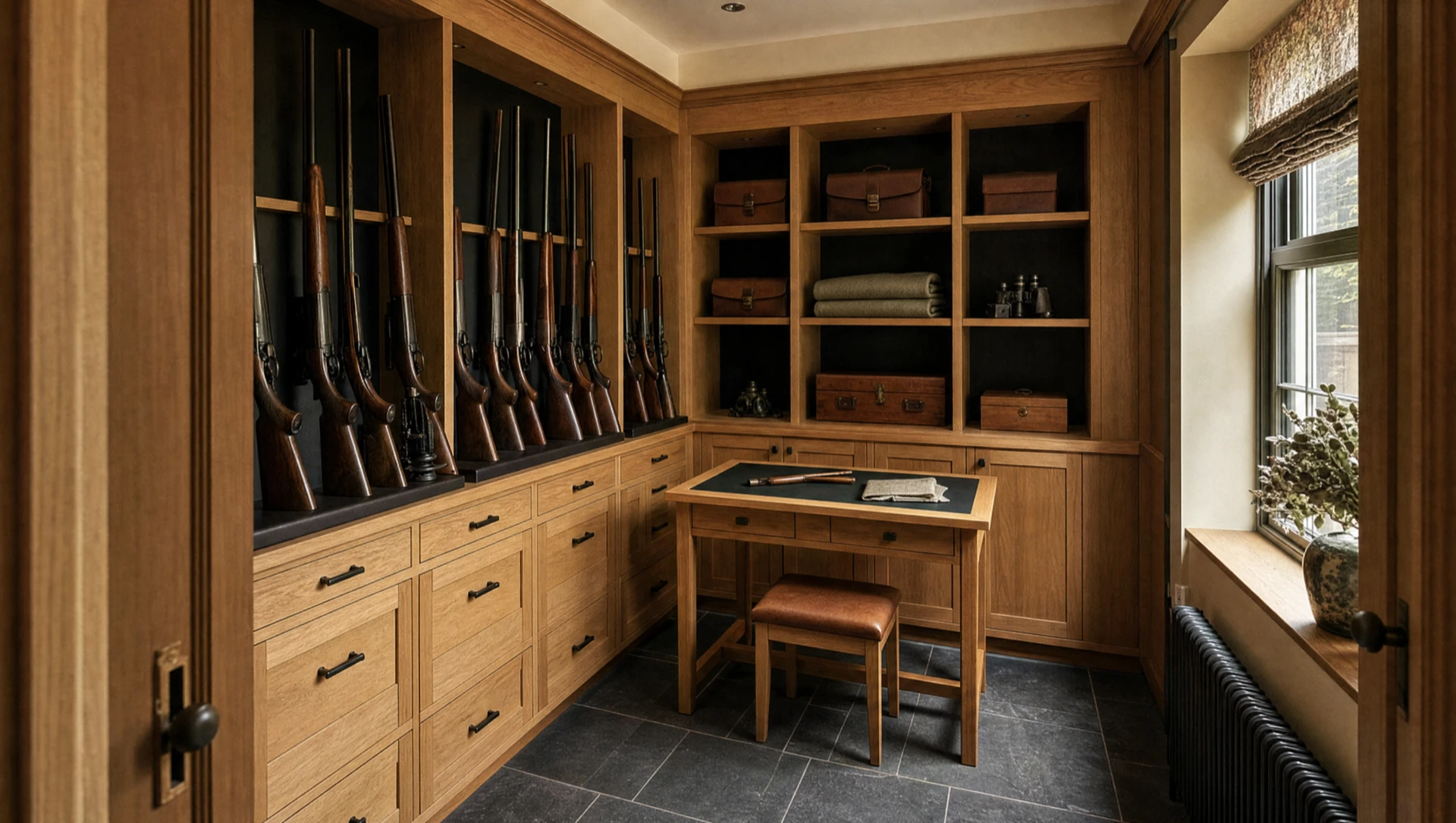
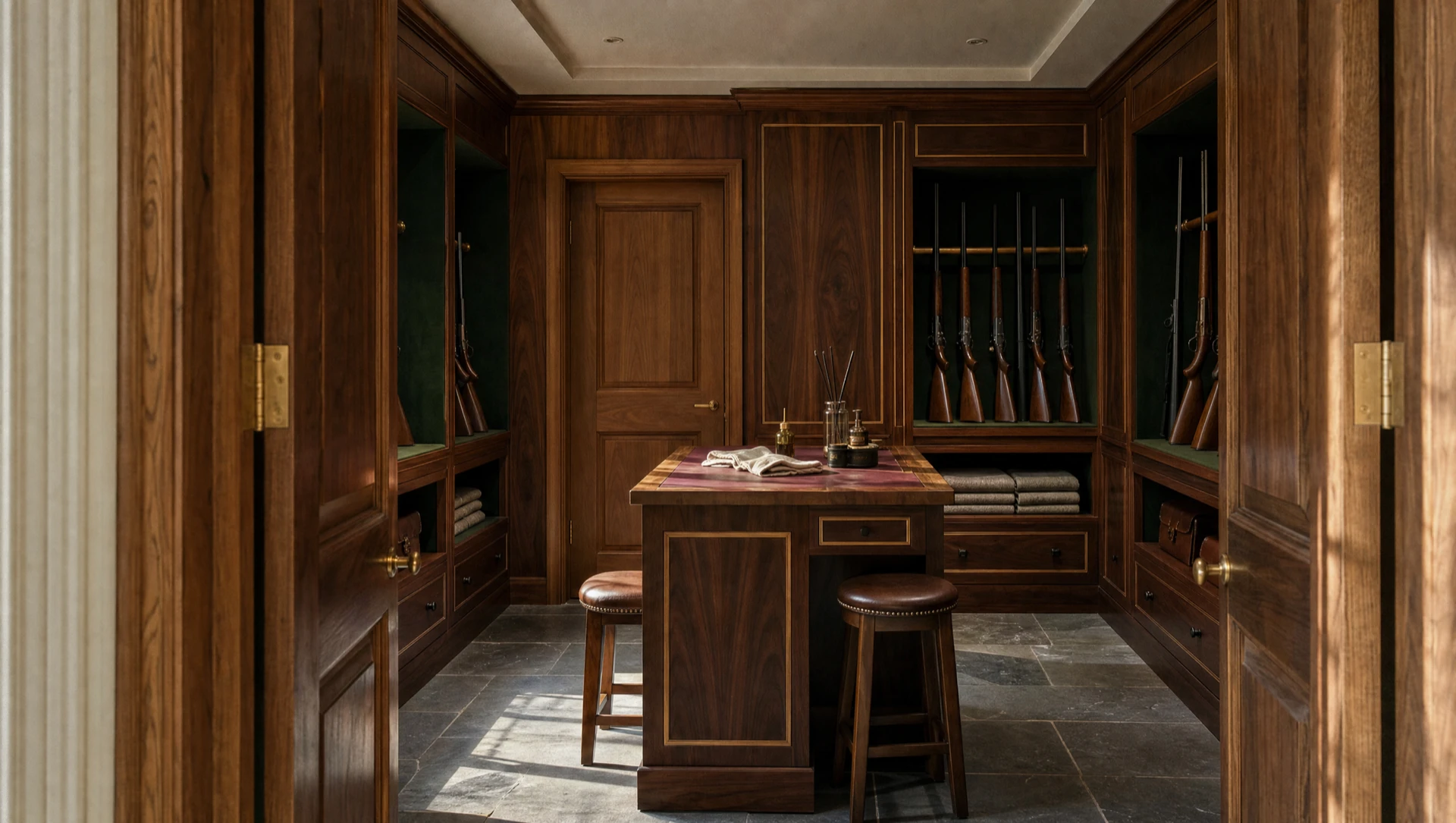
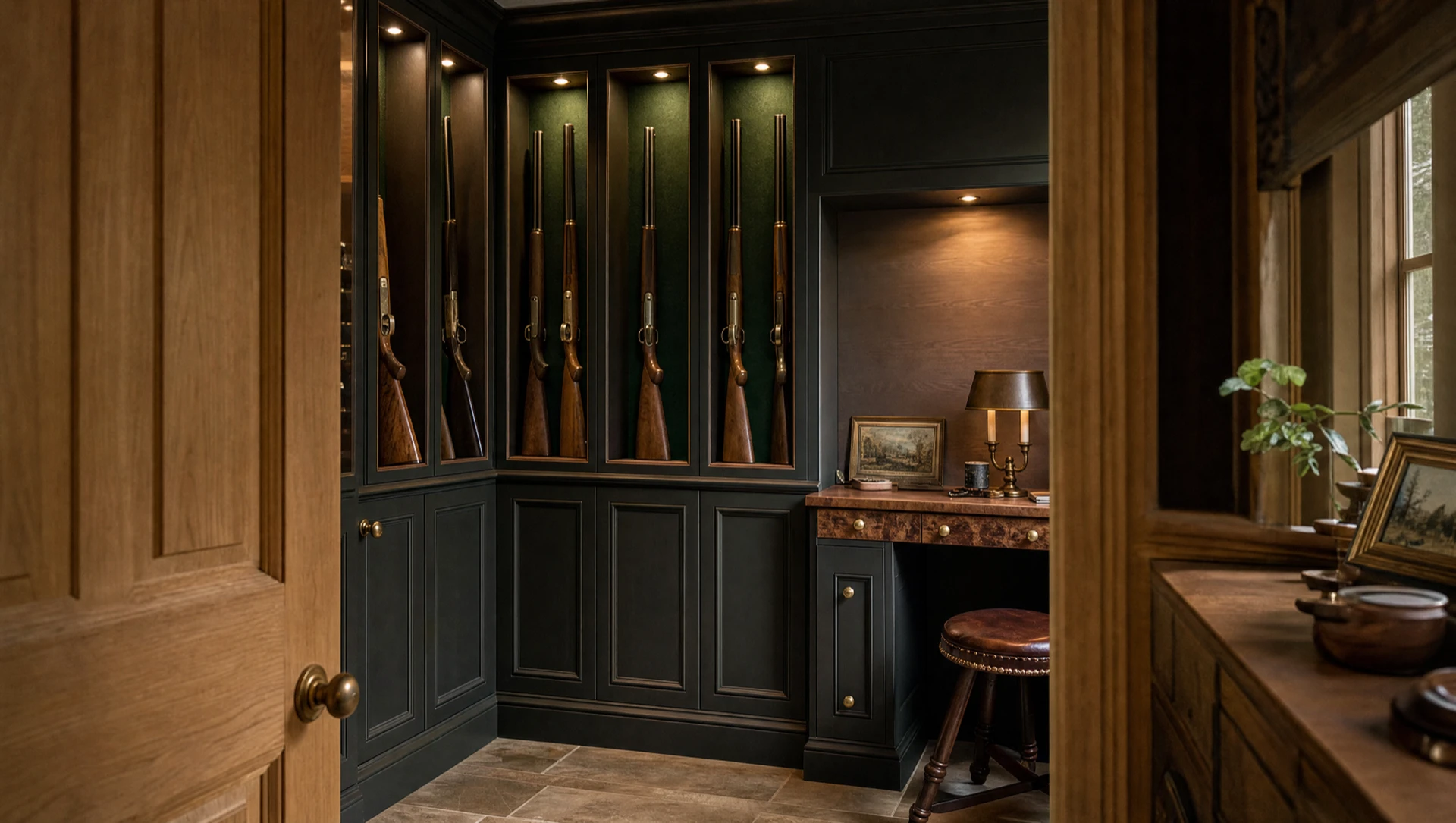
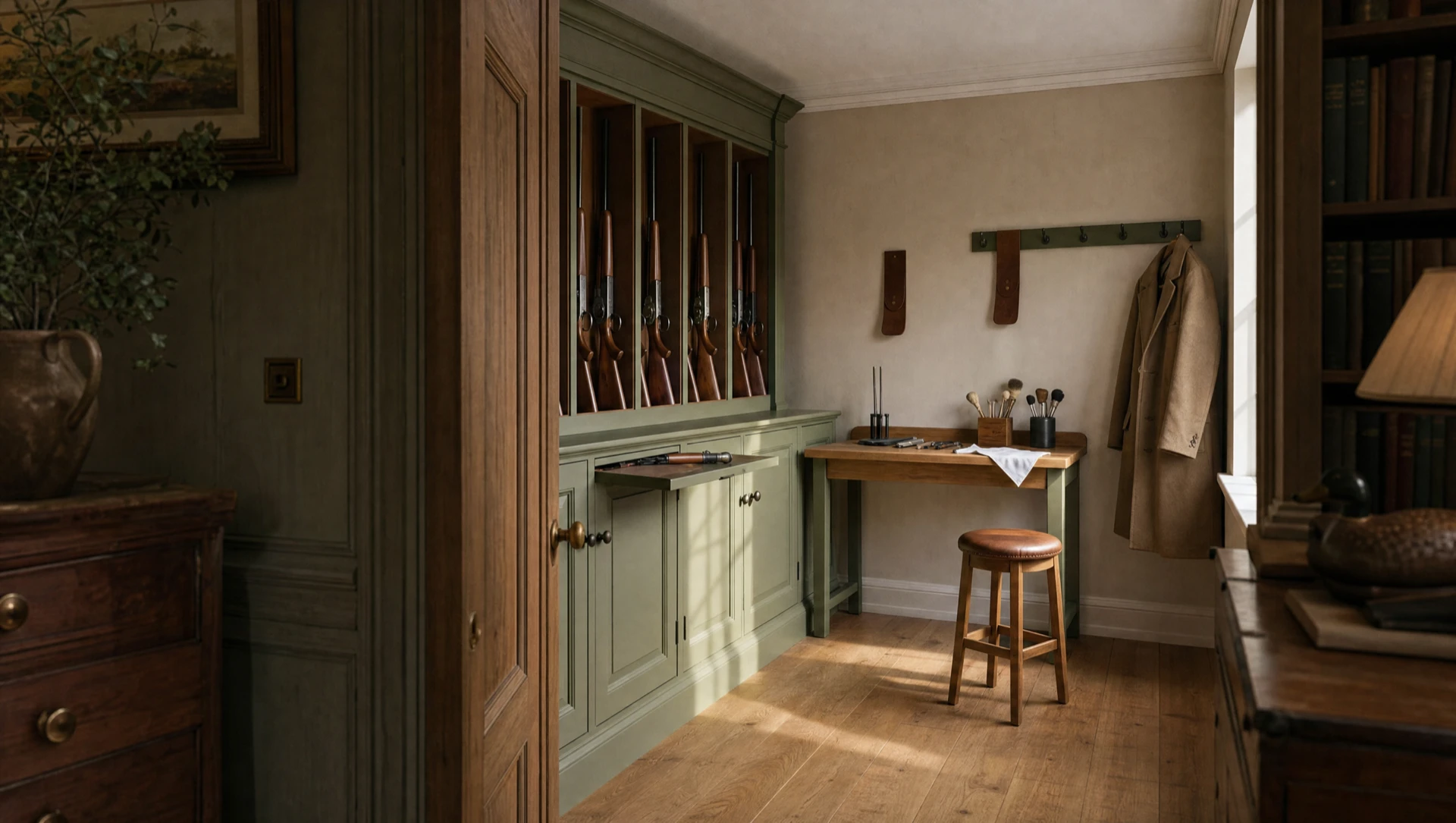
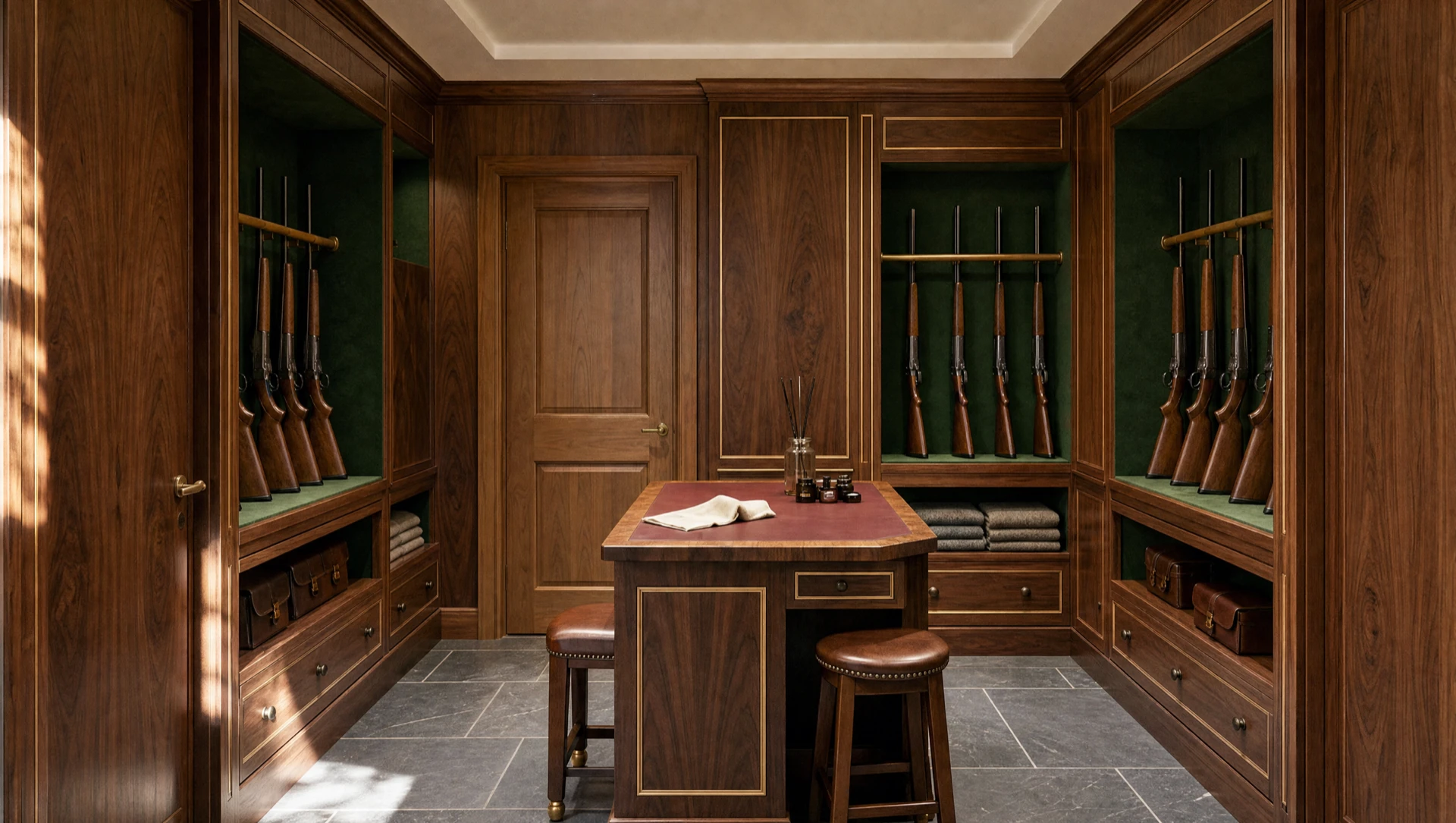
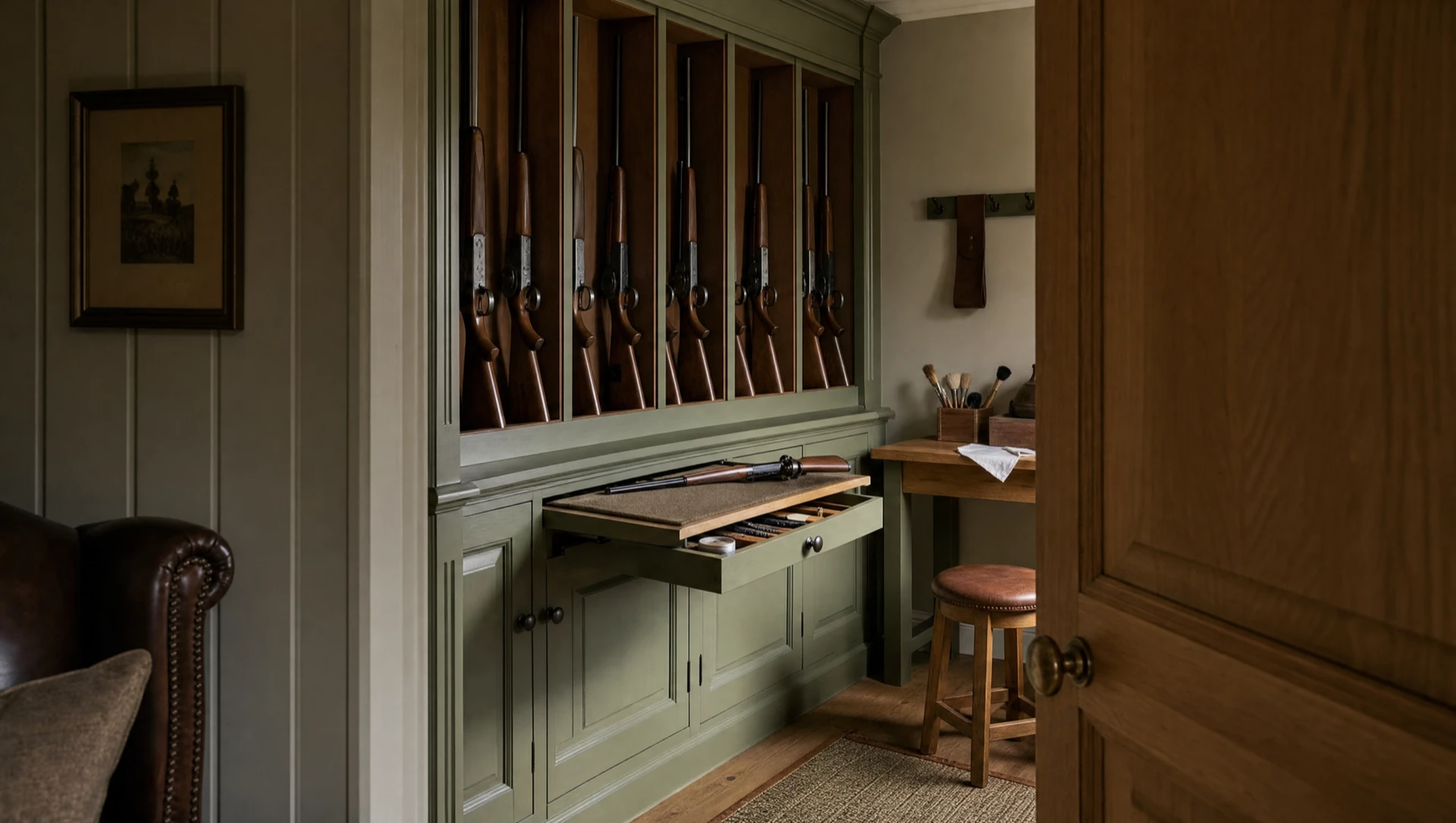
An anonymised design drawing is shown here rather than a client photograph. It demonstrates how the interior is drawn around the collection and the room.
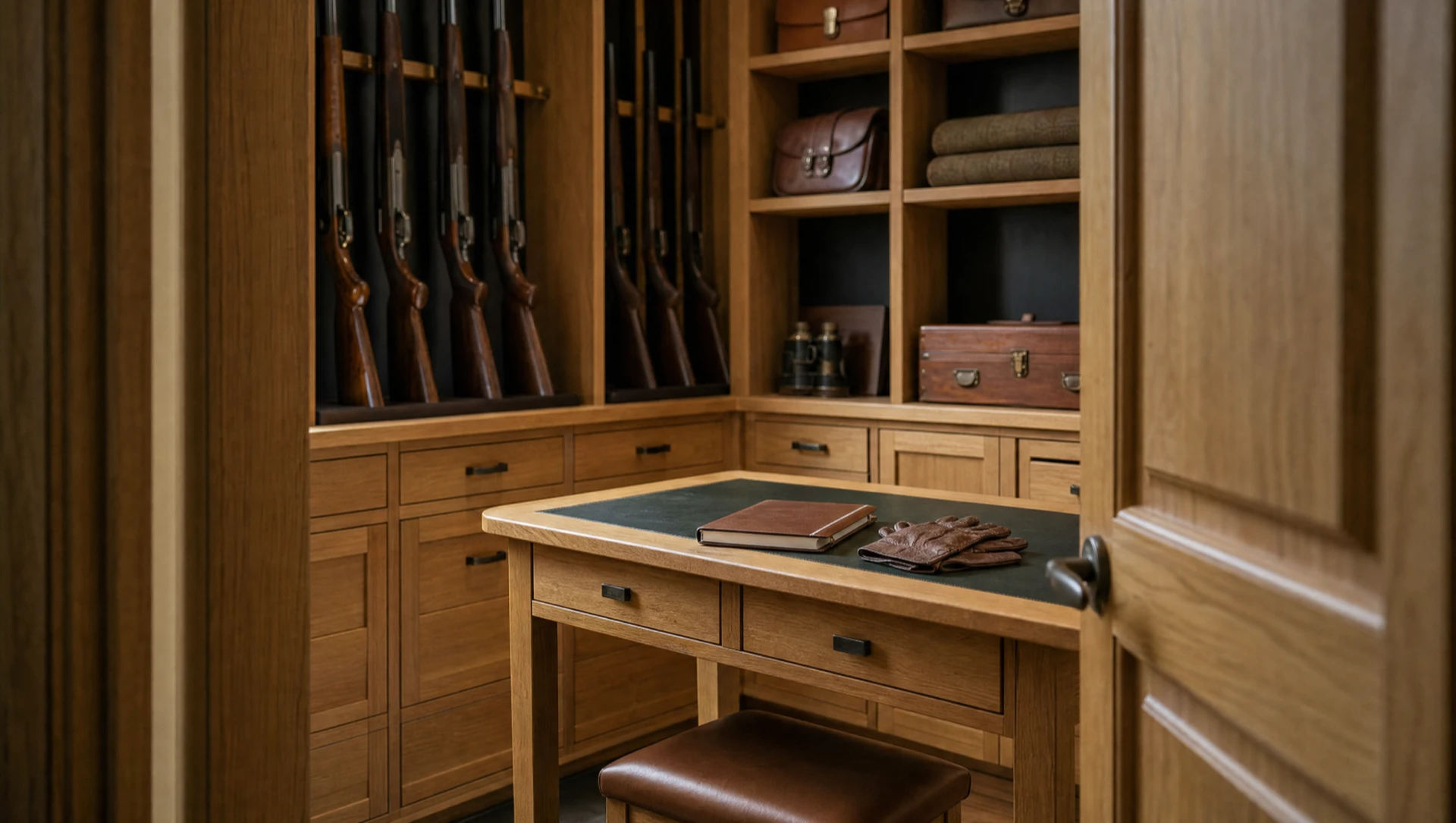
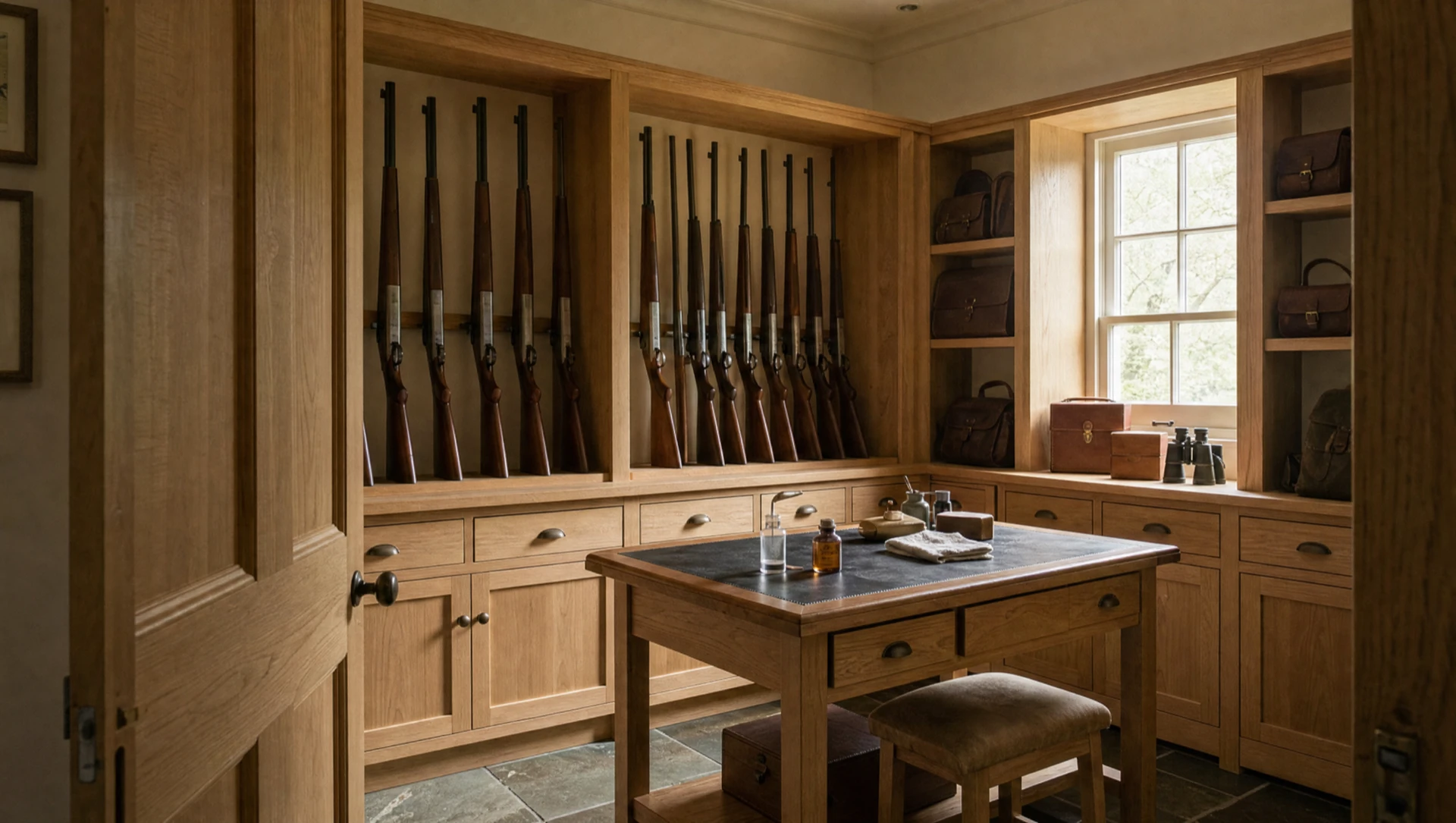
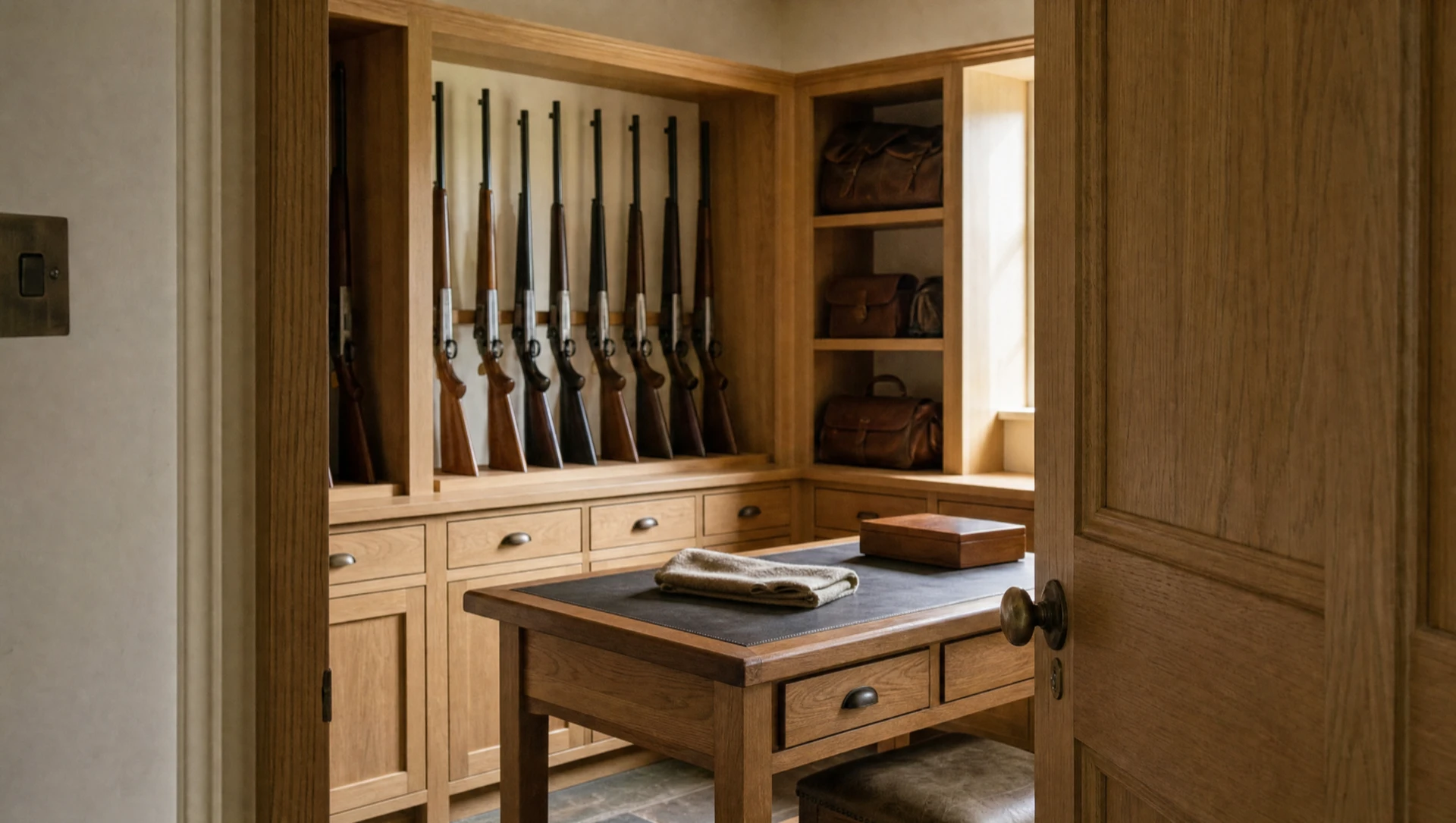
Almost every disappointing gun room we are asked to look at has the same fault, and it is never the steel. It is that the interior was drawn from a rack layout rather than from a collection: identical slots at identical centres, no thought to what actually goes in them, and no room to do anything except put guns away and take them out again.
On this page
- It starts with the gun list
- Racks, and why centres matter
- Scope clearance
- The cleaning table
- Cartridges and ammunition
- Cased guns, slips and kit
- Circulation and the awkward small room
- Light and sightlines
- Boots, coats and dogs
- Designing for a collection that grows
- Gun room design: the setting-out figures
It starts with the gun list
Before we draw a line we ask for a list. Not serial numbers — we do not want them and would rather you did not email them. What we want is:
- What you own: shotguns, rifles, and what each one is
- What is a cased pair, and whether the cases live in the room
- What has a scope, and whether it stays mounted
- What is unusually long, heavy or fragile
- What you actually shoot, and what is here because it is not going anywhere
- How much cartridge storage you want, and what ammunition conditions are on your certificate
- What you expect to buy in the next few years
That last one is the question people are most surprised by and it is the one that saves the most money. Building in headroom now costs a fraction of adding a bay later, and it avoids the state most gun rooms end up in — technically secure, visibly crammed.
Racks, and why centres matter
A rack is a set of decisions about spacing, and spacing is where standard layouts fail.
Side-by-sides and over-and-unders are different widths at the action and different widths at the muzzle. Put them at the same centres and something touches — usually at the fore-end, usually every time the door is opened, and usually on the piece you least want rubbed. We set out racks from the actual guns: barrels supported, stocks seated, and nothing in contact with its neighbour.
Where the rack sits against the gun it is felt or baize lined. Where the gun rests on a heel, the heel is shaped rather than a straight edge, because a straight edge concentrates the load into a line.
Vertical or horizontal?
Vertical is the default and it suits most collections — compact, easy to scan, easy to take one gun without disturbing another.
Horizontal reads beautifully and is genuinely better for a small number of very good guns, particularly where you want them seen. It costs a great deal more wall for the same number of guns.
Most rooms end up with both: vertical for the working guns, a horizontal display run for the ones that deserve it.
Scope clearance
The single most common complaint about standard racking, and it is entirely avoidable.
A rifle with a scope mounted is wider and deeper than the same rifle without one, and the scope sits at exactly the height where a shelf edge or a rack bar wants to be. Design around it and the rifle stands with its glass on. Do not, and every trip to the range begins and ends with removing and refitting optics, which is a tedious way to introduce doubt into something you have spent money getting right.
We ask which rifles have glass, what the objective diameter is, and whether the mounts are quick-detach, and then we draw the bay around the answer.
The cleaning table
The thing most gun rooms leave out, and the thing that most changes how the room is used.
A cleaning table is a bench at working height with a felt bed, room to lay a gun down full length, and drawers underneath for rods, jags, brushes, mops, oils and solvents. Get the height right and you will clean guns in there. Get it wrong and you will keep doing it at the kitchen table, which is a domestic problem as much as a practical one.
| Element | Why it is drawn the way it is |
|---|---|
| Height | Set to you, standing, working with your elbows down — not to a standard worktop height |
| Length | Long enough for the longest gun you own, laid down whole |
| Felt bed | Replaceable. It is a wearing surface and it should be treated as one |
| Solvent storage | In a drawer, away from the guns and away from the cartridges |
| Lighting | Over the bench, in front of you, not behind your head casting a shadow onto the work |
| A lip or not | A raised lip stops things rolling. It also stops you sliding a gun off cleanly. We ask |
Cartridges and ammunition
Cartridges are heavy, and a cartridge drawer that will not slide when it is full is a design failure that only reveals itself after handover. Drawers are on full-extension heavy-duty runners, sized so that a full drawer still runs, and divided so that boxes stand rather than slide about.
Ammunition is stored in a separate lockable compartment with its own lock, so that securing one does not depend on securing the other. Where your certificate carries a condition about ammunition, tell us the exact wording and we will build to it rather than to a general assumption — conditions vary, and designing to the average is how you end up rebuilding a drawer.
Expanding ammunition and any component held under a condition gets its own locked provision.
Cased guns, slips and kit
A category that gets forgotten until the room is finished and there is a motor case on the floor.
- Cased pairs want a shelf that takes the case flat, at a height you can lift it from without turning it.
- Slips want hanging space, not a pile.
- Ear defenders, glasses, chokes and keys want a shallow drawer near the door, because that is where you will be standing when you want them.
- Certificates and paperwork want somewhere sensible and dry. The specification sheet we hand over lives with them.
Circulation and the awkward small room
Gun rooms are usually small, and small rooms full of tall joinery become unusable very quickly if the circulation is not drawn properly.
The governing dimension is not floor area, it is the space in front of the racks. You need enough room to bring a gun out to the vertical and turn it without touching anything, and you need that with the cabinet door open. Two runs of racking facing each other across a narrow room is a layout that looks efficient in plan and is horrible to stand in.
A few principles we apply:
- Racks on one long wall, bench opposite, is almost always better than racks on two.
- The door should not swing into the working space. If it must, it hangs the other way.
- Corners are for storage that is reached rarely — cases, boxes, spares — not for guns.
- Full-height joinery on the wall you face when you walk in makes a small room feel smaller. Break it with the bench.
- Leave one wall alone if you can. A room with something on every surface is a store.
Light and sightlines
Light is drawn at the same time as the joinery, not added afterwards by whoever is doing the electrics.
Lighting comes on with the door on a switch, so you are never reaching into a dark cabinet. It is aimed at the racks rather than at the glass, because a glazed door lit from the wrong angle shows you a reflection of yourself and nothing else. It is low-heat LED — a warm room is a worse room, for reasons covered on lighting, heating and ventilation.
Sightlines are worth a moment too. What you see when the door opens is the thing you will look at several hundred times a year. In most rooms the right answer is that you see the best guns, lit, framed by joinery — and that the cleaning bench, the cartridges and the kit are to the side.
Boots, coats and dogs
The best gun rooms sit on the route in from the field rather than at the far end of a carpeted hall, and once they do, they stop being purely gun rooms.
That is a good thing and it should be designed for: hanging that dries a coat rather than storing it wet, boot storage with a tray under it, somewhere for a wet dog that is not the joinery, and a floor that will take all three. If the room is doing that job as well, tell us at the outset — a gun room designed as a gun room and then used as a boot room ages badly.
Designing for a collection that grows
Three moves that cost almost nothing at drawing stage and a great deal afterwards.
- Rack on adjustable centresSo a bay can be reset for different guns rather than rebuilt.
- Leave one bay as shelvingIt looks intentional now and converts to racking later.
- Oversize the cartridge drawersNobody has ever regretted this.
And one that costs something and is usually worth it: run the joinery full height even where you do not need the top yet. Adding a top box later never quite matches, however good the polisher is.
Responsibility for meeting the security condition on your certificate rests with you as the certificate holder, and the adequacy of any storage arrangement is a matter for your local police firearms licensing department. Where your certificate carries specific conditions — on ammunition or otherwise — send us the exact wording and we will design to it. See the FEO process. Nothing on this page is legal advice.
Questions we are asked
How do you design a gun room layout?
From your gun list. We ask what you own, what stays cased, what has a scope mounted, what is unusually long or heavy, how much cartridge storage you want and what you expect to buy in the next few years — then we draw racks, bench and storage around that rather than from a standard rack layout.
How much space do I need in front of the racks?
Enough to bring a gun out to the vertical and turn it without touching anything, with the cabinet door open. That clearance, rather than floor area, is the governing dimension in a small room — which is why racks on one long wall with the bench opposite usually beats racking on two walls.
Can rifles be stored with scopes on?
Yes, and they should be. We ask which rifles have glass, the objective diameter and whether the mounts are quick-detach, then draw the bay around it so nothing has to be stripped to be put away.
What height should a gun cleaning table be?
Set to you, standing, working with your elbows down — not to a standard kitchen worktop height. It should also be long enough to lay your longest gun down whole, with a replaceable felt bed and drawers beneath for rods, oils and solvents.
Should the gun room double as a boot room?
Often, yes, and the best ones do — they sit on the route in from the field. But it has to be designed for at the outset: drying rather than storing, a boot tray, somewhere for a wet dog, and a floor that takes all three.
How do I allow for a growing collection?
Rack on adjustable centres, leave one bay as shelving that converts to racking later, and oversize the cartridge drawers. Running the joinery full height from the start is also worth it — a top box added later never quite matches.
Gun room design: the setting-out figures
These are the dimensions we start from. They are not rules — every one of them moves for a particular collection — but they are the numbers a room has to be tested against before the joinery is drawn.
| Element | Figure | Why |
|---|---|---|
| Rack centres, side-by-sides | 75–85 mm | Actions clear each other; nothing touches |
| Rack centres, over-and-unders | 85–95 mm | Deeper action, more clearance needed |
| Rack centres, scoped rifles | 110–140 mm | Set by the objective bell, not the barrel |
| Internal height, made-up guns | 1,250 mm minimum | Takes a long-barrelled wildfowling gun |
| Internal depth | 380–420 mm | Below 380 and a scoped rifle fouls the door |
| Cleaning table height | 950–1,000 mm | Higher than a desk — you work standing |
| Cleaning table length | 1,400 mm minimum | A gun apart, with room either side |
| Circulation in front of racks | 900 mm clear | Enough to turn with a gun in hand |
| Door swing clearance | Full width of the widest door leaf | The commonest small-room failure |
The two mistakes we see most
Racks drawn to an average. Average centres hold average guns. A collection with two over-and-unders, a pair of side-by-sides and a scoped stalking rifle needs three different centre spacings in one rack, and drawing it from a gun list costs nothing while drawing it from an assumption costs a rebuild.
Designing the storage and forgetting the work. A gun room is a workshop as well as a store. Somewhere to put a gun down, light on the bench rather than behind you, a bin for patches, a socket at working height, and a floor you can drop a screw on and find it. Rooms that get used are rooms where the cleaning is pleasant.
Before any of this, read the storage guidance your force works from — the Home Office Firearms Security Handbook. Gun room design that ignores where the room sits in the house is design that gets changed after the FEO visit.
Send us your gun list
It is the single most useful thing you can do, it takes five minutes, and it is what turns a quotation into a design.
Walk-in cigar rooms · Watch winders and watch safes · Fitted gun rooms