
The FEO Process
We agree the specification with your firearms enquiry officer before we make anything. It costs a telephone call, and it removes the only genuinely unpleasant surprise available in this process — a finished cabinet, or a finished room, that your licensing department is not satisfied with.
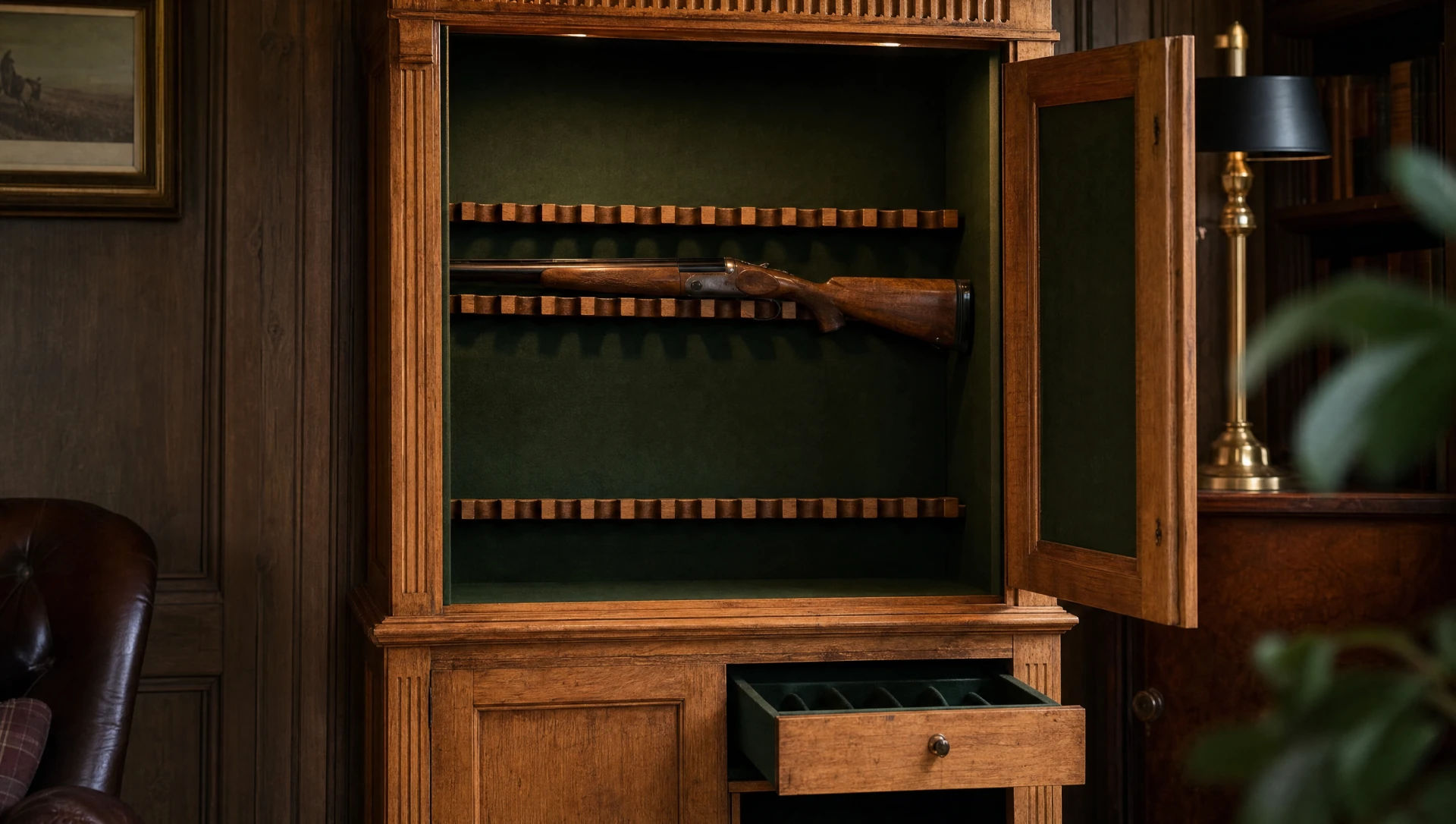
Almost nobody in this trade does this. Cabinets are sold, delivered, and only then presented to an FEO, at which point any disagreement is expensive and awkward. We would rather have the conversation while the timber is still a drawing.
On this page
Who the FEO is
A firearms enquiry officer is the person who visits your address on behalf of your police force’s firearms licensing department. They carry out the enquiries that inform a decision on a certificate application, variation or renewal, and, in practice, they are the person who looks at where you intend to keep your guns and forms a view about it.
They are, in our experience, sensible and practical people who have seen a very large number of storage arrangements and are quick to tell you whether yours is sound. They are also busy. A short, specific enquiry from someone who knows what they are asking gets a much better response than a long, vague one.
What the law actually says
Two things do the work here, and neither one mentions a brand of cabinet.
Under the Firearms Act 1968, a certificate is granted subject to conditions, and secure storage is one of them. Under the Firearms Rules 1998, the standard conditions require that firearms and ammunition to which the certificate relates are stored securely at all times, so as to prevent, so far as is reasonably practicable, access by an unauthorised person.
Read that phrasing carefully, because it is the whole of the argument:
“Securely” is not defined by a product. No statute names a cabinet, a thickness of steel or a British Standard.
“So far as is reasonably practicable” is a proportionality test. What is reasonable for two shotguns in an occupied village house is not what is reasonable for a substantial collection in an isolated one.
The condition is on you. It is a condition of your certificate, held by you. It is not a condition on the person who made your cabinet.
That last point is why we hand over a signed specification sheet, and why we would rather you spoke to your FEO than took our word for anything. The obligation cannot be transferred to us, so the least we can do is give you the documentation to discharge it.
Where the guidance sits
Underneath the law there is guidance, and it is guidance rather than law — a distinction that a surprising amount of marketing in this industry glosses over.
- The Firearms Security Handbook 2020 is the Home Office document describing how secure storage is usually achieved. It is produced with the National Police Chiefs’ Council and the British Shooting Sports Council, and it remains the current edition. It is advice on meeting the condition; it is not the condition.
- The Guide on Firearms Licensing Law is the Home Office guidance to police forces, updated periodically, which sets out how licensing decisions should be approached.
- EN 1300 Class A and VdS Class 1 are the European high-security safe lock standards, and they are what our 8-lever locks are certified to.
- BS 7558:1992, the old British Standard for gun cabinets, was withdrawn on 7 November 2025. It is no longer maintained. A cabinet advertised today as “made to BS 7558” is being described against a retired document.
None of this stops a force from being satisfied by something the handbook does not describe, and none of it obliges a force to accept something it does describe. Guidance informs the decision. It does not make it.
Who decides
Your local police firearms licensing department. Not us, not a standard, and not a certificate printed by a manufacturer.
The assessment is made in the round, on the facts of your situation: the number and type of firearms, the value and desirability of the collection, the construction of the property, whether it is occupied or left empty, how isolated it is, who else has access to it, and what else is in place — alarms, dogs, gates, staff, a busy village street.
Two identical cabinets in two different houses can attract two different responses, and there is nothing irrational about that. It is the proportionality test working as intended.
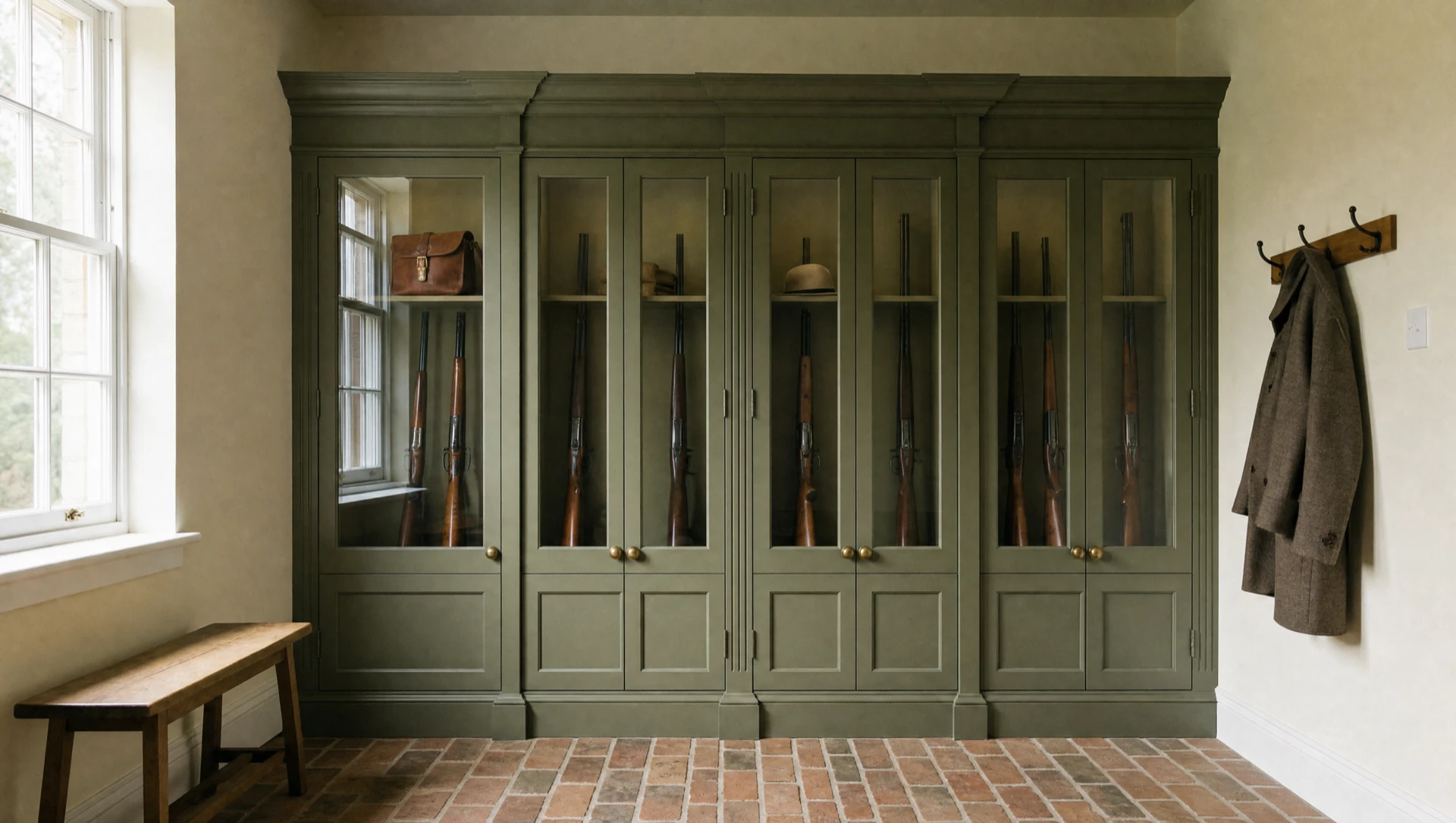
What we do
- We ask which force licenses youAt first enquiry, because it determines who we are talking to.
- We ask what your certificate conditions actually sayNot what conditions usually say. Yours.
- We set out the proposed specification in writingSteel thickness, glass, lock, fixing type and centres, ammunition provision, and where in the property it is going.
- You put it to your FEO, or we speak to them with youWhichever you prefer. Many clients would rather we did the technical part.
- We adjust if anything is raisedBefore making, when a change costs an amendment to a drawing rather than a rebuild.
- We hand over a signed specification sheet on completionSo the finished installation can be verified rather than assumed.
The specification sheet lists steel thickness, glass specification, lock model, fixing type and fixing centres, and is issued with drawings as installed. It is what your FEO will want to see, and increasingly what your insurer will want to see too.
When to make the call
At design stage. Not at completion.
On a private commission, that means before we cut timber. On a building project, it means at design stage alongside the rest of the specification, and this is worth flagging to architects: the licensing conversation has no dependency on site progress, so there is no reason for it to be sitting on the snagging list at practical completion. It is the cheapest programme item on the whole job and it is routinely left until the most expensive moment to deal with it.
If you are applying for a certificate for the first time, speak to the licensing department early. They will tell you what they expect to see, and it is a far better starting point for a design than anything you will read online — including this page.
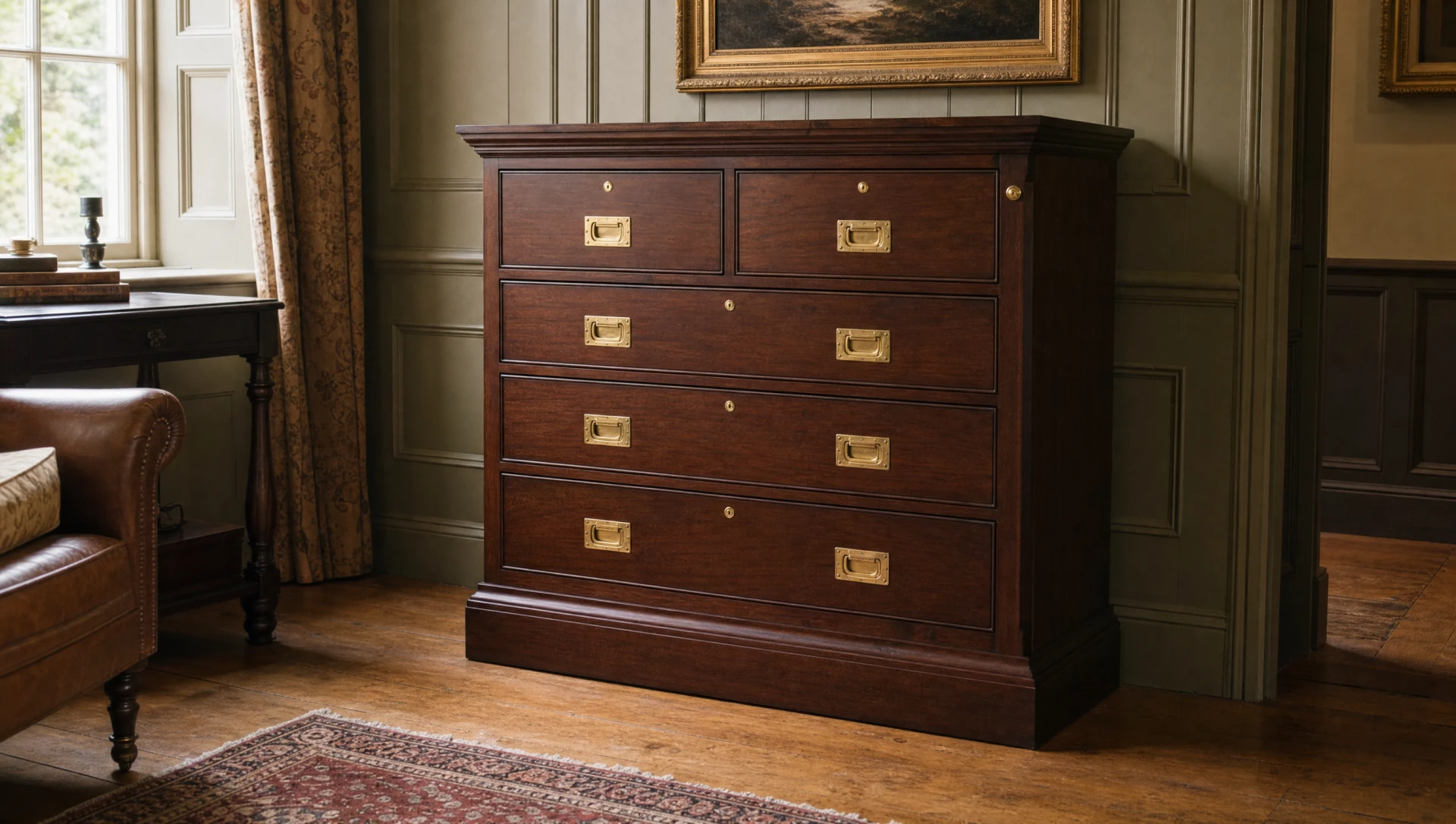
What to have ready
An FEO conversation goes considerably better when you can answer these without hunting for anything.
| Have ready | Why |
|---|---|
| What you hold, and what you are applying for | The collection drives everything else |
| The exact wording of your current conditions | Conditions are not identical across forces or certificates |
| Where in the property the storage will be | Room, floor, external walls, and what is on the other side of them |
| Wall construction | Masonry or timber frame decides the fixing strategy |
| The proposed specification, in numbers | Steel, glass, lock, fixings, ammunition provision. We give you this |
| Occupancy | Whether the house is regularly empty is genuinely relevant |
| Other security | Alarm, monitoring, gates, dogs, CCTV |
Moving house, and adding to a collection
Two situations catch people out, and both are avoidable.
Moving house. Your storage was assessed at your old address. A new address is a new assessment, and a cabinet that was entirely satisfactory in a terraced house in a town may prompt a different conversation in an isolated farmhouse. Tell your licensing department before you move, not after, and involve us early if the cabinet needs to be lifted and refitted — that is our work, and it needs doing properly rather than by a removals firm.
Growing collections. Storage that suited six guns can be marginal at sixteen. Building in headroom at the outset is far cheaper than a second cabinet three years later, and it avoids the conversation where the guns are technically secure but visibly crammed. When we ask what you expect to buy, that is why.
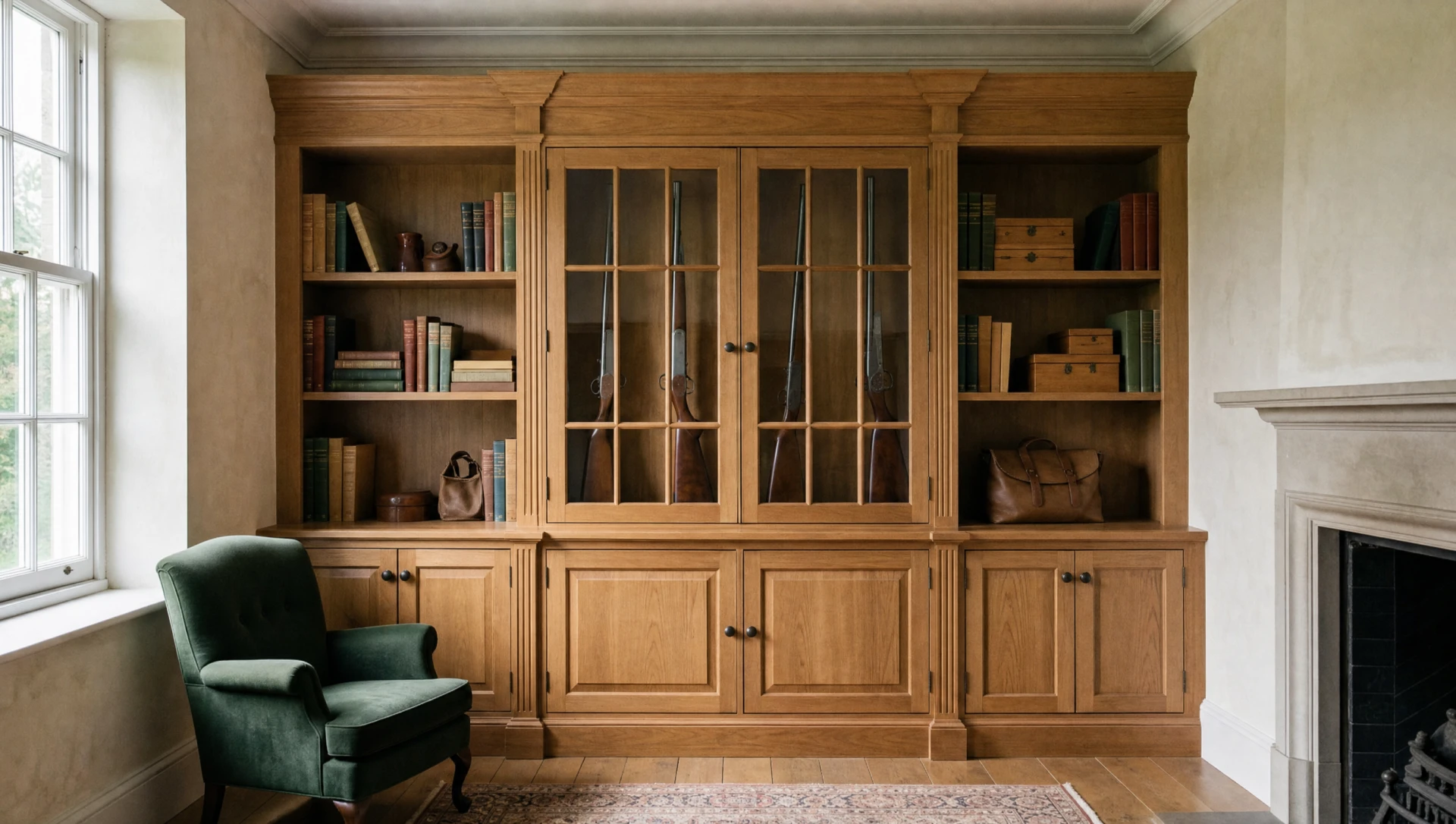
Scotland, and air weapons
The law is not uniform across the United Kingdom, and this is the most common point of confusion.
In Scotland, air weapons are separately licensed under the Air Weapons and Licensing (Scotland) Act 2015, and an air weapon certificate has been required since 31 December 2016. Storage of air weapons in Scotland therefore sits within a licensing regime that does not apply in the same way in England and Wales.
In England and Wales, since 31 July 2023 there has been a specific requirement to take reasonable precautions to prevent access to an air weapon by a person under the age of eighteen. That is a lower bar than certificate storage, but it is a legal requirement rather than advice, and it is one people frequently do not know about.
We make cabinets for clients in all four nations. Tell us where you are and which force or authority licenses you, and we will design to that rather than to a general assumption.
What we will not do
Three things, stated plainly, because the rest of this page is only credible if these are too.
- We will not promise you approval. Nobody who makes cabinets can. The decision is your licensing department’s, on the facts of your property.
- We will not describe our cabinets as police-approved. There is no such approval scheme for cabinets. That phrase is used widely in this trade and it means nothing.
- We will not tell you your FEO is wrong. If something is raised, we will explain the engineering, adjust the design, and let you and your FEO reach a view. Arguing with a licensing department on a client’s behalf has never once improved a client’s position.
Nothing on this page is legal advice. Responsibility for meeting the security condition on your certificate rests with you as the certificate holder, and the adequacy of any storage arrangement is a matter for your local police firearms licensing department. Requirements and conditions vary between forces and across the United Kingdom. Check your own certificate and speak to your licensing department. This page was last checked against Home Office guidance in August 2026.
Questions we are asked
Does the law say how thick a gun cabinet must be?
No. Neither the Firearms Act 1968 nor the Firearms Rules 1998 specifies a steel thickness, a product or a standard. The requirement is that firearms are stored securely so as to prevent, so far as is reasonably practicable, access by an unauthorised person. How that is met at your address is assessed by your licensing department.
Is any gun cabinet “police approved”?
No. There is no police approval scheme for gun cabinets in the United Kingdom, despite the phrase being widely used in advertising. Your firearms enquiry officer assesses the arrangement at your property; they do not approve products.
Should I speak to my FEO before or after buying a cabinet?
Before, always. Once a cabinet is made and fitted, any disagreement is expensive. We set out the proposed specification in writing so you can put it to your FEO — or we will speak to them with you — before we make anything.
Does the Firearms Security Handbook have the force of law?
No. It is Home Office guidance produced with the National Police Chiefs’ Council and the British Shooting Sports Council on how the storage condition is usually met. The condition itself comes from the Firearms Rules 1998, and the decision on adequacy is your licensing department’s.
What happens to my storage assessment if I move house?
A new address means a new assessment. Tell your licensing department before you move rather than after, and involve us early if the cabinet has to be lifted and refitted — the fixings are a large part of the security and refitting is not removals work.
My certificate has an unusual condition on it. Can you build to it?
Yes. Send us the exact wording. We would far rather design to your actual condition than to what conditions usually say.
What a firearms enquiry officer actually looks at
A firearms enquiry officer is assessing an arrangement at an address, not a product in a catalogue. That distinction is the whole reason no cabinet can be “approved”. In practice the assessment covers five things, and knowing them makes the visit straightforward.
- The container itself. Construction, thickness, locking. This is where our signed specification sheet does the work — figures rather than adjectives.
- How it is fixed, and to what. Very often the deciding factor. Anchors into masonry, not into plasterboard.
- Where it is in the building. Not visible from outside, not adjacent to an external door or a flat roof, not in an outbuilding unless there is a good reason.
- Ammunition separation. Whether defeating one lock delivers both. Ours are separate and keyed to differ as standard.
- The household. Who else lives there, who has access, where the keys are kept. This part is about you rather than about the joinery.
What we provide for that conversation
Before manufacture: a specification sheet stating the thinnest panel in millimetres, lock make and BS EN 1300 class, glass make-up where glazed, ammunition provision, and the fixing detail with anchor type and centres. Your FEO can look at that and tell you whether it satisfies the conditions on your certificate. After installation: a signed copy of the same sheet as built, plus a key schedule.
What we will not do is telephone your force on your behalf. A firearms enquiry officer will not discuss an individual’s arrangements with a third party, and any maker offering to “get it approved for you” is describing something that cannot happen.
Where the rules actually live
The obligation is on you, through the conditions on your certificate, made under the Firearms Act 1968. The guidance your force works from is the Home Office Firearms Security Handbook, supported by the statutory guidance to chief officers of police on firearms licensing. Both are public, both are readable, and neither contains the words “police approved”.
Scotland differs in one respect that catches people out: air weapons above a low power threshold require a certificate there and not in England and Wales, and the storage conditions follow. If you are moving guns to a Scottish address, raise it early.
Start with the specification, not the sale
Tell us what you hold, what your conditions say and which force licenses you. We will put a written specification together that you can take straight to your firearms enquiry officer — before you have committed to anything.