
Gun Rooms for Larger Collections
Past a certain point a gun room stops being storage and becomes a working room with an inventory. In large gun rooms what changes is not the steel — it is who has access to what, how the room behaves on a shoot day, and whether anybody actually knows what is in it.
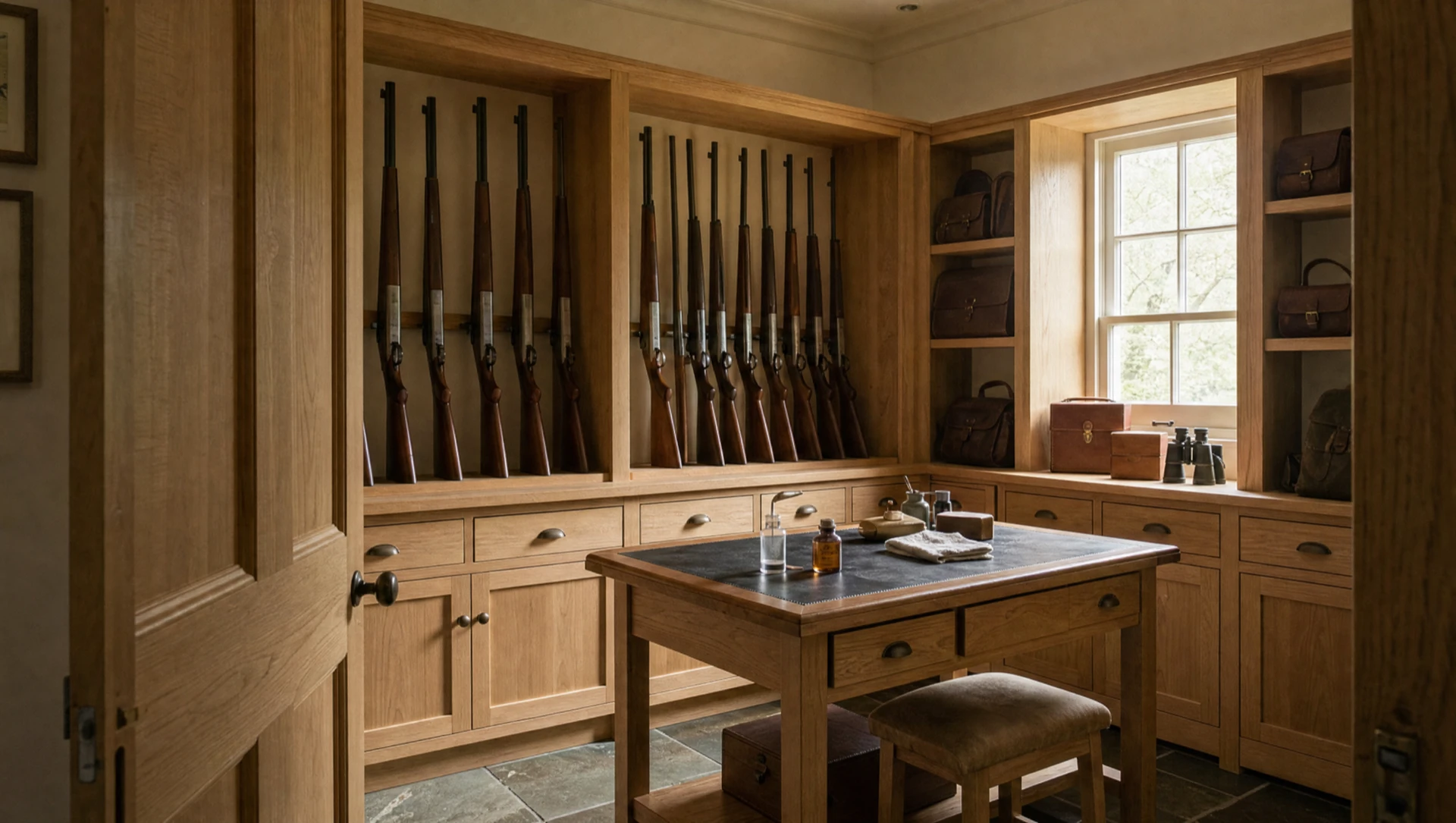
Most of this page is about a single idea: at scale, a gun room’s job is control rather than containment. One locked room with everything in it is a design that works beautifully for eight guns and progressively less well for thirty — not because it is less secure, but because everything inside it is secured to the same degree, released by the same key, and available to anyone who is in there for any reason.
On this page
When a room becomes a large room
There is no number. What we notice is that the character of the problem changes when one or more of these is true:
- More than one person legitimately goes into the room
- Guns belonging to more than one certificate holder are stored in it
- The room is used on days when the house is full of people
- There is a working element — cleaning for several guns, minor gunsmithing, cartridge handling in quantity
- You could not, from memory, list everything in there
Any two of those and the room needs designing differently. All five and you are designing an estate gun room, which is a different brief again.
Independent locking per bay
The single most useful move at scale, and it costs very little.
Rather than one room in which everything is equally available, the racking is divided into bays that lock independently. The room is secure; within it, each bay is its own decision. That lets you separate:
| Bay | Why it is separate |
|---|---|
| Working guns | Opened most days. Convenience matters here |
| Best guns and cased pairs | Opened rarely. There is no reason for this bay to be open when the working bay is |
| Rifles | Frequently subject to different conditions and different expectations |
| Guests’ guns | Other people’s property, held temporarily. Should be separable |
| Ammunition | Separately locked as a matter of course |
A single key turn should not open everything you own. That is true for security, and it is equally true for the far more common situation in which nothing has been stolen and you simply want to know who has been in which bay.
Ammunition at scale
Ammunition is always stored in a separate lockable compartment with its own lock. In a large room that provision needs to be genuinely sized rather than gestural — cartridges in quantity are heavy, and quantity is exactly where a token drawer stops working.
Drawers run on full-extension heavy-duty runners, sized so a full drawer still slides, and divided so boxes stand rather than shift. Expanding ammunition and any component held under a certificate condition gets its own locked provision.
Send us the exact wording of your conditions. On larger collections, conditions are more likely to be specific, and more likely to differ between the certificates held in one household. Designing to the average of several certificates is how a room ends up satisfying none of them.
A proper bench
At eight guns a cleaning table is a nicety. At thirty it is the reason the room works.
A larger room justifies a bench that is genuinely a bench: full length, felt-bedded, with a vice position if there is any gunsmithing, drawers for rods and tools, separate and ventilated storage for solvents and oils, and task lighting in front of you rather than behind your head. Where guns are cleaned in numbers after a day, that bench is in use for hours, not minutes, and it should be laid out like a workspace rather than a shelf.
Two details worth building in:
- Somewhere to stand guns temporarily. A short open rack beside the bench, so guns waiting to be cleaned are not leaning on anything.
- A bin. Genuinely. Patches, wads and packaging accumulate faster than anyone expects, and a room with nowhere to put them becomes a room with things on the floor.
Shoot days and guest guns
The day the room is under most pressure is the day it is busiest, and it is worth designing for that day rather than for a quiet Tuesday.
What tends to matter:
- Flow. Guns leave in the morning and return, often wet, often in a rush, often carried by people who do not know the room. A room that requires care to use will not get it.
- A holding bay. Somewhere guests’ guns can be secured separately, distinct from your own racking.
- Slips and cases. Hanging for slips, shelving for cases, sized for a day’s worth rather than yours alone.
- Wet gear. The room will collect it. Either design for it or design somewhere adjacent that takes it instead.
- A door that is not in the way. On a busy day a firearms door swinging into the working space is an obstruction and a hazard.
A practical and legal point rather than a joinery one: arrangements for storing firearms belonging to other people, and for who may have access to them, engage the conditions on the relevant certificates. It is worth raising with your firearms enquiry officer specifically, rather than assuming it follows from your own storage being satisfactory. Nothing here is legal advice.
Knowing what is there
The test we apply: can you tell, from the doorway, with the light on, that nothing is missing?
In a small cabinet the answer is obviously yes. In a thirty-gun room with mixed racking, cased pairs and a working bay, the answer is frequently no — and a gap that goes unnoticed for a fortnight is a materially worse problem than one noticed the same evening.
Design moves that help:
- Numbered positionsDiscreetly, in the rack. A gun has a place and the place is identifiable.
- Racks that read as fullSet out so an empty position is visually obvious rather than absorbed into general spacing.
- Glazed doors on the bays you want to scanSolid doors are more discreet and less legible. Choose deliberately.
- Lighting that reaches the backHalf-lit racking hides gaps.
- A written schedule kept in the roomWith your certificate paperwork and the specification sheet.
Access, staff and keys
In a house where staff, keepers, contractors or family have legitimate reason to be in or near the room, access becomes a design question rather than an assumption.
Independent bay locking does most of the work: the person who needs to get to the cleaning bench does not thereby have access to the best guns. Beyond that, keys are yours — we keep no copies, hold no register and supply no manufacturer’s master. If a key goes astray, the lock is replaced, and on a multi-bay room that means one lock rather than all of them.
Where the room sits within a wider security arrangement — alarms, monitoring, access control — that is your alarm company’s territory, not ours. What we will do is make sure cable routes exist before the lining goes on, because retrofitting them through steel and cladding is difficult. On that, see steel-lined gun rooms.
Environment at scale
More guns, more cases, more leather and a room in heavier use all make the environmental question sharper rather than softer.
Wet gear coming in on a shoot day puts a great deal of moisture into a cold sealed room in a very short time. That is precisely the condition that produces condensation, and it happens on the days you are least likely to notice. A large room in regular use makes a good case for humidistat-controlled mechanical ventilation rather than passive trickle vents, and for keeping wet gear somewhere adjacent rather than in with the guns.
The full treatment is on lighting, heating and ventilation.
Insurance and paperwork
As a collection rises in value, insurers ask for detail rather than description, and they ask earlier than people expect.
Every room we build hands over a signed specification sheet stating steel thickness, glass specification, lock model, fixing type and fixing centres, along with drawings as installed and photographs of the lining before cladding. On a large room that photographic record is the single most useful document produced, because once the timber is on, nothing behind it can ever be inspected again.
Tell your broker what is being installed before it is installed. Requirements vary between insurers, and building something in at design stage is far easier than adding it to a finished room.
Questions we are asked
At what size does a gun room need designing differently?
There is no fixed number. The character changes when more than one person uses the room, when guns belonging to more than one certificate holder are stored, when it is used on days the house is full, when there is real working use — or when you could not list everything in there from memory.
Should each bay lock separately?
In a large room, yes. It lets you separate working guns, best guns, rifles, guests’ guns and ammunition, so a single key turn does not open everything you own — and so a lost key means replacing one lock rather than all of them.
Can I store other people’s guns in my gun room?
Arrangements for storing firearms belonging to other people, and who may access them, engage the conditions on the relevant certificates. Raise it with your firearms enquiry officer specifically rather than assuming it follows from your own storage being satisfactory. We will build a separable holding bay for guest guns as a matter of course.
What changes on a shoot day?
Flow, mostly. Guns leave and return in numbers, often wet and in a hurry, handled by people who do not know the room. It needs a guest holding bay, hanging for slips, shelving for cases, somewhere for wet gear, and a door that does not swing into the working space.
How do I keep track of a large collection?
Numbered positions in the racking, racks set out so an empty position is obvious, glazed doors on the bays you want to scan, lighting that reaches the back, and a written schedule kept in the room with the certificate paperwork and specification sheet.
Does a large room need different ventilation?
Usually a stronger case for humidistat-controlled mechanical ventilation rather than passive trickle vents — a shoot day puts a great deal of moisture into a cold sealed room very quickly. Keeping wet gear adjacent rather than in with the guns helps considerably.
Key management in large gun rooms
On a collection of forty or more, held across several bays, with a keeper, a loader and family members all needing different access, key management stops being a detail and becomes the design. It is also the thing most often got wrong, because it is invisible on a drawing.
What we build, and why:
- Independent locking per bay, keyed to differ. One key does not open the room. The guns in daily use, the cased pairs, the rifles and the ammunition are four separate locks.
- Master-keyed only where it is genuinely needed, and never across the ammunition. A master suite is a convenience that also creates a single point of failure; we will build one if you want it and we will tell you what it costs you in security.
- A key cabinet outside the gun room, not in it. Keys stored inside the room they open is a surprisingly common arrangement.
- A written key schedule, issued at handover, listing every lock, its differ number and who holds which key. It goes in the O&M pack and a copy stays with us.
Certificate conditions rest on the holder. Where guns belonging to more than one certificate holder are kept in one room, each holder generally needs to be able to secure their own firearms independently — which is the practical argument for bays keyed to differ rather than a single master. Agree the arrangement with your firearms enquiry officer before it is built; the Home Office Firearms Security Handbook is the guidance your force will be working from.
Inventory
Above thirty guns, nobody reliably knows what is in the room without a list. We build a shallow A4 drawer for the inventory and the certificates, and set out the racks so that positions can be numbered — a rack with numbered positions turns a stock-take from an afternoon into ten minutes, and it makes an absence obvious rather than something you notice in November.
Send us the list and a plan
On a larger room the gun list, the room plan and the exact wording of your certificate conditions are what turn a conversation into a design. Send those and we will come back with a scheme.
For what this looks like in practice, see a gun room for a forty-gun collection.
>