
Ammunition Cabinets
Ammunition gets its own lock. Not a shelf, not a drawer within the gun cabinet that opens when the gun cabinet opens — a separate lockable compartment or a separate cabinet, so that securing one does not depend on securing the other.
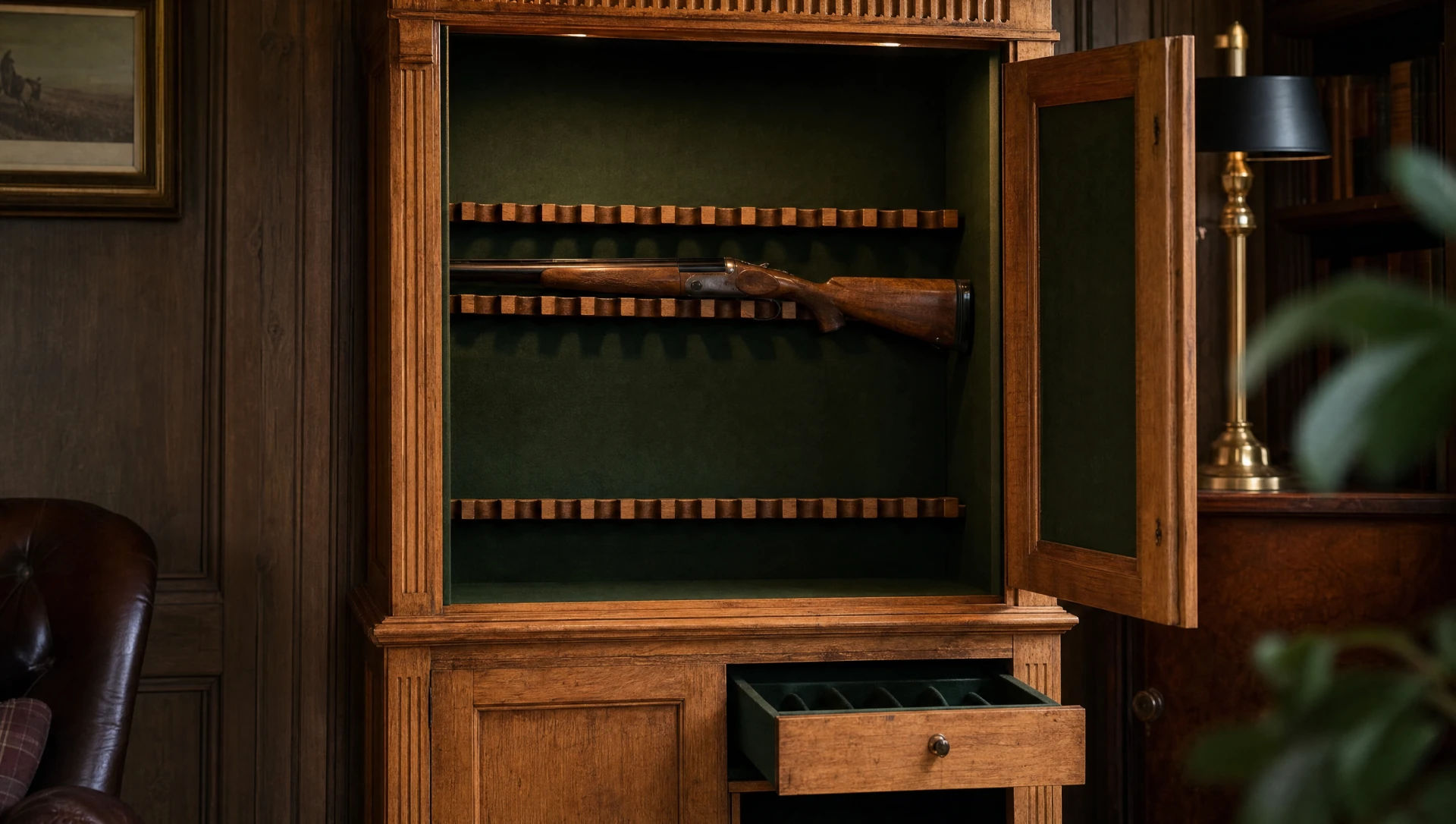
This is the part of a commission where we ask you to send us the actual wording on your certificate rather than a description of it. Conditions vary — between forces, between certificates, and between the certificates held in one household — and designing to what conditions usually say is how a cabinet ends up satisfying nobody.
On this page
Why separate
Because a single lock that secures firearms and ammunition together makes the two conditional on each other. Separate them and you get three things:
- Independent security. One lock defeated does not give access to both.
- Independent access. The person who needs cartridges for a day’s shooting is not thereby in the gun cabinet.
- A simpler conversation with your firearms enquiry officer, because the arrangement is demonstrable rather than argued.
Every cabinet and every room we build includes separately locked ammunition provision as standard. It is not an option and it is not an upgrade.
Your conditions, not the average
Secure storage is a condition of your certificate under the Firearms Act 1968 and the Firearms Rules 1998, and the specific conditions attached to a certificate are not identical everywhere. Some are more prescriptive about ammunition than others. Some distinguish between types.
So: send us the exact wording. Photograph the condition page or type it out. It takes a minute and it means we design to what you are actually required to do rather than to a general assumption. Where your certificate is silent on something, we will say so rather than invent a requirement.
We then set the proposed specification out in writing and agree it with your licensing department before we make anything. That is the whole point of the FEO process.
Responsibility for meeting the security condition on your certificate rests with you as the certificate holder, and the adequacy of any storage arrangement is a matter for your local police firearms licensing department. Requirements differ between forces and across the United Kingdom. Check your own certificate and speak to your licensing department. Nothing on this page is legal advice.
Built in, or its own piece
| Form | Suits |
|---|---|
| Separately locked compartment within a gun cabinet | Most commissions. Its own lock, its own door, inside the same piece of furniture |
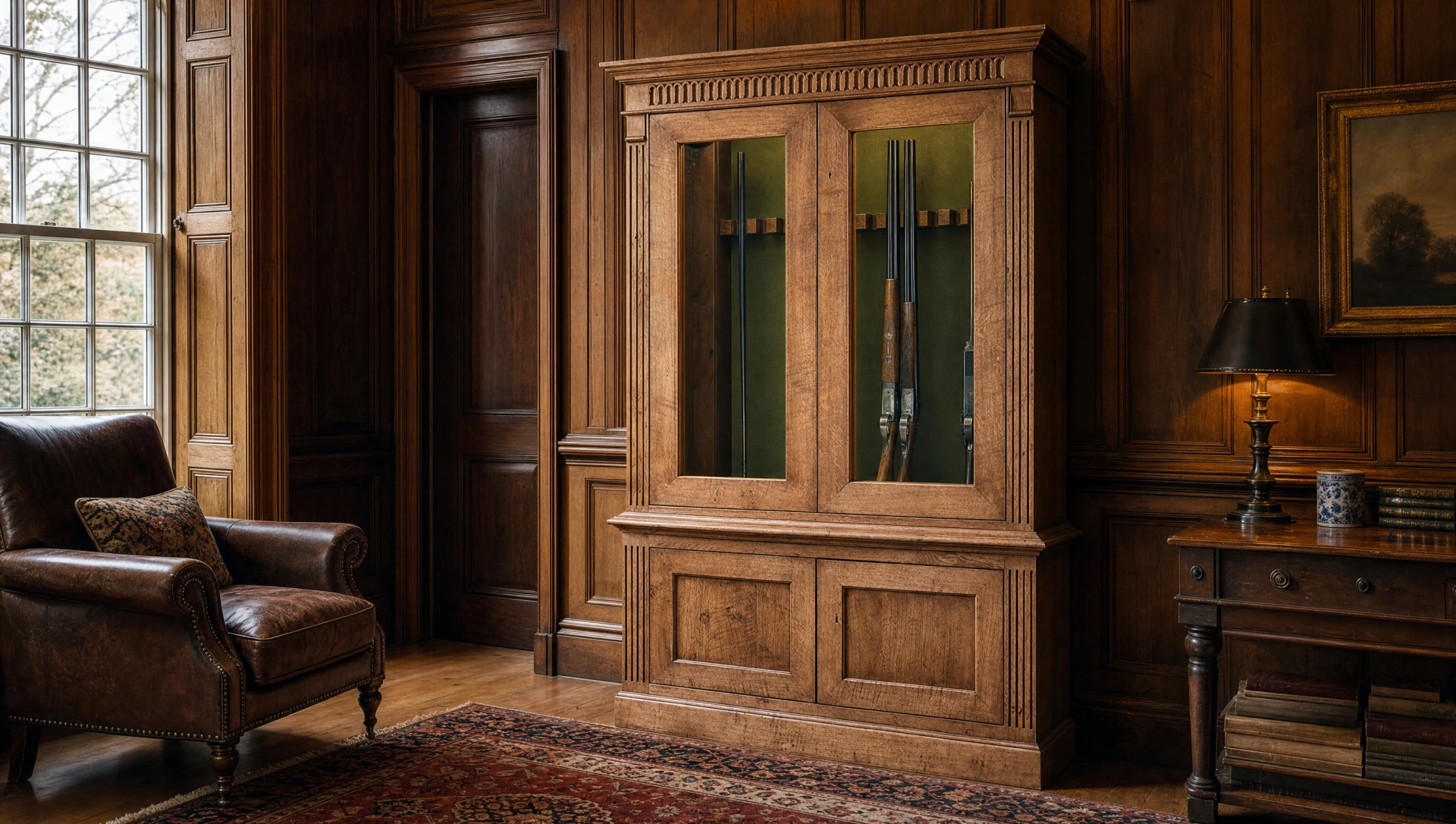
| Separately locked base cupboard | A cabinet with glazed guns above and locked ammunition below. Our most-made arrangement |
| Standalone ammunition cabinet | Where quantity justifies it, or where it needs to live in a different room from the guns |
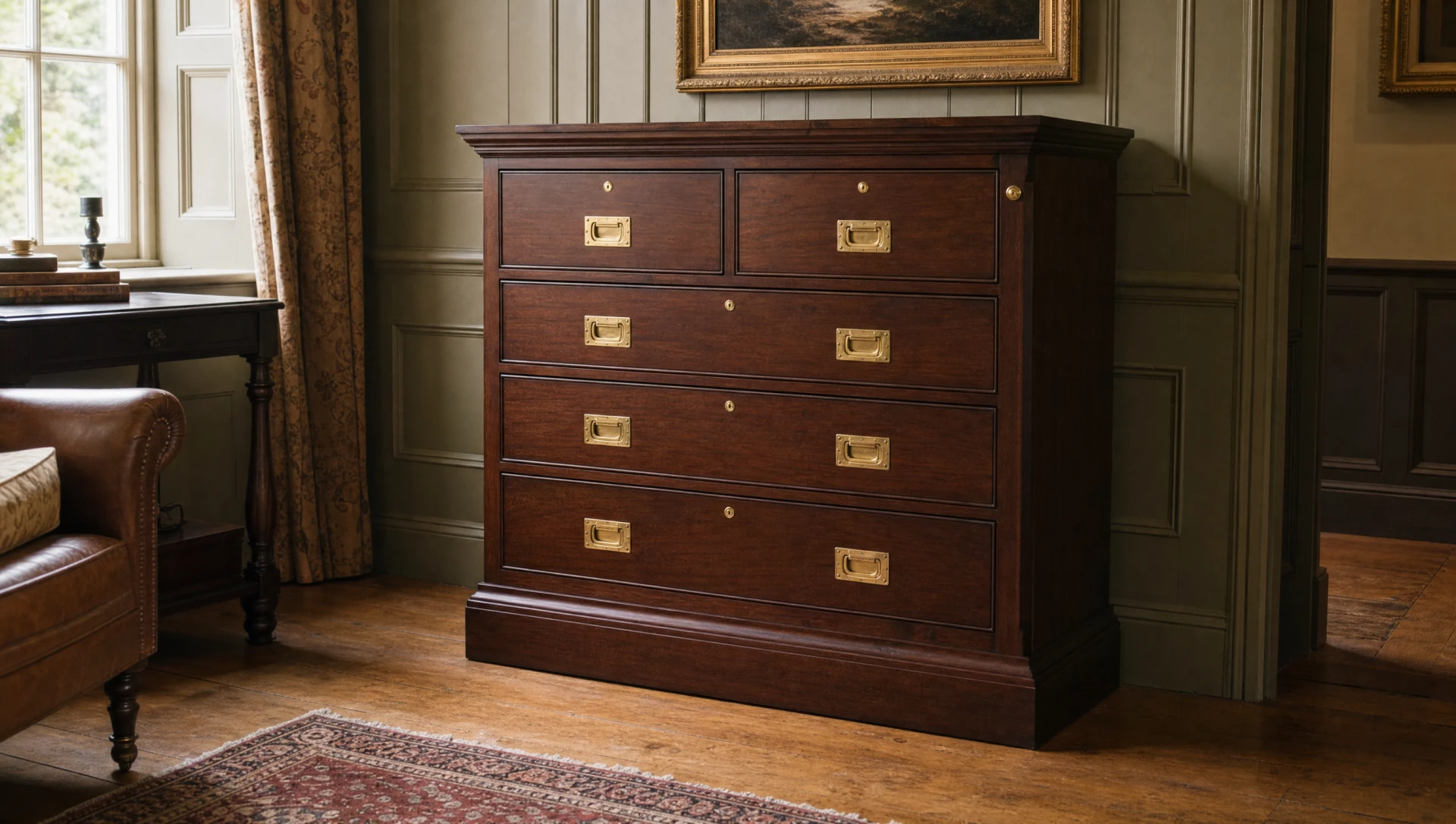
| Drawer bank with a single locked front | What reads as a chest of drawers is one locked unit. Discreet, and it holds a great deal |
| Within a Wellington chest | Cartridges and ammunition in proper drawers, in a recognised piece of furniture |
| Its own bay in a gun room | Where the room is doing the work, the ammunition bay still locks on its own |
Weight, which is the design problem
The thing that catches people out about ammunition storage is not security. It is mass.
Cartridges are dense and they accumulate quietly. A drawer that runs beautifully empty is a different object when it is full, and this is where a great deal of ammunition storage fails within a year or two:
- Full-extension heavy-duty runners, sized for a loaded drawer rather than for the drawer box. This is not a place to save money.
- Shorter, deeper drawers rather than long shallow ones. A long drawer full of cartridges racks and jams; a shorter one does not.
- Divisions, so boxes stand rather than sliding into a heap every time the drawer moves. The heap is what makes a drawer hard to open.
- Load taken by the carcass, not by the drawer sides. On heavy banks the runners are carried on rails fixed back into the carcass frame.
- Fixings and floor, because a full ammunition cabinet is a genuinely heavy object. On a suspended timber floor we will look at what is underneath it.
We ask how much you actually hold, and how much you hold in season. People routinely underestimate the second number.
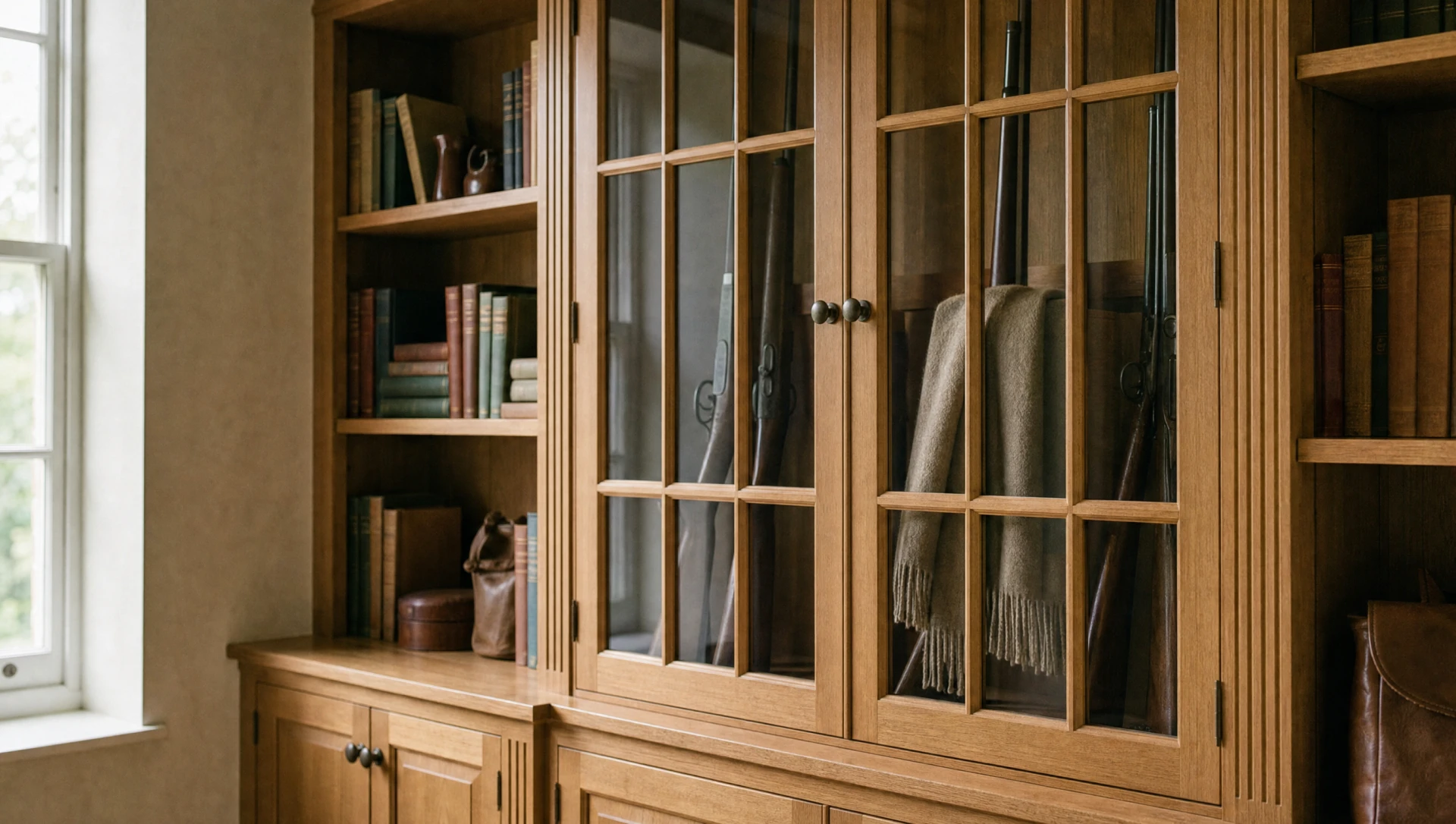
Inside
Simple, and designed around boxes rather than around an idea of boxes.
Shelves or drawers are set out to standard cartridge box dimensions, with the divisions falling so that a slab stands squarely rather than needing to be wedged. Depths are set so nothing is stored two deep — anything you cannot see is anything you will forget, and forgotten ammunition at the back of a shelf is how people end up uncertain about what they hold.
Where you want it, we number or label positions discreetly, so a glance tells you what is where. On larger provision that is worth doing.
Expanding ammunition and components
Expanding ammunition, and anything else held under a specific condition on your certificate, gets its own locked provision within the ammunition storage. It is a small amount of joinery — a lockable inner box or a separately locked drawer — and it prevents an awkward conversation later.
Again: send us the wording. Where a condition requires something specific, we build to that. Where it does not, we will tell you what we would recommend and why, and let you decide.
How much provision to build
The number people give at first enquiry is almost always the number they hold today in June. The number that matters is the one they hold in October, having bought ahead.
So we ask three questions rather than one:
- What do you hold now? Today, on the shelf.
- What do you hold at the peak? After a bulk order, before the season starts.
- Does anyone else’s ammunition live here? A spouse’s, a son’s or daughter’s, or a guest’s during a shooting weekend — each of which may sit under a different certificate with different conditions.
Then we build to the peak, with headroom. The cost of an extra drawer at drawing stage is trivial; the cost of a second cabinet in three years is not, and the intermediate state — provision that is technically adequate and visibly overflowing — is the one that prompts questions at renewal.
Where more than one certificate holder’s ammunition is stored in the same house, it is worth raising specifically with your firearms enquiry officer rather than assuming it follows from your own storage being satisfactory. We will build separable provision as a matter of course so that the arrangement is demonstrable.
Insurance
As collections rise in value, insurers ask about storage in more detail and they increasingly ask for it in writing rather than as a description. Ammunition provision comes up more often than people expect, particularly the question of whether it is secured independently of the firearms.
Every piece we build leaves with a signed specification sheet stating steel thickness, lock model, fixing type and fixing centres — for the ammunition provision as well as for the gun storage. Send it to your broker. If your broker has a written requirement, send it to us before we draw anything, and we will design to it rather than around it.
Damp, heat and where not to put it
Three practical points that have nothing to do with locks.
Keep it dry and keep it stable. The same conditions that suit guns suit ammunition: gentle background temperature rather than warmth, air movement rather than a sealed box, and stability rather than swings. Our cabinets are ventilated internally as standard. There is more on this on humidity, damp and blued steel.
Keep it away from heat. Not above a radiator, not in an airing cupboard, not against a flue, and not in a conservatory or a south-facing bay. This governs where the cabinet goes, so it is worth saying at survey rather than after.
Keep solvents and oils elsewhere. Cleaning materials belong in the cleaning bench drawers, not in with the ammunition and not in with the guns. On a gun room layout we separate all three as a matter of course.
Specification
Ammunition provision is built to the same standard as everything else we make. It is not a lighter cabinet with a smaller lock on it.
Every ammunition cabinet and compartment
- 3mm mild steel (0.12in) throughout the lined carcass
- Folded steel door returned behind the frame to the hinge side
- 8-lever safe lock to EN 1300 Class A, independent of the firearms locking
- Mechanically anchored into masonry or located structural timber, at recorded centres
- Internally ventilated
- Dressed in timber to match the room — solid oak, walnut, mahogany or hardwood for paint
All of it recorded on the signed specification sheet you receive at handover.
The full specification, and the questions worth asking anybody else who is quoting, are on the specification page.
Questions we are asked
Does ammunition have to be stored separately from firearms?
The conditions on your certificate govern this and they vary, which is why we ask for the exact wording rather than a description. As a matter of practice we build separately locked ammunition provision into every cabinet and every room, so that securing one does not depend on securing the other.
Can ammunition go in the same cabinet as the guns?
Yes, in a separate compartment with its own lock — commonly a locked base cupboard beneath a glazed gun cabinet. What it should not be is an open shelf or a drawer that opens when the gun cabinet opens.
How big should ammunition storage be?
Bigger than you first say. We ask what you hold and what you hold in season, and the second number is routinely underestimated. Building in headroom now is far cheaper than adding a second cabinet later.
Why do ammunition drawers jam?
Weight. Cartridges are dense, and a drawer that runs beautifully empty is a different object full. The answers are full-extension heavy-duty runners sized for a loaded drawer, shorter and deeper drawers rather than long shallow ones, divisions so boxes stand rather than slide, and the load carried by the carcass.
Where should an ammunition cabinet not go?
Away from heat — not above a radiator, in an airing cupboard, against a flue, or in a south-facing bay — and away from damp. Keep solvents and oils in the cleaning bench rather than in with the ammunition.
What about expanding ammunition?
It gets its own locked provision within the ammunition storage, as does anything else held under a specific condition. Send us the exact wording on your certificate and we will build to it.
Where ammunition cabinets sit in the guidance
There is no British Standard for an ammunition cabinet and no approval scheme for one. What exists is the Home Office Firearms Security Handbook, which sets out what police forces are asked to look for, and the individual conditions written on your certificate. Those conditions are the document that matters, because they are the only part of it that is binding on you.
The handbook’s position on ammunition is straightforward: it should be kept separately from the firearms, in a manner that means defeating one lock does not deliver both. It does not specify a steel thickness, a lock grade or a fixing pattern, and any maker telling you their ammunition cabinets meet a standard is describing something that does not exist.
What we build to instead is the sensible reading of that guidance, which is the same construction as the gun cabinet itself: 3 mm folded steel, an eight-lever lock certified to BS EN 1300 Class A, keyed differently from the gun cabinet, and bolted back into masonry rather than into the carcass of the piece it sits in.
Expanding ammunition and reloading components
Expanding ammunition is separately authorised on most certificates and is worth its own compartment simply so that the authorised quantity can be seen and counted without turning out the whole cabinet. Reloading components are a different problem again: primers and propellant are covered by explosives law rather than firearms law, and there are quantity limits and separation distances that have nothing to do with your certificate. If you reload, tell us at survey — the provision changes and, above certain quantities, so does where in the house the cabinet can go.
What we ask you before drawing it
- The exact wording of the ammunition condition on your certificate.
- What you actually hold at the peak of the season, not the average across the year.
- Whether any of it is expanding, and whether you reload.
- Whether the ammunition cabinets are to be visible in the room or built into the gun cabinet’s plinth or base.
- Who else in the household holds a certificate, because separate holders often want separate provision and separate keys.
None of that takes more than a five-minute conversation, and it is the difference between provision that is right for ten years and provision that is full in the second season.
Ammunition provision in the standard range
Every cabinet in the standard range is two-tier, with a solid base cupboard on its own separate lock for ammunition. It is part of the cabinet, not an extra. Where cartridges are kept in quantity, The Orwell is a Wellington chest of graduated drawers with a locking stile down one side.
Send us your certificate conditions
Photograph the condition page, tell us roughly what you hold in season, and we will design provision that meets what you are actually required to do rather than what conditions usually say.
For how a separate ammunition compartment is usually approached, see our guide to ammunition, cartridges and separate locking.
>