
Gun Cabinet Specification
Download this specification as a two-page PDF — our figures on one side, a blank comparison grid for two other makers on the other. Take it with you.
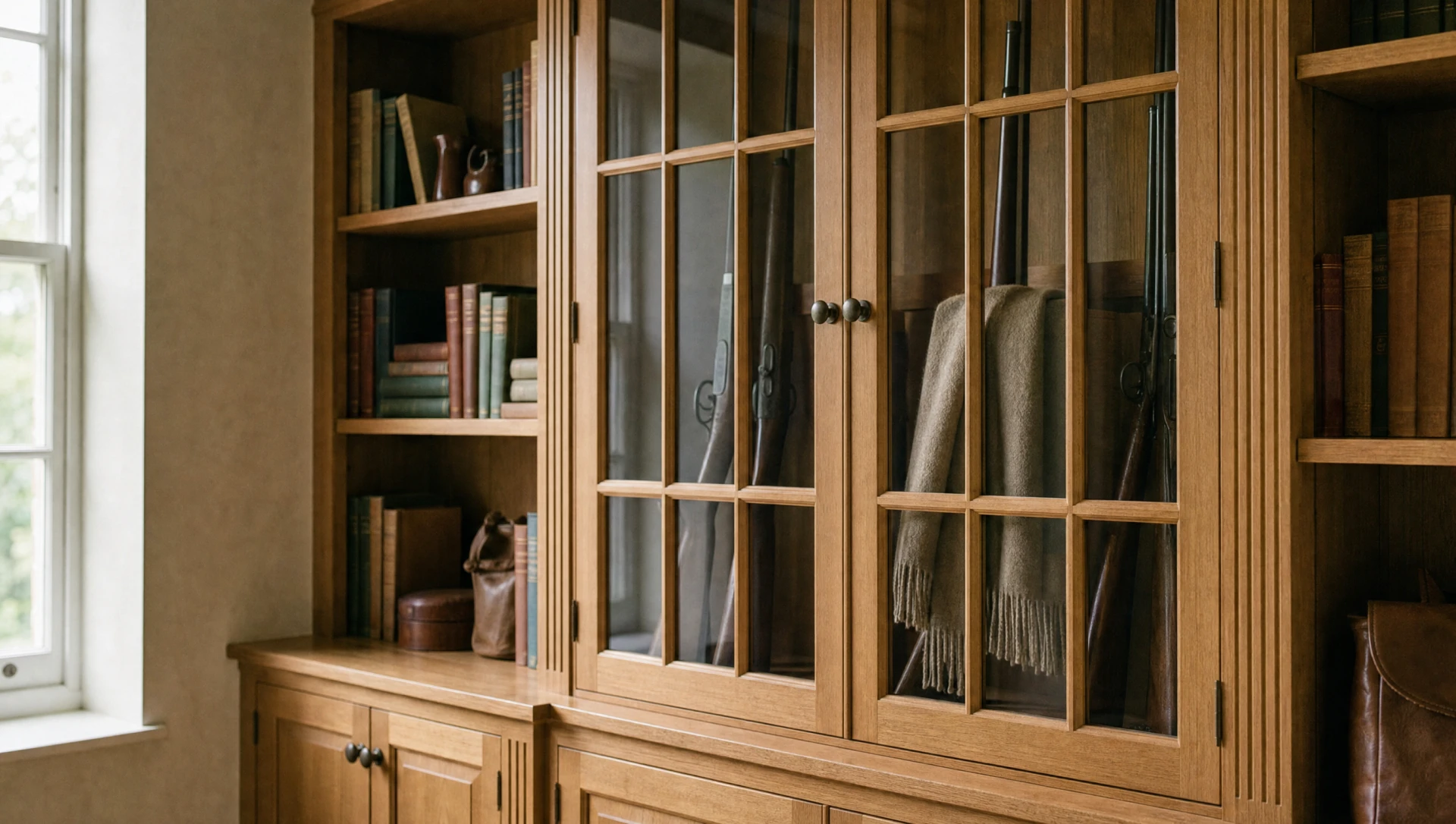
This page exists because almost nobody publishes one. Ask most makers what their cabinets are built from and you get adjectives — heavy-duty, police-approved, high-security. Here are the numbers instead, so you can compare them with anybody else’s.
On this page
The carcass
3mm mild steel (0.12in) throughout. Not a 2mm back panel with thinner sides, and not a timber box with a steel liner in the bottom. The whole enclosure.
The distinction matters more than the number does. A great many cabinets are specified by their thickest single component, which is a bit like describing a house by its front door. An attack does not choose the strongest face. If any panel of the enclosure is lighter than the rest, that panel is the specification, whatever the brochure says.
Corners are formed and reinforced rather than simply butted, because a folded corner is a stiff corner and a stiff box does not distort. Distortion is what creates the gap that a bar goes into, and once a bar is in, thickness stops being the argument.
The doors
Folded steel, returned behind the frame on the hinge side.
Doors are where attention is concentrated, so they get the most work. The steel is folded to form a returned edge rather than left as a flat plate, which both stiffens the door and closes the line of attack around its perimeter. There is no useful purchase for a lever between a returned door edge and a formed frame.
On the hinge side, the door’s folded return passes behind the frame. The leaf is held in the aperture by the steel itself rather than by its hinges, so if someone removes or defeats the hinges the door still cannot be drawn forward out of the opening.
Doors close onto a formed frame rather than a flat return, so the shut line is small and consistent, and stays that way. A cabinet that has drooped on its hinges after ten years is a cabinet with a gap in it.
Locks
8-lever high-security safe locks to EN 1300 Class A, rated VdS Class 1.
EN 1300 is the European standard for high-security locks on secure storage units, and Class A is its entry grade for certified safe locking. VdS is the German certification body whose approvals German and Austrian insurers work from. Between them they test the finished lock — against picking, against drilling and against force — rather than counting its levers.
This matters more than it sounds. A great many gun cabinets are fitted with a cabinet lock or a domestic door lock. Ours are safe locks, made for safes, with 80,000 differs and anti-pick levers fitted as standard.
Larger and multi-door cabinets take more than one lock, so that a tall door is secured along its height rather than at a single point. Where a cabinet has several bays, each bay is secured independently — a single key turn should not open everything you own.
Keys are yours. We do not keep copies, we do not hold a register of your locks, and we do not supply a manufacturer’s master. If you lose a key, the lock is replaced.
Glass
Laminated security glass — 26mm (1in) as standard.
This is the specification people find most surprising, and it is the one we would defend hardest.
Ordinary toughened glass is the wrong material here. Toughened glass is strong until it is not, and then it is gone entirely — it fails into a heap of small pieces and leaves a completely open aperture. Laminated glass behaves in the opposite way. It is made of glass plies bonded to tough polymer interlayers, so when the outer ply breaks, the interlayer holds the fragments and the pane stays in place. The ESG Secure 113/26T panel we use goes further: a 26 mm laminate of glass, polycarbonate and specialist interlayers, rated beyond the top class of EN 356 for manual attack, LPS 1270 rating 113, and bullet resistant to EN 1063 BR2. It keeps resisting after it has cracked.
At 26mm the pane is thick, heavy and expensive, and it changes everything behind it. The door has to be built to carry the weight, the hinges have to be sized for it, and the glazing bars have to be structural rather than decorative. That is exactly why so few glazed cabinets are made this way — it is not the glass that is difficult, it is everything the glass then demands of the door.
The panels are made to finished size and cannot be cut afterwards, so the glass is ordered from the drawing and bedded directly into the folded steel door section, never into the timber. The product reference and rating go on your specification sheet.
A note on glazed cabinets and discretion
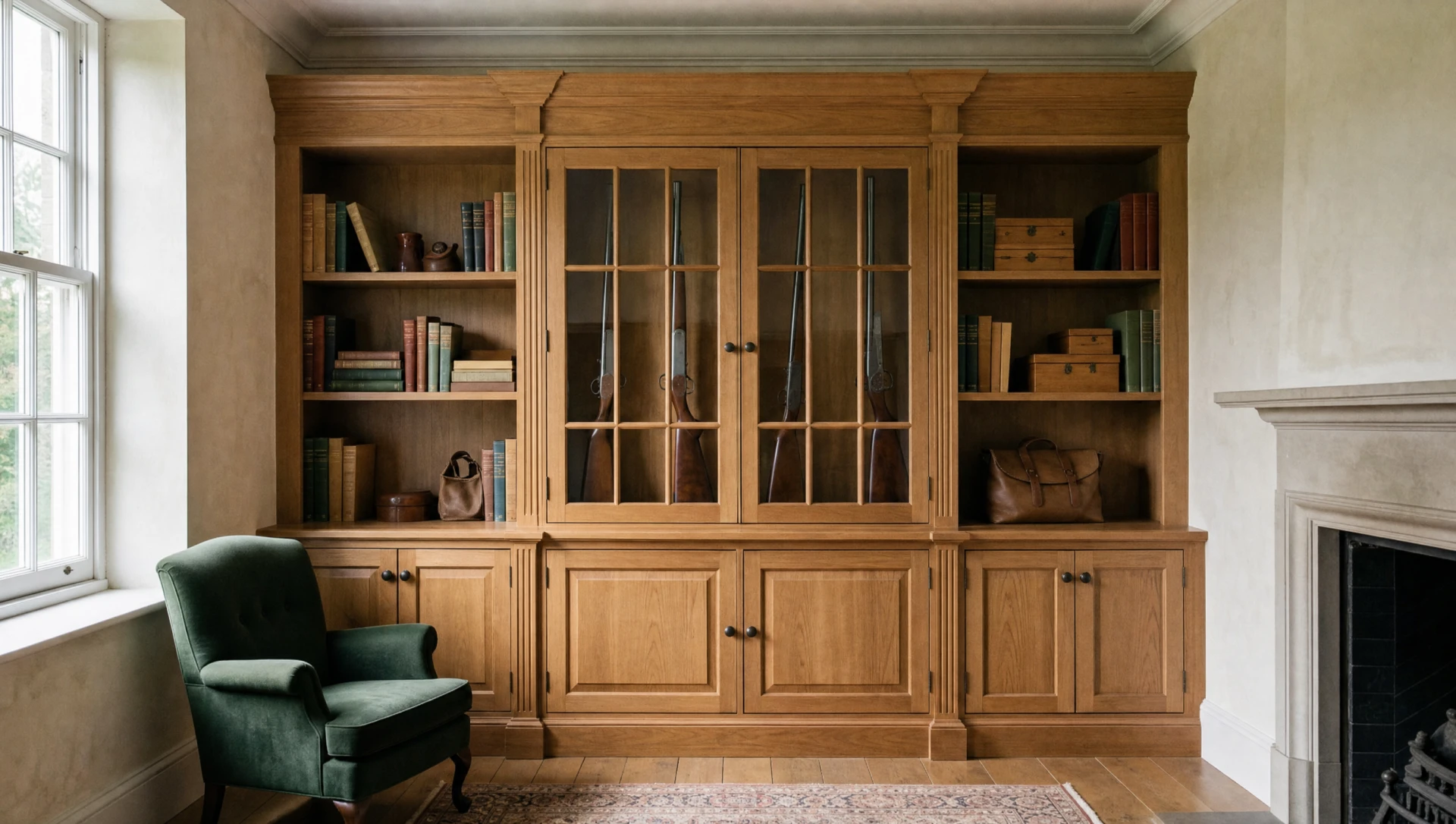
Glazed doors let you see the collection, which is the whole pleasure of a good cabinet. They also let other people see it. Where a cabinet sits in a room that visitors, contractors or cleaners use, consider a solid-fronted piece, or concealed storage. Security and discretion are different problems, and the strongest cabinet in the house is still a cabinet everyone knows about.
Fixings
Anchored into masonry or structural timber. Never into plasterboard.
A cabinet that can be removed from the wall is a cabinet that can be opened somewhere quieter, with more time and better tools. Fixing is not the last step of the installation; it is a large part of the security.
We fix into masonry wherever masonry exists, using anchors sized to the piece, at centres appropriate to its weight and height. Where the wall is timber-framed we fix into structure — studs and noggins, located properly rather than guessed at — and where necessary we add backing so that the load is spread across more than one member. Floor fixings are used as well as wall fixings on tall and heavy pieces.
Fixing type and fixing centres are recorded and written on your specification sheet. If your firearms enquiry officer wants to know how it is held to the wall, the answer is a document rather than a shrug.
Where the wall behind is unsuitable, we say so at survey rather than on installation day. There is almost always a solution — a different wall, a different anchor, backing behind the cabinet, or a change to the piece itself.
Ammunition
Ammunition is held in a separate lockable compartment with its own lock, so that securing the ammunition does not depend on securing the firearms, and vice versa.
Where a certificate carries a specific condition about ammunition — and conditions vary — tell us what yours says and we will build to it rather than to a general assumption. Expanding ammunition and anything else held under a condition gets its own locked provision. It is a small amount of joinery and it prevents a conversation later.
Interior
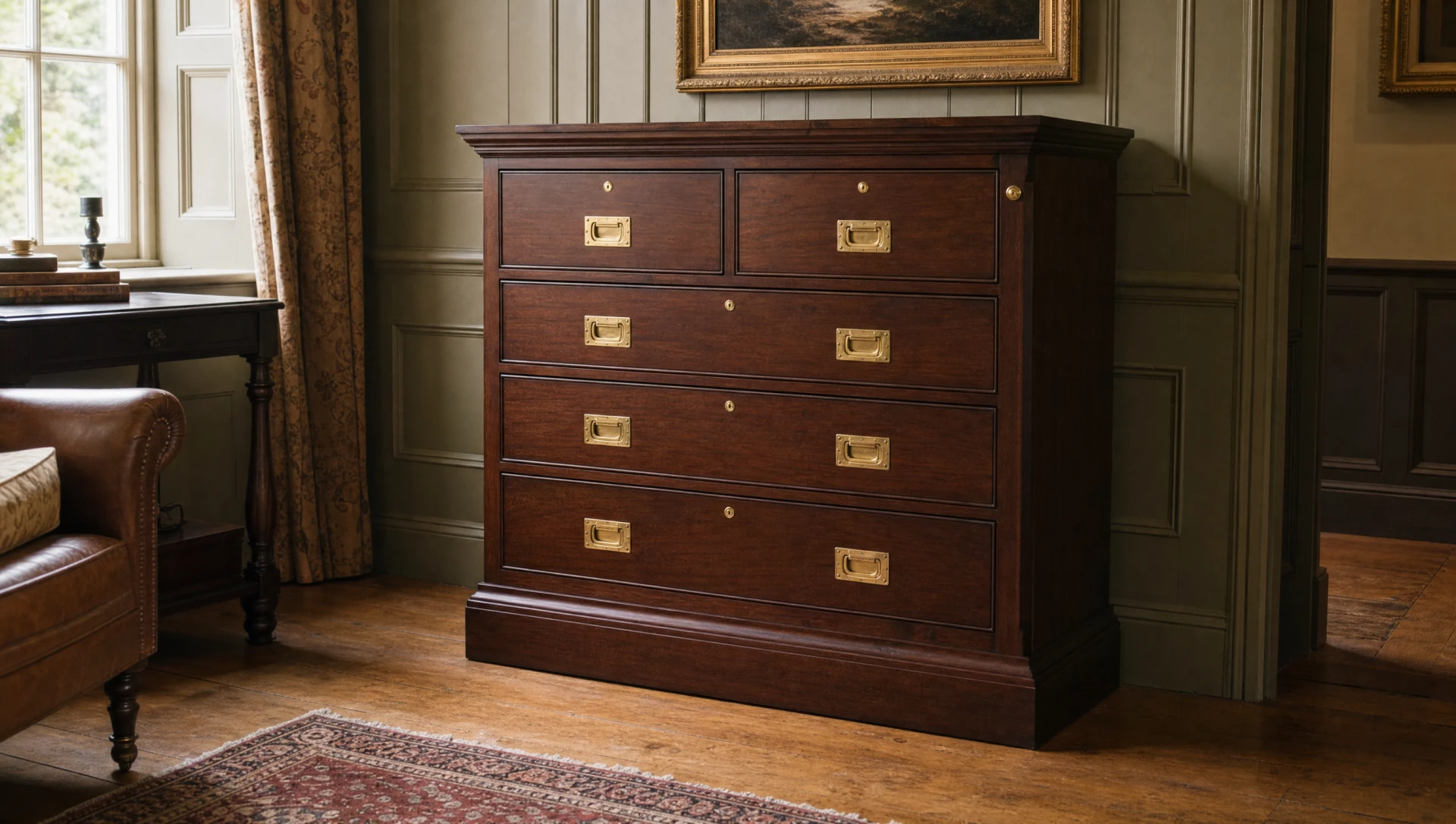
The interior is drawn from your gun list, not from a template.
| Element | Specification |
|---|---|
| Racks | Cut to your guns. Barrels supported, stocks seated, no gun touching another |
| Scope clearance | Rifles stand with optics mounted |
| Lining | Baize or felt, colour chosen with the timber and the room |
| Cleaning rack | Felt-lined, so there is somewhere to lay a gun that is not a table |
| Drawers | Full-extension heavy-duty runners, sized for a full load |
| Ironmongery | Solid brass or bronze, aged on request |
| Lighting | Low-heat LED on a door switch, aimed at the racks rather than the glass |
| Ventilation | Internal air movement. Sealed cabinets and damp guns are a bad combination |
On ventilation and damp specifically, see humidity, damp and blued steel. It is the most common cause of avoidable damage to a collection, and it is entirely preventable.
Timber and finish
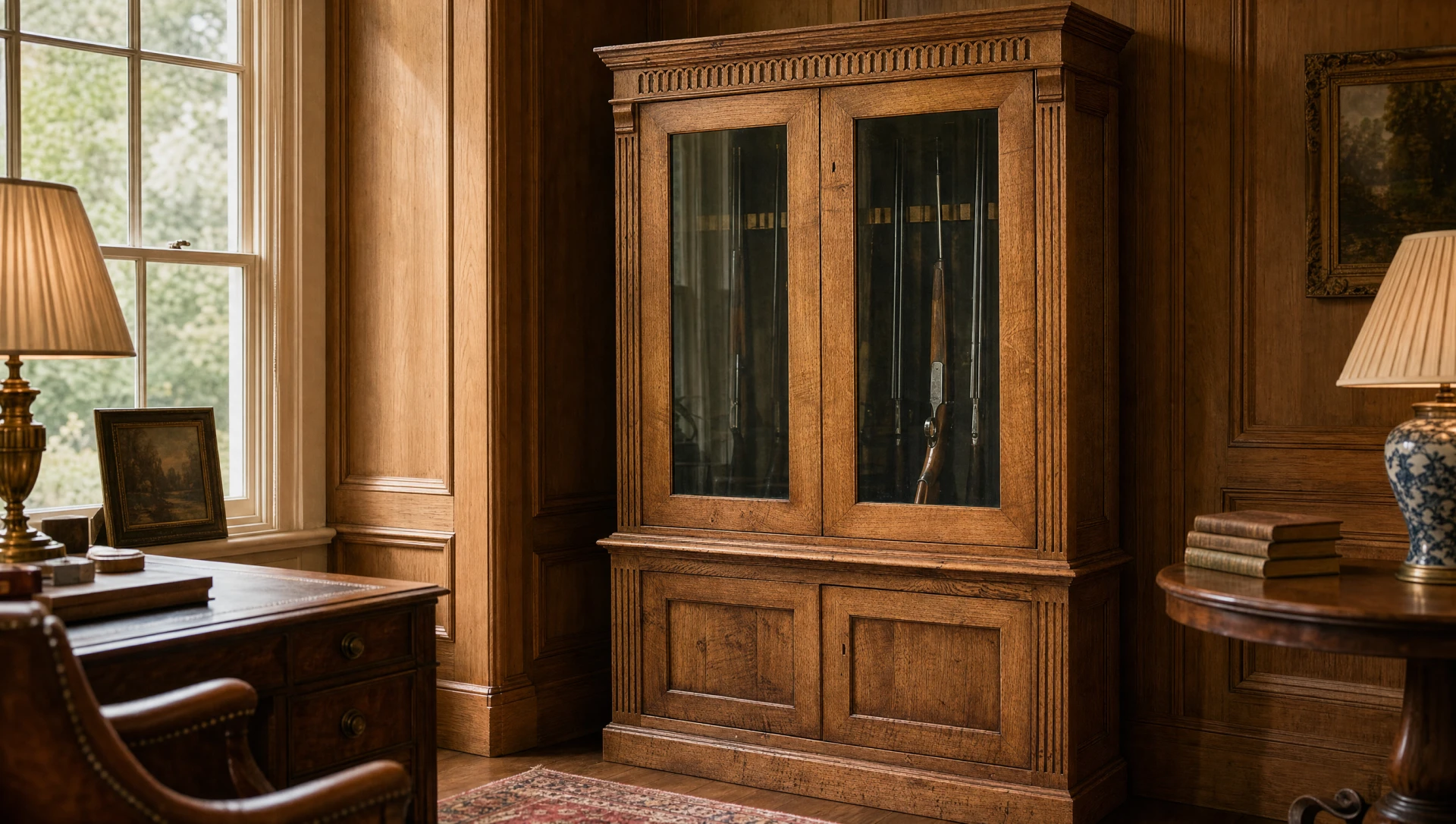
Quarter-sawn solid oak, walnut or mahogany, book-matched across pairs of doors, or a hardwood built for paint. Solid timber, with engineered substrates used only where movement would otherwise be a problem — a wide painted panel, for instance, is more stable and will stay flatter than a wide solid one.
Finishes: French polish, hand-oiled, hand-painted, or antiqued by hand. All applied in our own finishing shop by our own polisher, which is the reason we can match an existing piece and be confident about it.
Where the standards sit
This is worth setting out plainly, because the picture changed recently and there is a lot of out-of-date information about.
- The law. Secure storage is a condition of your certificate under the Firearms Act 1968 and the Firearms Rules 1998. The condition is on you, as the certificate holder.
- The guidance. The Home Office Firearms Security Handbook sets out how that condition is usually met. It is guidance for police forces and certificate holders — it is not itself the law, and it does not require a particular brand or product.
- The old British Standard. BS 7558:1992, which covered gun cabinets, was withdrawn on 7 November 2025. A withdrawn standard is no longer maintained, and a cabinet described as “manufactured to BS 7558” is being described against a document that has been retired.
- The lock standard. Our locks are 8-lever safe locks certified to EN 1300 Class A and rated VdS Class 1 — European safe-lock standards rather than a British door-lock standard, and both current.
- The decision. Whether an arrangement is adequate at your address is a matter for your local police firearms licensing department, in the light of the collection, the property and its circumstances.
Our position on all of this is unchanged by the withdrawal, because we have never built to a minimum. If the guidance tightens tomorrow, cabinets we made ten years ago are still comfortably above it.
Nothing on this page is legal advice, and it is not a substitute for speaking to your firearms enquiry officer. Requirements differ across the United Kingdom — Scotland licenses air weapons separately under the Air Weapons and Licensing (Scotland) Act 2015 — and conditions can differ between forces. Check your own certificate and ask your licensing department.
What you receive on completion
- A signed specification sheet stating steel thickness, glass specification, lock model, fixing type and fixing centres
- Drawings as installed
- Care instructions for the timber and the finish
The specification sheet is the useful one. It lets your FEO verify what has been built rather than take anyone’s word for it, and it gives your insurer something better than a photograph and an adjective.
How to compare two quotations
If you are pricing us against somebody else, these are the questions that separate the quotations. We are happy for you to ask us all of them.
- Is the steel thickness the whole enclosure, or the thickest panel?Ask for the thinnest panel, not the headline figure.
- How is the hinge side secured?If the answer is only “hinges”, the door has one protected edge.
- Is the lock a certified safe lock, and to what standard?A lever count is a description. EN 1300 and VdS are tests.
- Is the glass laminated, and what thickness?Toughened glass leaves an open hole. Ask for the figure in millimetres.
- Who installs it, and into what?Delivery-only means the fixing — a large part of the security — is somebody else’s problem.
- Is ammunition storage separately locked?Not simply a separate shelf.
- What paperwork comes with it?If nobody will write the specification down, consider why.
Questions we are asked
What thickness steel should a gun cabinet be?
There is no single legal figure — the security condition on your certificate is applied by your local firearms licensing department. Our own standard is 3mm throughout the whole enclosure, which is heavier than a domestic installation is likely to require. The more useful question than “how thick” is “how thick is the thinnest panel”.
Is BS 7558 still current?
No. BS 7558:1992 was withdrawn on 7 November 2025. It is no longer a maintained standard, so a cabinet advertised as made to it is being described against a retired document. Your certificate condition comes from your licensing department, not from that standard.
Why laminated glass rather than toughened?
Toughened glass fails completely and leaves an open aperture. Laminated glass is bonded to polymer interlayers, so when it breaks it holds together and stays in the frame. Our ESG Secure 26 mm laminated panel is rated beyond the top class of EN 356 and is designed to resist sustained manual attack.
Why can the door not come away if the hinges are cut?
Because the door’s folded return passes behind the frame. The leaf is held in the aperture by the steel itself, so if the hinges are attacked or removed the door still cannot be drawn forward.
Can a cabinet be fixed to a plasterboard wall?
Not to plasterboard alone. We fix into masonry, or into located structural timber with backing added where needed, and we use floor fixings as well on tall or heavy pieces. If the wall you have in mind is unsuitable we tell you at survey, not on installation day.
Will my insurer want to see the specification?
Frequently, yes, particularly as the value of a collection rises. That is why the signed specification sheet exists — it gives them steel thickness, glass, lock model and fixing detail in writing rather than a photograph.
Comparing one gun cabinet specification with another
Everything above is written so it can be set beside somebody else’s. The comparison only works if both columns are describing the same things, so these are the four places where two quotations most often differ without appearing to.
- Thinnest panel, not headline thickness. A cabinet advertised as 3 mm may be 3 mm on the door and 1.2 mm on the back and sides. Ask for the thinnest panel in the whole carcass. Ours is 3 mm throughout.
- Lock certification, not lock description. “High security 8-lever” means nothing on its own. BS EN 1300 Class A is a test standard with a certificate behind it. Ask for the standard and the class.
- Glass make-up in millimetres. 10 + 1.5 + 10 laminated is a different object from 6.4 mm laminated, and both are sold as “security glass”.
- Whether ammunition provision is included or extra. It is standard in ours. It is very often a line item elsewhere, which is how two prices that looked the same stop being the same.
None of that is a criticism of anybody. It is simply that this trade has no common vocabulary, and the Firearms Security Handbook does not supply one — it describes outcomes rather than construction, deliberately, because the assessment is meant to be made at your address rather than from a catalogue.
Take the two-page PDF at the top of this page with you when you see other makers. Our figures are on one side and a blank grid is on the other. We would genuinely rather you compared properly and chose someone else than bought from us on a misunderstanding.
The published designs
This specification is what sits behind every cabinet we make, including the seven published with their sizes, gun capacities and prices in the standard range.
Ask us anything on this page
If you are comparing quotations and want a straight answer about how something is made — ours or anybody else’s — ring the workshop. We would rather have the technical conversation than the sales one.