
Glazed Gun Cabinets
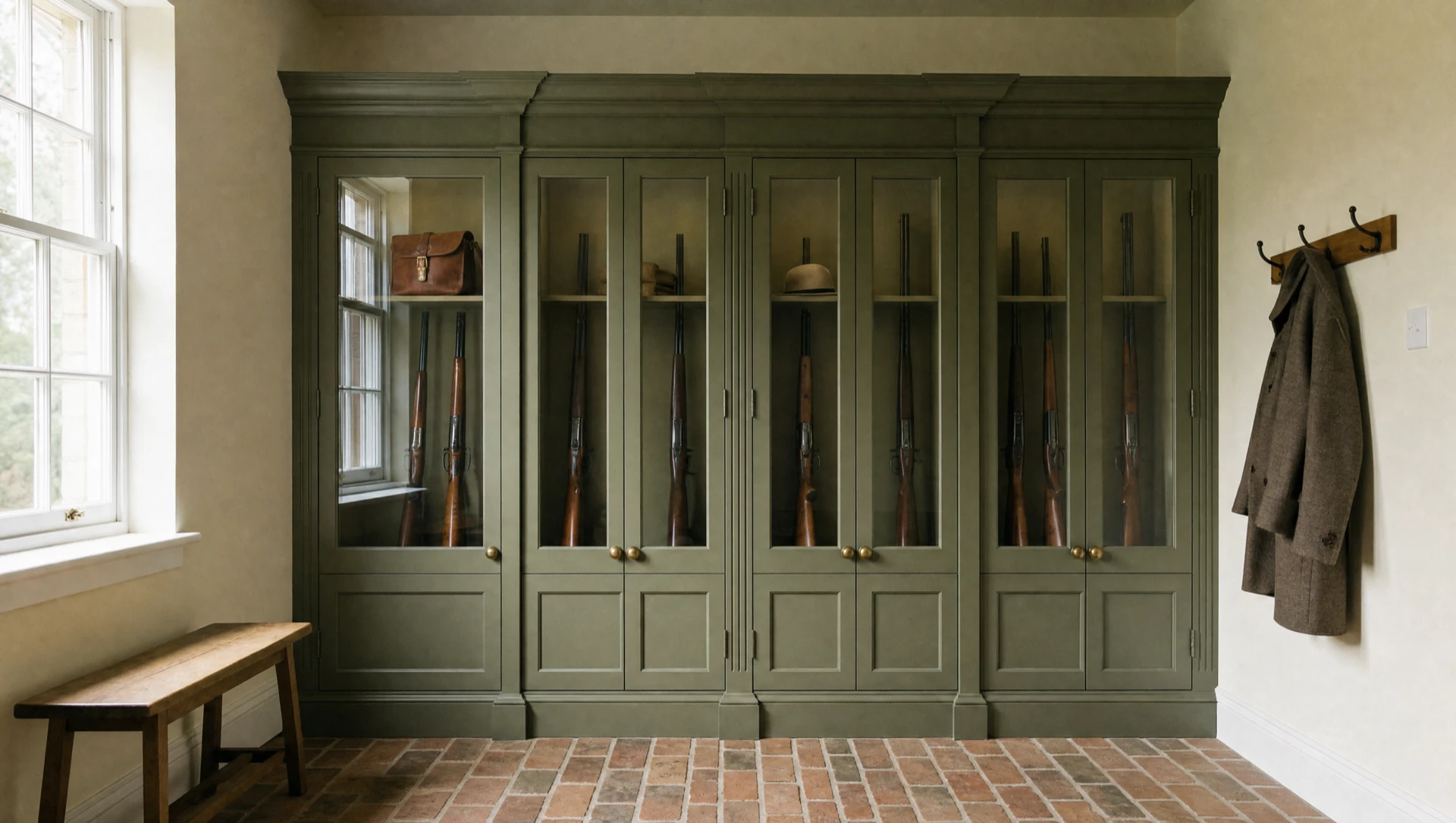
A gun collection you cannot see is a collection in a cupboard. Glazing is the reason to commission a cabinet rather than buy a locker — and it is also the single hardest thing to do properly, because the glass has to be heavy enough not to become the weak point.
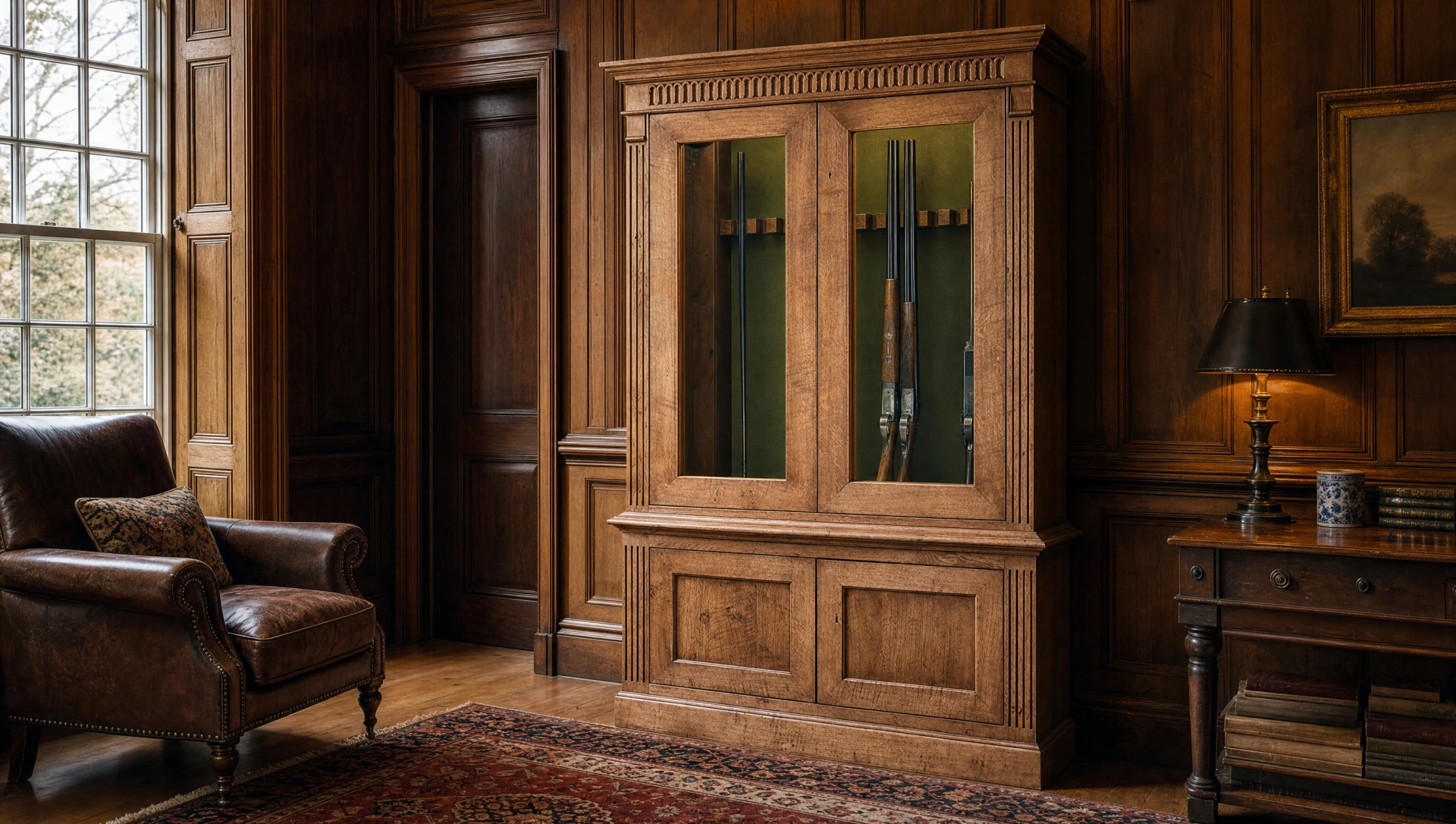
Most glazed cabinets on the market are solid cabinets with a window cut in them. The steel specification stops at the aperture, the glass is toughened rather than laminated, and the glazing bars are a decorative overlay on a single pane. The result looks like a gun cabinet and behaves like a display case.
On this page
The glass
Laminated security glass, 26mm (1in) as standard.
The choice between laminated and toughened is not a matter of degree — the two materials fail in opposite ways, and only one of them is any use here.
| Toughened | ESG Secure laminated (ours) | |
|---|---|---|
| How it fails | All at once, into small pieces | Cracks, and stays in the frame |
| After failure | The aperture is completely open | The interlayer still resists |
| Under sustained attack | One good blow | Designed to keep resisting |
| Weight | Modest | Considerable |
| Cost | Modest | Considerable |
Laminated glass is glass plies bonded to tough polymer interlayers. Break the outer ply and the interlayer holds the fragments and the pane together; the ESG Secure 26 mm panel we use goes further again: glass, polycarbonate and specialist interlayers, rated beyond the top class of EN 356 for manual attack, so it keeps resisting sustained attack rather than a single impact. That is the behaviour you want in front of a gun rack.
At 26mm the pane is thick, extremely heavy and expensive — which is exactly why so few makers use it, and why we publish the figure. Ask anyone else quoting for a glazed cabinet what their glass is, in millimetres, and whether it is laminated. The answer separates the market.
What the glass does to the door
This is the part that is invisible on a finished cabinet and is where most of the engineering goes.
A pane of 26mm laminated security glass in a full-height door is a serious weight, and it is a weight carried at the outer edge of a hinged leaf. Everything has to be sized up for it:
- The door frame is heavier in section than it would be on a solid door, so it does not rack under the load.
- The hinges are sized for the finished weight, not chosen by eye. A glazed door on hinges scaled to a timber door will drop within a couple of years, and a dropped door has a shut line that no longer closes.
- The steel behind the glazing continues around the aperture, formed and returned, so the opening is a framed hole in a stiff structure rather than a cut in a plate.
- The lock is a Lowe & Fletcher 3012 eight-lever safe lock (VdS Class 1), and on taller doors more than one, so the leaf is held along its height rather than at a single point.
- The carcass is unchanged: 3mm (0.12in) steel throughout, a folded return behind the frame on the hinge side, mechanically anchored into masonry.
The full specification is published on the specification page, with the questions worth asking anybody else who is quoting.
Glazing bars
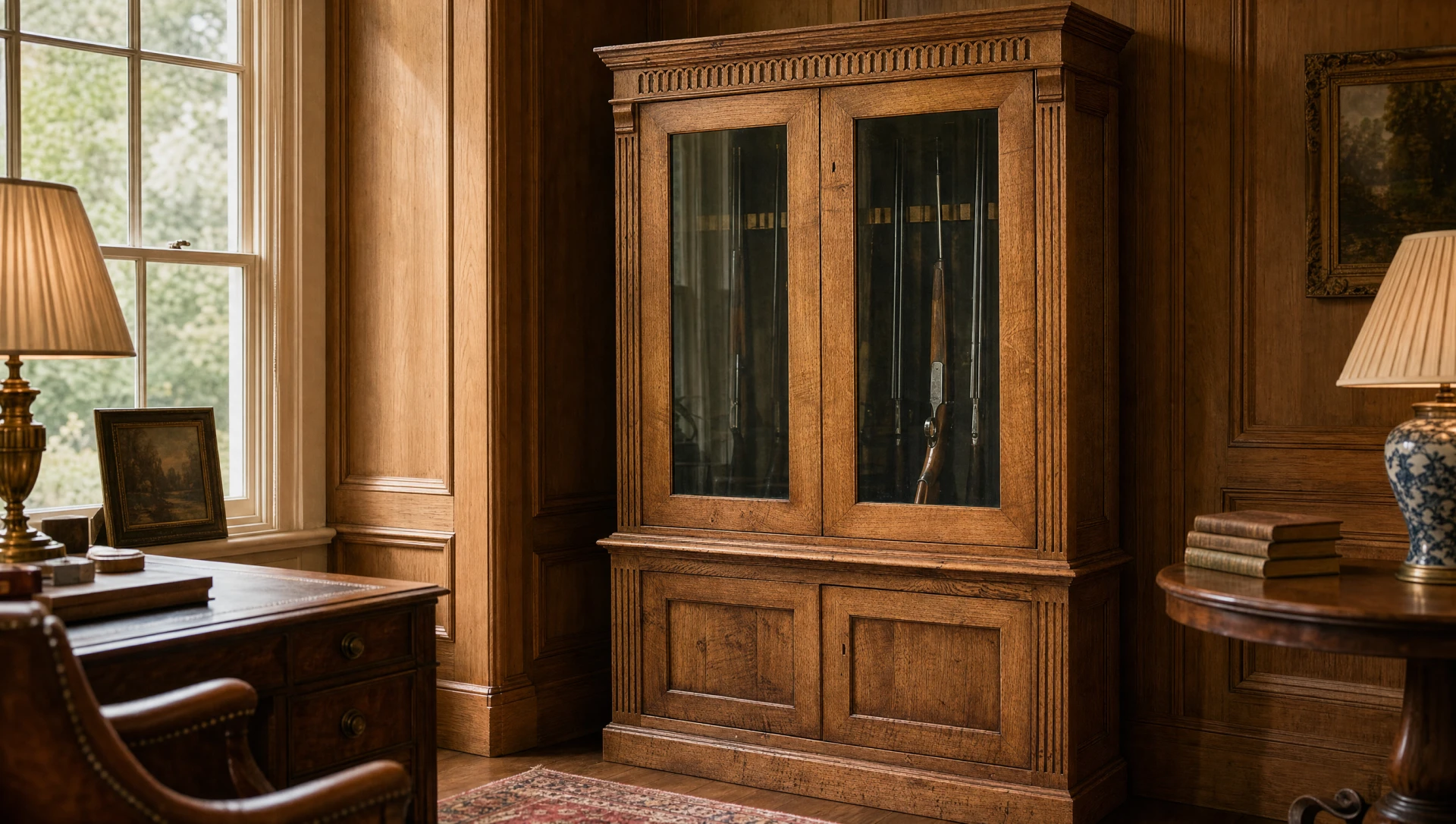
Glazing bars are the detail that decides whether a cabinet reads as furniture or as a cupboard with a window in it.
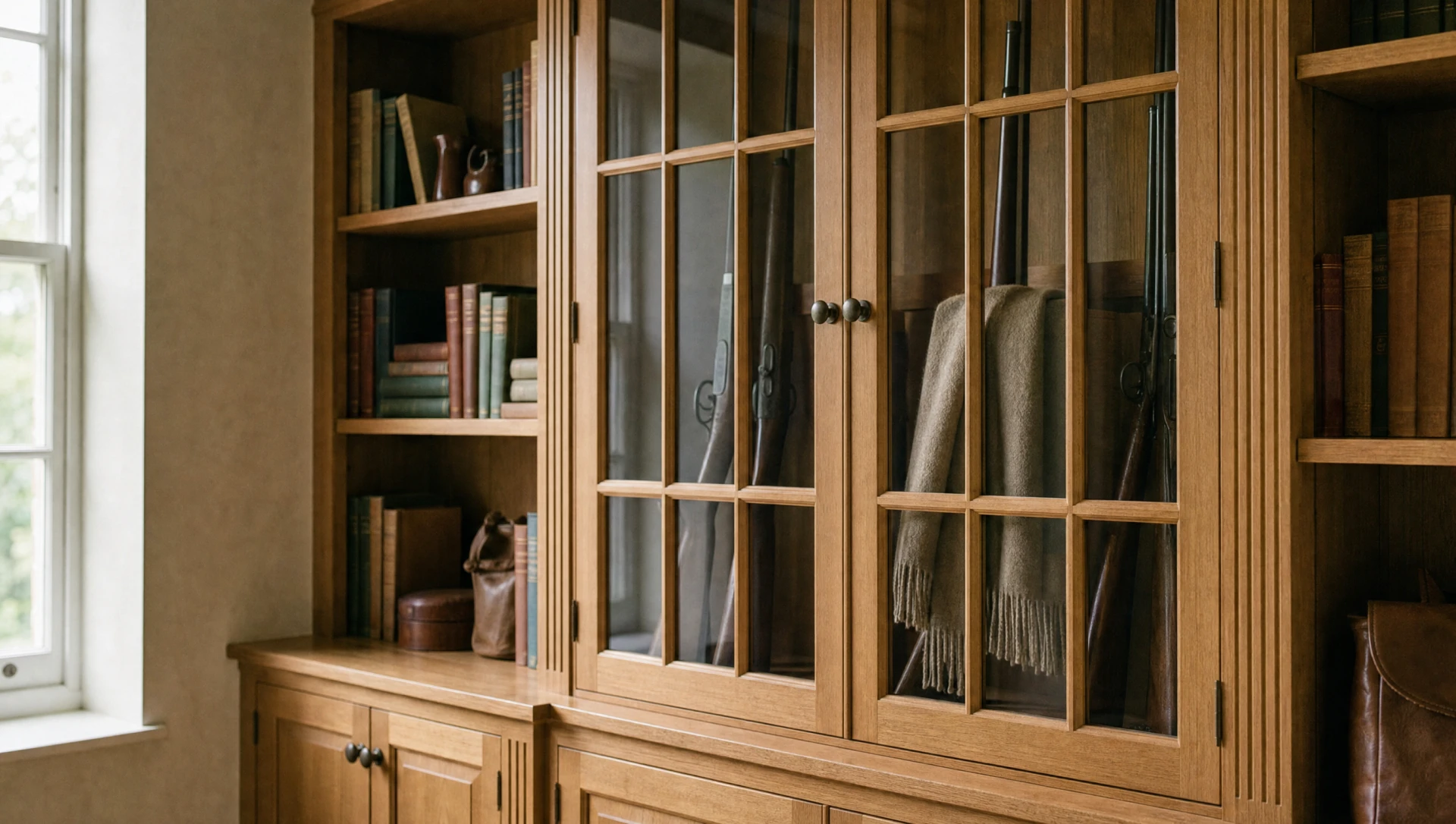
On a good cabinet they are structural and proportioned to the piece — sized like the bars on a period bookcase or a bureau bookcase, with mouldings that match the rest of the joinery. On a poor one they are a plastic or timber lattice laid over a single sheet of glass, and the give-away is that the shadow lines are wrong: applied bars cast no depth.
Bar layout is a design decision worth taking seriously, because it frames what you are looking at. Fewer, wider divisions suit a modern room and show more of the guns; a finer grid of smaller panes suits an older house and reads as a period piece. Arched heads, astragals and radiused corners are all available and all change the character of the cabinet completely.
A note on reflections
Glass reflects, and a cabinet placed opposite a window will show you the window rather than the guns for most of the day. This is a siting decision, not a glass decision, and it is worth making at survey. Where the position cannot move, lighting the interior properly is the fix — see below.
Lighting a glazed cabinet
If you are spending money on security glass, spend a little more on lighting what is behind it. An unlit glazed cabinet is a dark rectangle with reflections in it.
- Low-heat LED, because warmth inside a cabinet is not wanted and heat close to timber over years is unkind to a finish.
- On a door switch, so it comes on when you open the cabinet and you are not feeling for a switch with a gun in your hand.
- Aimed at the racks, not the glass. Light from above and inside the front edge, so it washes down the guns. Light from behind your head shows you yourself.
- A second circuit where you want the cabinet lit as a piece of furniture in the evening, independent of the door switch.
Final electrical connection is your electrician’s; we install the fitting and the switch. Positions need agreeing before first fix — there is more on that on lighting, heating and ventilation.
What people see
A glazed cabinet is a piece of theatre, so the interior is designed to be looked at as well as used.
Lining. Baize or felt, chosen with the timber and the room. Green is traditional and still the best background for browns and blued steel. Teal and oxblood both look extremely good and are less expected. The lining is the largest area of colour in the piece and it is the first thing anyone sees.
Spacing. Guns are set out so nothing touches and so the eye reads a rhythm rather than a crowd. A rack drawn to the guns you own looks deliberate; a standard rack half-filled looks like a shortfall.
What sits below. Most glazed cabinets are made as a two-part piece — glazed above, solid below — which gives you cartridge and kit storage that nobody can see, and gives the piece the proportion of a bookcase or a linen press rather than a tall box.
The discretion question
Worth putting plainly, because we would rather you thought about it now than afterwards.
A glazed cabinet shows the collection to everybody who enters the room: guests, contractors, cleaners, delivery drivers, your children’s friends and everyone all of those people subsequently talk to. The cabinet is no less secure for being visible — but visibility is information, and information travels.
So the sensible arrangement in many houses is both: a glazed cabinet in a room only the household uses, and something quieter where the traffic is. A solid-fronted cabinet gives nothing away at ordinary cabinet prices, and concealed storage gives nothing away at all.
We will ask who uses the room. It is not an idle question.
Forms we make
| Form | Suits |
|---|---|
| Single glazed door | A modest collection, a narrow wall, a corner. The simplest and the least expensive glazed piece |
| Double glazed doors | The classic. Reads as a bookcase and holds a real collection |
| Glazed above, panelled below | Our most-made form. Display above, cartridges and kit hidden below |
| Four-door and multi-bay | Larger collections, with each bay locking independently |
| Arched or pedimented head | Where the room is period and the cabinet has to earn its place |
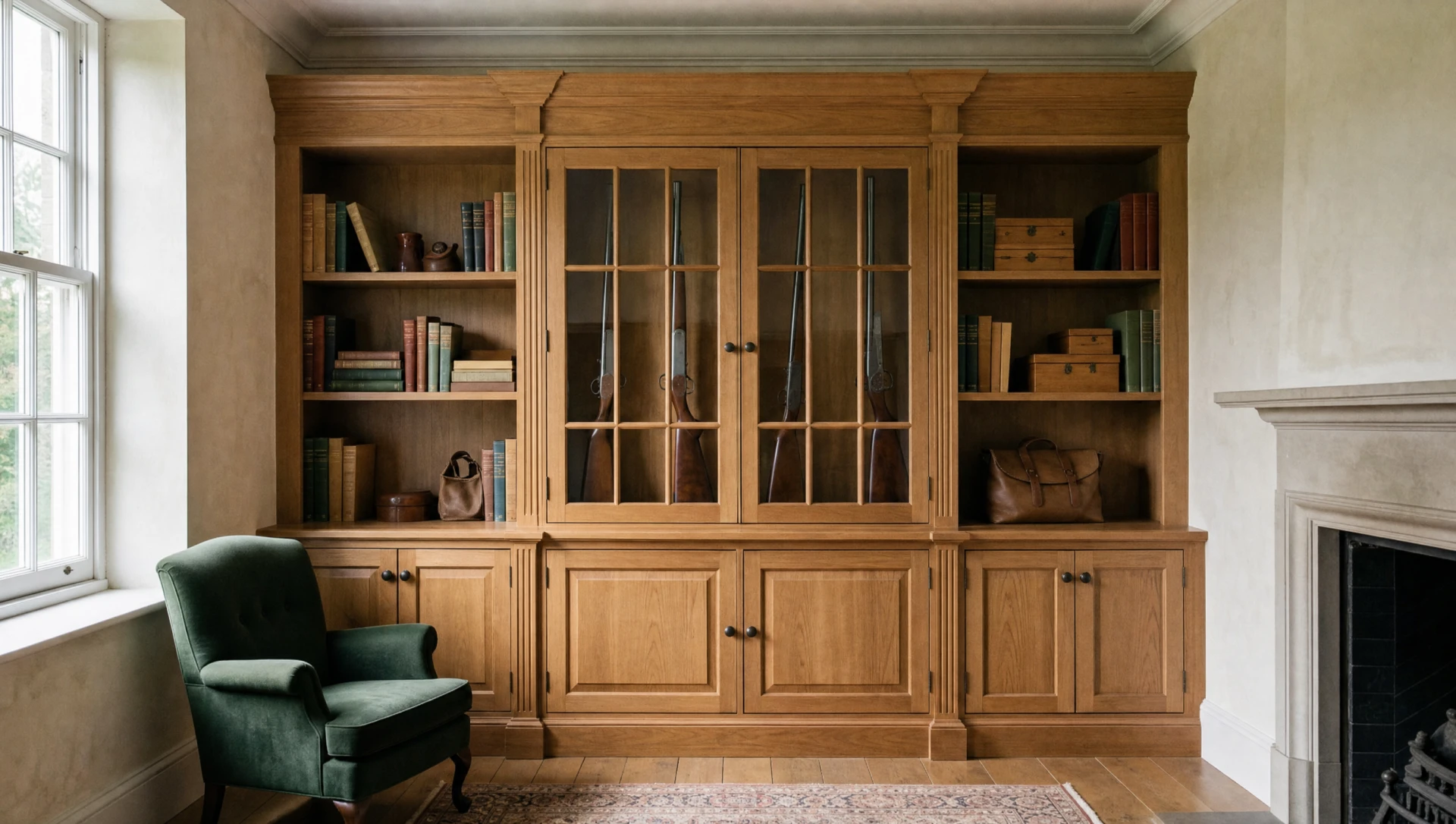
| Built into a run of joinery | Glazed cabinet set into panelling or shelving. See fitted cabinets |
Timber is quarter-sawn solid oak, walnut or mahogany, book-matched across a pair of doors so the figure runs continuously, or a hardwood built for paint. Finishes run from French polish through hand-oiled to hand-painted and hand-antiqued.
Living with glass
Three practical notes people are glad of afterwards.
It is heavier than you expect. A glazed door swings with real momentum. Where the cabinet is in family use we fit a check or a stay as a matter of course.
Clean it with almost nothing. A barely damp cloth and a dry one. Solvent cleaners run down onto the timber below the glass, and over years they will take the finish off the bottom rail before you notice.
Ventilation still matters. A glazed cabinet is not a sealed one, and it should not be. Cabinet interiors are ventilated as standard, because a sealed box and a gun put away slightly damp is the classic route to rust on something you were sure you had cleaned. See humidity, damp and blued steel.
Responsibility for meeting the security condition on your certificate rests with you as the certificate holder, and the adequacy of any storage arrangement is a matter for your local police firearms licensing department. We agree the specification with your firearms enquiry officer before we make anything — see the FEO process. Nothing on this page is legal advice.
Questions we are asked
What glass is used in a glazed gun cabinet?
Ours use laminated security glass, 26mm as standard. Toughened glass is the wrong material — it fails completely and leaves an open aperture, where laminated glass cracks and stays in the frame.
Does glazing make a cabinet less secure?
Not if it is built properly. The steel continues around the aperture, formed and returned; the door frame and hinges are sized for the weight of the glass; the locking is EN 1300 Class A 8-lever, multiple on taller doors; and the carcass specification is unchanged. It is more expensive precisely because none of that can be skipped.
Will my firearms enquiry officer accept a glazed cabinet?
Glazed cabinets are commonplace and we agree the specification with your FEO before making anything, handing over a signed specification sheet stating steel thickness, glass specification, lock model and fixing detail. The decision remains your licensing department’s.
Should the cabinet be lit?
Yes. An unlit glazed cabinet is a dark rectangle full of reflections. Low-heat LED on a door switch, aimed at the racks rather than at the glass, with a second circuit if you want the piece lit in the evening.
Glazed or solid — which should I choose?
Glazed if the room is one only the household uses and you want to see the collection. Solid where contractors, cleaners and visitors pass through, because a glazed cabinet tells everyone who enters what is in the house. Many clients have both.
How do I clean the glass?
A barely damp cloth and a dry one. Solvent cleaners run down onto the timber below the glass and will take the finish off the bottom rail over time.
What the glass in glazed gun cabinets is, in numbers
Glass is where the marketing language in this trade is thickest, so here are the actual figures and what they mean.
| Type | Make-up | Behaviour when attacked | Our use |
|---|---|---|---|
| Float / annealed | Single pane | Shatters into shards, aperture open | Never |
| Toughened | Heat-treated single pane | Disintegrates completely, aperture open | Never in a gun cabinet |
| Laminated 6.4 mm | 3 + 0.38 PVB + 3 | Cracks, holds, defeated with sustained effort | Display cabinets only |
| ESG Secure 26 mm laminated security glass (EN 356 greater than P8B, LPS 1270 rating 113, EN 1063 BR2) | Glass, polycarbonate and interlayers | Cracks and stays in the frame under repeated blows | Our standard |
The point of laminated glass is not that it cannot be broken. It is that it cannot be broken quietly or quickly, and that when it does break it stays in the aperture rather than leaving a hole you can reach through. Toughened glass fails in the opposite way, which is why it is the wrong material here however impressive the word sounds in a specification.
What the glass does to the rest of the cabinet
A 26 mm ESG Secure pane at 1,400 × 400 mm weighs around 26 kg. Two of them in a pair of doors is 52 kg hanging on hinges, and it is the reason glazed gun cabinets need heavier butts, a stiffer door frame and a carcass that will not rack. A maker who quotes the same door construction glazed and unglazed has not thought about it.
Ask any maker for the laminate make-up in millimetres — the 10 + 1.5 + 10 figure — rather than the word “security glass”. The Firearms Security Handbook does not specify glass at all, so the only meaningful comparison is the construction itself.
Glazed cabinets in the standard range
Two of the published designs are glazed: The Deben, a glazed upper section over a locking base cupboard in one to five bays, and The Blyth, the same cabinet drawn into a run of open bookcases under a shared cornice. Both are priced in oak, walnut, mahogany and paint in the standard range.
Send us your gun list
Tell us what you own and send a photograph of the wall, including what is opposite it. We will tell you what we would build, how it should be lit, and roughly what it would cost.
For a glazed cabinet built into a library, see a glazed oak cabinet for a library.
>