
Humidity, Damp and Blued Steel
More guns are ruined by the air inside a cabinet than by anything that happens outside it. Gun cabinet humidity is the most common avoidable damage we see, it is almost always the same three causes, and none of them costs much to fix.
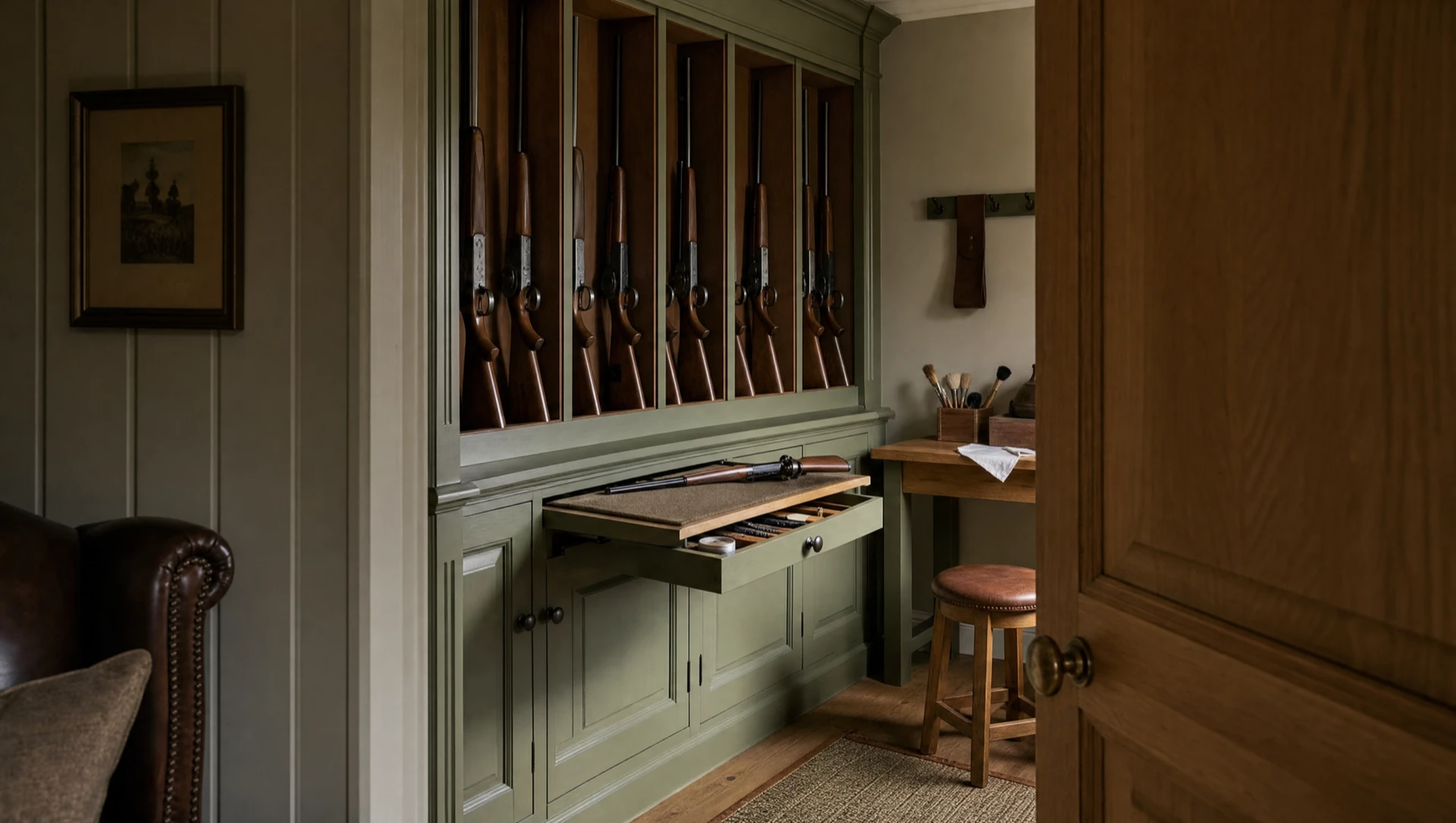
We are asked about steel gauge constantly and about humidity almost never, which is the wrong way round. A cabinet gets attacked perhaps never. It is exposed to the air in the room every hour of every day for thirty years, and blued steel and figured walnut are both quietly reactive to that air.
This page is what we have learned building storage into real houses — cellars, boot rooms, converted stables, gun rooms in the coldest corner of a Georgian block. It is not a product pitch. Most of what follows costs less than a tank of fuel.
On this page
- Why guns rust indoors
- The bit everybody misses: dew point
- Slips, sleeves and cases — the worst offender
- The numbers to aim for
- Ventilation, and why a sealed cabinet is a bad cabinet
- Controlling it: desiccants, heaters and dehumidifiers
- Where to put the cabinet
- What damp does to the timber
- What we build in as standard
- Questions we are asked
- Measuring gun cabinet humidity properly
Why guns rust indoors
Rust needs three things: iron, oxygen and water. The iron and the oxygen are not negotiable. Water is the only variable you control, and in a house it arrives as water vapour in the air rather than as anything you would recognise as wet.
Bluing is worth understanding here, because it is widely misunderstood. Blued steel is not a coating in the sense that paint is a coating — it is a controlled layer of black iron oxide formed on the surface of the steel. It is a conversion of the metal itself, it is thin, and it is porous. On its own it offers very little corrosion protection. What protects a blued barrel is the film of oil sitting in and over that porous layer. Take the oil away and you have a decorative finish with no defence at all.
That is why a gun can sit oiled in an unheated cellar for a decade and be fine, and another can go orange in a warm house in a fortnight. The question is never simply how damp the room is. It is whether there is a continuous film of oil, and whether water is being deposited faster than it can evaporate.
The bit everybody misses: dew point
Relative humidity is the figure people quote, but on its own it explains very little. The mechanism that actually causes most cabinet corrosion is condensation on cold metal, and that is governed by dew point.
Dew point is the temperature at which the air is fully saturated and has to give up its moisture as liquid water. Any surface colder than the dew point of the surrounding air will collect condensation. Not might — will.
Now consider what a gun actually is. It is a considerable mass of steel with high thermal inertia, sitting in a cabinet, often against an external wall. It changes temperature slowly. The air in the room changes temperature quickly — the heating comes on, someone lights the fire, the sun hits the window, a mild wet front arrives after a cold night.
So the sequence that does the damage is this. The house cools overnight and the guns cool with it. In the morning the heating comes on and warm, moisture-carrying air arrives. The steel is still cold. Warm damp air meets cold metal and water condenses out onto the barrel, invisibly, in a film. It evaporates later, having taken some of the oil with it and left the surface briefly wet. Repeat this a hundred and fifty times over a winter and you have pitting.
Two practical conclusions follow, and they are not obvious:
- A cold cabinet in a warm house is worse than a cold cabinet in a cold house. The problem is the difference between the metal and the air, not the absolute temperature of either.
- Bringing guns in from the cold and putting them straight away is the single most damaging thing you can do. A gun that comes out of a Land Rover at two degrees and goes into a cabinet in a heated house is guaranteed to condense. Let it come up to room temperature in the open first, then clean it, then put it away.
Slips, sleeves and cases — the worst offender
If we could change one habit in this country it would be this one.
A fleece-lined slip, a sheepskin sleeve, a foam-lined case: every one of them is an excellent absorber of water and an excellent insulator. Put a gun away damp in a slip and you have wrapped the barrel in a wet blanket and then insulated it so it cannot dry. The fleece holds moisture directly against the steel for days. Sheepskin is worse again, because residual tanning salts are hygroscopic and mildly corrosive in their own right.
Foam-lined cases add a second problem. Closed-cell foam does not breathe, so any moisture that goes into the case stays in the case, and some foams give off traces of acidic compounds as they age. A gun stored long-term in a foam case is in a small sealed environment of its own making.
The rule is simple and it is not negotiable in our view: guns are stored out of the slip, in the open, on a rack, not in the case. Slips and cases are for transport. If you want them stored with the collection, they should live in a separate ventilated compartment, dry, with nothing metal in them.
This is one of the reasons we build racks rather than shelves. A gun on a rack has air on all sides of it. A gun lying on a shelf in a slip has a wet contact patch underneath and no air movement at all.
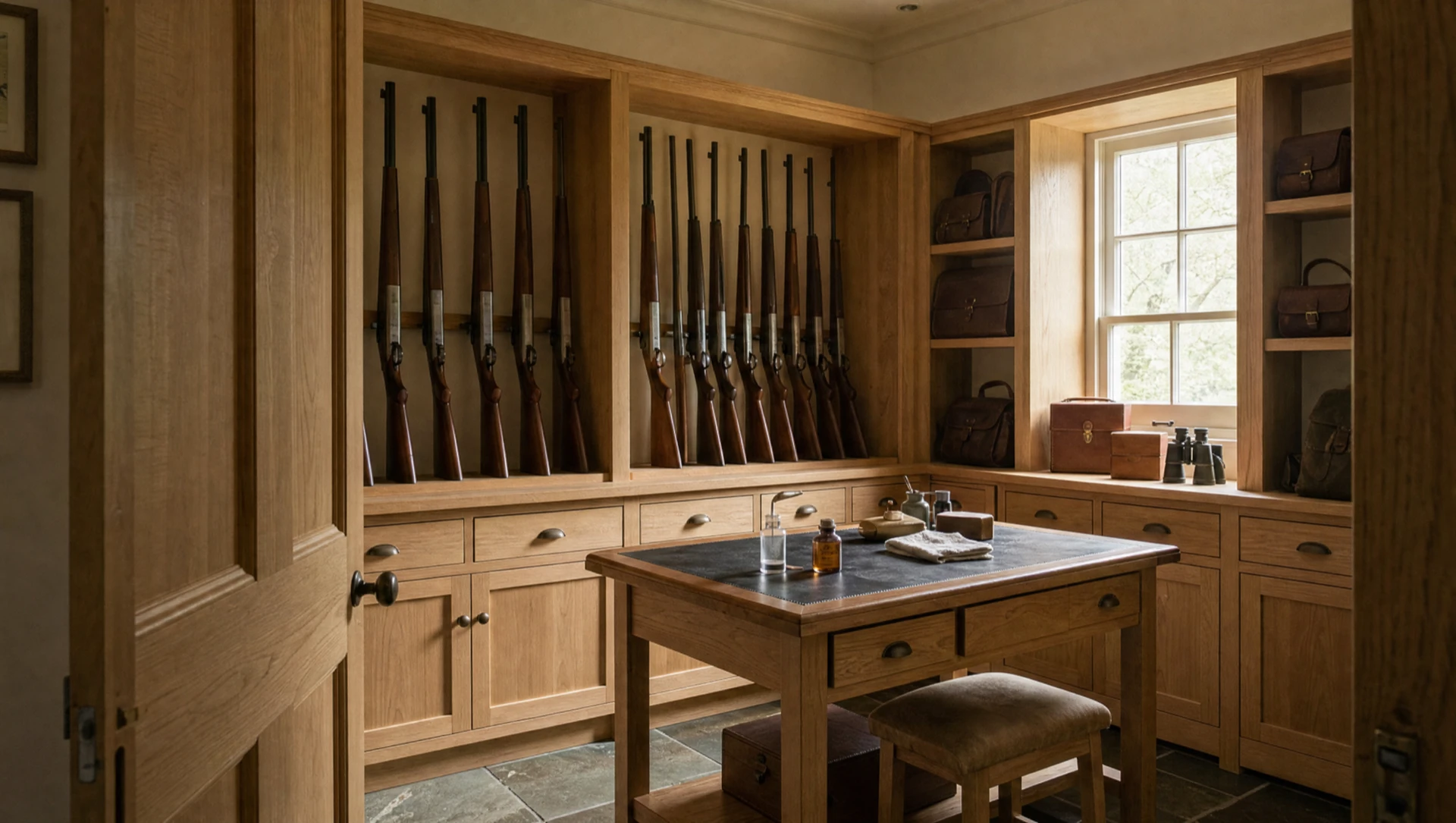
The numbers to aim for
There is no single official figure, and anybody who gives you one to the decimal place is selling something. The consensus across conservation and firearms practice sits in a band, and the band is what matters more than the midpoint.
| Measure | Target | Why |
|---|---|---|
| Relative humidity | Roughly 45–55% | Below about 40% and timber, horn and old leather start to shrink and check. Above about 60% corrosion accelerates markedly and mould becomes possible |
| Stability of RH | More important than the exact figure | Repeated swings move moisture in and out of timber and cause more damage than a steady figure at either end of the band |
| Temperature | Even, rather than warm | The enemy is the difference between metal and air, not the absolute temperature |
| What to measure with | A digital hygrometer inside the cabinet | The room reading and the cabinet reading are frequently several points apart, particularly against an external wall |
Buy the hygrometer before you buy anything else. It costs very little, it goes inside the cabinet rather than on the wall, and it will tell you within a fortnight whether you have a problem at all. A great many people spend money solving a problem they do not have, and a few discover they have a serious one they had not noticed.
Ventilation, and why a sealed cabinet is a bad cabinet
There is an instinct to seal a cabinet tight, and it is exactly wrong.
A sealed steel box with a damp gun in it does not stay dry. It becomes a small climate of its own, in which the moisture that went in is trapped, cycling between the air and the metal every time the temperature changes. Add a cold external wall behind it and you have built a condenser.
What you want is gentle, continuous air movement — enough that moisture leaving a gun can go somewhere, and enough that no corner of the interior sits still. In practice that means the interior is not divided into airtight compartments, that the base is not a moisture trap, and that where a cabinet is a fitted or built-in piece there is provision for air to move behind and beneath it rather than being pressed flat against cold plaster.
This is also why we are wary of carpet. A cabinet standing on carpet against an external wall in an unheated room is standing on an insulating layer that holds moisture and stops the base from drying.
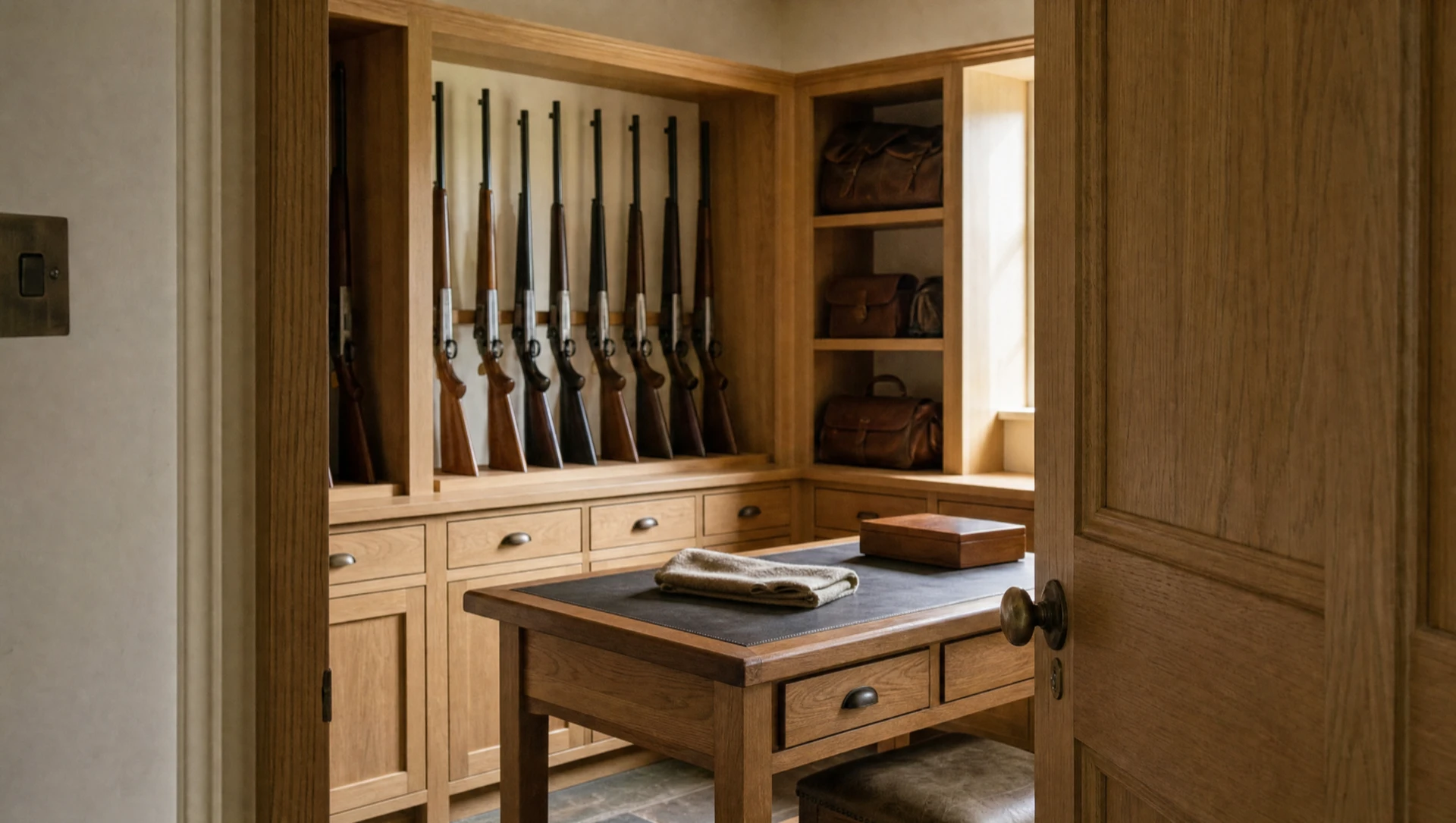
Controlling it: desiccants, heaters and dehumidifiers
Four approaches, in rough order of how often they are the right answer.
1. A low-output heater, sometimes called a dehumidifier rod
A long, low-wattage electric rod fixed low in the cabinet, left on permanently. It does not dry the air by removing water; it works by keeping the interior a degree or two above the surrounding air, which raises the metal above dew point and sets up a gentle convective current.
For most houses this is the most effective single measure, because it addresses the actual mechanism — cold metal in warmer air — rather than the symptom. It uses very little electricity. It needs a fused spur or a discreet socket, which is why we would rather know at design stage than drill a cabinet afterwards.
2. Rechargeable silica gel desiccant
Silica gel adsorbs moisture from the air and holds it. The rechargeable canisters have an indicator that changes colour when saturated; you dry them in a domestic oven and put them back. Cheap, entirely passive, no electricity, no cable.
The limitation is capacity. Silica gel is very good in a modest sealed volume and much less useful in a large ventilated one, and it is useless once saturated — which is precisely when you have stopped checking it. It suits a smaller cabinet, or a drawer of optics, better than a full room.
3. Vapour corrosion inhibitors
VCI emitters and papers release a vapour that deposits a molecular protective layer on ferrous surfaces. They are widely used in industry for storing and shipping bare steel, and they work on the metal rather than on the air, which makes them a useful belt-and-braces measure alongside one of the above. They have a service life and need replacing on schedule; a spent emitter is doing nothing while looking like it is.
4. A room dehumidifier
Where the whole room is the problem — a cellar, an outbuilding, a converted stable — treat the room rather than the cabinet. A cabinet cannot fix a wet building, and neither can a rod. If the walls are damp, that is a building problem and it wants a builder or a surveyor, not a joinery solution.
Whatever you install, still oil the guns
None of the above replaces a wiped film of oil. Every one of these measures is there to buy margin for the days when the oil film is thin, the weather turns, or a gun goes away in more of a hurry than it should have done. Handling leaves salts and acids from skin on the steel, which is why a wipe-down after handling matters as much as one after shooting.
Where to put the cabinet
Siting is free, and it does more than any accessory.
- Internal wall in preference to external. An external wall is the cold surface in the house and the cabinet against it will track its temperature.
- Away from radiators and direct sun. Both create the swings that drive moisture in and out of timber and metal.
- Not a cellar, not an unheated garage, not a loft, unless the room itself is being controlled. These are the three places we are most often asked to fit and the three that cause the most trouble.
- Not a bathroom wall, and not backing onto one. Obvious once said, and we have seen it more than once.
- Where the room is used. A cabinet in a room somebody walks into daily gets noticed. A gun going quietly orange in a spare room does not.
Security and climate sometimes pull in opposite directions here — the discreet corner is often the cold one. That is a real trade-off and it is worth discussing at survey rather than discovering later. Gun room lighting, heating and ventilation deals with it at room scale.
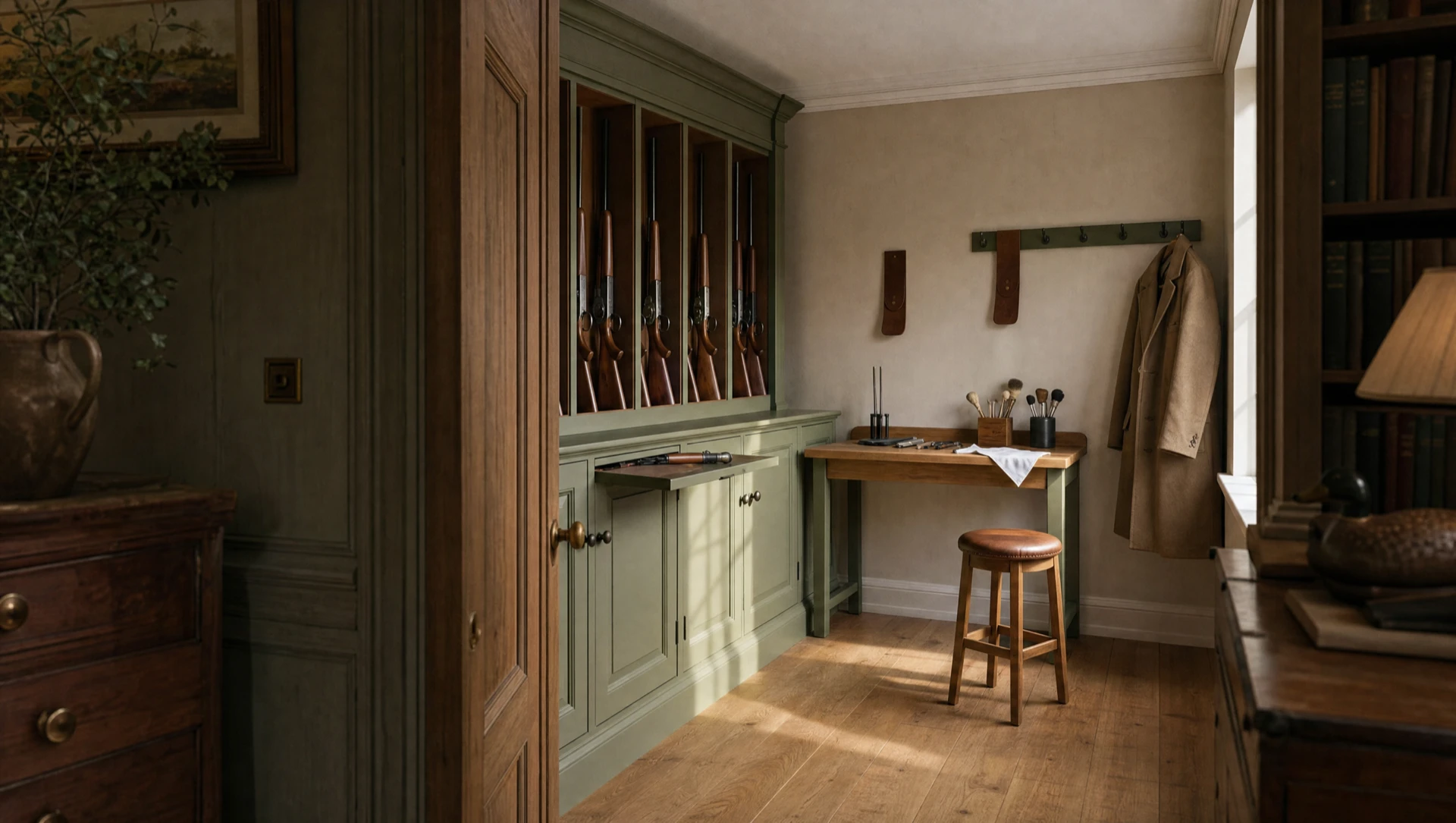
What damp does to the timber
The cabinet has a stake in this too, and so does the stock.
Timber is hygroscopic: it takes up and gives off moisture with the surrounding air, and it moves as it does so — mostly across the grain, very little along it. Cabinetmaking is largely the management of that movement, which is why we use quarter-sawn timber for its greater stability, why panels float in their frames rather than being glued in, and why a wide painted panel is sometimes better as an engineered substrate than as a solid one.
Sustained high humidity swells doors so they bind, then sustained dryness shrinks them so the shut lines open. Cycling between the two is what opens joints and lifts finishes. A walnut stock does the same thing on a smaller scale, which is how checkering goes proud and inletting goes loose around the action.
The band that suits your guns — roughly 45 to 55% RH, held steady — is the same band that suits the furniture and the stocks. That is convenient, and it is not a coincidence: both are the same problem of keeping a moisture-sensitive material in equilibrium.
What we build in as standard
- Internal air movement, so no part of the interior is a still, sealed pocket
- Racks rather than shelves, so air reaches every surface of every gun
- Provision for a heater rod — cable route, fixing and a discreet spur position, agreed at design stage rather than drilled in later
- Baize or felt lining at the contact points only, not wrapped around the gun
- Ventilated provision for slips and cases, away from the firearms themselves
- A back detail that allows air behind the piece where it sits against an outside wall
- Low-heat LED lighting, which does not add a heat source to the interior
None of this is expensive. All of it is much easier to draw in at the start than to retrofit into a finished cabinet, which is the reason this page exists — by the time somebody rings us about rust, the cabinet is usually already built.
Questions we are asked
What humidity should a gun cabinet be kept at?
Roughly 45 to 55% relative humidity, and steadier matters more than exact. Below about 40% timber, horn and old leather shrink and check; above about 60% corrosion accelerates and mould becomes possible. Measure it with a digital hygrometer inside the cabinet rather than on the wall, because the two readings often differ by several points.
Should I store guns in a slip inside the cabinet?
No. Fleece and sheepskin slips absorb moisture and hold it against the steel, and they insulate the gun so it cannot dry. Foam-lined cases do not breathe. Store guns out of the slip on a rack with air around them, and keep slips and cases in a separate ventilated compartment. Slips are for transport, not storage.
Are dehumidifier rods worth it?
For most houses, yes — it is usually the most effective single measure. A low-wattage rod does not remove water from the air; it keeps the cabinet interior slightly warmer than the surrounding air, which lifts the metal above dew point and creates gentle air movement. It uses very little electricity, but it needs a power supply, so it is best planned at design stage.
Why does a gun rust in a warm house?
Because of condensation rather than damp. Steel has high thermal mass and changes temperature slowly, so when warm moist air arrives in a room the guns are still cold, and water condenses onto them. This is also why a gun brought in from a cold vehicle should be allowed to reach room temperature before it is cleaned and put away.
Does bluing protect against rust?
Barely, on its own. Bluing is a thin, porous layer of black iron oxide formed on the surface of the steel rather than a coating over it. What protects the barrel is the oil held in and over that layer. Remove the oil and the finish offers very little defence.
Is silica gel enough?
In a smaller cabinet or a drawer, often yes. Rechargeable canisters change colour when saturated and are dried in a domestic oven. The limitation is capacity: silica gel is much less effective in a large ventilated cabinet, and it does nothing once saturated, which tends to be exactly when it has stopped being checked.
Should the cabinet be sealed to keep damp out?
No — a sealed cabinet traps moisture rather than excluding it, and becomes a small climate of its own that cycles water between the air and the metal. Gentle continuous air movement is what you want, so that moisture leaving a gun has somewhere to go.
Measuring gun cabinet humidity properly
Almost everybody who has a problem here is measuring the wrong air. The room reads 52% and everything seems fine, while the closed cabinet against an external wall sits at 68% and the guns in it are quietly blooming.
Two hygrometers, then. One in the room and one inside the cabinet, both logging rather than instantaneous, and both checked against a known reference once a year — the salt test is free and takes six hours. What you are looking for is not the average but the spread: a cabinet that swings from 45% to 70% across a week is worse for blued steel than one that sits steadily at 60%, because every crossing of the dew point puts liquid water on the metal.
| Reading inside the cabinet | What it means | What to do |
|---|---|---|
| Below 40% | Too dry. Stocks and cases shrink, chequering lifts. | Reduce heat, or stop dehumidifying |
| 45–55% | Correct. | Nothing |
| 55–60% | Acceptable, watch it. | Improve air movement |
| 60–65% | Blueing at risk over a season. | Ventilate, add background heat |
| Above 65% | Active corrosion risk. | Open it up, dry it out, find the cause |
The three causes, in the order we find them
- A gun put away in a slip or a fleece cover. The cover holds moisture against the metal and stops any air reaching it. This is the single commonest cause and it is free to fix — nothing goes into a cabinet in a slip.
- A sealed cabinet. A cabinet with no ventilation is a container for whatever air was in it when you shut the door, plus whatever the guns brought in. Ours are vented top and bottom for exactly this reason.
- A cold external wall behind the cabinet. The back panel sits below the dew point of the room and condenses. Pack the cabinet 20 mm off the wall, or put it on an internal wall.
The underlying physics is the same as in any building with a cold envelope and warm, moist air inside it, and Historic England’s technical guidance on moisture in traditional buildings is the clearest free treatment of it we know. Everything on this page follows from it.
Tell us where the cabinet is going
Half of this is solved at survey, for nothing, by choosing a different wall. Send us your gun list and a few photographs of the room and we will tell you what we would do about the climate as well as the joinery.
Humidity is managed the other way round where cigars are concerned — see ventilation and filtration for cigar storage.