
Reel and Tackle Cabinets
Reels are heavy, dense and easily marked, and they end up in a drawer with everything else. A cabinet drawn around your own reels turns a box of tackle into something worth opening.
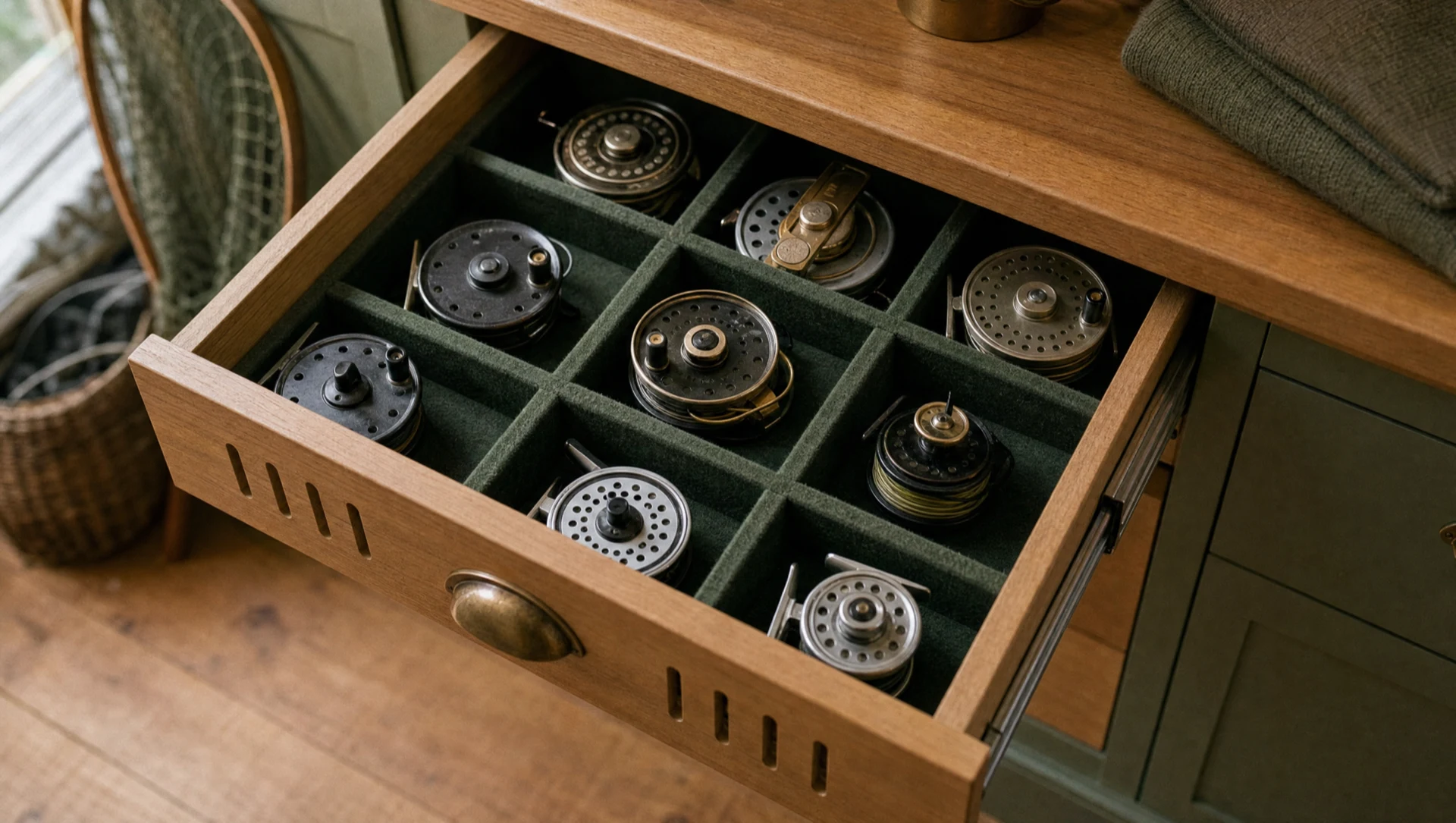
A rod is a display object and gets treated like one. Reels are the opposite: they are small, they are expensive, several of them are quietly beautiful, and they live in a heap.
The reason is almost always that the storage was designed for volume rather than for reels. Which is a solvable problem, and the solution is mostly drawers.
On this page
Why drawers, not shelves
A shelf stores one layer usefully and everything behind it invisibly. Anything small and valuable put on a shelf ends up in a row at the front and a mystery at the back.
A drawer shows you everything at once. That is the entire argument, and it is the same argument as the one for cartridge drawers.
The engineering matters, because reels are dense. A drawer of a dozen salmon reels is a genuinely heavy drawer, and a drawer that sags, racks or has to be lifted to close is a drawer that stops being used.
- Full-extension runners, rated for the load rather than for the drawer size. The back of the drawer has to be reachable — otherwise it is a shelf with extra steps.
- Solid drawer boxes, dovetailed, with bottoms sized for weight rather than for economy.
- Shallow drawers, more of them. Two shallow drawers hold reels better than one deep one, because reels stored on top of each other mark each other.
- Soft close, or none at all. A reel drawer slammed shut is a reel bouncing into its neighbour.
Storing reels properly
Three things damage a reel in storage, and all three are storage decisions rather than accidents.
Contact
Reels put away loose slide, and anodised aluminium marks against anodised aluminium. The answer is division: felt or baize-lined compartments, cut so each reel sits in its own place and stays there when the drawer moves.
Divisions can be fixed or adjustable. Fixed looks better and works better, and it requires knowing what is going in — which is why we ask for the list. Adjustable is the right answer where a collection is genuinely still forming.
Damp
A reel used in salt water and put away without rinsing and drying will corrode, and it will do it inside where nobody looks. No cabinet fixes that — but a cabinet can stop making it worse.
Which means air movement rather than a sealed box, and a lining that does not hold moisture against metal. It is the same principle set out at length in the humidity and damp guide, and it applies to reels as much as to blued barrels.
Line left under tension
Not a joinery problem, but worth saying because the cabinet is where it happens. Backing and fly line left tight on a reel for a season takes a memory. Slackening off before a reel goes away for the winter costs nothing.
Lines and leaders
Fly lines want somewhere dark, cool and dry, and off the reel if they are being stored long-term. Spare spools want their own shallow divided drawer so they are not stacked. Leader material and tippet spools want a rack or a drawer with round divisions rather than a bag, because a tangle of spools is a tangle for the rest of its life.
The practical answer in most cabinets is one shallow drawer given over entirely to spools and leader, divided into circles, with the labels facing up. It takes very little room and it removes an entire category of irritation.
Fly boxes
Fly boxes are awkward because they are all different and they multiply.
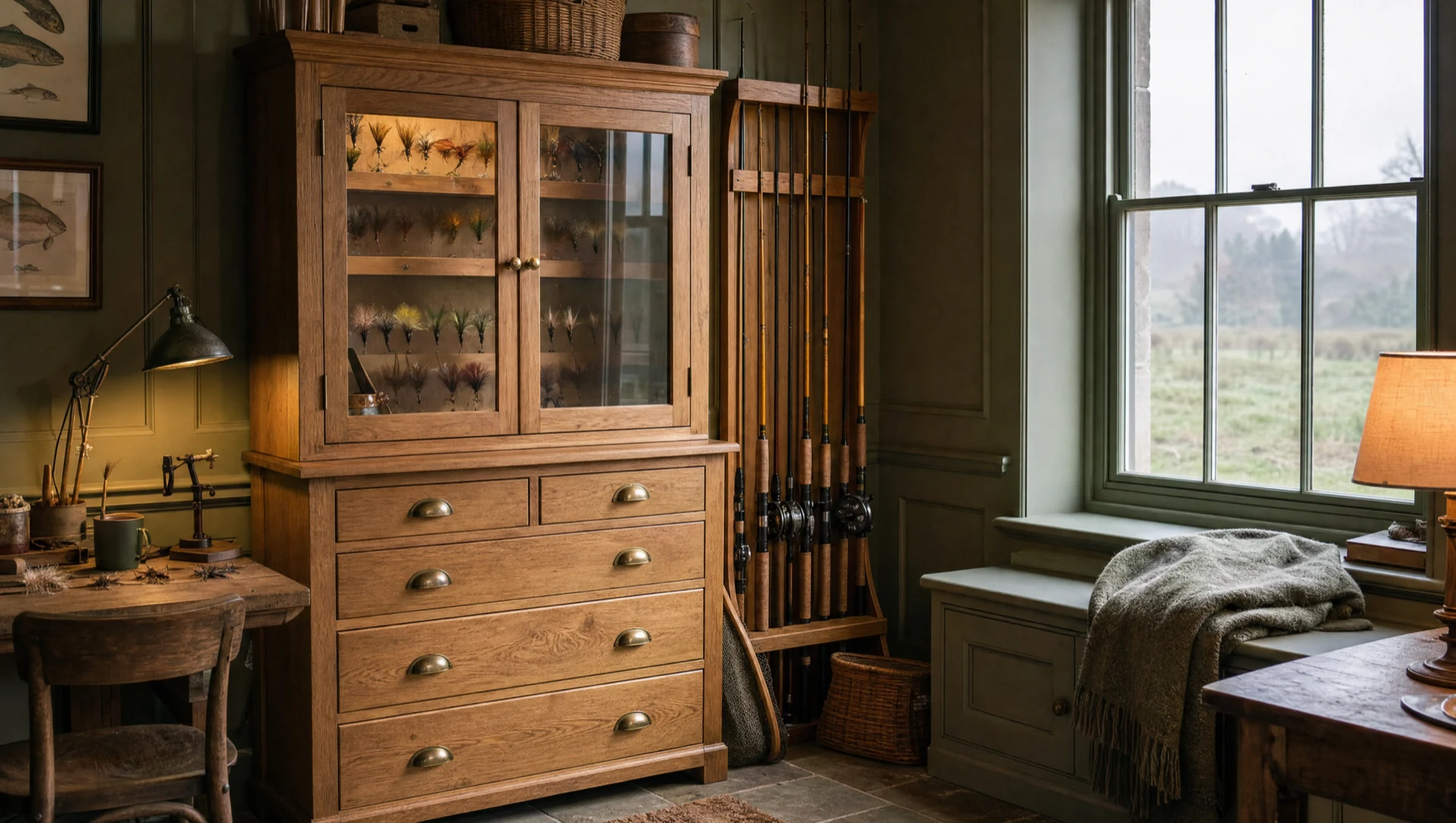
Stacked flat they are unreadable; stood on edge they are readable and they fall over. So the sensible arrangement is on edge, in divisions sized to the boxes you actually own, spines out, like books. From there you can see the whole collection and take one out with one hand.
A drawer of divided fly boxes is one of those details that costs almost nothing at drawing stage and is impossible to retrofit, because it is entirely a matter of the division spacing.
What we need from you
Numbers and sizes. How many reels and roughly what diameters — a 3in trout reel and a 4½in salmon reel want different compartments. How many spare spools. How many fly boxes and what size. Whether any of it is being kept for display rather than use.
Estimates are fine. What we cannot do is draw divisions from an assumption and have them fit.
Display, where it is deserved
Some reels should be behind glass rather than in a drawer, and it is worth saying which.
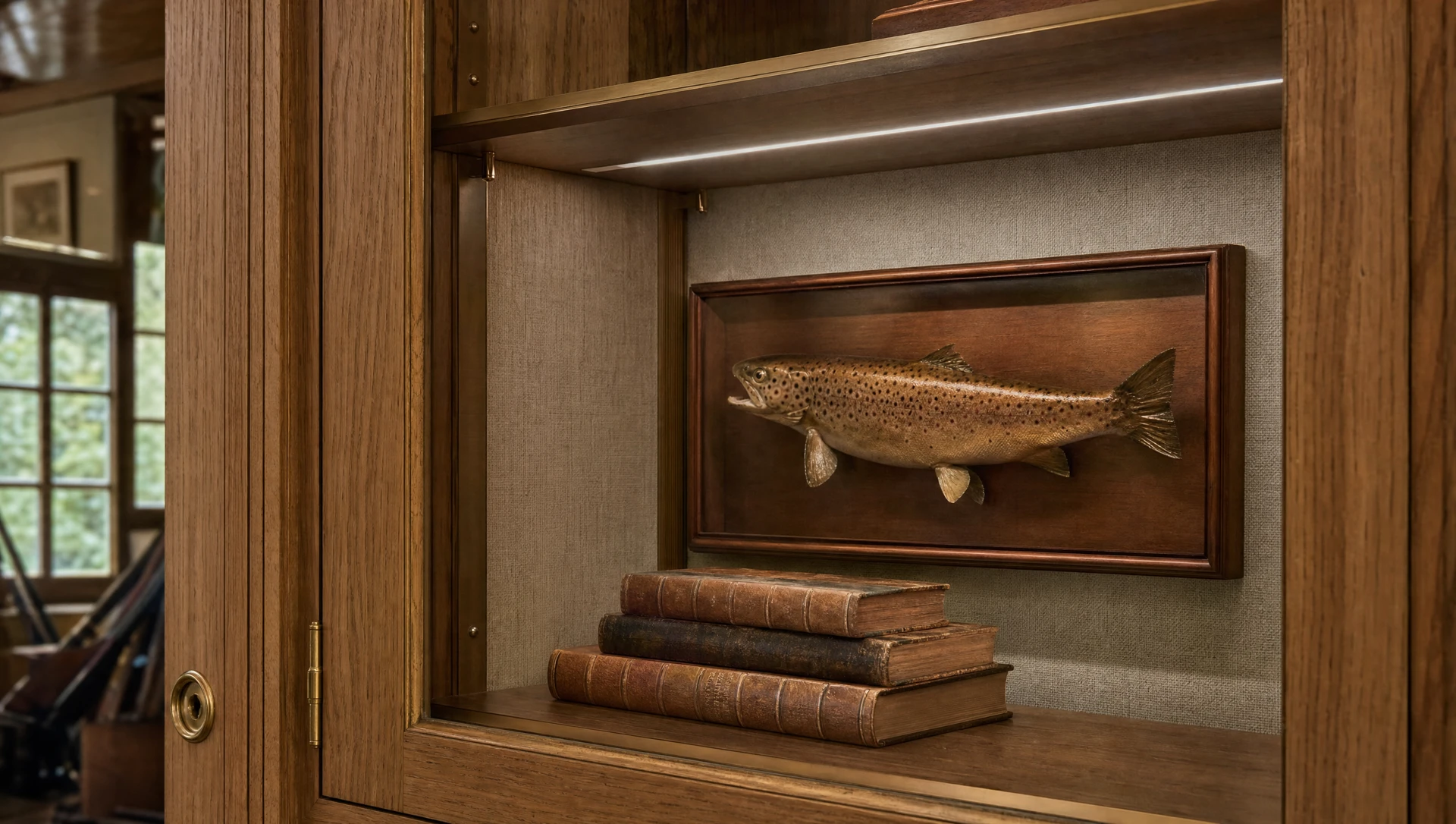
An early Hardy, something built for a particular river, a reel that belonged to somebody — these are objects, and a glazed compartment with proper lighting treats them as such. The rest of the collection stays in drawers below, where it is used.
Where we glaze for display we use low-iron glass, which is close to colourless and shows brass and anodising honestly, and low-heat LED positioned to graze rather than flood. Where daylight is strong, a UV-filtering laminated interlayer, because light damage is cumulative and does not reverse.
That is the same specification as the display cabinets on the sporting rooms page, and it is frequently the same piece of furniture.

How it is built
Quarter-sawn solid oak, walnut or mahogany, book-matched across pairs of doors, or a hardwood built for paint. Dovetailed solid drawer boxes on full-extension heavy-duty runners. Baize or felt linings, colour chosen with the timber. Solid brass or bronze ironmongery. French polish, hand-oiled, hand-painted or antiqued by hand, in our own finishing shop by our own polisher.
A reel and tackle cabinet is usually part of a larger fitted room — drawers under a run of rod racking, next to a tying bench, with the wet kit at the far end. It also works perfectly well as a single freestanding chest, which is where a good many commissions start.
Common questions
Why drawers rather than shelves for reels?
A shelf stores one layer usefully and everything behind it invisibly. A drawer shows you the whole layer at once. Reels are dense, so the drawers have to be engineered for the load — full-extension runners rated for weight, dovetailed solid boxes, and shallow drawers rather than deep ones, because reels stored on top of each other mark each other.
Should reel compartments be fixed or adjustable?
Fixed looks better and works better, and it needs us to know what is going in — which is why we ask for numbers and diameters. Adjustable is the right answer where a collection is genuinely still forming. Either way the compartments are lined in felt or baize so anodised aluminium is not sliding against anodised aluminium.
How should fly boxes be stored?
On edge, spines out, like books, in divisions sized to the boxes you actually own. Stacked flat they are unreadable; stood on edge without divisions they fall over. It costs almost nothing at drawing stage and cannot be retrofitted, because it is entirely a matter of the division spacing.
Where should fly lines be kept?
Somewhere dark, cool and dry, and off the reel if they are being stored long-term. Spare spools want their own shallow divided drawer so they are not stacked, and leader and tippet want round divisions rather than a bag. One shallow drawer given over to spools and leader, labels facing up, removes an entire category of irritation.
Can some reels be displayed rather than stored?
Yes, and it is usually worth it for one or two. A glazed compartment in low-iron glass with low-heat LED lighting, over drawers holding the working collection. Where daylight is strong we add a UV-filtering laminated interlayer, because light damage to lacquer, leather and finish is cumulative and does not reverse.
How reel and tackle cabinets are set out
A reel is a dense, precisely machined object with a painted or anodised finish that marks if it is allowed to move. Almost every problem with tackle storage comes from reels being stored loose in a box where they knock together, or stacked so the weight of one bears on the frame of another.
The answer is shallow drawers with fitted divisions, and the setting out follows the reels rather than the other way round.
| Reel type | Compartment | Drawer depth |
|---|---|---|
| Trout, 2¾–3½ in | 110 × 110 mm | 60 mm |
| Salmon, 3¾–4½ in | 140 × 140 mm | 75 mm |
| Spey / large salmon, 4¾ in + | 165 × 165 mm | 90 mm |
| Spare spools | Half-depth, stacked two high | 60 mm |
| Multipliers and fixed spool | Cradled, not square | 90–110 mm |
Divisions are in solid timber rather than ply, lined in a napped wool cloth rather than synthetic felt, and made removable so the layout can be changed when the collection does. Cloth matters: synthetic felt holds moisture against an aluminium frame and will mark an anodised finish over years.
Lines, backing and the things that perish
Fly line is the shortest-lived thing in the room. It goes off from heat, ultraviolet and being left under tension, in that order — which is an argument for a drawer rather than a display shelf, and for storing spare lines on large-diameter spools rather than tightly coiled. Braid and backing are largely indifferent. Monofilament perishes quietly and unhelpfully, and is worth dating with a pencil on the spool.
What goes on top
Most reel and tackle cabinets we make are drawer banks with a working top — somewhere to lay a rod down, thread a line, or spool up. Solid timber, 40 mm, oiled rather than polished so a wet reel does not bloom the finish. If you fish salt water, tell us: everything above changes, the ironmongery goes to stainless or bronze, and there needs to be somewhere to rinse.
If your fishing takes you between rivers, please read the Check Clean Dry guidance on invasive species. It is the reason we build drying provision into every fishing room rather than a cupboard — kit that goes away damp is kit that moves things between catchments.
Tell us what is going in
How many reels and roughly what diameters, how many spools, how many fly boxes and what size. Estimates are fine — what we cannot do is draw divisions from an assumption.