
Watch Storage
How a Watch Safe Is Made
Two pieces of work that have to become one. A steel security box, folded and welded, with nothing combustible inside it; and a piece of cabinetwork — oak, leather and glass — built round it so that what you see from the room is furniture.
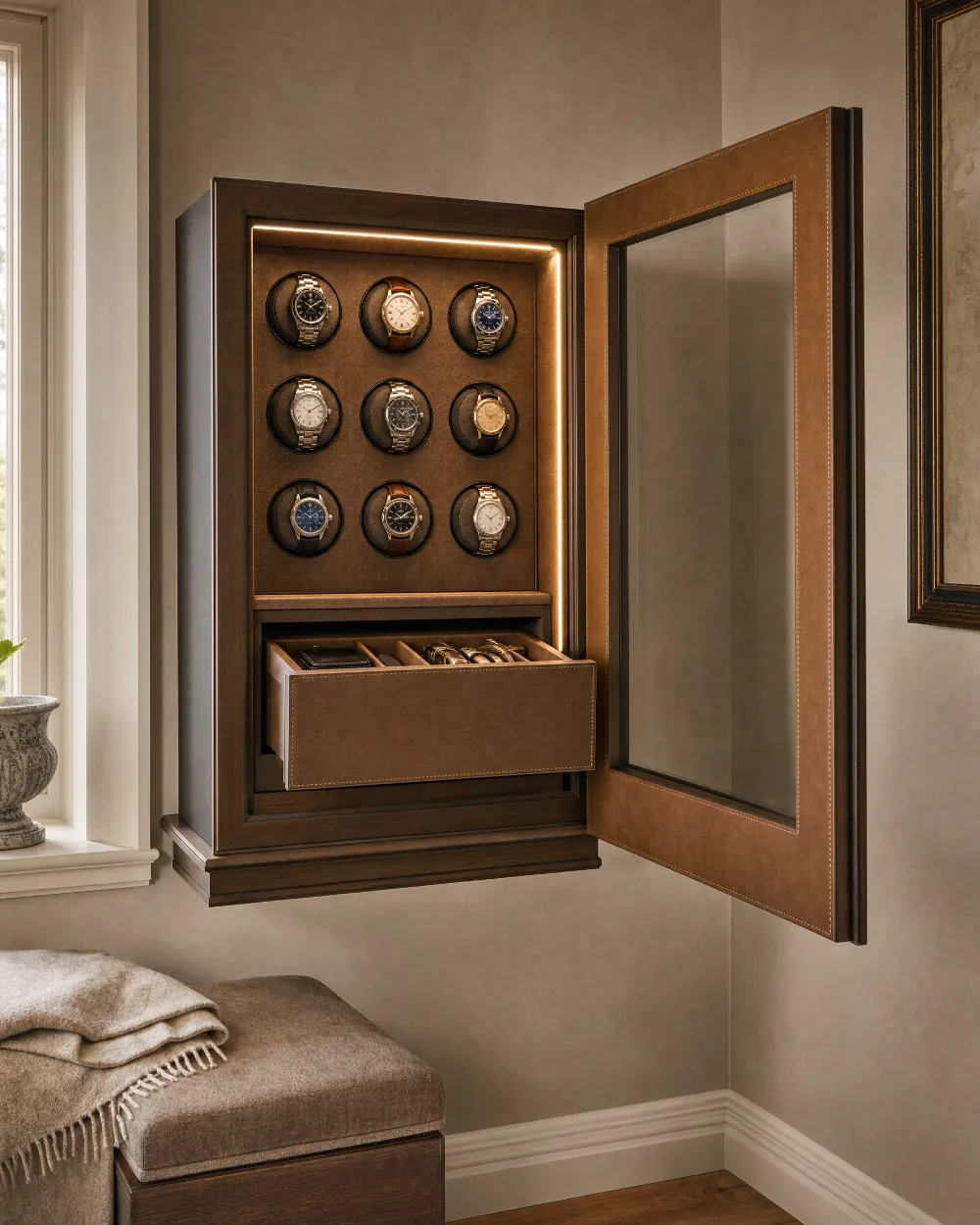
The order matters. The steel is drawn and made first, because everything about the joinery — the aperture, the reveal, the way the surround meets the plaster, how the door swings and where the hinge knuckles fall — is set by the box. A safe built to fit a piece of furniture is a piece of furniture. A piece of furniture built round a safe is a watch safe.
The steel carcase
The body and frame are folded from mild steel plate and continuously welded, so there is no fixing, no rivet and no bolted joint for anybody to work on. Folding the corners rather than welding them up out of flat sheet leaves fewer weld lines to attack in the first place. The body is 5 mm plain carbon steel, folded from a single blank with every join fully welded and linished flush. The door is built up from drawn 3 mm steel parts and closes into the folded front edge of the body, on purpose-made hinges set inside the oak surround so nothing is exposed on the face.
Nothing structural inside the steel box is timber or composite. That is a deliberate rule and it is why the leather lining and the drawer are made as separate, removable elements dropped into a finished shell rather than as a carcase the steel is wrapped around. The shell is coated in a durable black finish before anything goes into it.
It is built into the wall with multiple fixing points through the back and sides, and the cable for the lighting and the locking enters through the base, inside the fabric of the wall, where nobody can get at it. There is no visible cable anywhere and nothing to unplug from the room.
The surround
The timber face is what makes it liveable. On the safe drawn above it is oak, worked to the wall face as a moulded surround with the door frame set within it, so the whole thing reads as a glazed cabinet let into the panelling rather than as an opening with a safe behind. If we are making the wardrobes or the panelling in the same room, the surround is cut from the same boards, so the grain and the colour carry through and the safe disappears into the run.
It does not have to be oak and it does not have to be recessed. Walnut, sycamore, painted, or freestanding as a chest or a cabinet if the wall will not take it — the steel work is the same either way.
The inside
Every interior surface is leather lined, including the back of the door, and the rear panel is made as a removable leather-covered oak panel. That matters more than it sounds: the winder positions and the wiring sit on that panel, so in ten years when a module needs replacing, the panel comes out and goes back rather than the safe being stripped. Watches are laid and held in a lined, lit face, with the lighting run at low voltage and cool enough not to sit warm against a case.
Below the winder face is a drawer with drop-in trays, which is where most collections actually live — the pieces that are not on winders, the spare straps, the papers. Trays are made to the watches: bracelet-width cushions, deeper wells for a dive watch, lower ones for a dress piece.
Drawn twice
Like everything else we make, it is drawn in CAD and then drawn again full size on a rod before the machines are set. With a recessed piece that is not ceremony: the wall opening is cut once, and the reveal, the coating thickness, the glass rebate and the leather all have to have been allowed for before anybody puts a saw into the plaster.
Next: security, glass and locking, and winders, movement and capacity.
If you are building or refitting
Bring us in while the wall is still a drawing. A watch safe is straightforward to build into a room that is being worked on and awkward to retrofit into one that is finished.
Watch winder modules · Security glass and locking · Inside the workshop
Questions we are asked
Which is made first, the steel or the joinery?
The steel. Everything about the joinery — the aperture, the reveal, the way the surround meets the plaster, how the door swings and where the hinge knuckles fall — is set by the box. A safe built to fit a piece of furniture is a piece of furniture; a piece of furniture built round a safe is a watch safe.
How is the steel carcase made?
The body and frame are folded from mild steel plate and continuously welded, so there is no fixing, no rivet and no bolted joint for anybody to work on. The body is 5 mm plain carbon steel, folded from a single blank with every join fully welded and linished flush. The door is built up from drawn 3 mm steel parts and closes into the folded front edge of the body, on purpose-made hinges set inside the oak surround so nothing is exposed on the face.
Is there any timber inside the steel box?
No. Nothing structural inside the steel box is timber or composite. That is a deliberate rule, and it is why the leather lining and the drawer are made as separate removable elements dropped into a finished shell rather than as a carcase the steel is wrapped around.
Where a watch safe goes — the siting decision that sets everything the drawing does afterwards.
Leather, trays and lighting — what goes inside the shell once the steel is made.