
Watch Storage
Leather, Trays and Lighting
The inside of a watch safe is where a good one separates itself from an expensive one. Everything a watch touches, everything that holds it, and the light you look at it under — none of it is trim, and all of it is decided at the drawing stage.
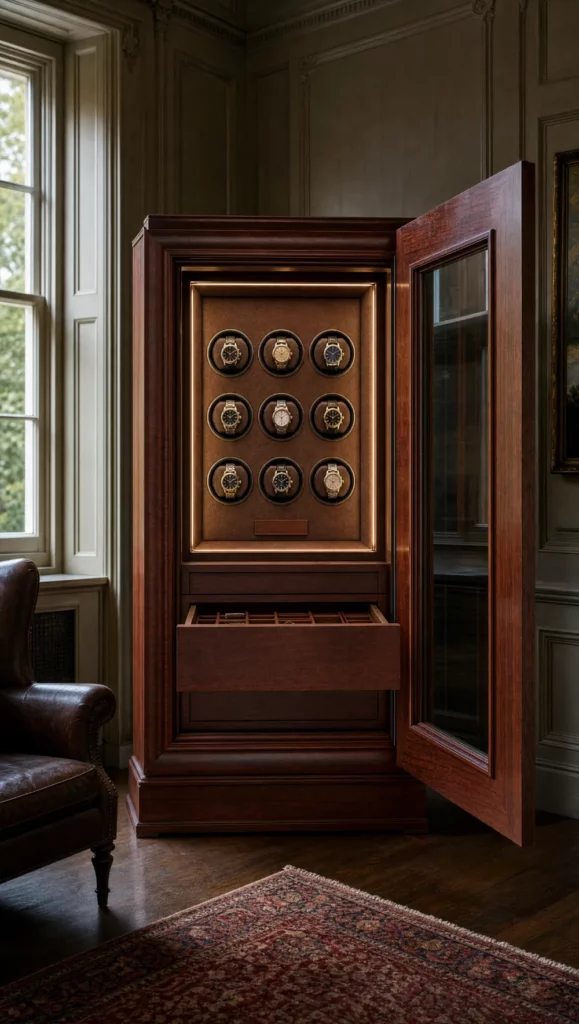
The steel is the part people ask about. The lining is the part they live with.
On this page
Leather, and why it lines everything
Leather lines the panel, the drawer and the interior faces for one practical reason before any aesthetic one: it is the only surface a watch case and bracelet can sit against, be moved across, and be picked off, without the finish suffering.
A polished case will pick up hairlines from almost anything else. Timber is too hard, and an unlined timber interior inside a sealed steel box is also exactly what we will not do — nothing structural inside the steel is timber or composite, which is a deliberate rule.
It also does something to the light. A leather face absorbs rather than reflects, so the watches read against a quiet ground rather than competing with a shine behind them.
Cushions, and the bracelet problem
The cushion is the part most often got wrong in bought winders, and it is easy to see why: it has one job that pulls in two directions.
It has to hold the watch firmly enough that the winder can turn it without the case shifting, and loosely enough that a bracelet is not forced open. A cushion that is too fat splays a bracelet and works the links; one that is too slim lets the watch rotate on the post rather than with it, and the winder does nothing.
It is worth saying plainly that a bracelet sitting stretched over an oversized cushion for years is doing itself no favours, and that is a bought-in-box problem more often than a bespoke one. The cushion wants to suit the pieces that will actually live on it.
Fitted trays and the drawer
Not everything belongs on a winder. Most collections are a handful of pieces that are worn in rotation and a larger number that are not — and the second group wants a lined, tray-fitted drawer rather than a motor.
The drawer underneath is where straps, spare links, papers, a loupe and a spring bar tool live. Fitted compartments rather than one open box, because a drawer of loose straps becomes a drawer nobody opens. Where the collection runs to sets and boxes, the drawer is drawn to them rather than to a standard.
A drawer of fitted trays also costs a fraction of the space and the money that winder positions do, which is the honest answer to how many positions most people need.
Lighting, which is harder than it looks
Three things make interior lighting in a watch safe difficult, and all three are solved at the drawing stage rather than afterwards.
Heat. A light sitting against a watch all day has to run cool. That is a specification decision about the fitting and the driver, not something that can be fixed by turning it down.
Glare. A hard point source behind glass produces a reflection exactly where you want to look. Light from a lit ring around each position, or diffused from the edge, shows the dial rather than the light.
Colour. A neutral white near daylight so that a dial reads at ten at night as it will read at noon. Warm domestic lighting flatters a gold case and lies about a blue one.
And the whole lot runs on a low-voltage supply with the driver outside the safe, in the wall, so there is nothing inside the box to fail and nothing in the room to unplug.
Why it all comes out
The leather-faced panel carrying the winder positions comes out as a unit. That is the single most important decision in the piece, and it is about the next twenty years rather than the first one.
Winder modules are bought in, deliberately — they are small precise motors made by people who make nothing else. In ten years a module will be tired, or the market will have moved, and at that point the panel is unscrewed and the modules changed. No cabinetmaker comes back to the house, no wall is opened, and the piece is not obsolete because its electronics are.
The same thinking applies to the drawer and the trays: made as separate, removable elements dropped into a finished shell, rather than as a carcase the steel was wrapped around.
Questions we are asked
Why is the interior leather rather than timber?
Because a polished case picks up hairlines from almost anything harder, and because nothing structural inside the steel box is timber or composite — that is a deliberate rule. Leather also absorbs light rather than reflecting it, so the watches read against a quiet ground.
Will a winder cushion damage a bracelet?
It can, if it is the wrong size. A cushion that is too fat splays a bracelet and works the links over time; one too slim lets the watch turn on the post instead of with it. It wants to suit the pieces that will actually live on it, which is one of the arguments for having it made.
How many winder positions do most people need?
Fewer than they think. Most collections are a few pieces worn in rotation and a larger number that are not, and the second group is better served by a lined, tray-fitted drawer — which costs a fraction of the space and the money.
Does the interior lighting get hot?
It should not, and it is a specification decision rather than something to turn down. A fitting that will sit against a watch all day has to run cool, and the driver sits outside the safe in the wall.
What happens when a winder module fails?
The leather-faced panel comes out as a unit, so the modules are changed without a cabinetmaker coming back to the house or a wall being opened. That is the whole reason the panel is built to be removable.
Can the drawer be laid out for my own pieces?
Yes, and it is worth doing. Fitted compartments for straps, links, papers and tools rather than one open box — a drawer of loose straps becomes a drawer nobody opens.
Tell us what is actually in the collection
How many are worn, how many are laid up, what is on a bracelet and what is on a strap. That is what decides the split between winder positions and drawer, and it is easier to settle before the drawing than after.
Talk to the workshop Winders, movement and capacity Where a watch safe goes