
Sporting Rooms
Trophy and Display Cabinets
A collection is usually better than the furniture it is kept in. Antlers go on a landing wall because nobody drew anything for them, cased fish sit in a spare room, and forty years of shoot cards live in a drawer. A display cabinet is the piece that fixes that, and almost all of it is decided before anything is cut.
On this page
What the cabinet is actually doing
Three jobs at once, and they pull against each other. It has to show the collection, which wants glass and light. It has to protect it, which wants the opposite of light and a stable, dust-free volume. And it has to look like furniture in a room that already has furniture in it, which is the part that gets dropped first when a cabinet is bought rather than drawn.
Almost every compromise between those three is settled at the drawing stage. We would rather see the collection first, or photographs of it with a tape in shot, than be given a width and a height and left to guess. A cabinet drawn around what is going into it looks composed. A cabinet drawn first and filled afterwards looks arranged, and no amount of cabinetwork rescues that.
The glass
Ordinary float glass carries a green cast. You stop noticing it in a window and you never stop noticing it in front of something you care about, because it sits on exactly the colours that matter — feather, fur, patinated metal, old leather, the olive and brown of a cased trout. Low-iron glass is close to colourless and costs a little more. On a display cabinet it is the single change that makes the most difference, and it is the one most often left out.
Where a piece is valuable, or the room takes strong daylight, we specify laminated glass with a UV-filtering interlayer. Light is what fades a specimen and the damage is cumulative and permanent: nothing brings a bleached hackle or a faded cape back. The interlayer is invisible, it does not change how the piece reads, and it is cheap insurance against the one failure mode you cannot repair.
Glazing bars are a separate decision and a proportional one rather than a technical one. Fewer, heavier bars suit a plainer room; a finer division suits older furniture. They are drawn to the room the cabinet is going into rather than picked from a list, which is the same way we draw the glazed gun cabinets.
The light
Lighting a cabinet from a single point at the top gives you one bright shelf, a shadowed one under it, and a reflection at eye level in the glass. What works is low-heat LED, colour-matched across the whole piece, positioned to graze across an object rather than flood it from in front. Grazing light is what makes texture read — the lie of a feather, the set of a scale, the grain of an antler.
Heat matters more than people expect. An enclosed glazed case with a warm lamp in it will cook a specimen slowly and will drive moisture about inside the volume, which is how a mount dries out on one side and lifts. Run the fittings cool, keep them out of the sealed part of the piece where the design allows it, and switch them on the door or on their own circuit so the lights are off when nobody is looking. The same thinking applies to a whole room, which we set out on lighting, heating and ventilation.
The back
The back of the cabinet decides whether you look at the collection or at the cabinet. There are three honest answers and they suit different things.
- Mirrored. Doubles the apparent depth and shows you the reverse of whatever stands in front of it. Right for glass, silver and anything with a worked back. Wrong for a flat-backed mount, which ends up looking like it is hiding something.
- Fabric-lined. Baize, wool or linen. Kills reflection completely and makes the object the only thing in the frame. It is the usual answer for cased fish, flies, medals and shoot cards, and the colour is chosen against the collection rather than against the room.
- Painted. Quieter still, and the right answer when the cabinet is built into panelling and is meant to disappear into it. A dark painted back behind a pale specimen is the oldest trick in the room and still the best one.
Shelves, and why most of them are wrong
Shelf spacing is where display cabinets fail, and they fail in a drawing office rather than in a workshop. Equal shelves look tidy on a drawing and are close to useless in practice, because collections are not evenly sized. You end up with four inches of dead air above the small things and nowhere at all to stand the tall ones.
Adjustable shelving is the usual answer and it is a compromise rather than a solution: the strips show, they interrupt the lining, and in our experience the shelves are rarely moved after the first fortnight. Given a list of what is going in — or better, the collection in front of us — we set the shelves out properly and fix them. The piece then looks composed rather than arranged, and nothing is standing in a space that was not drawn for it.
A brass shelf edge is worth the money on a cabinet that gets opened. It takes the wear where objects are slid in and out, it catches the light along a front edge, and it stops a soft timber front arris from going grey. On deeper shelves we set the stock out with a gap front and back so air moves round it rather than past the front of it.
Antlers, cased fish and the awkward things
Most of a sporting collection does not sit tidily on a shelf, which is the real reason so little furniture exists for it.
- Antlers and horns want to be carried on the structure, not on a shelf. A mounted head is heavier and further forward than it looks, so the fixing goes back into framing drawn for it rather than into a lining. Lit from above and slightly to one side, so the beams throw a shadow and read as three-dimensional.
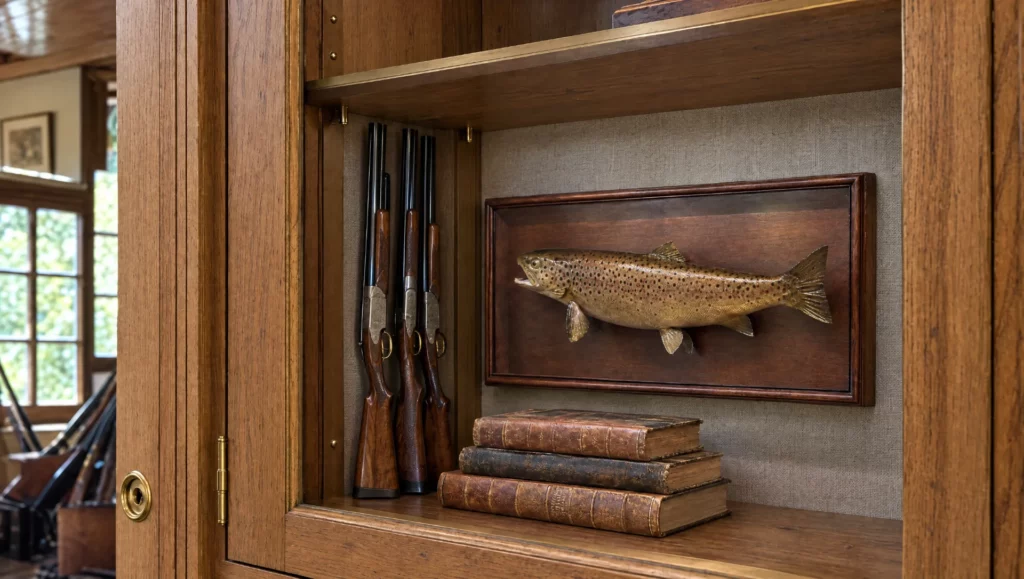
- Cased fish usually arrive in their own case, which is part of the object and should not be stripped out of it. The cabinet is drawn around the case: a rebated recess, a fabric back behind it, and light from in front and above rather than through the old glass, which is rarely flat and will bounce anything you shine through it.
- Flies, medals and cartridge displays are small, flat and best in shallow drawers under the glazed section rather than on a shelf where they read as clutter. Lay-flat drawers with a felt or baize bed, drawn so a tray lifts out and can be looked at on a table.
- Shoot cards, game books and photographs are paper, and paper is the thing daylight destroys fastest. These belong behind a solid panel rather than glass, in the base of the cabinet, and they are the strongest single argument for a cabinet that is glazed above and solid below.
Mounted specimens are organic and they move with the room. A cabinet that is sealed tight and then lit warm is a worse home than an open shelf; what they want is a stable room rather than a stable box. That is a different problem from a humidor, where a sealed volume is the entire point — we have set that out separately under cigar storage.
Where it goes in the room
Three things decide the position, and only one of them is about how it looks.
Daylight. A cabinet on the wall opposite a south-facing window takes the full load of the day whether or not it is in direct sun. If that is where it has to go, the UV-filtering interlayer stops being optional.
Heat. Over a radiator, beside a woodburner or on a chimney breast with a lit fire below are all places where the piece will be dried on one face and not the other. Timber will take that for a while and then tell you about it at a shut line. If the only sensible wall is a warm one, the carcase is drawn for it — back ventilated, panels free to move, and the shelves and lining detailed so nothing is held rigid across its width. That is the same reasoning as quarter-sawing and book-matching.
How you stand in front of it. A cabinet you have to back into a doorway to see properly never gets looked at. Where the room allows it, we would rather the piece sat where there is some distance in front of it, even if that means a shallower carcase.
Finish is chosen the same way as everything else we make. French polish gives depth on mahogany and figured walnut; oil is more forgiving in a working room and can be touched up by hand. Both are covered under finishes, and where a cabinet is going in beside existing furniture our own polisher matches it by eye rather than to a code.
Common questions
Is low-iron glass really worth the extra?
On a display cabinet, yes, and it is the change clients notice first. Ordinary float glass puts a green cast over everything behind it, which lands hardest on exactly the colours a sporting collection is made of. On a glazed door where the point is to see through it clearly, it is the cheapest large improvement available.
Will the light fade my specimens?
Daylight will, and the damage is cumulative and cannot be reversed. Laminated glass with a UV-filtering interlayer deals with most of it. Cabinet lighting is a smaller risk if it is low-heat LED, run cool and switched off when the door is shut; the greater danger from a fitting is heat rather than light.
Can you build around a case or mount I already own?
That is the usual way we work. Old cases are rarely square and almost never a standard size, so the cabinet is drawn to the object rather than the object trimmed to the cabinet. We would want to measure it, or have photographs with a tape in shot, before anything is drawn.
Fixed shelves or adjustable?
Fixed, if you can tell us what is going in. Adjustable shelving is there for the case where nobody knows, and the price of it is visible strips, an interrupted lining and shelves that in practice never get moved. Where a collection is genuinely still growing we will draw one bay adjustable and fix the rest.
Can a display cabinet be locked?
Yes, and on a valuable collection it should be. A lock on a glazed door is a deterrent rather than security, because the weak point is the glass and not the lock. Where the contents warrant more than that, the answer is laminated glass and a properly drawn door that pulls onto its frame, which is the same thinking we use on security glass and locking. Where firearms are to be kept inside, that is a separate conversation and a different piece of furniture: see gun cabinets.
Can it match furniture we already have?
Matching an existing piece is a large part of what the workshop does. Timber is selected for grain and colour, mouldings are copied properly rather than approximated, and the polish is matched by eye by the person who applied it. It is the last ten per cent of the job and the reason the finishing shop is on site.
Show us the collection
Bring a list, or photographs with a tape in shot, and we will draw the cabinet around it. Visits to the Mickfield workshop are by appointment, and we will show you drawings, timber samples and references for completed work in person.