
Sporting Rooms
Boot Rooms and Dog Rooms
The boot room takes more punishment than any other room in a sporting house, and it is usually the one drawn last. It is wet, it is muddy, the dogs live in it, and it still has to look like the rest of the house.
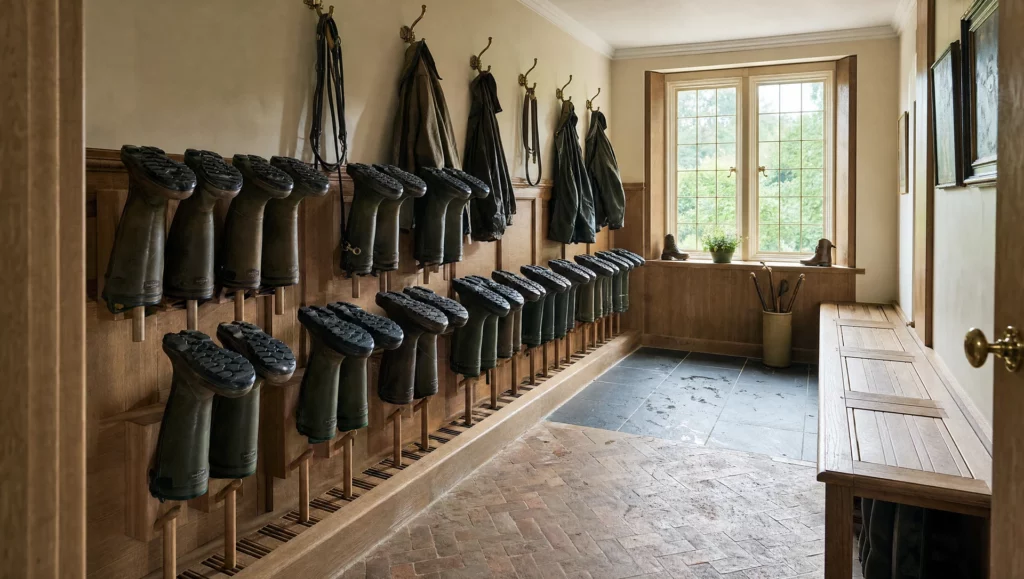
This is how we set one out: which end is allowed to be wet, how things dry, what the dogs get, and which finishes survive being wiped down every week. Most of it is ordinary joinery thinking applied to a room that rarely gets any.
On this page
Start with where the water goes
Everything in a boot room sits downstream of one decision: which end is allowed to be wet. Put the outside door, the fall of the floor and the route the dogs take in from the garden at the same end, and keep the dry storage — clean coats, hats, anything going back into the house — as far from it as the room allows. A boot room that mixes the two is the reason coats never dry and the room always smells.
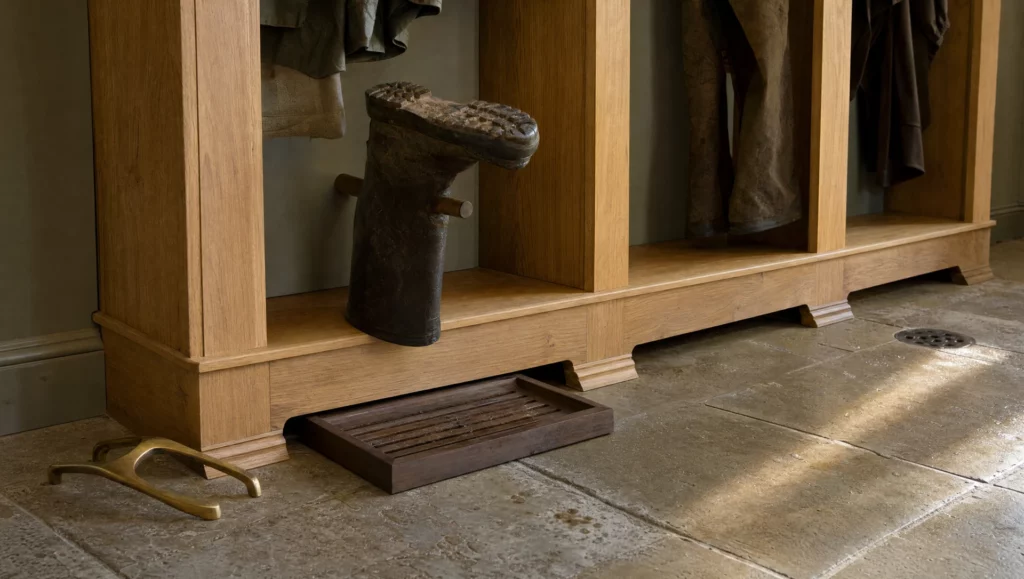
The floor matters more than the joinery. Stone or tile with a fall towards a gully, or at least towards the door, forgives a great deal. Where the floor cannot be changed, we lift the cabinetwork clear of it so water is never standing against the end of a carcase.
Boots off the floor
Boots dry from the inside, and they only do that if air can get into them. A slatted shelf, open front and back, does more than any cupboard door. Wellingtons want to stand upright or hang upside down rather than lie in a heap, and shooting boots want space around them.
A bench over the boot storage gives somewhere to sit and pull, and a boot jack fixed to the floor at the end of it saves the paintwork. We generally make the bench top liftable so the space underneath can be swept out properly rather than raked at.
Coats that actually dry
A peg rail beats a wardrobe rail for wet things, because the coats hang apart instead of pressed together. Two heights, where the room allows it, keeps a long coat off the floor and puts something within a child’s reach.
Air has to move. A wet coat in a closed cupboard is still wet in the morning. If the room has a radiator or a warm wall, the coats belong near it and the dry storage does not. Where there is no heat at all, we leave the coat run open and put the doors on the things that actually need hiding.
A bed built in, not bought
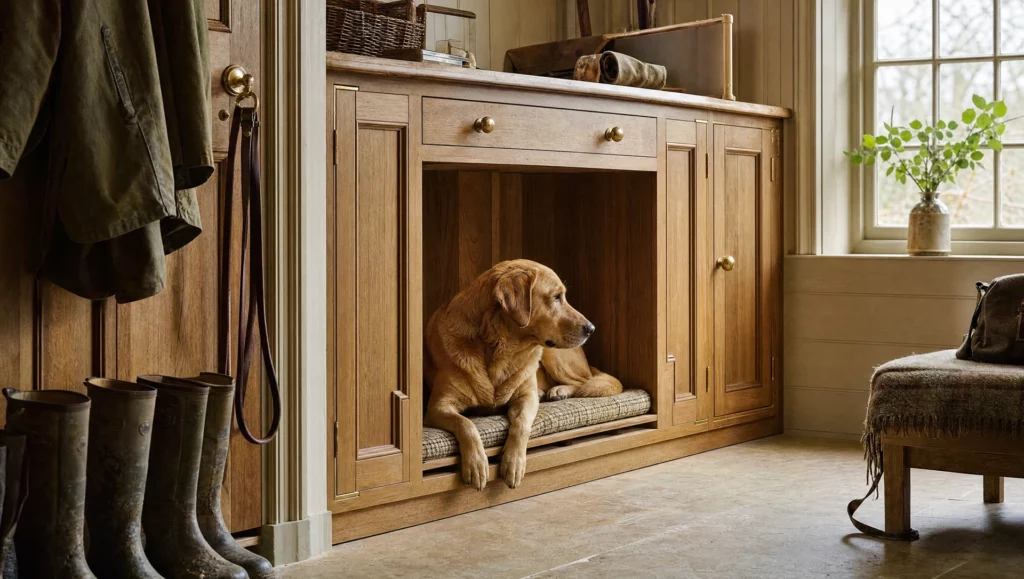
A bed built into the run of cabinetry is the part of a boot room people are most pleased with afterwards. It puts the dog in the room with everybody rather than behind a gate somewhere, and it stops a plastic bed being shunted round the floor.
Three things matter. The opening has to be generous enough that an older dog can get in and out without contorting. The base has to lift or slide out so the whole thing can be washed rather than wiped at. And the sides have to be solid enough to be leaned on, because they will be. We draw it round the dog you actually have — a spaniel and a labrador do not want the same opening — so tell us the breed and the age rather than a size.
Leads, towels and the rest of it
The small things decide whether a boot room works. Leads on hooks inside a door rather than on the peg rail among the coats. A drawer for towels at the dog end and another for collars, whistles and everything that otherwise lives on the windowsill. Feed in a lidded bin inside a cabinet, not a bag on the floor.
None of that is difficult. It is a matter of deciding where each thing lives before the joinery is drawn, rather than afterwards when it is already fitted.
Finishes that take a wet cloth
A boot room gets wiped down, so the finish has to be one that can be. Painted work suits the room and can be touched in where a boot has caught it. Oak carries the wear and shows less of it. Either way the finishing is done in our own shop, on the same benches as everything else, so a boot room drawn alongside a kitchen, a library or a gun room matches it properly rather than approximately.
Questions we are asked
Can a built-in dog bed be washed out?
Yes, if it is drawn that way from the start. We make the base removable and keep the inside as one wipeable surface rather than a set of corners that collect hair.
Painted or timber?
Both work. Painted joinery is easier to touch in after a knock; oak hides wear rather than showing it. A good many boot rooms end up as painted carcases with an oak bench top and an oak dog bed.
Do you make boot rooms on their own?
Yes. Some start as part of a larger job and some do not. Either is fine.
What do you need from me to start?
A plan of the room with the doors and windows marked, a note of which end the dogs come in at, and the breeds. Photographs of the floor help more than you would think.
What does a boot room cost?
It depends on the length of the run and how much of it is fitted. Our guide prices are set out on the prices page, and we will put a figure against your room once we have seen a plan.
A boot room drawn round your dogs
Send a plan of the room, tell us which end is wet and which dogs use it, and we will draw it from there.