
Rods, Reels and Lines: Storing Fishing Tackle Properly
Nothing here needs a lock. Everything here needs air, support and darkness, and almost every ruined rod we are shown was ruined by being stored badly rather than by being fished hard.
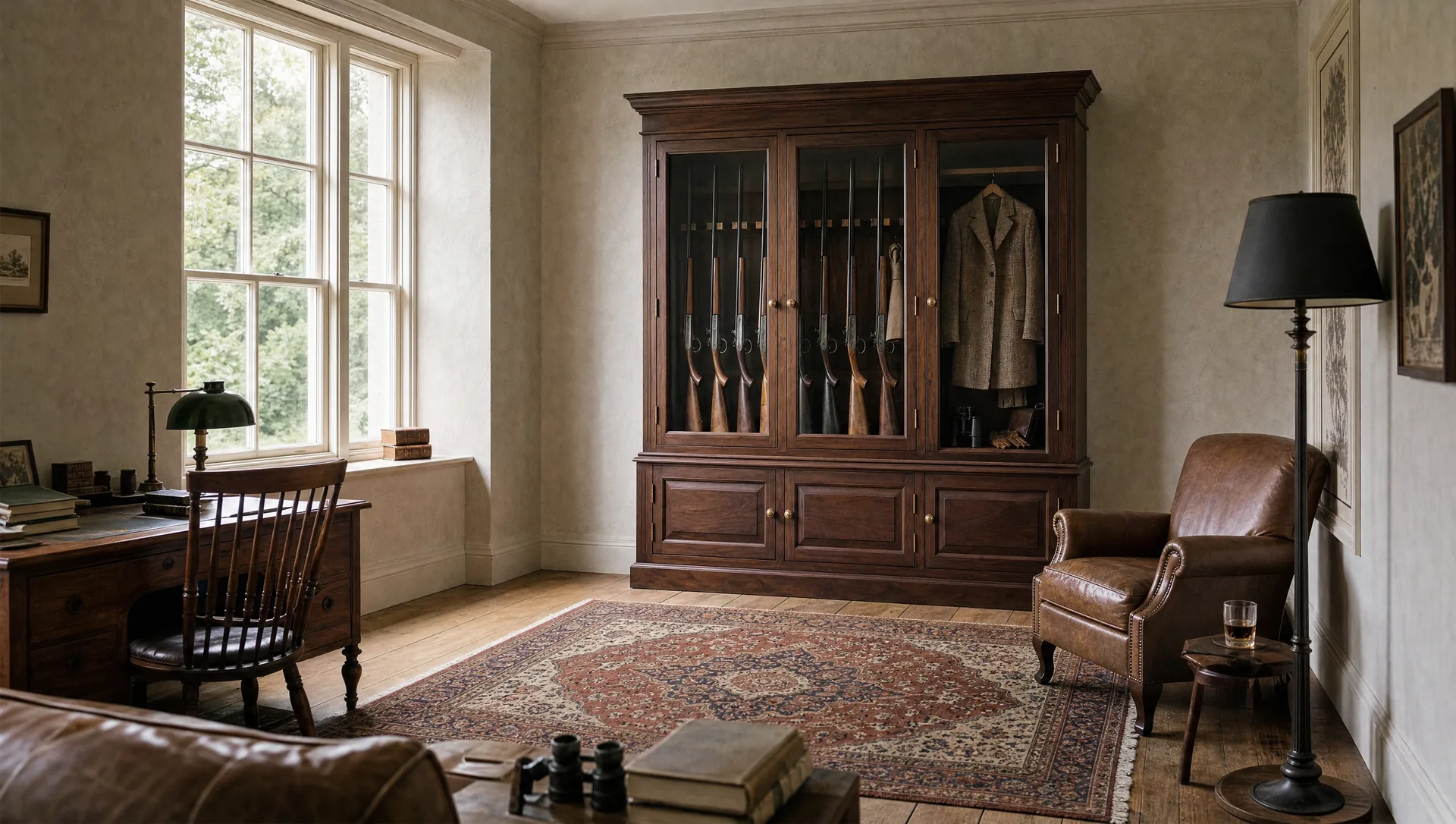
Fishing tackle usually ends up wherever the guns are not, which tends to mean a garage, a loft or the back of the boot room — the three worst places in the house for it. This page is what we build instead, and why.
On this page
Rods: how they actually fail
Three ways, in order of how often we see them.
Leaning in a corner. A rod stood on its butt against a wall takes a permanent set over years, and the tip section is the part that suffers. Cane is worst, but modern blanks are not immune.
Stored damp. Put away after a wet day, in a bag, in an unheated space, and the ferrules corrode, the whippings go, and the varnish lifts. Cork handles go black and soft, which is almost impossible to reverse.
Stored hot. A loft in August is a place where glue lines and varnish are quietly punished, and where anything with a cork handle dries out and shrinks away from the blank.
The answer to all three is the same: horizontal or vertical but properly supported at more than one point, in a room the house heats, with air moving round it.
Bags and tubes are for travelling, not for storing
A cloth bag inside an alloy tube is exactly the right thing for a car boot and exactly the wrong thing for eleven months of the year. Both hold moisture against the rod. Anything that goes away wet goes away for good.
Dry the rod, dry the bag separately, and store the rod out of both if you can. Where clients want tubes on show — and a rack of them looks well in a sporting room — we build the rack so the tubes sit open-ended and horizontal with the caps off.
Reels
Rinse anything that has been in salt water, and rinse it properly rather than wiping it. Dry it before it goes anywhere. Back the drag off before it is put away, because a drag left wound up compresses the washers and they take a set.
Reels want a shallow drawer with a soft lining and individual compartments so they are not knocking against one another. Cased reels can live in their cases provided the case is dry — the felt lining in an old block-leather case holds damp beautifully, which is not a compliment.
Lines and leaders
Fly lines dislike three things: heat, ultraviolet light and being left under tension on a small-diameter spool. Store them out of sunlight, out of a hot space, and loosely wound. A line coiled tight on a small arbour for a winter takes memory and never quite loses it.
Monofilament degrades with time and light whatever you do. Date it when you buy it, keep it dark, and be ruthless about throwing out anything of uncertain age before a trip that matters.
Flies, and the moth problem
Everything worth eating in a fly box is natural: fur, feather, wool, silk. Clothes moth will find it, and a tightly closed box of damp flies will corrode hooks as well.
Let flies dry properly before they go back in the box. Keep boxes somewhere ventilated rather than sealed. Cedar in the drawer helps and does no harm; the old-fashioned alternatives are effective and unpleasant to live with. And look through the boxes in the close season rather than discovering the problem on the riverbank.
The single best thing you can do: move the tackle out of the garage or the loft and into a heated part of the house. Everything above is detail by comparison.
Building it into a room
Where a client has a boot room, a back corridor or a sporting room, tackle storage sits naturally alongside gun storage and is made from the same frames, the same rails and the same paint. What differs is the internal fit-out.
| Element | What it needs |
|---|---|
| Rod storage | Full length where the room allows — a tall cupboard rather than a rack, with supports at two or three points and a soft-lined cradle at the butt. |
| Reel drawers | Shallow, lined, divided, on runners rated for the weight of a dozen reels. |
| Fly boxes | Shallow trays with a lip, not deep drawers where boxes stack and are forgotten. |
| Waders and nets | Hanging, ventilated, with slatted doors so damp has somewhere to go, and a floor that can be mopped. |
| Ventilation throughout | Slatted or louvred rather than sealed. Sealed is what ruins things. |
None of this needs to be locked, which means it can be far more open and better ventilated than gun storage — and it means the two can sit side by side in one run of joinery without the tackle side having to pretend to be a safe.
If it is going in the same room as the guns
Tell us at the drawing stage. Rods decide the height of a cupboard and waders decide the ventilation, and both are much easier to design in than to add. Send a photograph of the room and a list of what you own.