
Watch Storage
Watch Winders and Watch Safes
A collection that never leaves the house still has to live somewhere. We build wall-recessed watch safes and freestanding winder cabinets in the same workshop, and to the same standards, as our gun cabinets: a steel box nobody is getting into, wrapped in joinery you are happy to have on the wall of a dressing room.
Most watch storage sold in this country is one of two things. It is either a piece of furniture with a winder dropped into it, which looks well and offers no security at all, or it is a safe, which is secure and looks like a safe. Neither is much use if the watches are worth more than the car and the room they sit in is a panelled dressing room rather than a strongroom.
What we make is the third thing. The security box is folded and welded steel with no timber or composite anywhere inside it. The part you see is cabinetwork: a worked surround, leather lining throughout, a drawer of fitted trays, and 42 mm switchable security glass so the watches are on display when you want them to be and invisible when you do not.
The range
Five pieces, from a compact safe let into the wall of a dressing room to a grand cabinet standing in the room. Every one is drawn to its own site, so the range below is a set of starting points rather than a catalogue: the number of winder positions, the depth of the drawer and the proportions of the surround are all settled at the drawing stage. All five are shown with nine winder positions, which is the number most collections settle on, and all five are made in any of our timbers or hand-painted. Press play on any of them to see the door and drawer open.
The Butley — compact wall-recessed safe
The smallest of the five, and the one that disappears most completely. Built into a wall or the back of a wardrobe run and fixed back to masonry, with only the leather-faced door and the glass showing. Nine winder positions on a lit, leather-faced panel, with one lined drawer beneath for straps, papers and the pieces that are not on winders.
For a dressing room where the wall can take it and you would rather nobody knew the safe was there at all.
The Sudbourne — wall-recessed safe
The same recessed construction as the Butley with more depth behind it: a deeper carcase, a fuller drawer, and room to grow the winder face if the collection does. The door is leather-faced around 42 mm security glass, hung on internal welded hinges, and the whole thing sits proud of the plaster by the thickness of its surround.
This is the format the safe on our construction page was drawn and built to.
The Bawdsey — slim freestanding cabinet
For rooms where there is no wall to build into, or where the piece is meant to be seen rather than hidden. A narrow standing cabinet on a plinth, glazed door, lit winder face, and a wide drawer under it divided into compartments for watches laid flat.
Shown in oak. It takes very little floor and sits comfortably against panelling or in an alcove.
The Rendlesham — freestanding cabinet with storage
Taller and deeper than the Bawdsey, with proper storage under the winder face — a lined and divided drawer over a cupboard, for boxes, papers, spare bracelets and everything else a collection accumulates.
Shown in dark walnut. The right piece where the watches are one part of a dressing room being fitted out properly.
The Orford — grand cabinet
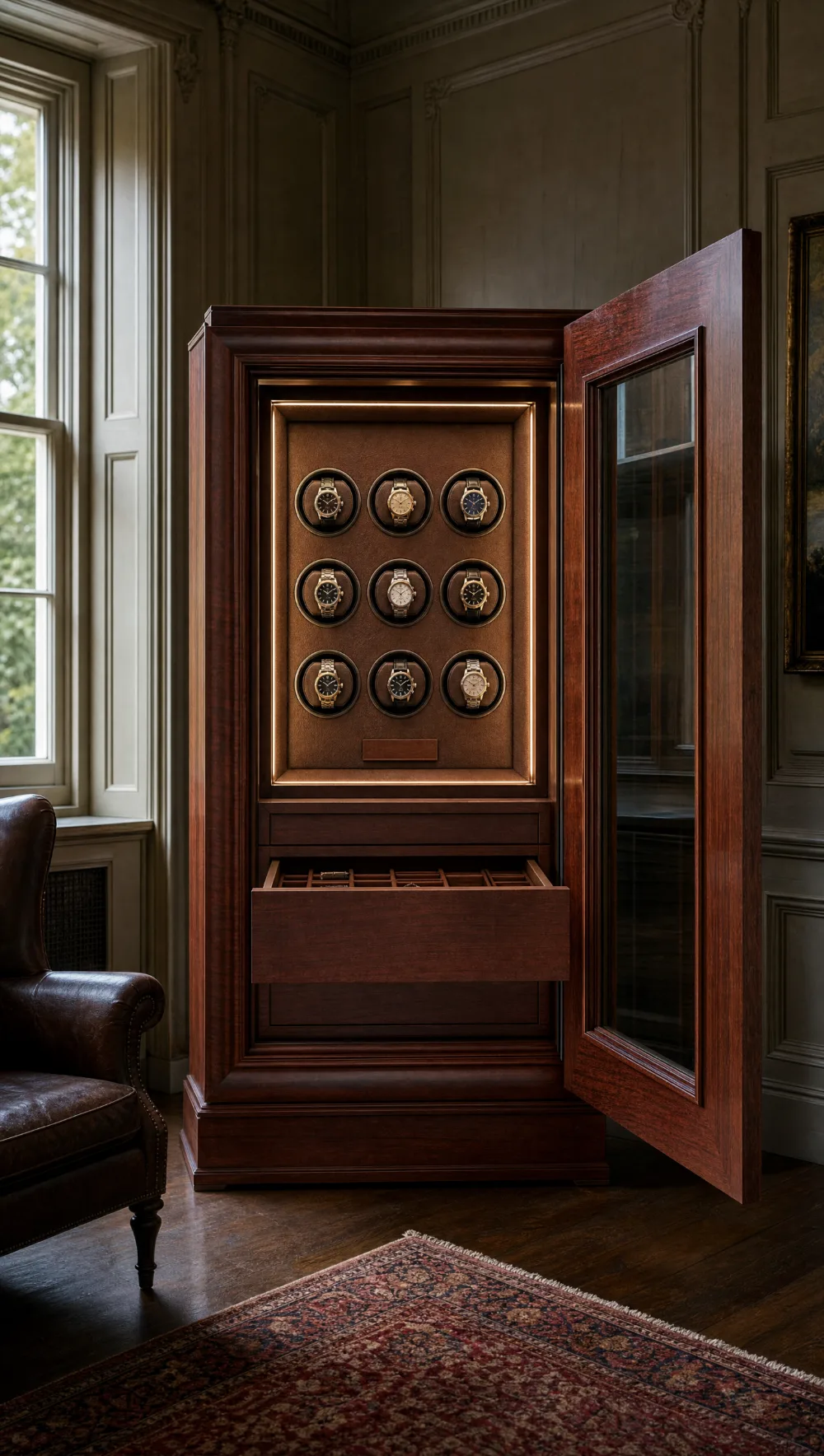
The largest and the most worked. A moulded and mitred surround, a deep lit reveal around the winder face, a heavy glazed door and a fitted drawer below. Made to stand in a library or a bedroom as a piece of furniture in its own right, with the security built in behind it rather than announced.
Shown in mahogany. This is the one to specify when the cabinet is going to be looked at as much as used.
And the sixth option
If we are already making the wardrobes or the panelling, the watches do not need a cabinet at all. Leather-lined, tray-fitted drawers can be worked into the run we are building, with or without winders and with or without a steel liner behind them, so the storage disappears into the joinery entirely.
Every one is bespoke
The number of positions comes from the collection, the aperture comes from the wall, the timber and the finish come from whatever else is in the room, and the locking comes from a conversation about how the house is run and what the insurer has asked for. Everything is drawn before anything is cut, and drawn twice: once in CAD, and again full size as a rod on the bench.
Where a room is being panelled or the wardrobes are being made at the same time, the safe is drawn into that work rather than added to it afterwards, and the surround is cut from the same boards as the panelling so the grain and the colour run through.
Read further
- How a watch safe is made — the steel carcase, the timber surround, the leather and the drawer.
- Security, glass and locking — bolts, keypads, monitoring, and glass that turns opaque.
- Winders, movement and capacity — how many positions, how they turn, and what they need.
Talk to the workshop
Tell us roughly what the collection is, where it is going to live and whether there is a wall we can build into. We will tell you what is sensible before anyone draws anything.
Watch safes are made on the same bench as the gun cabinets, in the same timbers and finishes, and can be drawn to match joinery already in the house. How a commission works · Prices and lead times
Questions we are asked
How is a watch safe different from a winder cabinet?
Most watch storage sold in this country is either a piece of furniture with a winder dropped into it, which looks well and offers no security at all, or a safe, which is secure and looks like a safe. What we make is the third thing: a folded and welded steel box with no timber or composite anywhere inside it, wrapped in cabinetwork you are happy to have on a dressing room wall.
How many winder positions do you fit?
All five pieces are shown with nine winder positions, which is the number most collections settle on. The number of positions, the depth of the drawer and the proportions of the surround are all settled at the drawing stage, because every piece is drawn to its own site.
Can it be made to match joinery already in the room?
Yes. All five are made in any of our timbers or hand-painted, and where we are making the wardrobes or the panelling in the same room the surround is cut from the same boards so the grain and the colour carry through.
Where a watch safe goes — recessed or freestanding, what the wall has to be, and what your builder needs to know.
Leather, trays and lighting — what the inside is made of, and why the whole panel lifts out.