
Cigar Storage
Humidity, Seasoning and Holding Sixty-Eight
A humidor is a sealed volume with a job: hold sixty-eight to seventy per cent relative humidity through a Suffolk winter with the heating on and a July week with the windows open. Almost everything that makes that work is decided before the cabinet is made, and the rest is the fortnight after it arrives.
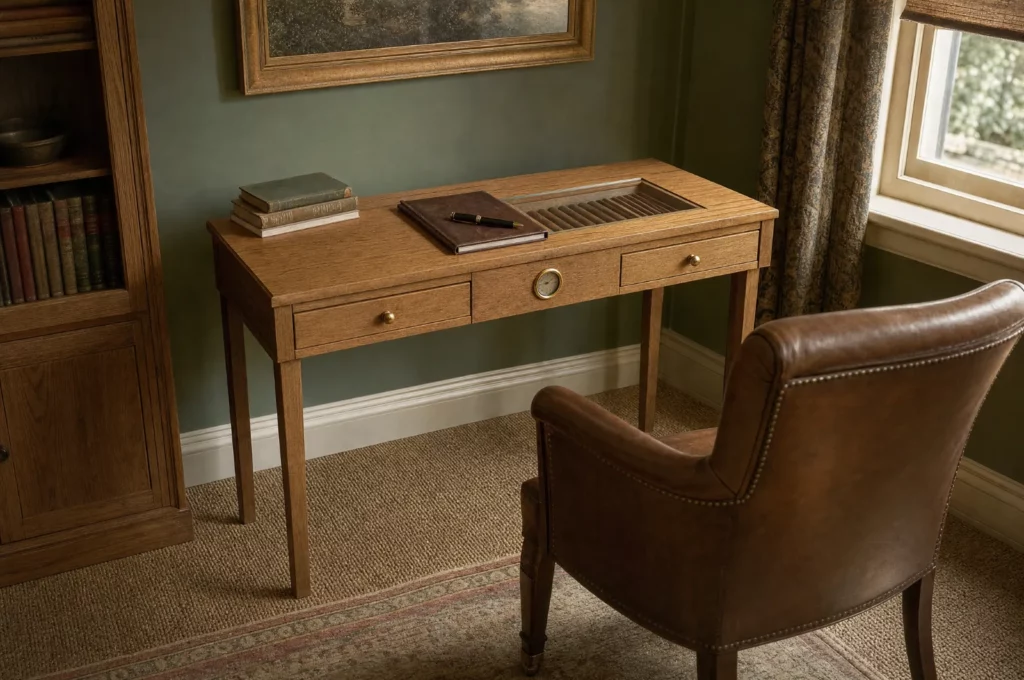
Most humidors that fail do not fail because the humidification is wrong. They fail because the volume was never sealed properly, or because the cedar was fixed in a way that stops it moving, or because nobody seasoned it and the lining spent its first three months drinking everything the humidifier produced.
On this page
Why sixty-eight to seventy
A cigar is a hygroscopic thing: it takes moisture from the air around it and gives it back, continuously, trying to reach equilibrium with wherever it is. The number matters less than the steadiness, which is the part most people have backwards.
Too dry and the wrapper shrinks faster than the filler, which is what splits a wrapper. The burn goes hot and fast and the flavour goes with it. Too wet and it will not draw, the burn tunnels or goes out, and you are into mould territory somewhere above about seventy-five.
But a cabinet that sits steadily at sixty-five will keep cigars in better condition than one that swings between sixty-two and seventy-four every time the heating comes on. It is the movement that does the damage — the wrapper and the filler expand and contract at different rates, and every cycle works the join between them.
So the design problem is not hitting a number. It is building a volume stable enough that the number stops moving.
Seasoning a new cabinet
New cedar is thirsty. A cabinet that has just been made and delivered will pull moisture out of the air for weeks, and if you fill it with cigars on day one the cigars are what it pulls from.
Seasoning is the process of letting the lining reach equilibrium before anything goes in. It is slow, it is dull, and skipping it is the single commonest reason a good cabinet performs badly in its first season.
- Put the humidification in, empty, and close the cabinet.
- Leave it. Check it every few days rather than every few hours.
- The reading will climb, then fall back as the cedar takes it up, then climb again. That cycle repeating with a smaller swing each time is what you are waiting for.
- When it holds steady for several days without intervention, it is seasoned.
- Fill it gradually rather than all at once, and expect the reading to move again as the cigars themselves come to equilibrium.
Do not wipe the cedar down with water, and do not stand a dish of water in it. Wetting cedar directly raises the grain, can spot it, and puts liquid water somewhere you have spent a great deal of effort keeping water vapour under control.
Passive and active, and which you need
Passive humidification is a medium — a gel, a bead or a two-way pack — that holds at a set humidity and exchanges with the air around it. It has no moving parts, nothing to fail and nothing to power. Its limitation is capacity: it can only give up moisture at a certain rate, so in a large volume, or one that is opened often, it cannot keep up.
Active humidification adds air movement and a reservoir, and it can hold a larger volume against a bigger difference. It needs power, it needs filling, and it needs to be reachable for maintenance without dismantling anything — which is a joinery decision, not an equipment one.
The rule of thumb we work to is that a table or a small cabinet runs passively and is happier for it, and anything at full-height cabinet scale or above wants active humidification with a plenum so that air moves around the stack rather than past the front of it. On the pieces we draw, the Stonham runs passively and the Framlingham splits — a passive display bay over an actively humidified cabinet, sealed as two independent volumes with a vapour break between them.
Temperature, which nobody mentions
Relative humidity is relative to temperature, which is why a cabinet can hold a perfect reading and still be wrong. Warm the same air and the relative humidity falls; cool it and it rises, and at some point it reaches dew point and you have water on a cold surface inside a sealed box.
In practical terms: keep the cabinet out of direct sun, off an external wall where you can, and away from a radiator, a flue or underfloor heating. A room that swings ten degrees a day is a harder problem than a room that is slightly too warm and steady.
The cold-surface point is why a walk-in room needs continuous insulation and a properly detailed vapour control layer, and why a glazed vision panel in one is double or triple glazed with a warm edge. A single sheet of cold glass in a humidified volume is a dehumidifier with a handle on it.
Reading a hygrometer honestly
Most cheap hygrometers are wrong, and most of them are wrong in the same direction. Calibrate before you trust a reading, and calibrate again once a year.
The other thing worth knowing is that one reading is one point in one place. A tall cabinet is not uniform — the top will read differently from the bottom until the air is moving properly, and if it keeps reading differently that is telling you the air is not moving, which is a design fault rather than a humidification fault.
What changes across the year
| Season | What the room does | What the cabinet feels |
|---|---|---|
| Midwinter, heating on | Room humidity falls, often to the thirties | Steepest gradient of the year; passive systems run out fastest |
| Spring and autumn | Room sits closer to the cabinet | Easiest months; least intervention |
| High summer, windows open | Room humidity climbs, temperature swings | Less demand on humidification, more risk of a temperature spike |
| Any season, house empty and unheated | Temperature falls, relative humidity climbs | Condensation risk on any cold surface inside the sealed volume |
A cabinet that needs constant attention in January and none in May is behaving normally. A cabinet that needs constant attention in May is telling you the seal is not doing its job.
When something is wrong
- Reading will not climb. Usually the seal, not the humidification. Check the door pulls onto its seal all the way round rather than closing near it.
- Reading climbs then collapses overnight. Temperature swing, or a volume being opened more than you think.
- Top and bottom read differently and stay different. Air is not circulating; the stack is packed too tight or there is no gap front and back.
- Cigars draw badly but the reading is right. Check the hygrometer against a calibration before you change anything else.
- A musty smell rather than a cedar smell. Stop, take everything out and get it looked at. That is the one to act on quickly.
Questions we are asked
What humidity should a humidor hold?
Sixty-eight to seventy per cent relative humidity is the usual target, but steadiness matters more than the exact figure. A cabinet holding sixty-five without moving will keep cigars better than one swinging between sixty-two and seventy-four.
How long does seasoning take?
Until it holds steady without intervention for several days, which is a matter of weeks rather than days. The reading will climb, fall back as the cedar takes it up, then climb again with a smaller swing each time — that settling is what you are waiting for.
Should I wipe the cedar with water to season it?
No. Wetting cedar directly raises the grain, can spot it, and puts liquid water inside a volume where the whole design effort is about controlling water vapour. Season with the humidification itself, empty, and be patient.
Do I need active humidification?
A table or a small cabinet is usually better passive — nothing to power, nothing to fail. Anything at full-height cabinet scale or above generally wants active humidification with a plenum, so air moves around the stack rather than past the front of it.
Why does my cabinet read differently at the top and the bottom?
Air is not circulating. Either the stack is packed too tightly or there is no air gap front and back. A persistent difference is a design fault rather than a humidification one.
Can a humidor sit against an outside wall?
It can, but it is the harder place to put one. Cold surfaces inside a humidified volume are condensation sites. Away from direct sun, radiators and underfloor heating is worth more than any equipment you can add.
Tell us the room before the cabinet
Where a humidor goes decides more about how it performs than what goes inside it. Send a photograph of the room and roughly what you want to keep in it.
Talk to the workshop Cigar cabinets and humidor tables Walk-in cigar rooms
Cedar, and what it actually does — why the lining buffers, and why sealing it ruins that.
Ageing cigars at home — what a stable cabinet lets happen over years, and how to lay cigars down.