
Cigar Storage
Cedar, and What It Actually Does
Spanish cedar is not a decorative lining. It is a working part of the humidor, and almost every way a cabinet can be got wrong is a way of stopping the cedar doing its job.
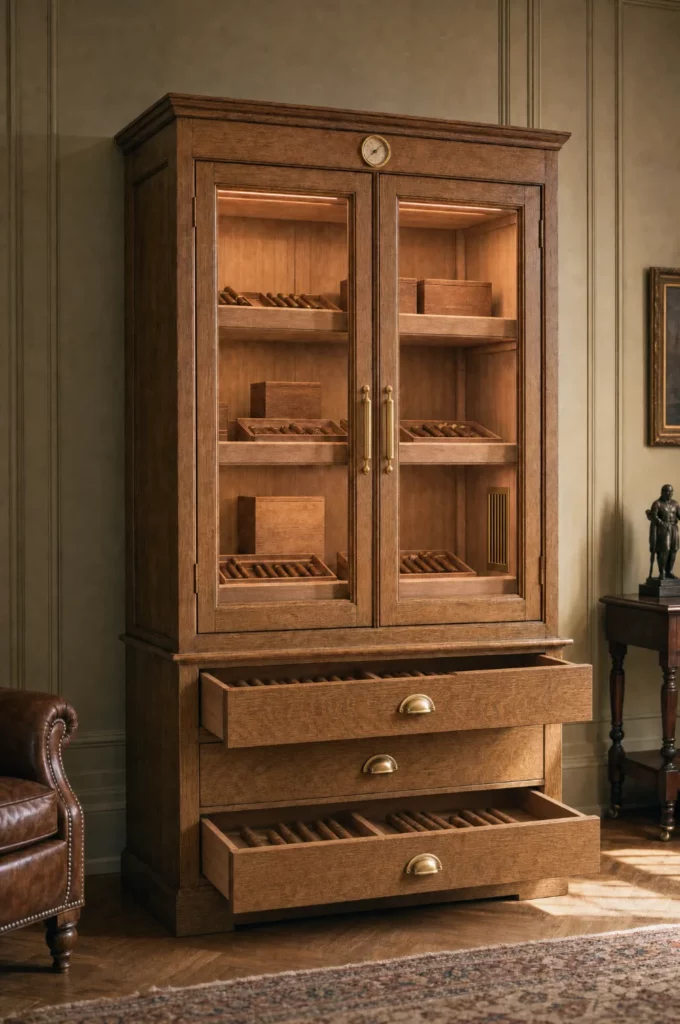
People think of the cedar as the smell. It is doing three things at once, and the smell is the least important of them.
On this page
The three jobs
It buffers. Cedar is hygroscopic: it takes moisture up when the air is wetter than it is and gives it back when the air is drier. A cedar-lined volume therefore resists change in a way a lacquered box cannot. Open the door for a minute and the reading recovers, because the lining has a reservoir in it. That buffering is most of why a well-made humidor holds steady between interventions.
It deters. The aromatic oils in cedar are unattractive to the beetle that ruins a collection. It is not a guarantee and it is not a substitute for buying carefully, but it is one of the reasons cedar rather than something inert.
It contributes. The aroma does transfer, slowly, and most people want it to. It is the reason cigars kept in cedar for a year taste of somewhere rather than of nothing.
Which cedar, and why not the other one
Spanish cedar is not a cedar and is not Spanish. It is a tropical hardwood in the mahogany family, and it is the timber the trade has used for cigar storage for two centuries because it does the three jobs above without doing anything unwanted.
Aromatic red cedar — the one used for moth-proofing a wardrobe or lining a blanket chest — is a different timber entirely, far more strongly scented, and it will overwhelm a cigar rather than complement it. It belongs in a linen press, not a humidor.
We line in solid Spanish cedar. Not veneered board, not a cedar-faced panel: solid, because the buffering depends on the thickness of timber available to take moisture up, and a veneer has almost none.
Fixing it so it can move
This is where most humidors fail, and it fails quietly over the first two winters rather than on delivery.
Cedar that is buffering moisture is cedar that is moving. It has to be conditioned before it is fixed, so it goes in at roughly the moisture content it will live at, and it has to be hung so it can expand and contract — not glued rigid to a substrate that will not move with it. Fix it hard to a stable board and one of two things happens: the cedar cups and lifts, or it splits along its length. Either one breaks the seal you spent the rest of the money on.
It is the same discipline as any solid timber panel in a frame, and it is the reason a humidor is a joinery problem rather than a cabinet-fitting problem.
Why nothing goes on it
The lining is left unfinished. No lacquer, no oil, no wax, no sealer.
A finish is a barrier, and a barrier is exactly what you do not want on the one surface whose job is to exchange moisture with the air. Seal the cedar and you have turned a working lining into decoration, and the cabinet will hold humidity far worse while looking as though it should hold it better.
It also means the cedar smells of cedar because it is cedar, not because anything has been sprayed on it. If a humidor smells of solvent, something has gone on the lining that should not have.
Trays, runners and air gaps
Everything inside the sealed volume follows the same rule: cedar, or nothing.
Trays run on cedar runners with a few millimetres of clearance. There are no metal runners inside a humidified volume — metal is a cold surface and a cold surface in humid air is where condensation forms. Sliding trays sit at working height for singles, open shelving above takes standing factory boxes, and deeper storage low down holds what is being laid down and not touched.
Air gaps front and back matter as much as the lining. Pack a cabinet tight against its back and the air moves past the front of the stack rather than around it, and the top and bottom of the cabinet will read differently from each other for ever. On the actively humidified pieces we build the rear plenum and a twenty millimetre gap at every level are there to stop exactly that.
How it ages, and when to do something
Cedar darkens from pale straw toward a deeper honey over several years, and it loses aroma slowly as the surface oils give up. Both are normal and neither needs action.
What does need action: a musty smell rather than a cedar one, any white bloom, or a lining that has visibly cupped or opened a gap. The first two mean stop and get it looked at. The third means the lining was fixed rigid, and it is a repair rather than a maintenance job.
Where the aroma has genuinely faded after many years, a very light sanding with a fine paper exposes fresh timber and brings it back. Nothing wet, nothing applied afterwards.
Questions we are asked
Is Spanish cedar actually cedar?
No. It is a tropical hardwood in the mahogany family, not a true cedar and not Spanish. It has been the trade’s timber for cigar storage for two centuries because it buffers humidity, deters beetle and contributes aroma without overwhelming anything.
Can I line a humidor with the cedar used in wardrobes?
No. Aromatic red cedar is a different timber and is far more strongly scented — it will overwhelm a cigar rather than complement it. It belongs in a linen press.
Should the cedar be sealed or oiled?
Never. A finish is a barrier, and the lining’s whole job is to exchange moisture with the air. Sealing it turns a working lining into decoration and the cabinet holds humidity worse while looking as though it should hold it better.
Why solid cedar rather than a cedar-faced panel?
Because the buffering depends on how much timber is available to take moisture up. A veneer has almost none, so a veneered lining looks right and behaves like a lacquered box.
My lining has cupped or opened a gap — what happened?
It was almost certainly fixed rigid to a substrate that does not move with it. Cedar that is buffering moisture is cedar that is moving, so it has to be conditioned before fixing and hung so it can expand and contract. That is a repair rather than maintenance.
Can I bring the smell back after years?
Usually, with a very light sanding with a fine paper to expose fresh timber. Nothing wet and nothing applied afterwards.
Lining an existing cabinet
We are asked fairly often to line something that already exists. Sometimes it is the right answer and sometimes the carcase will never hold a seal, and we would rather say so than take the work. Send photographs and we will tell you which it is.
Talk to the workshop Humidity and seasoning Walk-in cigar rooms