
Guides
Oak, Walnut or Mahogany: Choosing a Timber
The timber decides more about how a cabinet ages than any other choice you will make, and most of that is settled before a board is cut. This is how the four we use actually behave, and which one suits which room.
People usually arrive at this decision from the wrong end — a photograph of a finished piece, in somebody else’s light, at somebody else’s stage of ageing. Timber does not stay where the photograph caught it. Walnut lightens. Cherry darkens. Oak goes from the colour of a new floor to the colour of an old one over about a decade, and it does it whatever you put on it.
So the question is not which looks best now. It is which will look right in the room in fifteen years, against the floor and the panelling that are already there.
On this page
Before the timber: how the board was cut
This matters more than the species. A log can be cut straight through, board after board, which is fast and wastes almost nothing. Or it can be cut radially, so the growth rings meet the face of each board at a steep angle. The second is quarter-sawing. It wastes a great deal more timber, takes longer and costs more, and it buys two things.
Stability. Timber moves across its width as humidity changes, and quarter-sawn boards move roughly half as much as through-and-through ones. On a wide door in a house with underfloor heating and a dry winter, that is the difference between a shut line that holds and one that opens.
Figure. In oak, quarter-sawing exposes the medullary ray — the silvery flecking across the grain that people recognise in good English oak without knowing its name.
Everything below assumes quarter-sawn stock and boards kept together from the same log, because that is what we work to. How we select and set out timber covers the rest of it, including book-matching.
Oak
English oak, quarter-sawn, is the default and it is the default for good reasons. It is hard, it is stable once it has been dried and acclimatised properly, it takes a wax or an oil beautifully, and it is the timber most English houses are already full of — so a cabinet in oak tends to sit down in a room rather than announce itself.
It is also the most forgiving over time. Oak marks, and the marks become patina rather than damage. A scratch in oak looks like age. The same scratch in a dark polished surface looks like a scratch.
Against it: it is the most common choice, so it is the least distinctive. And new oak is noticeably paler than old oak — if it is going next to an eighteenth-century dresser it will not match for years unless it is coloured to get there.
Character oak and pippy oak
Both are oak with the interesting parts left in rather than cut out.
Character oak keeps the knots, the medullary rays and the colour movement that a clean specification would reject. It reads as older and more agricultural, and it suits a room with beams and a stone floor far better than clean oak does. It adds about 8% to the price of a cabinet, because the yield from the log is lower and more of the board is worked around.
Pippy oak carries clusters of small burr pips through the grain. It is the most figured of the oaks we use and no two boards are alike, which is the point of it and also the caution: on a large plain door it is magnificent, and across six doors it can become busy. It adds about 12%.
Neither is a decision to make from a photograph. Both are worth a sample in the actual room, in the actual light.
Walnut
English walnut is the one people fall in love with in the workshop and occasionally regret in the room. The figure is extraordinary, the colour is deep and warm, and a book-matched pair of walnut doors is about as good as cabinetwork gets.
Two things to know. It lightens — walnut mellows toward a warmer, softer brown over years, which is the opposite of what most people expect, and strong daylight accelerates it. And it is expensive and comes in narrower boards, so a wide run costs more and needs more careful setting out.
It suits a library, a study, a dark panelled room. It is a harder choice in a bright modern space, where it can read as heavy.
Mahogany
Mahogany is the traditional cabinetmaker’s timber and it is traditional for a reason: it is exceptionally stable, it machines and carves cleanly, it holds a crisp moulding and it polishes to a depth that nothing else quite reaches.
If the room is Georgian or Regency in feeling, or there is existing mahogany furniture in it, this is usually the answer and nothing else will sit right beside it. It darkens and reddens gently with age and light.
Against it: it is formal. In a farmhouse or a boot room it can look overdressed.
Painted, and when it is the right answer
Hand-painted work is not the cheap option and it is not a compromise. It is the right answer more often than people expect — in a room where the joinery should recede rather than be admired, where it has to match existing painted panelling, or where the architecture is doing the talking and the cabinet should not compete.
Our standard colours are Light, Medium and Dark, which go on any of the oaks, and Mahogany and Walnut, which go on those timbers. If none of the five is right we colour-match to whatever you give us — a paint reference, a piece of existing joinery, or a length of fabric — and there is no extra charge for matching on a standard-range cabinet.
Matching what is already in the room
This is the commonest brief and the one most often got wrong by ordering from a photograph. Matching is done by eye, against the actual piece, in the actual light — and it is a finishing problem more than a timber problem. The species sets the grain; the polish sets the colour.
What helps us: a photograph taken in daylight without flash, a second taken in the evening with the room lights on, and, if you can, an offcut or a drawer front we can work against. Where the existing piece is old, say so — matching new timber to something that has had eighty years of light on it means colouring forward to where it already is.
Choosing, in practice
| If the room is | Start with | Because |
|---|---|---|
| Panelled, formal, or already has mahogany in it | Mahogany | It is the timber that architecture was drawn around, and it holds a moulding |
| A library or study, darker, with good artificial light | Walnut | The figure earns its keep where you sit close to it |
| Beamed, flagged, agricultural in feeling | Character oak | Clean oak looks too new against old stone |
| Bright, modern, or the joinery should recede | Painted | Colour is easier to place than grain in a plain room |
| Anything else, or you are not sure | Oak | It is the default because it is right more often than not |
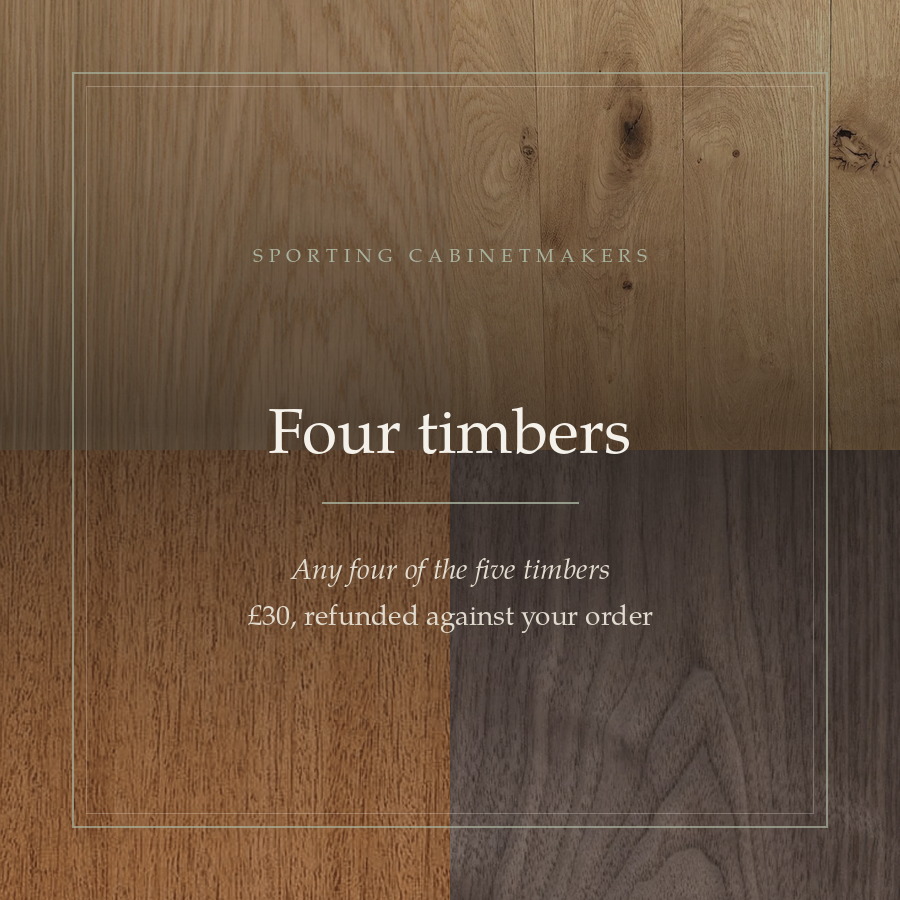
And if you are choosing between two, order both. Timber samples are £10 each, posted free, cut from the boards we are working to and polished to the finish you choose, so what arrives is what you will get. The cost comes off your order if you go ahead.
Questions we are asked
Which timber is the most hard-wearing?
Oak, by a margin, and it is also the most forgiving of damage because marks in oak read as age rather than as damage. Mahogany is the most dimensionally stable. Walnut is the softest of the four and shows a knock most readily.
Will walnut go darker over time?
No — it goes lighter, which surprises most people. Walnut mellows toward a warmer, softer brown over years, and strong daylight speeds it up. Oak and mahogany both darken.
Can you match a cabinet to furniture I already own?
Routinely, and it is most of what colour matching is for. Send a daylight photograph and an evening one, and an offcut or a drawer front if you have one. Matching is done by eye against the actual piece, and there is no extra charge for it on a standard-range cabinet.
How much more do the figured oaks cost?
Character oak adds about 8% to the price of a cabinet and pippy oak about 12%, because the yield from the log is lower.
Do I have to use the same timber throughout the room?
No, and sometimes you should not. A gun cabinet in oak beside painted panelling reads deliberately; the same cabinet in a fifth timber reads like an accident. The rule of thumb is two timbers in a room, or one timber and a paint.
Not sure which way to go
Send a photograph of the room and tell us what is already in it. We will tell you which two are worth sampling, and why.