
Insurance, Valuations and What Underwriters Want to See
Nobody enjoys this part. But the difference between a claim paid in full and a claim argued over for six months is almost always paperwork that took an afternoon to put together, years earlier, and was then kept somewhere sensible.
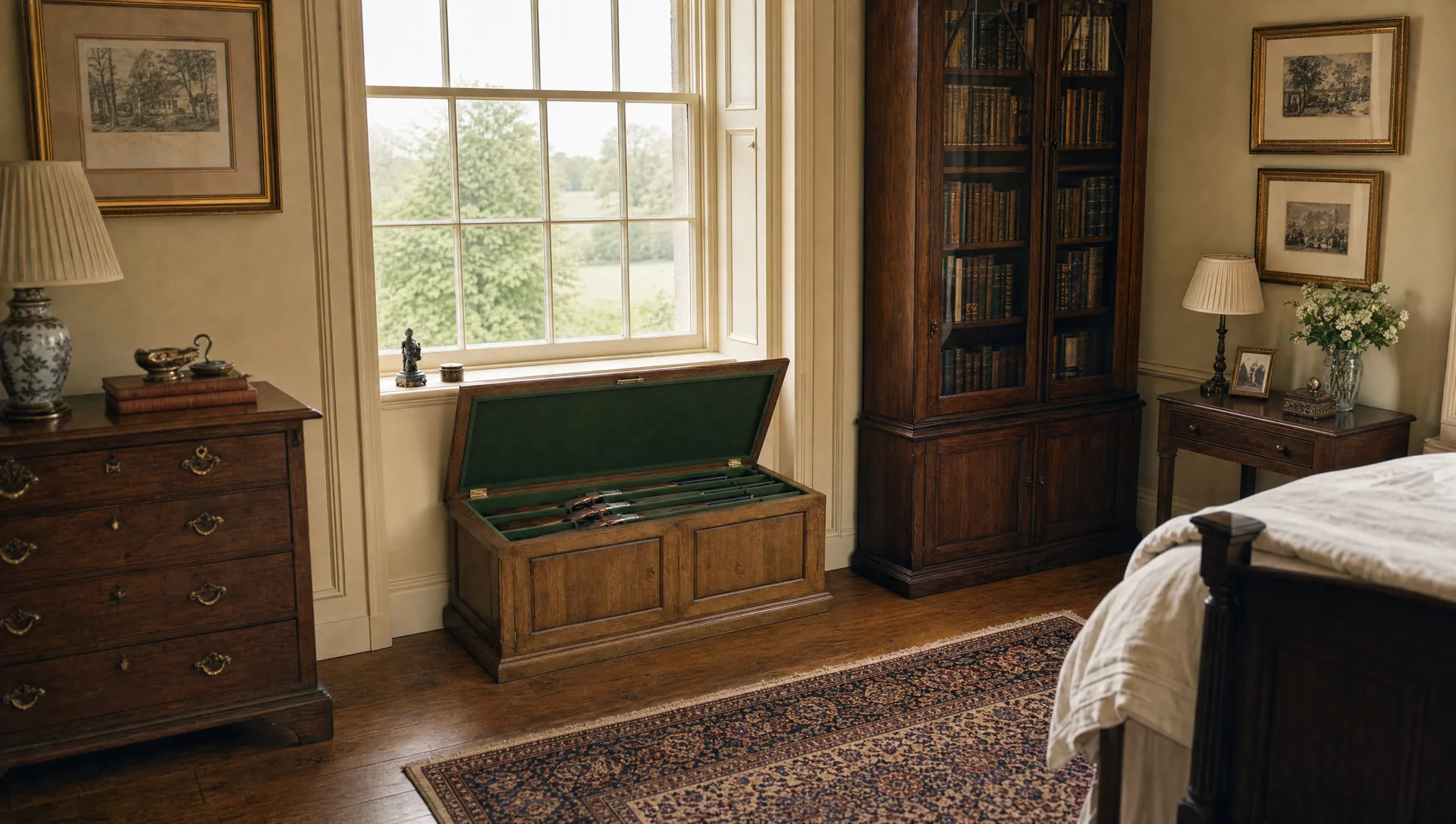
We are not brokers and this is not advice on your policy. What follows is what we see from the making side: what clients are asked for, what they wish they had photographed, and the handful of things about a cabinet that change how an insurer looks at the risk.
On this page
Your policy wording is the only thing that counts
There is no industry standard for insuring guns. Some household policies cover them under general contents up to a limit, some exclude them entirely, some require them to be specified individually, and some attach their own conditions about how and where they are kept. Two policies that cost the same can behave completely differently after a burglary.
So the first job is not to buy anything. It is to read the wording, or have your broker read it to you, and get answers to five questions in writing:
- Are guns covered under contents, or do they need to be specified separately?
- Is there a single-item limit, and a total limit for the category?
- Are they covered away from the house — at a shoot, in a vehicle, in for repair, abroad?
- What storage conditions are attached, in the policy’s own words rather than the broker’s summary?
- Is cover on an agreed-value basis or on indemnity, and what does the insurer accept as evidence of value?
That last one matters more than people expect. Indemnity means you are paid what the gun was worth, which an insurer will decide after the event, using their own evidence if you have not supplied better. Agreed value means the number was settled in advance.
What a valuation actually is
A valuation is a document from somebody qualified, on their letterhead, dated, describing each gun sufficiently to identify it and putting a figure against it. It is not a list you typed yourself and it is not the price you paid.
Three things about them are worth knowing. They go out of date, and a valuation written eight years ago for a pair of English guns is unlikely to be defensible now. They are usually charged as a percentage or a day rate, and for a collection of any size that is money well spent. And a good valuer will describe condition, not just make and model, which is precisely the thing that is impossible to establish after the guns have gone.
Where a gun has provenance, or has been rebarrelled, restocked or altered, that paperwork belongs with the valuation rather than in a drawer somewhere else.
The record to make now
This is the afternoon that pays for itself. What we would do, in order:
| What | Why it matters |
|---|---|
| Serial numbers, photographed rather than transcribed | Transcription errors in serial numbers are common and they are the one field the police and the insurer will both key on. |
| Each gun photographed whole, both sides, in good light | Establishes condition at a date. A phone is fine. |
| Close-ups of engraving, any damage, and the case | Identifying features are what recovers a stolen gun years later. |
| Receipts, valuations and any gunsmith’s work sheets | Evidence of value and of what has been done to it. |
| A photograph of the cabinet, closed and open, and of how it is fixed | Demonstrates the arrangement you told the insurer about actually exists. |
Keep it somewhere that is not the house. A cloud folder and a copy with your broker is enough. A folder in the gun room is no use at all after a fire, and it is a shopping list after a burglary.
What about the cabinet changes the conversation
Underwriters are not usually interested in the make of your cabinet, and there is nothing to be gained from telling them a cabinet is police approved, because no such approval exists in the United Kingdom. What they are interested in is the arrangement as a whole.
In practice, the things that get remarked on are: whether the storage is fixed into something structural rather than into plasterboard; whether it is out of sight of a window and not the first thing a stranger walks past; whether ammunition is held separately; whether keys live somewhere other than the room the cabinet is in; and whether the house has an alarm and whether the gun room is on it.
None of that is exotic and none of it is expensive. It is also, almost word for word, what a firearms enquiry officer is looking at, which is convenient: get the arrangement right for your certificate and you have very largely got it right for your insurer.
Storage conditions and the trap in them
The trap is a condition you agreed to years ago and no longer meet, usually because the collection grew.
Say the policy was written when there were four guns in a cabinet in a cellar. There are now nine, two of them do not fit, and one lives in a case in the boot room because it is easier. The policy still says what it said. That is a live problem and it is one an insurer will find, because after a loss they will ask exactly where each gun was kept.
The same is true of certificate conditions. If the arrangement has changed materially, tell your licensing department, and tell your broker at the same time. It is a five-minute job that removes an argument you cannot win afterwards.
If the worst happens
Report to the police and get a crime reference. Tell your firearms licensing department without delay — this is a condition of most certificates and not a courtesy. Tell your insurer. Then send the record you made: serials, photographs, valuation, receipts.
Clients who have that folder are usually settled quickly. Clients who do not spend months reconstructing what they owned from memory and old photographs, and they are almost always paid less.
What we can do about it
Nothing to do with insurance, and we would not pretend otherwise. What we can do is build storage that stands up to the questions above — fixed properly into real structure, ammunition held separately, keys thought about, and a specification we will put in writing so you have something to send your broker and your firearms enquiry officer.
If you already have a policy with conditions attached to it, send us the wording before we design anything. It is far easier to build to a condition than to argue with one later.
This page is written from a cabinetmaker’s experience and is not insurance, legal or regulatory advice. Your policy wording and the conditions on your certificate govern, and your broker and your local firearms licensing department are the people to confirm anything here against your own circumstances.